

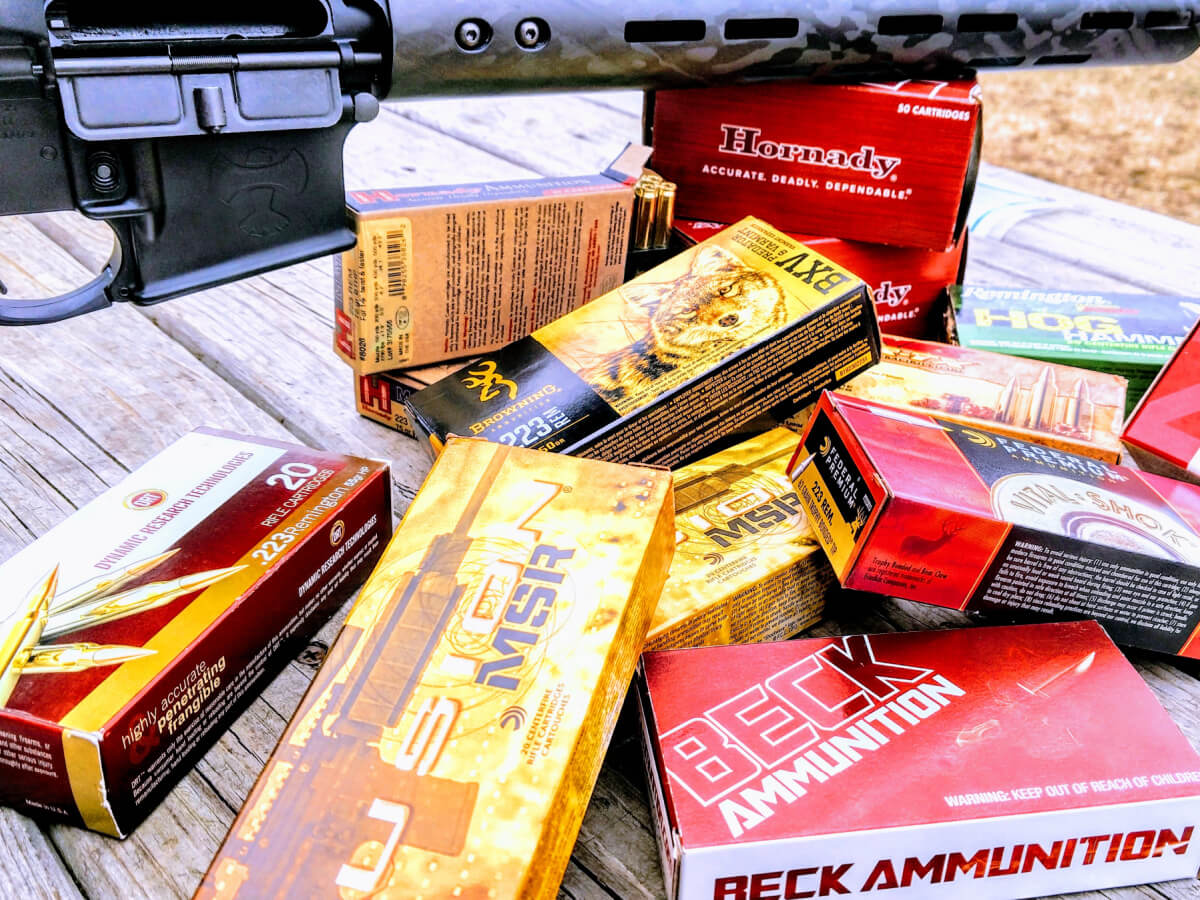
Sixty-plus years in, .223 Remington still delivers cheap practice and low recoil, but its ceiling shows fast. We ran it through hunting, defense, and training use to see exactly where it still wins and where it taps out.
The 223 Remington’s been on the civilian market for more than 60 years. In that time, it’s enjoyed extraordinary popularity thanks to its low cost, availability, and minimal recoil. 223 Remington looks like the perfect versatile rifle cartridge on the surface, but is it really? 60 years later, have we moved on to possibly bigger, more ballistically advanced cartridges? Let’s find out.
.223 Remington’s Military DNA vs Modern Demands
Back in the 1950s, when Eugene Stoner’s AR platform was brand new and still working out the kinks, it came to the attention of the military that they needed a different cartridge. Sure, the 308 Win/7.62x51mm was okay, but wouldn’t it be great if there was a quicker, smaller option? The too-long-didn’t-read version is that Eugene Stoner worked with Robert Hutton, who was the Technical Editor at Guns & Ammo at that time, and they came up with the 5.56 NATO. The 223 Remington was a natural progression, and it hit the market in 1963. As its name suggests, the 223 Remington was manufactured by Remington, back when they were in the thick of things, and business was booming. (Yes, there’s a lot more to it, but this isn’t the time for a history lesson.)
A lot of people think of 223 Remington as a military round, and it kind of is, but it also isn’t. Not to mention that when you defend it that way, you’re relying on ballistics and technology that’s well over half a century old. We can all agree that ballistics have come a long way since the 1960s.
The 223 Remington is the sporting version of the 5.56 NATO, and although it’s extremely similar, it is not the exact same cartridge.
Hunting With .223 Remington: What It Can And Cannot Do
No, you can’t shoot whatever you want with 223 Remington. This is one of those cartridges that’s small enough to make it a less-than-ideal option for larger game, including whitetail deer. If you get the right load, it’s possible to use the cartridge on deer, but it requires precise shot placement, and there’s basically zero margin for error. Deer tend to move and twitch, as do hunters, so you can imagine why it might be a bad idea. Don’t even get me started on hog hunters who lean on it, because it tends to be woefully inadequate for single-shot clean kills on feral hogs.
If you use the correct ammo and you’re chasing rabbits, prairie dogs, coyotes, raccoons, and other appropriately-sized game, go for it. But if you want to hunt bigger animals, consider a bigger, quicker cartridge with a flatter trajectory (check out 22-250 if you’re really attached to the idea of this caliber).
Cheap To Shoot, Easy To Train: Why AR-15 Owners Love .223
Yes, it’s fairly affordable to mag dump 223 Rem. That’s undeniable, and it makes the AR-15 in this chambering a great plinking gun. Target rounds are typically cheap(ish), and it isn’t hard to find a wallet-friendly AR-15. The market is glutted with them, so take your pick.
Home Defense With .223 Remington: Ammo Choice Makes Or Breaks It
Before we jump into this, here’s a reminder: human anatomy and that of animals are different. That means a lot of cartridges that wouldn’t work reliably on a game animal will, indeed, work on a human threat. Compared to many animals, humans are flat-out fragile.
AR pistols and carbines chambered in 223 Rem are great options for home defense. For those who need a truck gun, they can work, too, but the issue you run into there is the distance at which you’re likely to be taking shots (and at what). If human threats at close-ish range are your concern, the 223 Remington is a solid choice. Just take care to use defensive ammunition, not target rounds.
Is .223 Remington Outdated In 2026 Or Still Relevant?
Whether or not this is an outdated cartridge is a bit of a matter of opinion. In some ways, it is, but it’s also reasonably timeless. It’s not my favorite anymore because better options are on the market today, but it still has its place. Thanks to its super-low felt recoil and cost, it’s ideal for a lot of AR owners, especially those just now getting into guns. And let’s face it, odds are most of us have at least one classic AR-15 in our collection.
So, is it outdated? It kind of is. In its heyday, it was a great example of innovation and progress, but a lot changed over the decades. It’s a good cartridge for basic stuff that’s been far outpaced by newer designs and advances in technology.
.223 Remington Today: Where It Still Shines
Whether this is a relevant cartridge depends on who you ask. If you’re trying to decide for yourself, first stop and ask yourself what you want to use it for. As with any cartridge, its effectiveness depends on what it’s being used for, and that means you need to decide what to do with it. This goes beyond tactical or hunting, too; you need to figure out what animal you want to hunt or what type of tactics you expect it to execute. And if you’re sure you want it, stop and consider whether a different cartridge would be better suited or more versatile. I’m not trying to talk you out of 223 Rem, exactly, just trying to explain that it might not be ideal for your situation.
Where this cartridge shines is plinking and teaching new shooters to run an AR-15. The idea that it produces no felt recoil is ridiculous, but what it does produce if negligible. That makes it great for teaching the basics of the AR platform. There’s also the fact that availability is so widespread, you’re always likely to find both the guns and the ammo in stock. Commonality can be a good thing.
On the other hand, if your intent is hunting or long-range shooting, you’re going to want a different cartridge. There are far better and higher-performance options. That’s even true for home defense, where you’d be well served to consider something like 300 BLK (assuming you’re stuck on having a rifle and not a pistol caliber).
Bottom Line On .223 Remington: Time To Reconsider?
If this were about 45 ACP, most of you would be on the same page. There’d be no hesitation to call it antiquated, slow, and replaceable. But because it’s 223 Remington, it still has a dedicated and large following. Maybe it’s time to reconsider its performance and whether it’s an ideal fit for your gun needs. Just saying.
Dedicated to the cartridge? Try Hornady’s loads.
Want to try something different? Check out 300 BLK.
.223 Remington Use Case Snapshot
| Use Case | Plinking and AR-15 fundamentals |
|---|---|
| Game Size | Small varmints and predators with proper loads |
| Home Defense | Viable with purpose-built defensive ammo |
| Recoil | Very low and beginner-friendly |
| Availability | Widespread guns and ammo |
Read the full article here
38 Comments
Production mix shifting toward USA might help margins if metals stay firm.
Good point. Watching costs and grades closely.
Uranium names keep pushing higher—supply still tight into 2026.
The cost guidance is better than expected. If they deliver, the stock could rerate.
Good point. Watching costs and grades closely.
Good point. Watching costs and grades closely.
Uranium names keep pushing higher—supply still tight into 2026.
Good point. Watching costs and grades closely.
The cost guidance is better than expected. If they deliver, the stock could rerate.
Good point. Watching costs and grades closely.
Uranium names keep pushing higher—supply still tight into 2026.
I like the balance sheet here—less leverage than peers.
Good point. Watching costs and grades closely.
Good point. Watching costs and grades closely.
The cost guidance is better than expected. If they deliver, the stock could rerate.
Nice to see insider buying—usually a good signal in this space.
The cost guidance is better than expected. If they deliver, the stock could rerate.
Good point. Watching costs and grades closely.
Good point. Watching costs and grades closely.
Exploration results look promising, but permitting will be the key risk.
Good point. Watching costs and grades closely.
Good point. Watching costs and grades closely.
Silver leverage is strong here; beta cuts both ways though.
Good point. Watching costs and grades closely.
Production mix shifting toward USA might help margins if metals stay firm.
Good point. Watching costs and grades closely.
Uranium names keep pushing higher—supply still tight into 2026.
Good point. Watching costs and grades closely.
Good point. Watching costs and grades closely.
Exploration results look promising, but permitting will be the key risk.
Good point. Watching costs and grades closely.
Good point. Watching costs and grades closely.
Interesting update on .223 Remington Relevance in 2026. Curious how the grades will trend next quarter.
Good point. Watching costs and grades closely.
Good point. Watching costs and grades closely.
Silver leverage is strong here; beta cuts both ways though.
Good point. Watching costs and grades closely.
Good point. Watching costs and grades closely.