

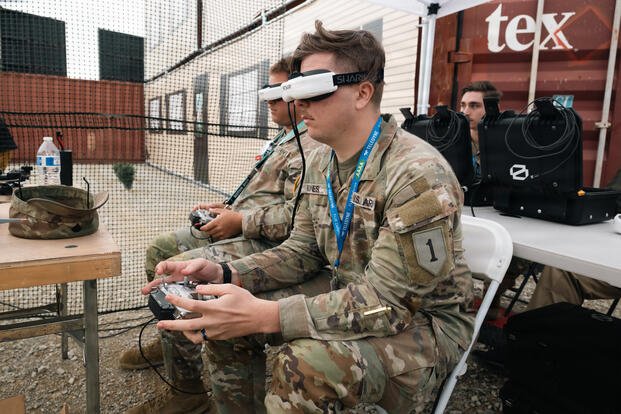
More than 200 competitors participated in the inaugural Best Drone Warfighter Competition, testing active duty, reserve and National Guard operators’ drone operating skills. One event partner told Military.com the competition was a litmus test for the U.S. military in an ever-evolving world.
The three-day event took place Feb. 17-19 and was hosted by the Army Aviation Center of Excellence and the Maneuver Center of Excellence, in Huntsville, Ala., sponsored by the Army Aviation Association of America (AAAA) in partnership with the University of Alabama Huntsville (UAH).
More than 800 attendees took in the action, observing what the Army dubbed as its most skilled small unmanned aircraft system (UAS) operators. The 200-plus participants competed in three challenges designed to test speed, precision, teamwork and creativity in small UAS employment: a high‑speed drone race, a tactical squad lane, and an innovation showcase.
This inaugural event occurred as the U.S. military continues to invest in and push drones under the umbrella of what the Department of Defense has called “Drone Dominance.” It’s a broad agenda to increase the United States’ drone manufacturing base, in turn arming combat units with low-cost attack drones while training senior officers “to overcome bureaucratic risk-aversion culture in drone procurement and training.”
That focus, for example, has been on display via Joint Interagency Task Force 401 which is training forces on drone instruction and technical integration to take advantage of what officials have referred to as an inexpensive yet prolific method of staying on par or ahead with American adversaries.
Military.com reached out to the Army for comment.
Inaugural Competition Winners
The Best Drone Warfighter Competition included numerous different tasks participants were forced to complete, both singularly and in teams, with a panel of experts ultimately judging prowess based on improving survivability, lethality and battlefield adaptability.
Competitors raced Neros Archer FPV (First Person View) drones through a complex obstacle course, while paired teams executed cross‑country hunter‑killer missions to identify and neutralize targets. They also showcased “Soldier‑designed” technologies like sensors and robotics that raise the ante on battlefields.
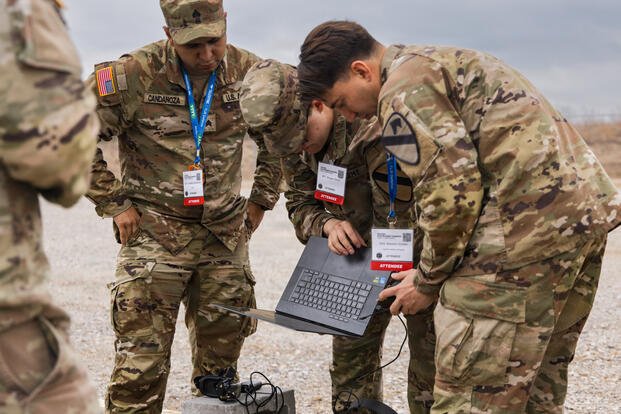
Winners of the 2026 Best Drone Warfighter Competition were as follows:
- Best Drone Operator: Sgt. Javon Purcher; 1st Cavalry Division, Fort Hood, Texas
- Best Tactical Squad: Staff Sgt. Angel Caliz and Spc. Jonah Burks; 2nd Cavalry Regiment, Vilseck, Germany
- Best Innovation: 1st Lt. Ryan Giallonardo, Chief Warrant Officer 3 Robert Reed, Chief Warrant Officer 2 Nathan Shea, and Sgt. 1st Class Brent Wehr – 28th Infantry Division, Pennsylvania Army National Guard
Warfighters Learned ‘To Test, Fail, Adapt and Improve’
The University of Alabama in Huntsville (UAH) became involved in the competition through its operation of the Huntsville Test Range—a nationally recognized unmanned aircraft Systems (UAS) and Counter-UAS test and training environment.
Jerry Hendrix, executive director of the Rotorcraft Systems Engineering & Simulation Center (RSESC) at UAH, told Military.com that as the Army and AAAA developed the competition concept, UAH was selected not only for its geographic location but for its in-house small UAS expertise, extensive experience delivering technical solutions to the warfighter, and proven ability to plan and execute complex, large-scale operations and test events.
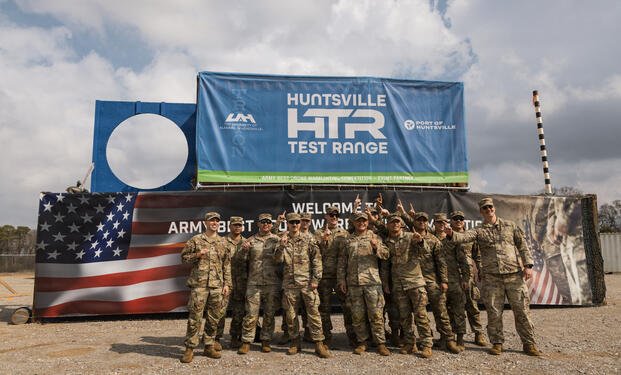
“The opportunity emerged during a visit by an AAAA planning staff member, who recognized that the location of UAH and the Huntsville Test Range—located between Fort Rucker, home of the Army Aviation Center of Excellence(AVCOE), and Fort Benning, home of the Maneuver Center of Excellence (MCOE) and the Army’s Transformation and Training Command (T2COM) —offered a unique advantage,” Hendrix said.
Another factor was that UAH already had established relationships with the Federal Aviation Administration (FAA) and airport authorities, properly managing airspace and relevant small UAS training and evaluation. Other necessary coordination efforts included airspace range operations, logistics, and integration with existing industry partners.
Initial discussions among partners on how to get this inaugural event off the ground began in September 2025, though detailed planning started well before that as operational requirements, participants and scenarios were finalized.
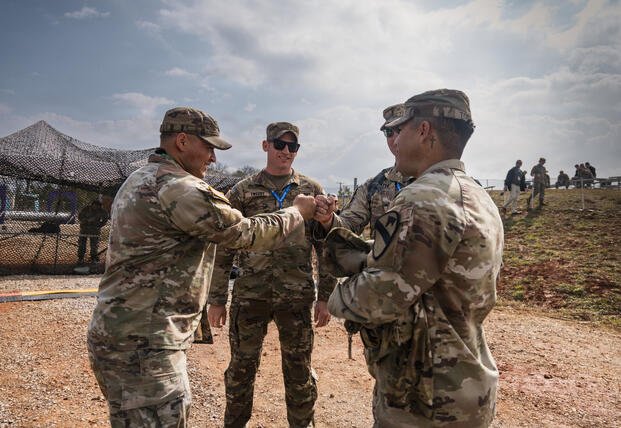
Planning and execution teams met internally and with Army stakeholders on a near-weekly basis for several months to ensure the competition was operationally relevant, competitive and valuable to the warfighter, Hendrix said.
UAH’s experience was highly rewarding, as unmanned systems are no longer experimental but decisive capabilities on today’s battlefield. Supporting an event that placed emerging tactics, techniques and technologies directly into the hands of soldiers reinforced the importance of this work.
“The competition provided a realistic, real-world operating environment—rather than a traditional military range—allowing warfighters to test, fail, adapt and improve in conditions that more closely reflect modern operational settings prior to deployment,” he added.
And if the Army came to UAH again to request their participation for the same event in future years, Hendrix said they won’t hesitate to do their part once more.
Read the full article here
40 Comments
Silver leverage is strong here; beta cuts both ways though.
Production mix shifting toward USA might help margins if metals stay firm.
Good point. Watching costs and grades closely.
Interesting update on Army’s Inaugural Drone Awards Competition Draws 200-Plus Participants. Curious how the grades will trend next quarter.
Good point. Watching costs and grades closely.
Nice to see insider buying—usually a good signal in this space.
Production mix shifting toward USA might help margins if metals stay firm.
Good point. Watching costs and grades closely.
Good point. Watching costs and grades closely.
Production mix shifting toward USA might help margins if metals stay firm.
Good point. Watching costs and grades closely.
Good point. Watching costs and grades closely.
Silver leverage is strong here; beta cuts both ways though.
Uranium names keep pushing higher—supply still tight into 2026.
Good point. Watching costs and grades closely.
Good point. Watching costs and grades closely.
Interesting update on Army’s Inaugural Drone Awards Competition Draws 200-Plus Participants. Curious how the grades will trend next quarter.
Uranium names keep pushing higher—supply still tight into 2026.
Good point. Watching costs and grades closely.
Good point. Watching costs and grades closely.
Production mix shifting toward USA might help margins if metals stay firm.
Good point. Watching costs and grades closely.
Silver leverage is strong here; beta cuts both ways though.
If AISC keeps dropping, this becomes investable for me.
Good point. Watching costs and grades closely.
If AISC keeps dropping, this becomes investable for me.
Good point. Watching costs and grades closely.
Interesting update on Army’s Inaugural Drone Awards Competition Draws 200-Plus Participants. Curious how the grades will trend next quarter.
Uranium names keep pushing higher—supply still tight into 2026.
I like the balance sheet here—less leverage than peers.
Nice to see insider buying—usually a good signal in this space.
Good point. Watching costs and grades closely.
If AISC keeps dropping, this becomes investable for me.
Good point. Watching costs and grades closely.
Good point. Watching costs and grades closely.
Exploration results look promising, but permitting will be the key risk.
Good point. Watching costs and grades closely.
Silver leverage is strong here; beta cuts both ways though.
Good point. Watching costs and grades closely.
Uranium names keep pushing higher—supply still tight into 2026.