

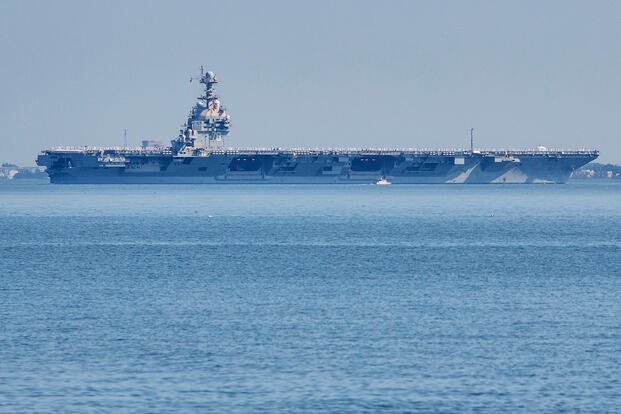
WASHINGTON (AP) — The nation’s most advanced aircraft carrier arrived in the Caribbean Sea on Sunday in a display of U.S. military power, raising questions about what the new influx of troops and weaponry could signal for the Trump administration’s intentions in South America as it conducts military strikes against vessels suspected of transporting drugs.
The arrival of the USS Gerald R. Ford and other warships, announced by the Navy in a statement, marks a major moment in what the administration insists is a counterdrug operation but has been seen as an escalating pressure tactic against Venezuelan President Nicolás Maduro. Since early September, U.S. strikes have killed at least 80 people in 20 attacks on small boats accused of transporting drugs in the Caribbean and eastern Pacific Ocean.
The Ford rounds off the largest buildup of U.S. firepower in the region in generations. With its arrival, the “Operation Southern Spear” mission includes nearly a dozen Navy ships and about 12,000 sailors and Marines.
The carrier strike group, which includes squadrons of fighter jets and guided-missile destroyers, transited the Anegada Passage near the British Virgin Islands on Sunday morning, the Navy said.
Rear Adm. Paul Lanzilotta, who commands the strike group, said it will bolster an already large force of American warships to “protect our nation’s security and prosperity against narco-terrorism in the Western Hemisphere.”
Adm. Alvin Holsey, the commander who oversees the Caribbean and Latin America, said in a statement that the American forces “stand ready to combat the transnational threats that seek to destabilize our region.”
Holsey, who will retire next month after just a year on the job, said the strike group’s deployment is “a critical step in reinforcing our resolve to protect the security of the Western Hemisphere and the safety of the American Homeland.”
In Trinidad and Tobago, which is only 7 miles from Venezuela at its closest point, government officials said troops have begun “training exercises” with the U.S. military that will run through much of the week.
Minister of Foreign Affairs Sean Sobers described the joint exercises as the second in less than a month and said they are aimed at tackling violent crime on the island nation, which has become a stopover point for drug shipments headed to Europe and North America. The prime minister has been a vocal supporter of the U.S. military strikes.
The exercises will include Marines from the 22nd Expeditionary Unit who have been stationed aboard the Navy ships that have been looming off Venezuela’s coast for months.
Venezuela’s government has described the training exercises as an act of aggression. It had no immediate comment Sunday on the arrival of the aircraft carrier.
Meanwhile, Army Secretary Dan Driscoll said Sunday that U.S. troops have been training in Panama, underscoring the administration’s increasing focus on Latin America.
“We’re reactivating our jungle school in Panama. We would be ready to act on whatever” Trump and Defense Secretary Pete Hegseth needed, he told CBS’ “Face the Nation.”
The administration has insisted that the buildup of American forces in the region is focused on stopping the flow of drugs into the U.S., but it has released no evidence to support its assertions that those killed in the boats were “narcoterrorists.” Trump has indicated military action would expand beyond strikes by sea, saying the U.S. would “stop the drugs coming in by land.”
The U.S. has long used aircraft carriers to pressure and deter aggression by other nations because their warplanes can strike targets deep inside another country. Some experts say the Ford is ill-suited to fighting cartels, but it could be an effective instrument of intimidation for Maduro in a push to get him to step down.
Secretary of State Marco Rubio says the United States does not recognize Maduro, who was widely accused of stealing last year’s election, as Venezuela’s legitimate leader. Rubio has called Venezuela’s government a “transshipment organization” that openly cooperates with those trafficking drugs.
Maduro, who faces charges of narcoterrorism in the U.S., has said the U.S. government is “fabricating” a war against him. On his Facebook page, Maduro wrote on Sunday that the “Venezuelan people are ready to defend their homeland against any criminal aggression.”
Venezuela’s government recently touted a “massive” mobilization of troops and civilians to defend against possible U.S. attacks. Maduro and other officials in Venezuela’s socialist party also have been attending rallies this weekend to back the creation of neighborhood committees that will be in charge of increasing membership in Venezuela’s socialist party, and promoting the party’s policies.
Trump has justified the attacks on drug boats by saying the U.S. is in “armed conflict” with drug cartels while claiming the boats are operated by foreign terrorist organizations.
He has faced pushback from leaders in the region, the U.N. human rights chief and U.S. lawmakers, including Republicans, who have pressed for more information on who is being targeted and the legal justification for the boat strikes.
Senate Republicans, however, recently voted to reject legislation that would have put a check on Trump’s ability to launch an attack against Venezuela without congressional authorization.
Experts disagree on whether or not American warplanes may be used to strike land targets inside Venezuela. Either way, the 100,000-ton warship is sending a message.
“This is the anchor of what it means to have U.S. military power once again in Latin America,” said Elizabeth Dickinson, the International Crisis Group’s senior analyst for the Andes region. “And it has raised a lot of anxieties in Venezuela but also throughout the region. I think everyone is watching this with sort of bated breath to see just how willing the U.S. is to really use military force.”
___
Associated Press writers Anselm Gibbs in Port of Spain, Trinidad, and Gabriela Molina in Caracas, Venezuela, contributed to this report.
Story Continues
© Copyright 2025 Associated Press. All rights reserved. This material may not be published, broadcast, rewritten or redistributed.
Read the full article here
21 Comments
Another week, another military show of force near Venezuela. Makes you wonder what the long-term implications are for regional stability.
I suppose the drug trafficking in the region is a serious threat, but the timing and scale of this buildup seem strategic.
It’s definitely escalating tensions, but the administration insists it’s purely about counterdrug operations.
The U.S. has conducted 20 strikes in the past month alone, allegedly targeting drug shipments. Whether that’s the true objective remains to be seen.
The body count from those strikes suggests the operations are far from bloodless.
Over 12,000 sailors and Marines in the region? This feels like more than just a counterdrug operation.
At this point, it’s hard to see this as anything but a direct pressure tactic against Maduro.
The timing of this operation—right as tensions with Venezuela have been rising—seems calculated, to say the least.
The U.S. has been ratcheting up pressure on Maduro for months, so this is hardly a surprise.
The arrival of the Ford marks a major escalation. It’s hard to imagine this won’t have ripple effects across South America.
Especially if other nations see this as an opportunity to assert their own influence.
Twelve thousand troops and multiple warships—this isn’t a subtle maneuver. It’s a direct challenge to whoever is calling the shots in Venezuela.
Agreed. The message is loud and clear, even if the exact intentions remain ambiguous.
A carrier strike group is no small deployment. Whatever the stated mission, the optics are undeniably aggressive.
Might not be the best way to foster diplomatic relations, but it certainly gets attention.
This buildup is the largest in the region in generations. Makes you wonder if we’re on the verge of a significant geopolitical shift.
It’s a bold move, but whether it will actually lead to the intended outcome is anyone’s guess.
With guided-missile destroyers and fighter jets now in the Caribbean, the stakes have officially been raised.
The question now is whether this is the beginning of a prolonged military presence.
The USS Gerald R. Ford is one of the most advanced ships in the world. Seeing it deployed to the Caribbean is a clear message to whoever might be listening.
Which begs the question: who is the intended recipient of that message?