

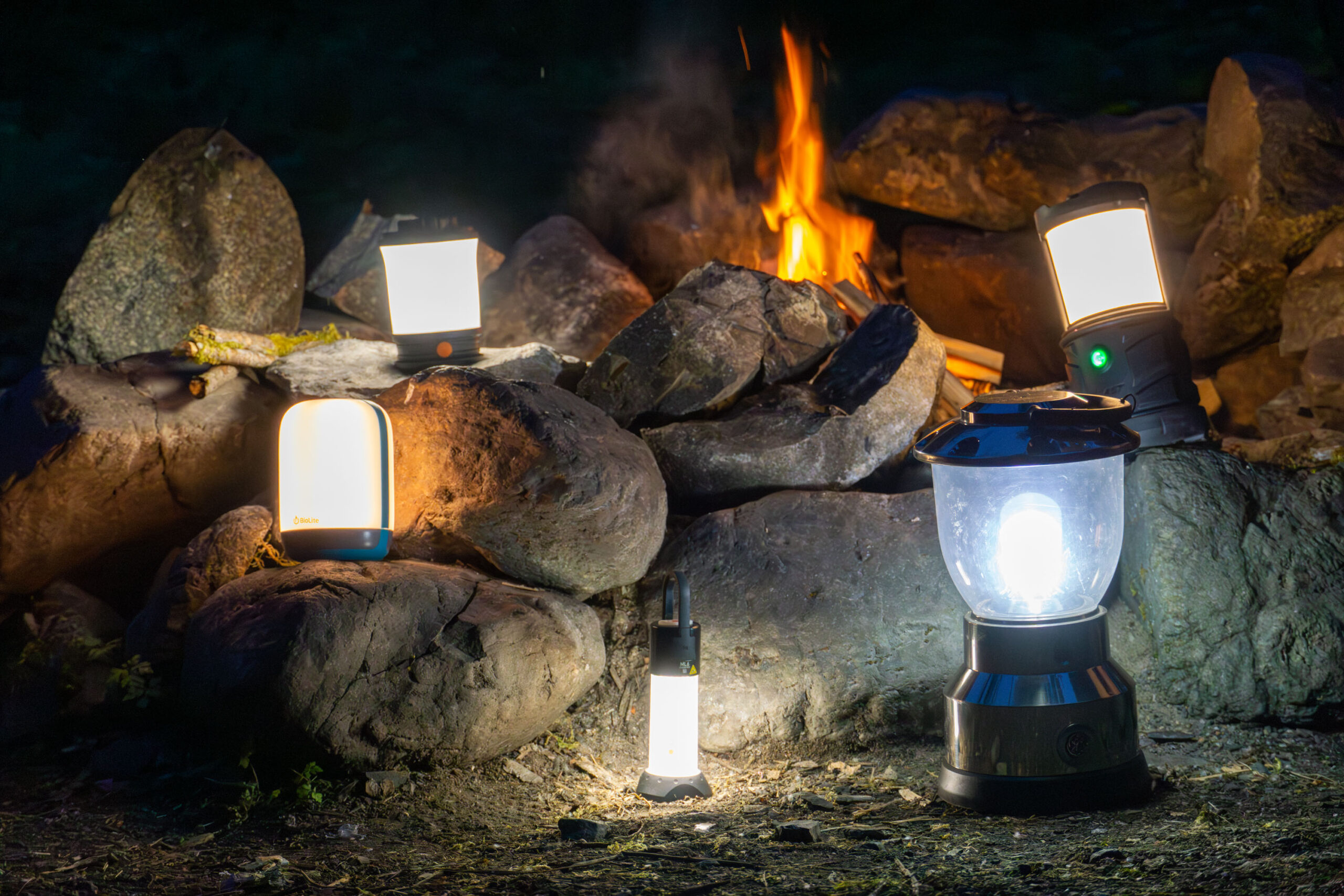
While there isn’t a single best camping lantern for everyone, we sure looked for one. We’ve tested nearly 40 different light sources across half a decade of camping seasons to pull together a list of the most worthy light sources to bring on your next wilderness outing. Our choices have traveled with us from the dark deserts of Joshua Tree to the green tunnels of the Appalachian Trail, and we weren’t gentle on them, either.
A good camping lantern is an outdoor essential. It’s a major help while cooking, is great for nightly camp games, and sets just the right outdoor ambiance. Sure, you could just use a flashlight or headlamp, but a top-pick lantern like the BioLite AlpenGlow 500 lights up the entire camp, and even budget options like the Duracell Tri-Power put out enough to illuminate the inside of your tent.
During our testing, we charged up, gassed up, and lit up our campsites with lanterns — paying special mind to a number of different factors: light output, power supply, burn time, durability, and more. Below, we’ve broken the list into handy categories to help you identify the best lantern for your use.
Editor’s Note: We updated our Camping Lantern guide on March 24, 2026, to add our new ‘Quick & Dirty’ taker on each lantern option, as well as direct comparisons between like options.
The Best Camping Lanterns of 2026
Best Overall Camping Lantern
8.9/10 Rating
Best Budget Camping Lantern
6.3/10 Rating
Best Solar-Powered Lantern
8.5/10 Rating
Best Candle Lantern
6.0/10 Rating
Best Camping Overhead Lantern
7.6/10 Rating
Best String Lights
7.9/10 Rating
Best Gas Camping Lantern
6.8/10 Rating
See more picks
-
Ability to recharge electronics from the 6,400 mAh power bank -
Many different modes to choose from and suit the mood -
ChromaReal LED technology provides excellent full-spectrum light
-
Shake to change functionality isn’t the most intuitive, sometimes doesn’t register -
We wished all new rechargeable electronics would come standard with USB-C, but this does not
Black Diamond Orbiter 650 Lantern: A Closely-Matched Alternative Lantern
The Orbiter 650 is a solid pivot from the AlpenGlow 500, and there are a few good reasons you might consider it over this lantern. For one, it pumps out just a bit more light compared to the AlpenGlow (650 to 500 lumens), and uses a future-proof USB-C charging port to stay topped off, while the AlpenGlow still uses USB-Mini. The Orbiter also has a few more display modes, with a set of three legs that can elevate the lantern over your camp table, and a straight-down light mode for hanging in your tent. You will get a longer run time on the BioLite lantern with an extra 1,200 mAh of battery, and the overall light quality of the ChromaReal LEDs used is more vibrant compared to what the Black Diamond lantern is capable of. Both are the same price, and it’s tough to go wrong choosing between them.
BioLite Luci Charge 360: No Fun Colors, But Can Recharge Itself
The Luci Charge 360 is another lantern in the BioLite lineup that packs a lot of good camp functionality, just in a collapsible form factor. The more minimal design does limit the overall specs a bit, but for the space it does take, it does a lot with. Light output will be a bit less at 360 lumens to the 500 coming from the AlpenGlow 500, and you also won’t get any of the color-changing ability (the warm white light of the Charge 360 is a great choice, however). Waterproofing, interestingly, is actually much better in the Luci lantern at an IP67 rating, while the AlpenGlow only sports IPX4, which is good for splashes from any direction. If you want a lantern that you can take backpacking as easily as you take it camping, the slight performance ding on the Charge 360 could be worth it. You’ll also save $20 by making the pivot.
-
Great price -
Sufficient lighting for large tent or cook space -
Good runtime
-
No steady red light -
Turns on at full power -
Slow charging
BioLite Luci Original Clear: Same Price, But Nowhere Near As Bright
The classic Luci Lantern is the same $30 price as the Duracell 2000, but unless you really need the collapsible ability (or plan on leaving it out in the rain often), the Tri-Power is likely a better budget lantern. The BioLite lantern will put out 75 lumens at max output, meaning it’s better mood lighting than serious coverage in camp. You’ll also get double the run time with the Duracell lantern, and multiple power options from D-cell batteries to the integrated solar panel and USB-C-charged internal battery. The Tri-Power is certainly clunky compared to the air-filled Luci Lantern, and if packability is your main concern, the BioLite lantern certainly wins out. For most budget-minded campers, the Duracell lantern still gets our nod.
Coast EAL22 Lantern: Impressive Budget Chops With A Few More Hanging Options
The EAL22 is a very close lantern when compared to the 2000 Lumen Tri-Power, and adds two integrated carabiner clips to either end of the light to make hanging it a breeze. The bail handle of the Duracell lantern can be made to work, but you’ll often need to rig it yourself for areas such as inside a tent or above a picnic table. An important difference between the two lanterns comes in the power source: both are dual-fuel lights that can run from D-batteries and an internal rechargeable battery pack, but only the Duracell comes with the rechargeable built in, while it’s a $44 add-on in the Coast lantern. Given that you can get more light out of the Tri-Lumen, we think it’s the one to get over the EAL22 (unless you need those handy hanging clips, or are fine running on D batteries).
-
Compact and affordable -
Lightweight -
Mood-light options -
Charge via solar
-
Smallish solar panel and battery -
Not immune from popping
BioLite Luci Original Clear: More A One-Trick Pony, But Half The Price
The Luci Original is just that: the OG, and if you don’t need the special features baked into the Charge 360, you can save a good bit by getting the lo-fi version. The 360 maximum lumens from the Charge version makes it a good functional light source for detailed tasks like food prep, while the 75 highbeam on the Original is better for ambiance or tight quarters like tents. You also get quadrupal(!) the run time on the low light setting by going with the Charge lantern. In our opinion, the Charge 360 makes a better all-around lantern, while the Original is better used in groups across a large space. It’s half the price of the Charge 360, so you can get at least two for a more versatile camp lantern set up.
UCO Original Candle Lantern: An Even More Cozy Light
If the warm light of the Luci Charge 360 just isn’t enough for you, a true candle lantern like the UCO might be the trick. The BioLite lantern will have it beat in just about every metric, but it’s tough to recreate the ambiance of a true candle flicker. The price of the UCO is about half of the $60 Luci Charge 360, but it’s important to remember that the candles are an ongoing expense, with a trio of the quality beeswax candles going for $16. We’ve found that we can get around a 12-hour burn time out of the candles, so a pack of three can supply many weekends of summer. We think a good battery-powered lantern is an essential these days, but the UCO makes a good ambiance add-on.
-
Can add a little warmth to a chilly campout -
Natural candle-lit lighting -
Very easy to use, just light and go
-
Need to be mindful of spilling wax and hot glass -
No turning up this lantern, the light you get is what you get
UCO Candlelier Candle Lantern: Triple the Candles, Double The Price
The ‘Candlelier’ puts three of the UCO candles in a larger enclosure and puts out more light, warmth, and burn time. The ability to burn one candle at a time triples the run time of this lantern, but also the expense in running it at full blast. The light put out by three candles is impressive and likely worth whatever little you’ll spend on wax if you want to use the lantern with bigger groups. The final trick the Candlelier has to play is its upper heat shield that can rewarm a cup of coffee. If that added bonus is worth about double the price, grab the triple candle version.
Snow Peak Mini Flame Lantern: A Camp Stove Fueled Flicker-Maker
The Mini Flame Lantern burns isobutane backpacking stove fuel, and makes a lovely little flame that emulates a candle perfectly. That flame is also adjustable in intensity, making the light output also adjustable. Both lanterns have a consumable to purchase, but the Mini Flame runs just fine on low camp fuel cans you’d otherwise not use backpacking. The $60 price on the Snow Peak lantern feels a bit steep for what is a simple lantern (and often emulated at a lower price). Buy the $30 UCO if you want a lantern that has an added emergency functionality; the Snow Peak if you backpack more than you camp.
-
150 feet of illumination in all directions with adjustable petals -
Impressive durability, including the case -
Incredible operating time
-
Life of the internal battery isn’t great -
Requires set-up each time
Devos Outdoor LightRanger 1200: Less Light, Less Height, Less Expensive
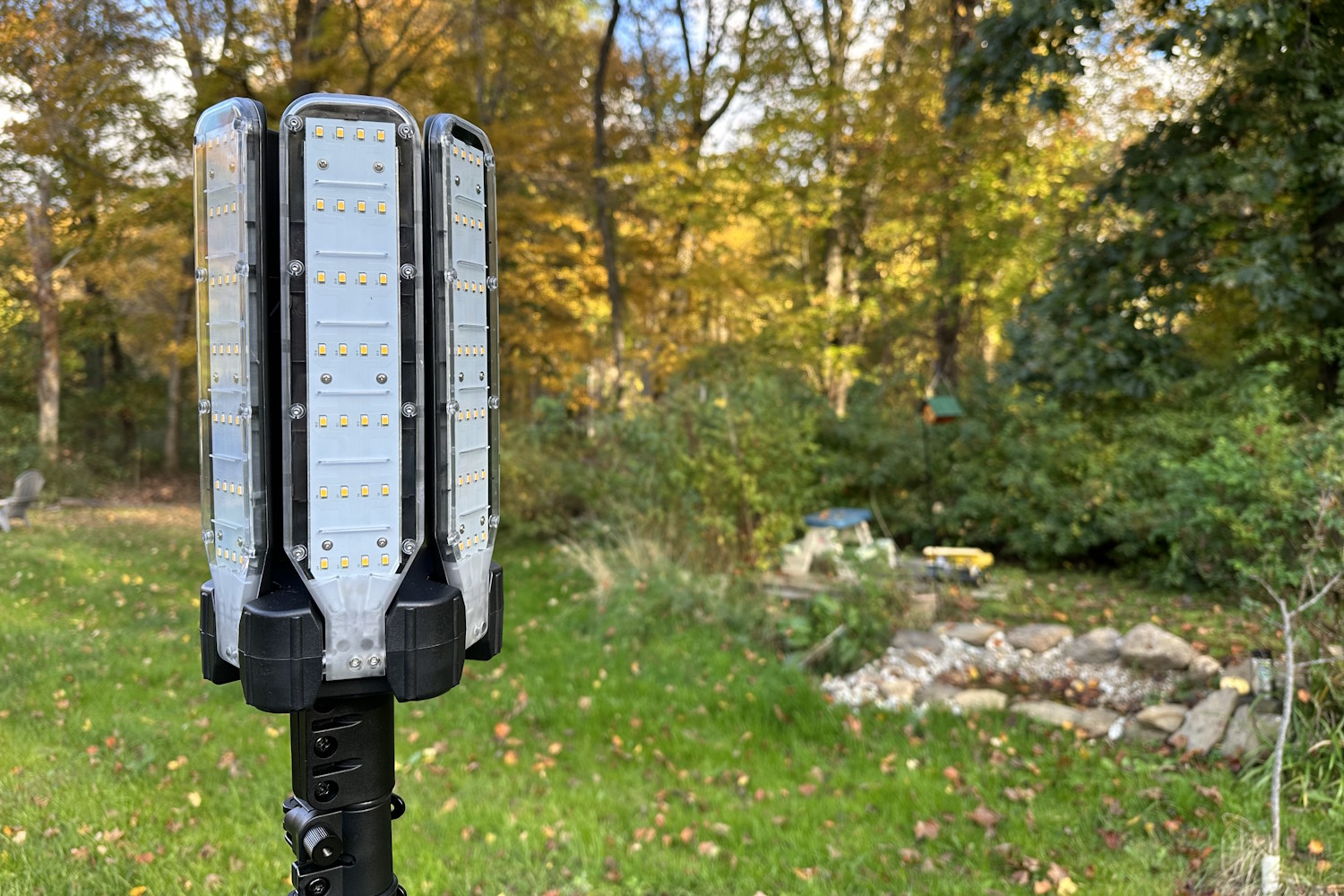
The $150 LightRanger 1200 takes a little bit of a different design tack as the Skylight, but accomplishes many of the same goals and hosts a few added functionalities. It won’t match the Goal Zero lantern for overall output (6,000 lumens on ‘Boost’ mode) as it does 1,200 flat out, but for most tasks this is plenty, and matches the Goal Zero’s ‘medium’ output. The more moderate output is partnered with a 10,400 mAh internal battery that gives this lantern a much better standalone run time of 80 hours on minimum (at 60 lumens); the Goal Zero will only do 8 hours off the cord. The lantern element isn’t petaled like the Skylight, and also stands on a shorter 8-inch stand. If you don’t already own a portable power station, the LightRanger might be a better standalone overhead choice.
BougeRV T1 Telescopic Camping Lantern: A Bargain That Packs On Versatility
At $120, the new 2026 T1 lantern from BougeRV undercuts both the LightRanger 1200 and Goal Zero Skylight, and adds even more functionalities than either. Overall height is going to be the biggest tradeoff in an otherwise feature-rich lantern, and the 5.5′ tall stand doesn’t give you much overhead lighting capability. That said, you do get: a large 15,600 mAh internal battery, 90-hour maximum run time, a very-suitable 3,000-lumen high mode, and three different light colors (cool white, warm, and red). Like the LightRanger, consider this lantern if you don’t already own a power station to run it from. The standalone nature of this lantern makes it very comptitive with the Goal Zero Skylight, just keep the lower overhead height in mind before pivoting.
-
Ability to light up a broad area, focus on specific zones -
String lights store on the lantern, limiting tangles -
Detachable power hub powers your electronics with USB-A and USB-C ports -
Warm light tone is softer on the eyes
-
The solar panel is small, and the charging capacity is limited -
Take care not to snag the lights, as the wiring can break
Revel Gear Trail Hound 30 Ft. Camping Light: Less Expensive Fairy Lights For Tents
The Trail Hound string lights are best for smaller camp spaces, such as inside of a tent or while car camping. They are powered via the USB cord, meaning you’ll need to provide your own portable power station or power block to run them. This does make the the BioLite String Lights a bit more of an all-in-one solution, but also fairly bulky to pack around if you’ve got far to get to your camp. The $25 price for the Revel Gear lights also affords you some more wiggle room in getting a few sets; for the same $100 spent on the BioLite’s, you could get four of the Revel Gear strands and cover 120 feet. Simply: if you’ve already got a camp power source you like, consider the Trail Hound string lights; if you want a self-contained lantern, look to the Luci Solar String Lights.
BioLite Luci Site Lights: Versatile, But Easy To Lose
The Luci Site Lights are interesting little bulbs that both interface with a tent stake to provide some low-level ambiance lighting, or can be strung along guylines for the same effect overhead. They aren’t that bright (BioLite doesn’t publish a lumen spec), and you’ll only have six of them compared to the 20 bulbs on the String Lights, but for sprucing up the lighting around a tent, they’re a solid choice. The 20 hours you’ll get out of each of the Site Lights is about half of what the String Lights will run for, but both cases recharge via solar, so your run time will be better with clear days inbetween your camp overnights. If you want to illuminate a big space, the string lights are a better choice. But for tighter quarters, these are a good consideration.
-
Classic styling and natural lighting -
Broad footed base limits risk of tipping -
Convenient carrying case -
Makes an excellent place to gather around
-
Requires consumable propane, which can add up -
Glass lens can become hot during use -
Fairly large footprint
Coleman Powerhouse Dual Fuel Lantern: Grandad-Approved Gasser
The Powerhouse Dual Fuel Lantern from Coleman is even more of a throwback than the Deluxe Propane lantern, and runs on either camping white gas or gasoline. This makes it a bit more involved than plugging in a new propane canister on the Deluxe, but it is more versatile if you already run your camp stove on the same fuel. Both white gas and gasoline both pack in more BTU energy per liter compared to propane, and do better at freezing temperatures, making the Powerhouse both more efficient and dependable in all conditions. If refilling a lantern doesn’t bother you, the Dual Fuel Lantern can be a great pivot.
Coleman Classic Recharge 800 Lumens Lantern: Classic Looks With A Battery and LEDs
The Coleman Classic Recharge is styled to look like the gas-fueled Powerhouse and Deluxe lanterns, but is powered by an internal 4,800 mAh battery. The LED bulb will put out up to 800 lumens on high, which is just about what both of the older designs will do as well. Run time, however, is much longer in the battery-powered lantern, which can dial back to 100 lumens and run for 45 hours. You also get the ability to use the lantern as a power source for your other electronics, making it more versatile. We can’t deny the old school charm of a gas lantern burning, however, so think hard on if the battery-powered update is worth it to you before jumping up to it.
Other Lanterns to Light Your Way
The lineup of lanterns above is enough to keep any campsite well-illuminated long into the evening, but they aren’t the only lights we’re fans of. Consider our alternative options below as stellar runner-ups.
-
Nice and bright at 650 lumens -
Multiple charge in and out options, with modern USB-C -
Can be hung or used on tabletop -
Full spectrum color modes
-
5,200 mAh battery isn’t as large as top-tier lanterns -
Bit heavy to hang from inside tents
Black Diamond Orbiter 450: Cute, But Just Buy The Big One
The Orbiter 450 is pretty much the same lantern as the 650, with the only differences being the weight, lack of colapsible legs, and smaller battery. The 4-hour run time (at the 250 lumen ‘medium’ setting) is a little brief compared to the 10 hours you’ll get from the 650 version, and we’d rather have enough run time for an entire night rather than most of it. The 450 will also charge-out to your phone, but the 2,000 mAh battery won’t have much left over if you recharge your phone and want to use the lantern later. You’ll save $20 by getting the smaller version, but we think the extra spend here is called for.
Goal Zero Lighthouse 600 Lantern: A Versatile Charger
The Lighthouse 600 Lantern from Goal Zero ticks a lot of the same boxes the Orbiter 650 does, and the collapsible legs are the strongest tie between the two. The light they put out is also similar at around 600 lumens, but you won’t get the colors and different whites that the Orbiter can do in the Lighthouse. The Goal Zero lantern instead covers the emergency supply side of lanterns and adds a hand-crank dynamo and a red light function. Both lanterns are the same price, so draw the line between more fun-functionality and always-ready reliability when deciding between the two.
-
High-definition cool white light is great for detail work like food prep at camp -
Budget price -
Tough design can withstand water and abuse -
Recharges in 7 hours with full sun
-
Not the longest burn time on high power -
Cool white light without matte finish can be tough to look directly at
Goal Zero Crush Light Lantern: A Breathless Alternative
The Crush Light Lantern accordions open to similar dimensions to the Luci Lantern, but doesn’t inflate, meaning it can’t puncture. The Goal Zero is cheaper and arguably easier to deploy (no blowing required), but it offers a lower lumen count and a less durable plastic housing. Choose the Crush Light for casual backyard use; stick with the Luci Original for a more rugged, waterproof backcountry light.
BioLite Luci Charge 360: The Power Bank Upgrade
The Luci Original is the purist’s solar lantern, however, for $30 more, the Luci Charge 360 adds a USB-A output port to charge your phone and bumps the brightness from 65 to 360 lumens. The Original is thinner and lighter for ounce-counting backpackers, but the Charge 360 is a much more versatile tool for basecamp. In our opinion, the Original is better as a for a set it and forget it backup, while the Charge 360 is the choice if you need to juice your electronics.
-
Highly adjustable color temp and brightness -
Rugged metal case -
Fast charging with USB-C -
Long burn time on low -
Small overall profile
-
Heavy for backpacking -
Pricey
Black Diamond Orbiter 650: A Softer Tabletop Ambiance
The CL27R looks a bit like camp lantern engineering with a magnetic base and a 1,600 lumen max output, but its light can feel a little industrial. The Orbiter 650 offers a softer and diffused glow that is better for social gatherings. We found that the Fenix makes a great work light for vehicle repairs or late-night camp repairs, and the Orbiter is more pleasant for the campfire or dinner table. The price is within $5 for either lantern, so for high-output utility look at the Fenix; and for camp vibes consider the Black Diamond.
Fenix CL30R: The Long-Haul Powerhouse
If you like the Fenix build but need even more runtime, the CL30R uses three replaceable 18650 batteries to provide a boost in endurance. The CL27R is more compact and hosts a unique dial for color temperature adjustment, which the CL30R lacks. Choose the CL27R for its versatility and adjustable tint; choose the CL30R if you need to light up a basecamp for a week straight without a recharge.
-
Burns isobutane, which you may already have on hand from making dinner -
Pleasant and warm light output -
Piezo ignition makes lighting easy
-
Will need to be used with care, as the glass globe can break -
You may need an additional canister if you want to cook food and power the lantern
UCO Original Candle Lantern: The Real Deal Candle Flame
The GigaPower uses isobutane to produce a max of around 400 lumens of light and a bit of heat. The UCO Candle Lantern provides a similar real-flame aesthetic but at a fraction of the cost and brightness. The GigaPower is a high-performance tool for lighting a large area, whereas the UCO is a personal ambiance light. Choose the GigaPower if you need some more serious illumination; the UCO if you just want a cozy, silent flicker to eat dinner by.
Coleman Deluxe Propane Lantern: The Heavy-Duty Workhorse
For car campers who already carry 1 pound propane tanks, the Coleman Deluxe is much brighter and more stable. The Snow Peak is significantly smaller and lighter, making it the only gas lantern we’d consider for short backpacking trips. We found that the light cast by the Coleman is farther reaching, and better suited for larger camps or groups. The fact that the Deluxe Propane Lantern is less expensive also helps it, and makes it a good option for gas-powered light.
-
Emergency-ready light source -
Blindingly bright high-mode -
Tough exterior build -
Multiple power source options
-
ZITHION battery pack required to hit full output numbers -
A little on the heavier side
Duracell 2000 Lumen Tri-Power: Budget Brightness
While both the EAL22 and Tri-Power are emergency-style lanterns, the Duracell offers 750 more lumens for $10 less. However, the Coast EAL22 feels significantly burlier and features a superior gate-clip hanging system on both the top and bottom. The Duracell is the better pure value, but the Coast is the more durable choice for a toss-in-the-truck kit. Choose the Duracell for max lumens; choose the Coast for long-term durability.
Goal Zero Lighthouse 600: A Feature-Rich Rival
The Coast is a blunt instrument of light — bright and tough. For $80, the Goal Zero adds a hand crank and a much more refined dimming dial. The Coast wins on raw endurance (225 hours vs. 180 hours on the low settings), but the Lighthouse 600 is easier to live with as a primary camp light. Choose the Coast for your emergency go-bag; choose the Lighthouse 600 for frequent camping trips.
-
Unique crank ability provides unlimited power supply -
Simultaneous recharge and discharge means you can provide light while charging -
Multiple mounting options, including hanging hooks and extendable legs -
Able to light only one side of the lantern at a time
-
The permanently attached USB cord seems like a failure point -
Wire legs are a bit wobbly -
No light diffuser makes higher outputs difficult to look at
BioLite AlpenGlow 500: The Modern Alternative
The Lighthouse 600 is an old-school favorite with a hand crank and a classic lantern silhouette. The AlpenGlow 500 is a more modern take, offering high-CRI color modes and a sleeker aesthetic. While the Goal Zero is better for disasters where you might lose power for days, the AlpenGlow offers a more natural light that is easier on the eyes during a card game. Consider which side of the camp lighting spectrum you’re on before buying either.
Goal Zero Lighthouse Micro Flash: A Handheld Flashlight Version
If the 600 feels too bulky for your kit, the Micro Flash provides a similar rechargeable function in a pocket-sized flashlight/lantern hybrid. You lose the hand crank, the 600-lumen output, and the large power bank, but you gain extreme portability (the 2.5 ounce Micro Flash slips into your pocket). Choose the 600 for family basecamps when you need a classic lantern; choose the Micro Flash for solo adventures or as a backup light.
Camping Lantern Comparison Chart
| Camping Lantern | Price | Lumens | Burn Time | Weight | Who Its For |
|---|---|---|---|---|---|
| BioLite AlpenGlow 500 Lantern |
$80 | 500 lm max; 5 lm min | 200 hours on low; 5 hours on high | 13.8 oz. | Most campers who want warm light, a good run time, and some charging ability |
| Duracell 2000 Lumen Tri-Power | $30 | 2,000 lm max | 50 hours on low | 1 lb., 14 oz. | Budget campers and backup-seekers |
| BioLite Luci Charge 360 | $60 | 360 lm max; 5 lm min | 110 hrs. on low; 5 hrs. on high | 10.1 oz. | Roadtrippers and those who forget to charge electronics |
| UCO Original Candle Lantern |
$26 | 20 lm max | 9-12 hrs. | 6.4 oz. | Warm ambiance seekers and emergency preppers |
| Goal Zero Skylight Portable Area Light | $400 | 6,000 lm max; 350 lm low | 8 hrs. on low; 1 hr. on high | 12 lbs., 1.9 oz. | Trailhead tailgaters or big groups |
| BioLite Luci Solar String Lights | $100 | 140 lm max; 20 lm low | 40 hours on low; 8 hours on high | 1 lb., 10.2 oz. | Glampers and RVers |
| Coleman Deluxe Propane Lantern |
$65 | 1,000 lm max | 13 hours on low | 3 lbs., 11 oz. | Old-school campers who want that classic glow |
| Black Diamond Orbiter 650 Lantern | $80 | 650 lm max; 25 lm low | 240 hrs on low; 4 hrs on high | 1 lb., 1.9 oz. | Campers who want a lantern that doubles as a power bank |
| BioLite Luci Original Clear | $30 | 75 lm max | 24 hrs. on low; 6 hrs. on high | 4.4 oz. | Bargain hunters and car campers |
| Fenix CL27R | $85 | 1,600 lm max, 5 lm min | 285 hours on low; 4 hours on high | 10.5 oz. | Folks who need to illuminate a big camp and want robust durability |
| Snow Peak GigaPower Lantern Auto |
$87 | ~400 lumens | 5 hours on a 4-oz. fuel can | 4.5 oz. | Backpackers and minimal campers who want to keep their camp bins small |
| Coast EAL22 Lantern | $40 | 1,250 lm max; 77 lm min | 225 hours on low; 7.5 hours on high | 2 lbs., 8.5 oz. | Prepared campers |
| Goal Zero Lighthouse 600 Lantern |
$80 | 600 lm max | 320 hours on low; 2.5 hours on high | 1 lb., 1.6 oz. | Those who always want a back-up charging solution |
How We Tested the Best Camping Lanterns
Outdoor lighting technology is always advancing. Not too many years ago, the best you could buy were propane lanterns, which, while having a classic look, brought along some classic issues. Today, most lanterns depend upon battery power for illumination, with improvements in lithium-polymer and lithium-ion batteries greatly extending burn times. Light element tech has also taken off, with smart LEDs that can change temperature and even color being the standard.
Our Testing Process and Testing Grounds
Our camping lantern testing begins when the day ends, and we’ve hit campsites across the country to test lights in all manner of settings and scenes. We busted out the large communal lanterns at front country campgrounds in Georgia and Utah, lighting up the night and getting a sense of total usable lit areas.
Backpackable lanterns were weighed and tucked into overnight packs on sections of the Pacific Crest Trail. Gas lanterns were run clear out, and we burned through a not-small number of batteries and candles to get a better sense of operating times.
Overall, we aimed to use these lanterns as they were intended. When we were done, we cycled them out to others on the testing team. Individual preferences vary, and we wanted to get a better-rounded opinion of these lanterns — no matter how you like to camp.

Our testing doesn’t end when the camping trip does, either. It extends to a set of bench tests designed to challenge manufacturer specifications and ensure accurate claims about these lanterns. One of our most important (and taxing) bench tests is our burn-time test, where we challenge claims on total run time with the lantern set on high. These tests can often last an entire day and end when the lantern finally winks out.
Our water-resistance test is equally rough. We break out the garden hose and spray each lantern from varying angles. We’ve only killed one lantern (so far) and find that most can hang in a light simulated rain.
Finally, a lantern isn’t much good if it’s not as bright as it claims to be, and we used a tool known as a lux meter to accurately measure the lumen output of each lantern, both on low and high. All of these tests aim to ensure that these lanterns do what they claim to do, and when they fall short, we make note of it.
Our Expert Testers
While putting this list together, our lead tester, Austin Beck-Doss, was living off-grid and relying on a lantern every single night. His exploits range from rock to snow, but when the light tilts out, its a lantern that he always reaches for. With outdoor products he’s personally tested tallying into the hundreds, Austin has honed a keen eye on what flies and what falls flat when it comes to getting outside.
Adding to the tester pool is Senior Editor Nick Belcaster, who has spent months at a time outdoors where having the proper illumination is key. He’s to thank for our updated bench testing regimen, and he dutifully mans the hose and timers to ground truth claims. Outside of the nitty-gritty, it’s his every-weekend-outside philosophy that keeps lanterns tested on a regular basis.
Our Lantern Rating System
When scoring these camping lanterns, we look at four specific rating attributes. These metrics are separate from our overall product scores and are meant to allow you to compare them when deciding on your next purchase.
Brightness is key in a lantern, and the more available, the better, in our opinion. We look for a healthy 500 lumens or more to award a high rating here, with lanterns over 1,000 lumens earning the highest rating. Battery Life is just as important, and we run these lanterns through an entire charge multiple times and record the overall run time. 5 hours at the highest output is what we expect from the best lanterns, along with at least 100 hours on low. The Feature Set is also considered and rated, with lanterns that include more usable abilities scoring higher. Finally, we rate Durability based on resistance to water, dropping, and overall battery longevity.
Buyer’s Guide: How to Choose a Camp Lantern
Electric vs. Gas-Powered Lanterns
Choosing between an electric and a gas-powered lantern comes down to what features you prefer. Electric lanterns are quiet, lightweight, and safe to use inside a tent. In general, we believe that battery-powered lanterns are the best investment these days, and the ever-improving quality of LEDs and rechargeable cells only reinforces that.
However, alkaline batteries lose about half their capacity when temperatures drop below freezing, and rechargeable batteries may not last on multiday trips without a recharge. Consider battery life whenever setting out for longer camping trips, as it’s a bummer to see your lantern flicker out.
Gas-powered lanterns like the Snow Peak GigaPower Lantern Auto are bright, have a long burn time, and work well in sub-freezing temperatures (the runtime drops, but not as much as when using alkaline batteries). Because they use a live flame, they are hot to the touch, need to be used away from flammable materials, and require ventilation. They are also more fragile than electric lanterns. But for the money, it’s hard to beat the old-school feel of the flame.
Lumens and Light Modes
Lanterns need to be bright enough to light up an area, but not so striking that they’ll temporarily blind you if you accidentally look at them. Brightness is measured in lumens, and while you probably won’t need a lantern to mimic the sun (35.73 octillion lumens, by the way), most lanterns have a maximum lumen output somewhere between 200 and 500 lumens. This is more than enough to light up most camping spaces, and it is most often dimmable to adjust to ambient light.
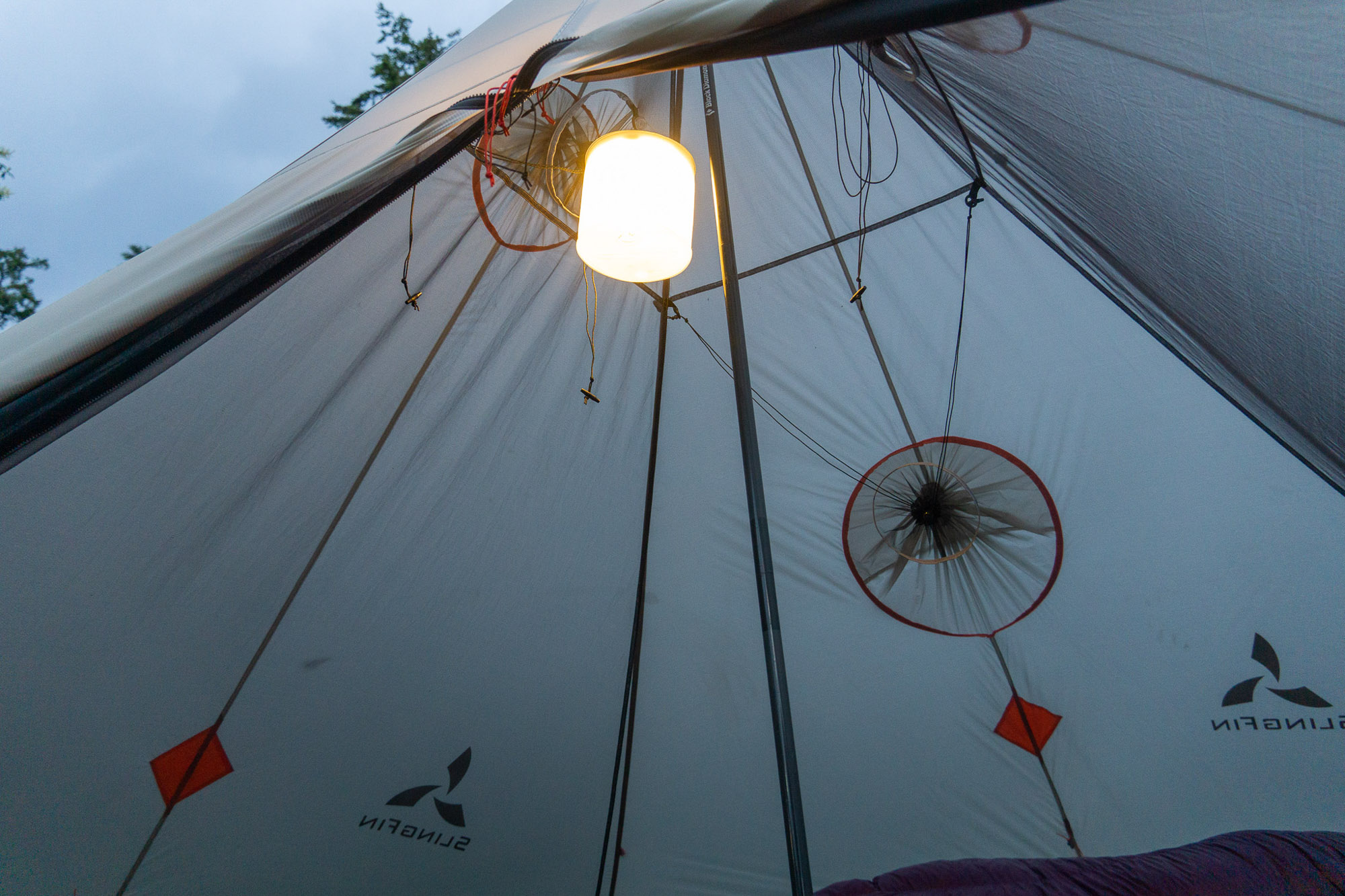
If you’re looking for a more pleasant glow, aim for an output of 60 to 100 lumens. Lanterns like the BioLite Luci Original Clear work well for use inside a tent. Also, know that diffusion is key in how light is displayed around camp, and that translucent globes will provide a softer, more diluted light that’s easier on the eyes. Lanterns like the BioLite AlpenGlow and Goal Zero Lighthouse 600 might be able to put out the same 500 lumens, but the AlpenGlow will be much nicer to look at in intimate settings.
Light Modes
Thankfully, we’ve come a long way from the simple ON/OFF button, and camping lanterns today feature many additional lighting settings for fine-tuning your lighting solution. Dimmability is one of the most important functions, in our opinion, as it allows you to dial in the light output in a set range.
Camping lanterns today have broad dimming ranges, with many able to reduce down to single-digit lumens and then ramp up to full power or even a turbo mode, such as the Fenix CL27R.
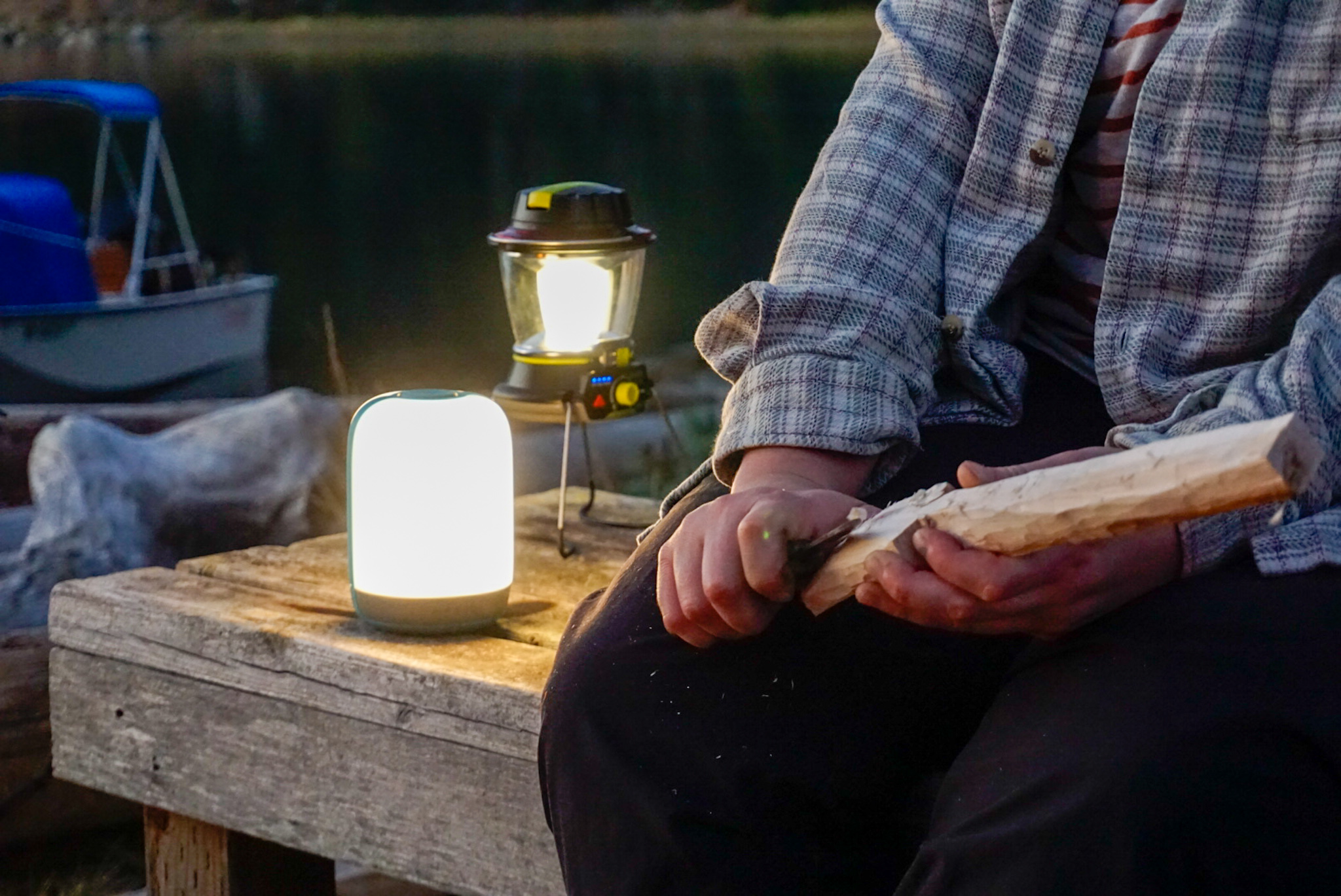
Some, like the BioLite Luci Original Clear, are fairly minimal, with only three different light settings: low, high, and flashing. Others jam in different modes to amp up the ambiance at camp and lend some light to whatever mood you’re going for. The BioLite AlpenGlow 500 has four main modes (white light, warm light, color light, and multi-color light), which can be further augmented with a few shakes to add single-side lighting, flickering, and even a “fireworks” light show effect.
Other lanterns, like the Coast EAL22, still offer a red light option, which can be very helpful when aiming to maintain your night vision (or avoid waking your tentmate). This lantern also flashes an SOS signal for emergency situations and a strobe meant for self-defense.
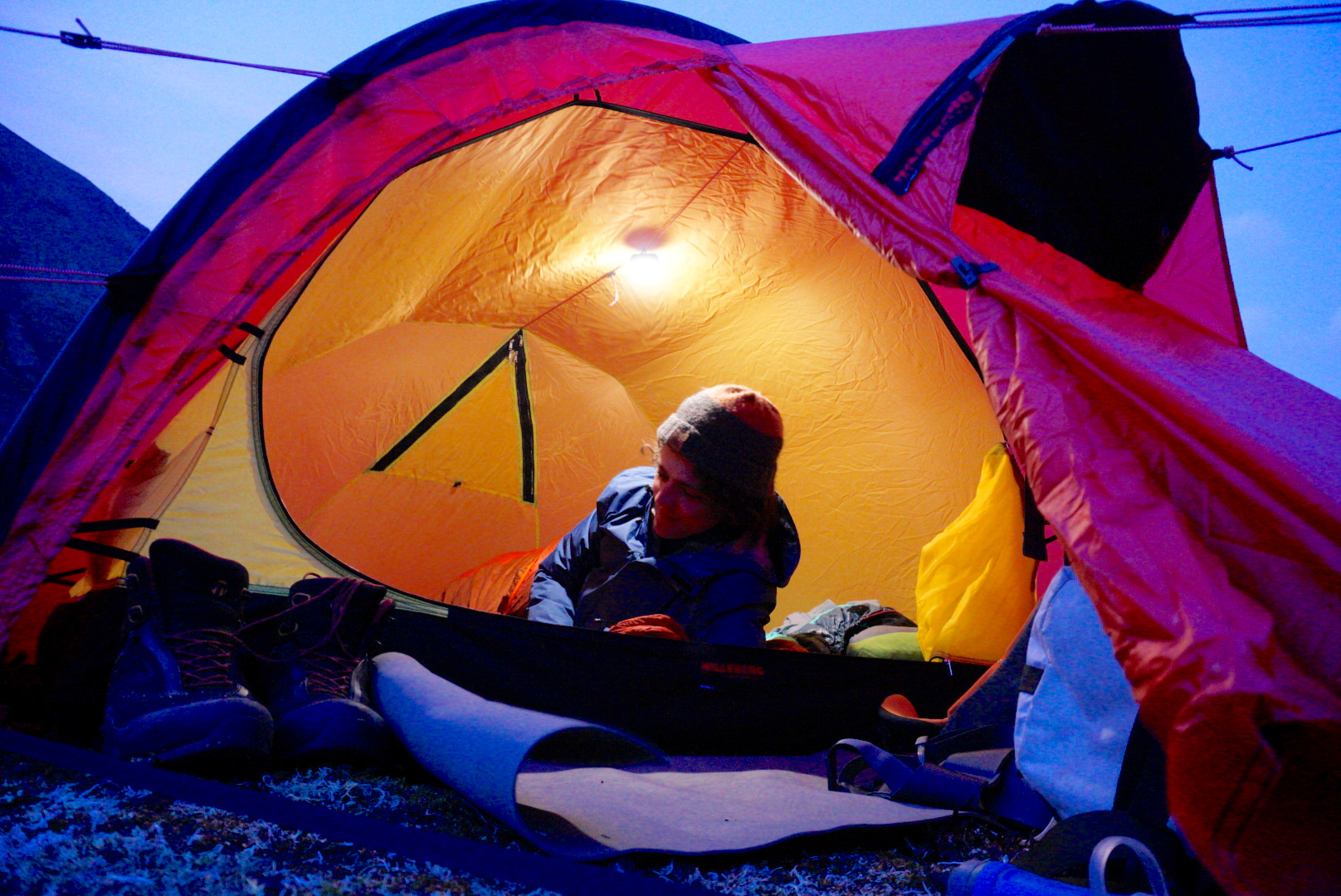
LED vs. Incandescent
Lanterns of old all utilized incandescent bulbs to provide their light, but these have largely gone away in favor of LEDs. Light-emitting diodes are far more energy efficient — often more than 75% — and have a lifespan that exceeds the wire filaments of incandescent bulbs.
Another benefit of LEDs is their high Color Rendering Index (CRI) level, a measurement of how natural colors render in certain light. Lanterns like the BioLite AlpenGlow 500 Lantern boast a CRI of 90 and produce high-quality color lighting.
One downside, however, is that LEDs are typically not user-replaceable. Thankfully, an LED’s lifespan is often given in years, not months, so barring a faulty light, you should never run into the issue.
Weight and Packed Size
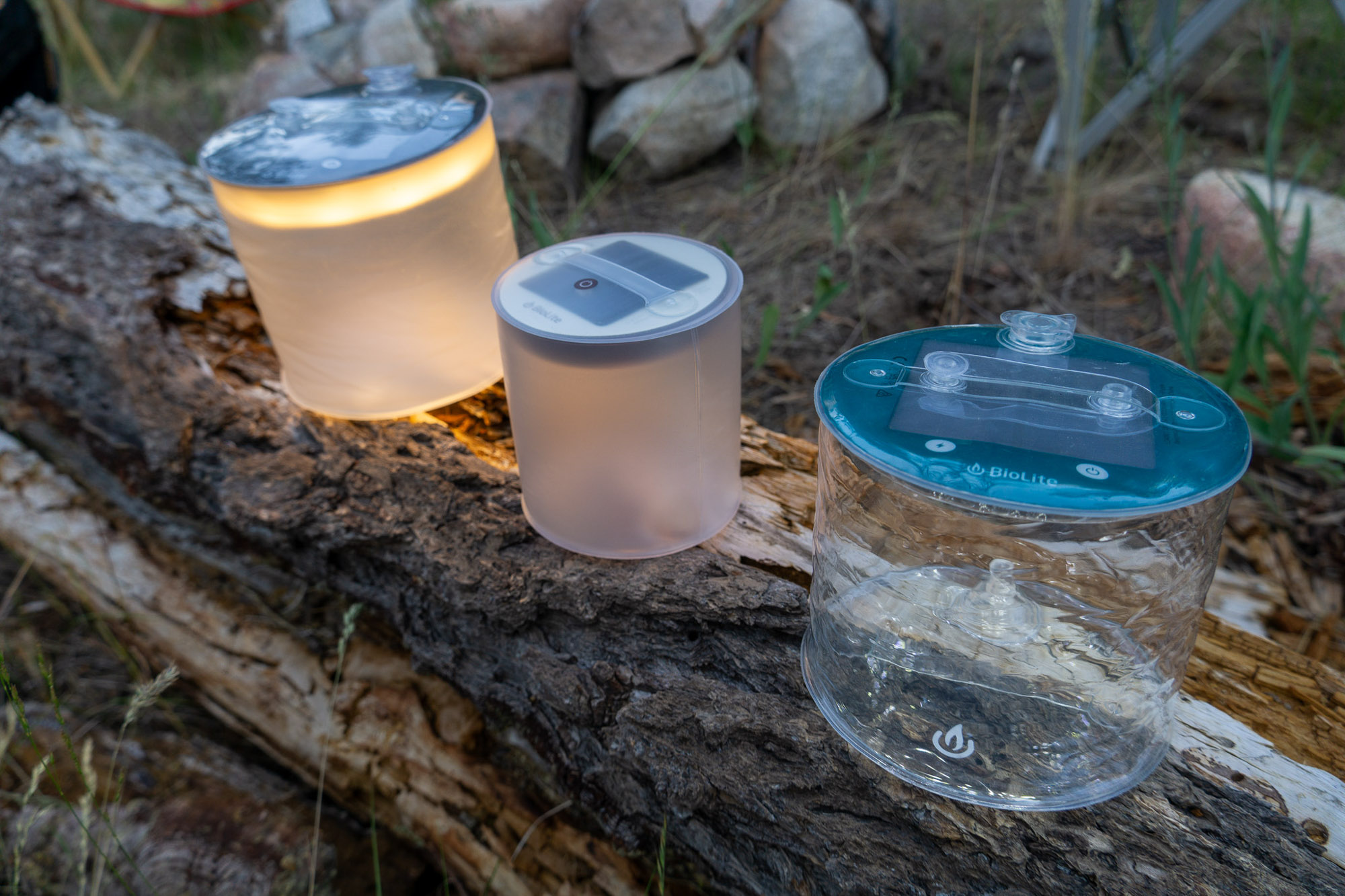
Consider how you will use your lantern. For car camping, weight and packed size are not going to be an issue. If you plan on packing your lantern into the woods, however, you’re going to want something lighter that won’t take up much pack space. If you’re going backpacking, look for a small or collapsible lantern. A good flashlight or a headlamp may even be in order.
Camping Lanterns
Lanterns like the BioLite AlpenGlow 500, Black Diamond Orbiter 650, and Goal Zero Lighthouse 600 are all at the top of our list of the best lanterns to take on camping trips. They all sport an extended battery life, broad light cast, and mounting solutions that make them amenable to different camp setups.
These lanterns all hover around the 1-pound mark, and while they aren’t the most packable, typically, folks going camping need only worry about over-filling the back of the car.
There are also a number of fun lighting options, like the MPOWERD Luci String Lights, which can be strung up and really spread some light, or the Goal Zero Skylight, which will illuminate your whole campsite (and then some). Consider a mix of both types of lighting to cover both your flood and spot light needs.
Backpacking Lanterns
When looking for a lantern to take backpacking, we’re quick to reach for the BioLite Luci Original Clear or Luci Charge 360. The collapsible options are excellent for long-distance trips where weight really matters.
Don’t count out candle- or isobutane-powered lanterns on your backpacking excursions, either. Both the UCO Candle Lantern and Snow Peak GigaPower lanterns are minimal enough not to be a boat anchor in your pack, and operate with fuels you’re likely already bringing along. We’ve often enjoyed the natural flicker of a flame over an LED when deep in the backcountry, and these lanterns easily make the cut in our packing lists.
Battery Life and Types
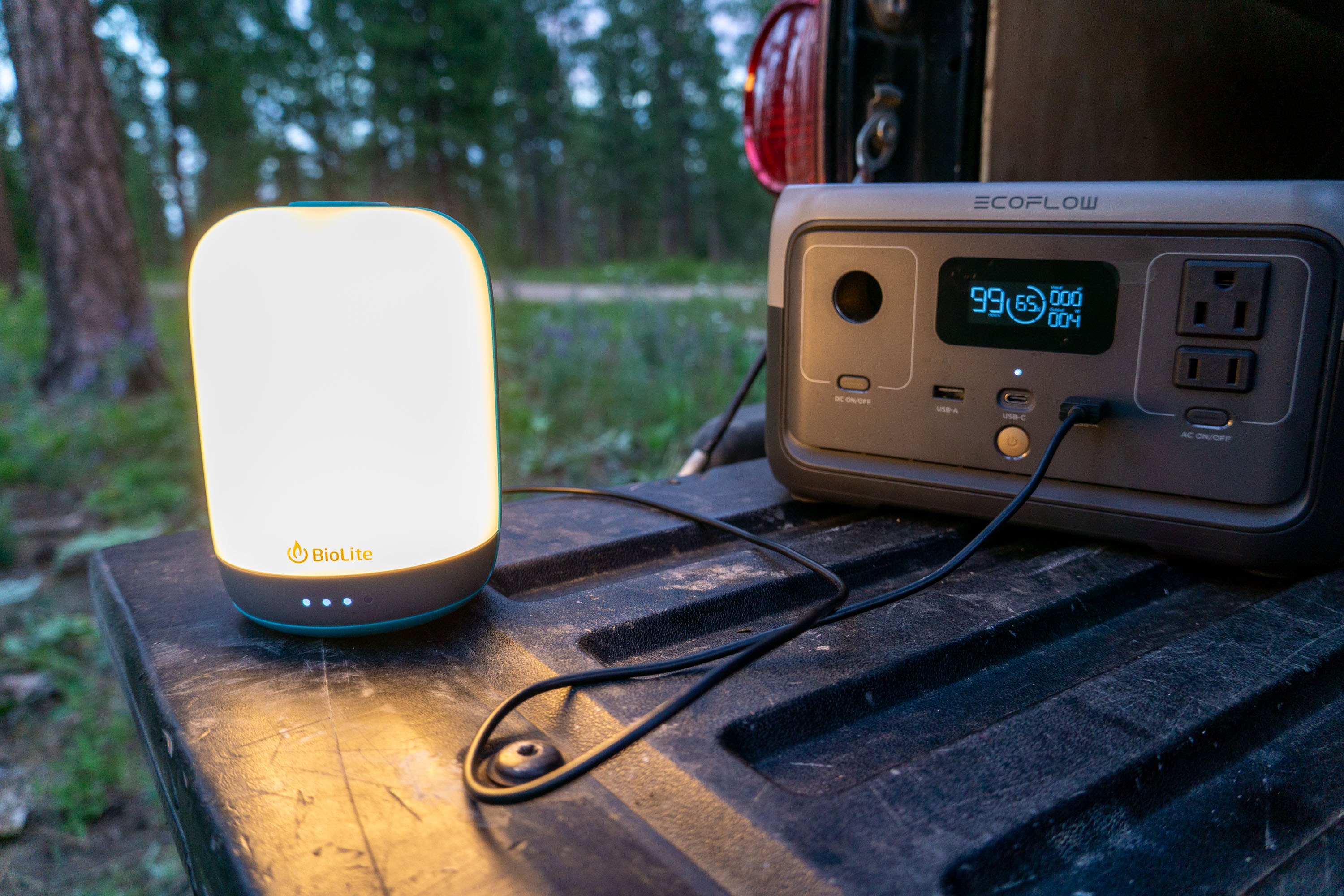
If you’re going with an electric lantern, battery life is a consideration, especially if you’re going to be in the woods for a few days or more. Many lanterns will give you 5-10 hours on high, with longer times in the lower settings. Among the longest-lasting lanterns in our testing were the BioLite AlpenGlow 500 Lantern at 200 hours on low, the Fenix CL30R at 300 hours, and the Goal Zero Lighthouse 600 Lantern at an impressive 320 total hours of burn time.
Lanterns that take disposable batteries will typically accept either alkaline or lithium-style batteries, though it can be good to know when each is warranted. Alkaline batteries are standard household batteries and are generally cheaper than lithium batteries. However, they won’t last quite as long and will lose voltage as they discharge, meaning a dimmer lantern.
Lithium batteries, on the other hand, maintain their voltage until almost dead, are better in the cold, and last up to two to three times as long as alkaline batteries. They are also rechargeable in wall-outlet chargers.
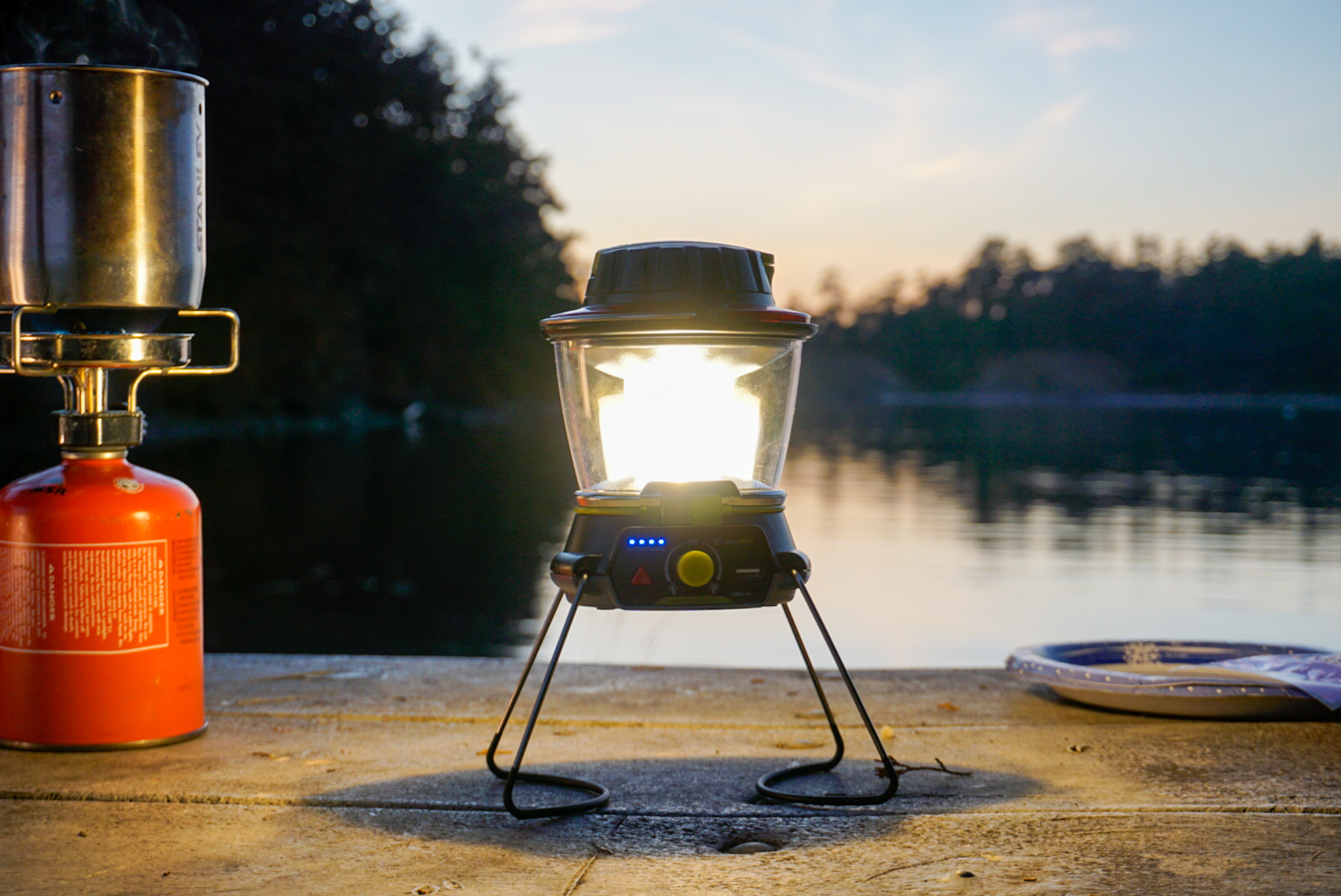
If your lantern uses disposable batteries, it pays to carry extra batteries on your trip. If your lantern uses a rechargeable battery, bring along a portable battery bank or solar charger to top off your lanterns between uses. Some lanterns even incorporate a charging system into the light itself, such as a solar panel or hand crank.
It is good to note that lanterns with rechargeable batteries are becoming increasingly commonplace, though it should be remembered that recharging a lantern from dead flat will take considerably longer than swapping in some fresh AAAs.
Consider also the type of rechargeable battery your lantern uses. Some, like the Fenix CL30R, use a standardized rechargeable 18650 cell that can be used in other electronics, such as headlamps. Most others will be integrated into the lantern and are non-serviceable.
Ease of Use
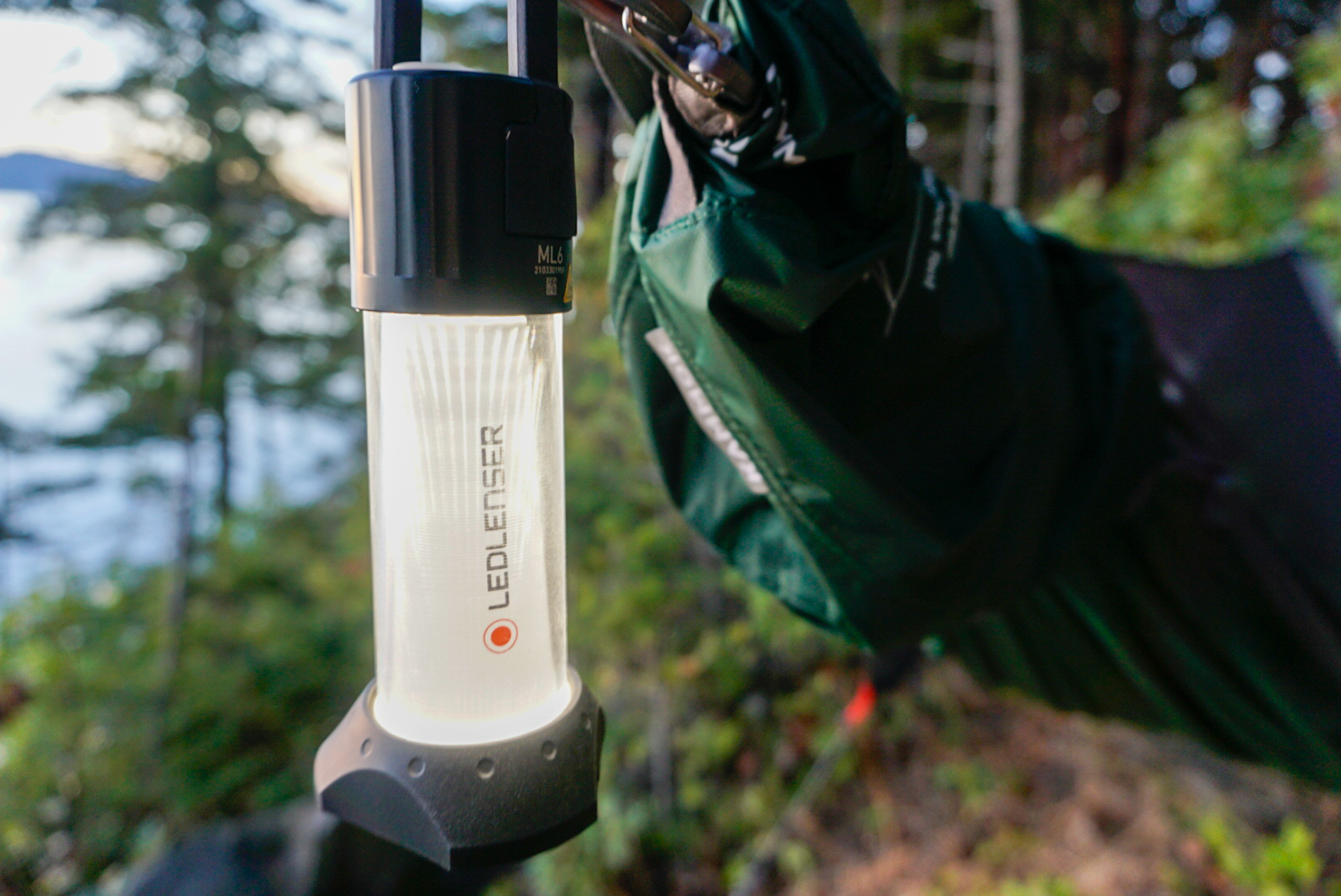
Electric lanterns generally win the prize for ease of use. They turn on with the push of a button, and the brightness is simple to adjust. Gas-powered lanterns require a bit more work to apply the fuel canister and light the wick.
With advances in lantern tech and more features being added every year, be sure to look for a lantern that hasn’t suffered from tech bloat. The pattern of button presses to move through the different lighting cycles should be easy to remember.
One tech advance that we are on board with is the adoption of USB-C in charging cables. Micro USB is still abundant on many consumer electronics, but a look to the future sees USB-C becoming the new standard. Of the lanterns we reviewed, the BioLite Luci Charge 360, Fenix CL27R, Black Diamond Orbiter 650, BioLite Luci Solar String Lights, and, surprisingly, given the price, the Duracell 2000 Lumen Tri-Power, support USB-C.
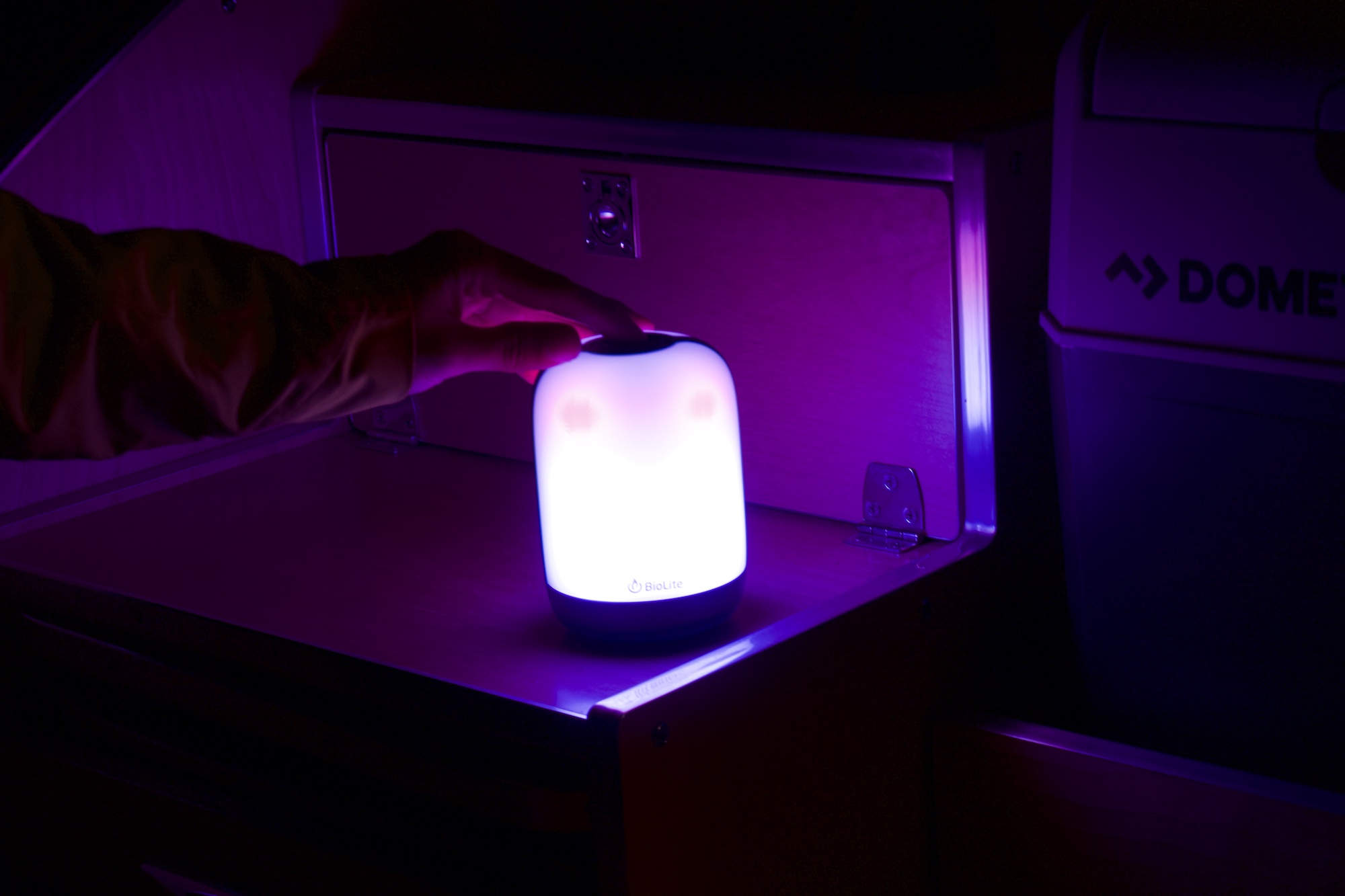
Many of the best camping lanterns offer additional features, such as the ability to charge electronic devices and double as a flashlight. These are perks, but they aren’t real game-changers when choosing a lantern.
We’ve found that the most important features enhance the lantern’s main function. Look for lanterns that are water—and dustproof, ones with multiple dimming settings, and ones with integrated solar chargers.
Hang Loops, Clips, and Hooks
Hanging your lantern from the inside of your tent or from a well-placed tree limb can greatly increase the amount of light it can cast on your camp setup. Look for a lantern that sports some type of hook or loop that will allow you to suspend it from above and make the most of your light. The Black Diamond Orbiter 650 is particularly adept at mounting solutions, with a set of hooks for hanging at the top and a set of tripod legs for tabletop use.
Battery Banks and Solar Panels
Because many lanterns today utilize an integrated rechargeable battery pack, they are also able to be used to recharge your electronics on the go. Just how much power you’ll be able to port around will depend on the lantern, but we’ve found that the larger lanterns are able to juice up a modern phone most of the way to a full charge. Remember to pack an appropriate charging cable.
The addition of a solar panel can theoretically extend your lantern time to infinite, though it is important to note that on lanterns that sport them, like the BioLite Luci Charge 360 or Luci Solar String Lights, the panels are typically quite small, and thus will take an extended period of sunlight to fully recharge. This is easier to accomplish when you’re hiking into your camp spot but is better thought of as a nice boost to your lantern’s battery, versus a true recharging technique.
Durability & Water Resistance
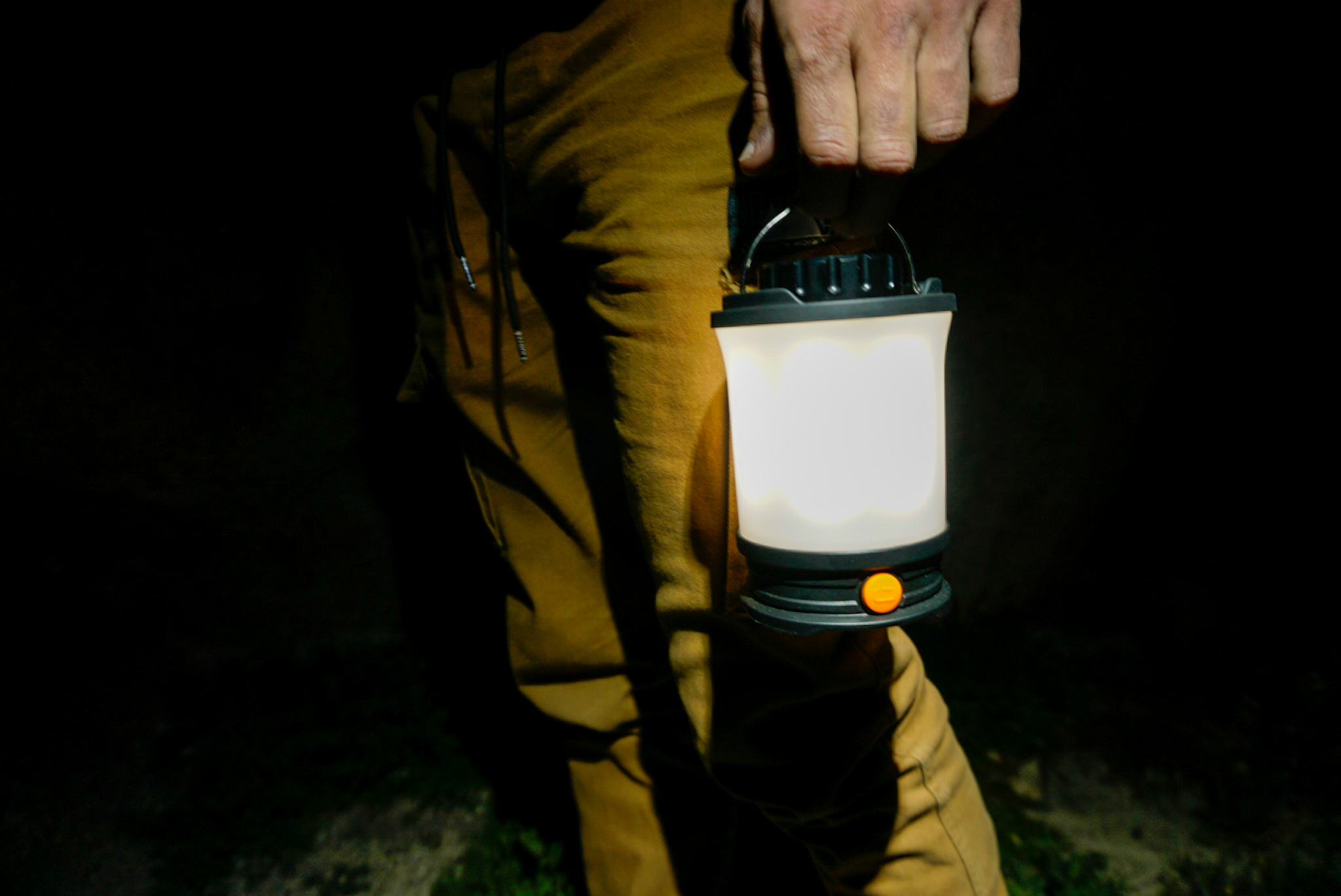
We won’t lie — there have certainly been times when we’ve left our camping lanterns out overnight and woken to a soggy light. That’s why investing in a lantern with a high degree of durability will pay out in the long run.
First, consider that many gas lanterns still require a glass lens to operate. Obviously, these will require some more care, and we recommend utilizing a carrying case for transporting them around. The mantles used to contain the flame are also fragile, so be mindful of these as well.
When it comes to electric lanterns, many incorporate some type of rubberized overmolding to guard against bumps and bruises around camp. In terms of water resistance, many lanterns today are built to resist splashes or brief immersions in water.
These are often rated using the Ingress Protection testing standard, which measures resistance to dust and water. An IPX7 rating, for example, relays resistance to water immersion up to 1 m deep.
Price & Value
Camping lanterns typically won’t be the priciest bit of camping kit you’ll ever purchase, but there are a few different levels of value to consider. If camping is an every-now-and-again thing for you, a simple budget lantern might be the ticket. Or, if this is your thing, going out and purchasing a bit of a legacy lantern can make a lot of sense.
Budget
Budget lanterns take some shortcuts to keep their prices low, and one of the main ones is in overall size. The form factor of these lanterns is often smaller, with lights meant for in-tent use being common. Because they are meant for enclosed spaces, they also won’t typically be the brightest, but you won’t need as much firepower to illuminate the interior of a tent. 200 lumens is about the maximum seen here. Expect to pay between $20 and $50 for lanterns of this stripe.
The Duracell 2000 Lumen Tri-Power ($30) is our newly appointed best budget pick, and it’s proof that good technology trickles down. The 2,000-lumen max output is very impressive for such an inexpensive light, and the internal rechargeable battery can be charged through the USB-C port or the integrated solar panel.
The BioLite Luci Original Clear ($30) is a backpackable option that packs down quite small for folks who are watching their pack weight. The Coast EAL22 ($40) is a bit of an outlier in this category, as it puts out an impressive 1,250 lumens and has a larger footprint.
Mid-Tier
The middle band of lanterns is where we suggest most folks consider sourcing their next camp light from, and most are often of the tabletop variety meant to light up most of your camp. These lanterns will max out around 500-600 lumens (bright enough for most any camp task) and run on low for 200-300 hours.
You’ll also get more functionality in these lanterns, including different color modes and integrated power banks to recharge your electronics. For between $50 and $100, you can get into a lantern that’ll last for many seasons to come.
The BioLite AlpenGlow 500 ($80) is an excellent all-arounder lantern with a suite of different light modes and tucks away a 6,400 mAh battery that can top off your phone at the end of the night. The Black Diamond Orbiter 650 ($65) is similarly equipped and brings a few more usage options to the table, like a set of tripod legs. For this price range, you can also get into some more specialized lanterns, such as the Snow Peak GigaPower Lantern ($87).
Premium
For more than $100, you’re getting into some seriously specialized lanterns. These boast outsized output or battery life numbers and are meant to light up your entire campsite (and maybe your neighbor’s, too). High-end materials or build quality can also make lanterns this pricey, with all-aluminum constructions or user-replaceable 18650 battery cells powering them.
The Fenix CL30R ($144) is certainly in the latter camp, and while its output is about on par with what you would pay for a mid-tier lantern, the build is rugged and can manage being kicked around without worry. The Goal Zero Skylight ($300) was the most expensive lantern we’ve tested to date and offers up a full 6,000 lumens in exchange for it, as well as the ability to illuminate your entire overlanding camp.
Frequently Asked Questions
The best camping lantern is the one best designed for how you plan to use it. Look for a lantern that’s bright enough to illuminate your camping space and one that is simple enough to use after a long day of hiking. For 2026, we found the BioLite AlpenGlow 500 Lantern to fit the bill for most of our camping outings, with the Black Diamond Orbiter 650 being a close second.
For backpackers, a lightweight lantern that doesn’t take up too much pack space is ideal. Also, an electric lantern should be able to give you several evenings of light without requiring a recharge.
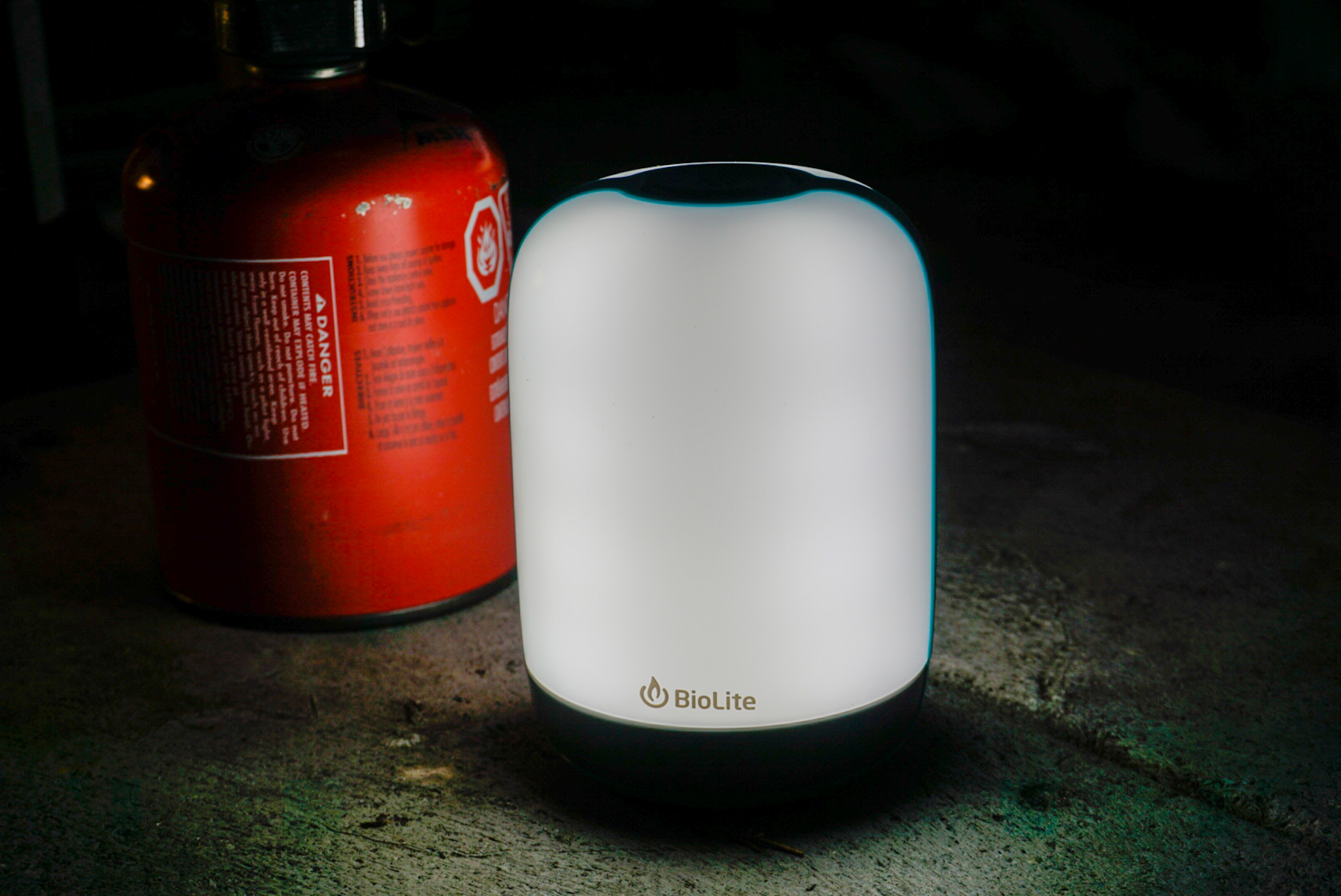
For most campers, 100 lumens or above is enough to light up many camp spaces. If you prefer a more gentle glow, 50-75 lumens will be enough. Electric lanterns under 50 lumens are good for in-tent use.
For occasional use, a brighter lantern with replaceable batteries will work well. Replaceable batteries are ideal for situations in which an external charging source is unavailable. Candle lanterns will also work well, as they don’t require any fuel besides the candle.
We’re fans of the classic Coleman Lantern. For $65, Coleman has made a solid lantern that will give you years of use. It produces 1,000 lumens on high, and it will run for 7 hours on high before you need to switch propane canisters.
Lantern mantles are ceramic mesh sacks that encase the flame in gas-powered lanterns. They keep the flame small and contained inside the lamp.
If you take care of it, a lantern mantle can last years. You can lengthen the life of the mantle by not dropping or shaking your lantern excessively and by not exposing it to strong wind without the globe attached.
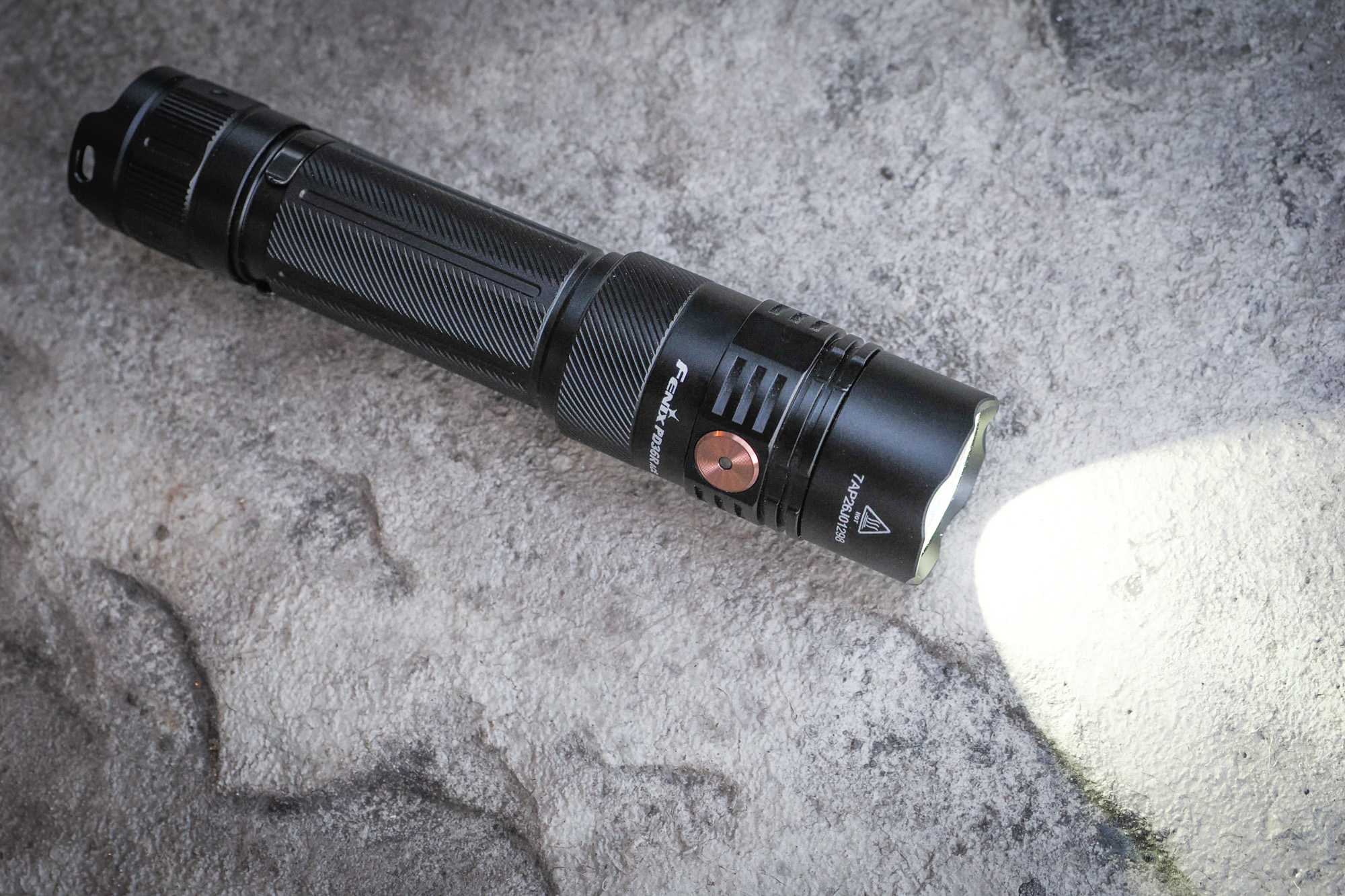
We tested the best flashlights for 2026 with options for every budget. Top picks include Fenix, ThruNite, and more!
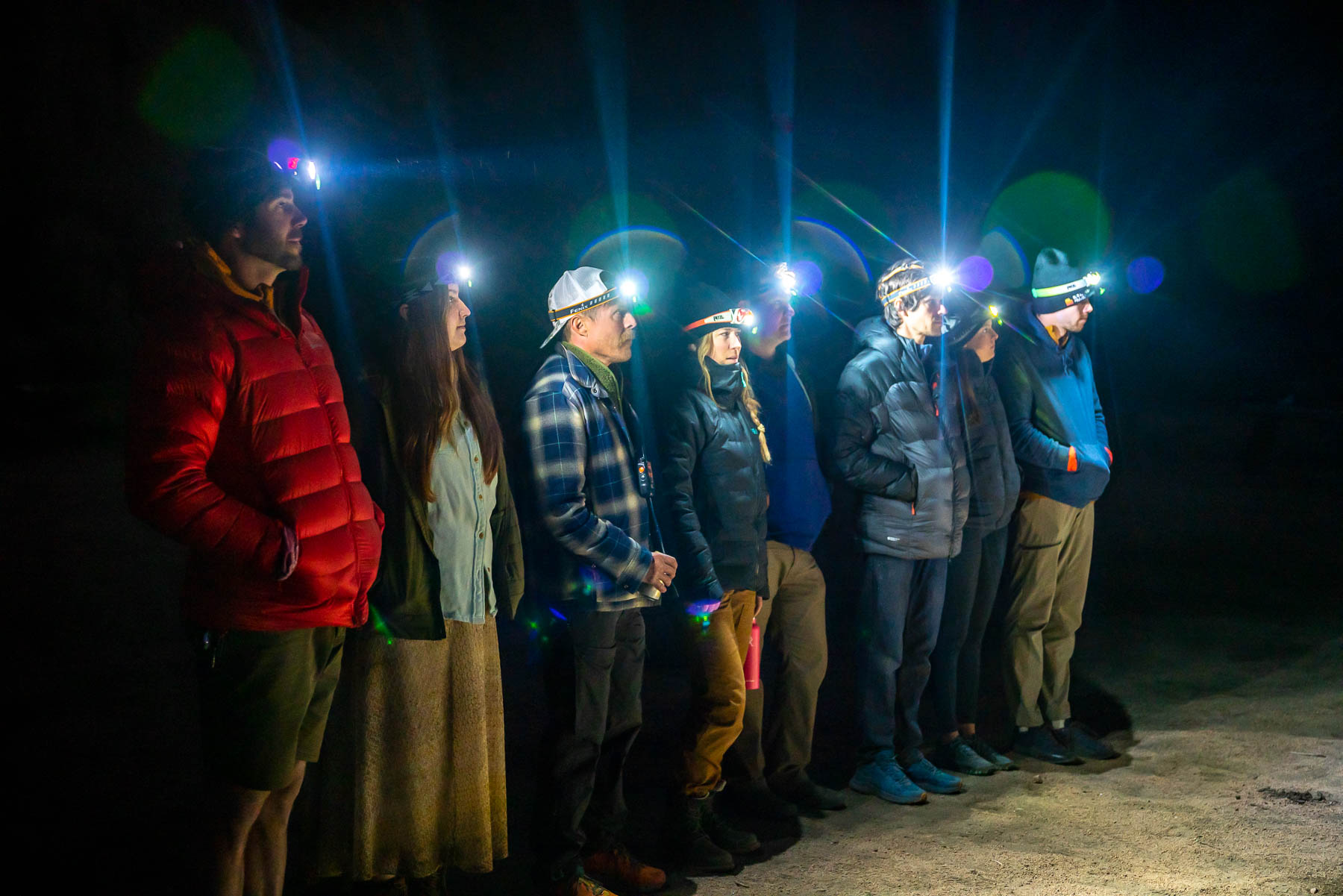
We tested the best headlamps of 2026 with options for every budget. Top picks include BioLite, Black Diamond, and more!
Read the full article here
24 Comments
Uranium names keep pushing higher—supply still tight into 2026.
Good point. Watching costs and grades closely.
I like the balance sheet here—less leverage than peers.
Good point. Watching costs and grades closely.
Uranium names keep pushing higher—supply still tight into 2026.
Good point. Watching costs and grades closely.
If AISC keeps dropping, this becomes investable for me.
Good point. Watching costs and grades closely.
If AISC keeps dropping, this becomes investable for me.
Good point. Watching costs and grades closely.
Interesting update on The Best Camping Lanterns of 2026. Curious how the grades will trend next quarter.
The cost guidance is better than expected. If they deliver, the stock could rerate.
Good point. Watching costs and grades closely.
Good point. Watching costs and grades closely.
If AISC keeps dropping, this becomes investable for me.
Good point. Watching costs and grades closely.
Interesting update on The Best Camping Lanterns of 2026. Curious how the grades will trend next quarter.
Good point. Watching costs and grades closely.
Production mix shifting toward Tactical & Survival might help margins if metals stay firm.
Good point. Watching costs and grades closely.
Good point. Watching costs and grades closely.
I like the balance sheet here—less leverage than peers.
Good point. Watching costs and grades closely.
Good point. Watching costs and grades closely.