

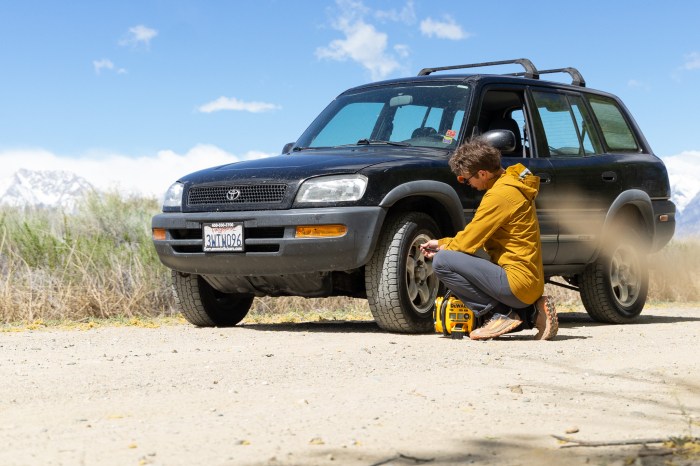
The best time to buy a tire inflator is before you hear the hiss. Whether you’re airing down for a washboard fire road, topping off a bike tire, or limping toward pavement on a flat, a compact compressor is one of the most useful things you can stash in your rig.
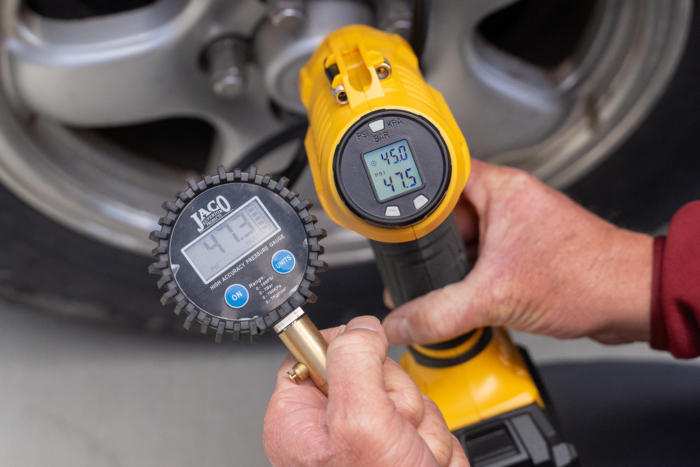
In our most recent laboratory dives, lead testers Alex Vaught and Paul Mandell put nine inflators through their paces around Bishop, Calif., in 75- to 85-degree garage conditions. Our test duo timed each portable tire inflator with a stopwatch as it inflated a 1997 RAV4’s 215/70 R16 tires from 10 to 45 psi. They repeated the test on a 2000 F-250’s 285/75 R16s, from 20 to 80 psi. They checked every gauge against a digital reference, tracked heat with an infrared thermometer, and aired up a few rafts and basketballs.
Our top pick, the DeWalt 20V MAX Tire Inflator, is the only cordless model that handled both cars and full-size trucks. On a budget, the AstroAI Handheld Cordless Air Compressor is quick and easy to use. For regular airing up, the VIAIR 88P filled the truck tire in about 15 minutes.
Editor’s Note: For our November 18, 2026, update, we added a new intro, updated reviews with signposts and bottom-line summaries, and an all-new comparison chart to help you pick the best possible tire inflator.
The Best Portable Tire Inflators of 2026
Best Overall Portable Tire Inflator

DeWalt 20V MAX Tire Inflator
Best Budget Portable Tire Inflator

AstroAI Handheld Cordless Air Compressor
Best for Regular Heavy-Duty Use
VIAIR 88P
Best Emergency Portable Tire Inflator

Fanttik X8 APEX
Easiest to Use Portable Tire Inflator
Wolfbox Megaflow 24 Portable Tire Inflator
Most Versatile Portable Tire Inflator

Avid Power 20V Tire Inflator
Another Great value

Airmoto Smart Air Pump
See more picks
DeWalt 20V MAX Tire Inflator
-

-
(photo/Paul Mandell)
-
(photo/Paul Mandell)
-
(photo/ Paul Mandell)


Specifications
Pros & Cons
Pros
- Versatile
- Powerful
- Utilizes a common battery platform
Cons
- Expensive
- Large
- Cannot be used as an auxiliary battery bank
Bottom Line: A burly cordless inflator that fills car tires, truck tires, and paddleboards alike, though the battery and charger will cost you extra.
Rugged construction, versatility, and power earn the DeWalt 20V MAX Tire Inflator ($127) the title of Best Overall for our guide. It’s the only cordless inflator in our review reasonably capable of handling both light vehicles and full-size trucks.
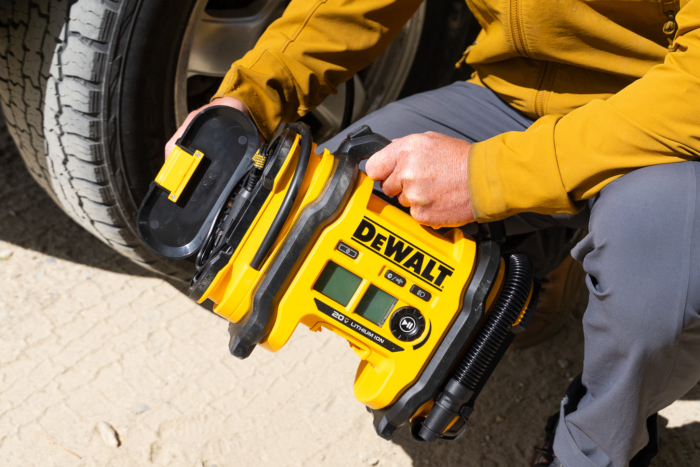
The Tech: The inflator’s round click-wheel selector sets the desired psi, and a real-time pressure readout (accurate to within ±1.5 psi) and automatic stop do the rest. It tops out at 160 psi, and the unit feels solid and well-built, with rubber feet that keep it from walking along the ground. The rubber hose with a threaded brass chuck attaches directly to a Schrader valve, and the Schrader-to-Presta adapter, needle valve for balls, and small smooth-bore nozzle all store neatly in the unit. A second, larger high-volume hose handles rafts, paddleboards, and air mattresses. A 13-foot 12V cable reaches the rear tires of an extended cab F-250 from the dashboard outlet. The spotlight turns on and off separately from the compressor. A 110V adapter is available for shop use.
What We Like: The DeWalt inflated a tire from 10 to 45 psi in an average of 7 minutes and 42 seconds. In the heavy-duty test, it took an average of 32 minutes and 36 seconds to bring a truck tire from 20 to 80 psi on a 5 Ah 20 V battery. If you already use the DeWalt platform, the batteries interchange with everything from impact drivers to lawnmowers. The spotlight works independently of the compressor, which is far more practical than lights that only turn on when the compressor runs.
What We Don’t: We’d like to see an integrated accessory charger, as on several other models in this review, for emergency charging of phones and headlamps. At 12 by 5 by 10 inches, it’s the largest in the lineup, though not by much once the others are in their bags. The $149 price doesn’t include the 20V MAX battery or charger, which run around $100 for the 1.5 Ah option.
Should You Buy It? If you have a medium-sized vehicle or full-size truck, frequently inflate boats or paddleboards, and want a burly inflator you can use with or without a cord, this should be your first choice. If speed matters more, the VIAIR 88P ($90) fills that truck tire in about half the time, but it has to be wired to your battery and has no auto shutoff.
AstroAI Handheld Cordless Air Compressor

Specifications
Pros & Cons
Pros
- Affordable
- Easy to use
- Battery can be used as an accessory charger
- Extra batteries can be purchased separately ($35)
Cons
- Not powerful enough for routine use in large truck tires
- Bulky
- Uses a battery from an uncommon platform
Bottom Line: A budget cordless that fills SUV tires in under eight minutes and doubles as a USB power bank, though it can’t recharge from your car’s outlet.
Ease of use, respectable performance, and a good price earn the AstroAI Handheld Cordless Air Compressor ($65) our pick for Best Budget. Of the cordless units, it came in second overall in our light and heavy vehicle tire tests.
The Tech: Very similar to the Avid Power 20V Cordless Inflator, the AstroAI has a slightly larger 20 V, 36 Wh lithium-ion battery with a USB port for emergency charging of small electronics. It weighs 4 pounds, 3 ounces and maxes out at 160 psi. A brass chuck attaches directly to a Schrader valve or to an included quick-disconnect valve. It has an auto-shutoff, a Schrader-to-Presta adapter, a needle valve for balls, and a 0.2–0.36-inch smooth-bore nozzle. A 12V DC adapter with a 9-foot-6-inch cable plugs into your car’s accessory outlet. The manual recommends a 20-minute duty cycle before a 10-minute rest, which we found conservative. The unit didn’t overheat during 20 continuous minutes under load at 85 degrees. The manual says it’s for SUVs, cars, motorcycles, and small inflatables, not RVs or trucks.
What We Like: We ran it through an E-rated ¾-ton truck tire anyway, and it brought the tire from 20 to 60 psi on a single battery discharge in an average of 18 minutes and 53 seconds. On the 215/70 R16 light-vehicle tire, it went from 10 to 45 psi in 7:53 on average. We prefer the screw-on chuck option, which feels more secure and bleeds less air than a quick-disconnect alone.
What We Don’t: The compressor can’t recharge from a vehicle’s 12 V outlet without a separate power inverter. The display is only accurate to within 3 psi and tends to inflate slightly higher than shown. The storage bag is functional but uses a bothersome Velcro strap system.
Should You Buy It? It’s a great choice for quickly inflating bicycle, motorcycle, light car, and SUV tires around the shop or in emergencies. If you expect to air down and up routinely or you’re rolling big balloon tires or a full-size truck, you’d probably be better off with the VIAIR 88P.
VIAIR 88P

Specifications
Pros & Cons
Pros
- Powerful
- Fast
- Simple
Cons
- No automatic shut off
- Analog gauge less accurate than some digital ones
- Must have vehicle running while in use
Bottom Line: A fast, no-frills compressor that clips to your battery and fills tires in half the time of the competition, though it runs hot and has no auto shutoff.
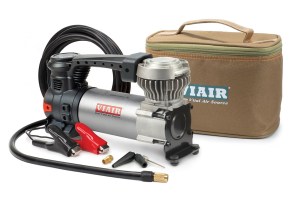
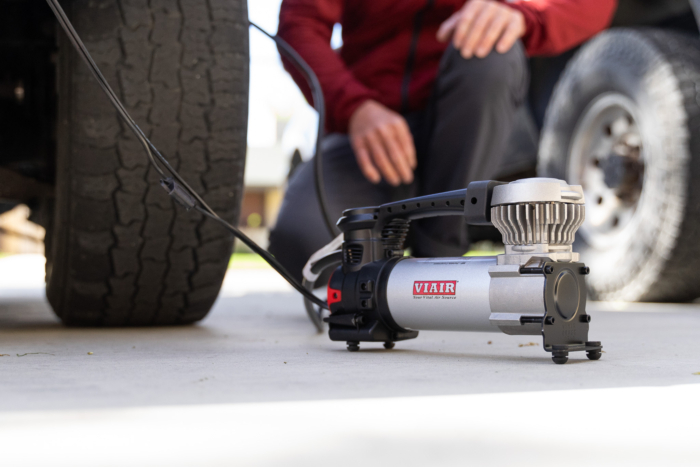
VIAIR is a well-known name in the portable air compressor world, so it was no surprise that the VIAIR 88P ($90) crushed the competition in the full-size truck tire test. It’s a simple, no-frills compressor that gets straight to the business of inflating tires.
The Tech: The 88P attaches to a vehicle’s 12 V battery with two robust alligator clips on a 10-foot power cord with an in-line 20-amp flat fuse, and it runs with a simple one-button operation. It weighs 4 pounds, 12 ounces, maxes out at 120 psi, and has a small analog gauge. The 16-foot heavy-duty rubber hose has a high-quality brass chuck for Schrader valves, with adapters for a needle valve, a Presta valve, and two small smooth-bore nozzles. Together, the cord and hose give you just over 26 feet of reach. A small spotlight is built in and turns on when the unit is attached to a battery. Keep the car running during inflation so you don’t end up with a dead battery.
What We Like: The 88P inflated the 215/70 R16 tire from 10 to 45 psi in an average of 3:09, and the larger truck tire in an average of 15:07, nearly half the time of the next-best performer. Realistically, it’s the only model in this guide fast enough that we’d consider it for regular off-road airing down. Our tester personally chose VIAIR for the onboard air compressor on his full-size pickup with a cabover camper.
What We Don’t: We wish it had an automatic shut-off, so take care not to over-inflate your tires. The small analog gauge can read up to 3 psi higher than actual and is a little hard to read. The compressor can also reach 160 degrees Fahrenheit after 12 minutes under load, and the heat exchanger sits close to the carrying handle.
Should You Buy It? This is easily the best choice for people who regularly change tire pressures off-road, run heavy-duty tires at higher psi, drive motorhomes or RVs, or are simply impatient. If you’d rather go cordless with auto shutoff and don’t mind the cost, the DeWalt 20V MAX Tire Inflator ($149) is the more convenient pick, but it takes more than twice as long on a truck tire.
Fanttik X8 APEX

Specifications
Pros & Cons
Pros
- Small
- Doubles as battery bank
- Spotlight works well as a flashlight or SOS signal
- Can be charged while on the road
Cons
- Less work capacity than other models
- Cannot be used while charging
Bottom Line: A pocketable inflator, power bank, and flashlight in one that handles small to mid-size vehicle tires in a pinch, though it overheats on truck tires.
The Fanttik X8 APEX ($99) is a compact, portable, cordless tire inflator that excels as an emergency backup for small to mid-size vehicles. We’re impressed by its size and sleek design, which bundles an emergency inflator, battery bank, and flashlight/emergency light, as well as its performance on smaller vehicle tires.
The Tech: The X8 APEX is about 6 inches long, weighs 1 pound, 11 ounces, and maxes out at 150 psi. A 17.5-inch hose has a Schrader valve, and a Presta valve adaptor and needle valve are included. Its 22.86Wh battery doubles as a power bank. A powerful LED spotlight works as a flashlight, and the blinking SOS mode automatically turns off after 30 minutes, which is great for roadside emergencies.
What We Like: It inflated our 215/70 R16 tire from 10 to 45 psi in an average of 11:52, with almost enough power left over for a second tire, usually falling short by only a few psi. With smaller tires, expect at least two inflations from nearly flat to normal pressure on a single charge. Although it isn’t intended (or advertised) for larger truck tires, it brought our truck tire from 20 to 51 psi in an average of 20:10.
What We Don’t: It’s not as small as the Airmoto Smart Air Pump, though the performance is significantly better. On the truck tire, it usually shut off from excessive heat before draining the battery, so using it on a full-size truck would be pushing it.
Should You Buy It? This is ideal for small- to mid-size vehicle owners who want an inflator and emergency charging battery in their kit, and it’s small enough to take on a bicycle or motorcycle. If that’s your intended use, you might prefer the Airmoto for its smaller size and adequate power.
Wolfbox Megaflow 24 Portable Tire Inflator
-
-
(photo/Paul Mandell)
-
(photo/Paul Mandell)


Specifications
Pros & Cons
Pros
- Doesn't require separate batteries or a proprietary charger
- Easy controls and a "set-it-and-forget-it" auto-stop function.
- Includes multiple adapters and can function as a USB-C power bank for other devices
Cons
- Moderate inflation speed
- The number of tires that can be fully inflated on a single charge is limited by the internal battery size
Bottom Line: A USB-C-rechargeable, set-it-and-forget-it inflator with a handy 11-foot car cable, though it’s not the fastest and its battery drains after four tires.
The Wolfbox Megaflow 24 ($89) is another contender in the compact, lightweight tire inflator category.
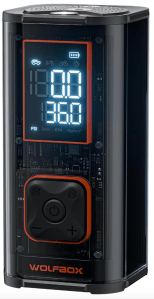
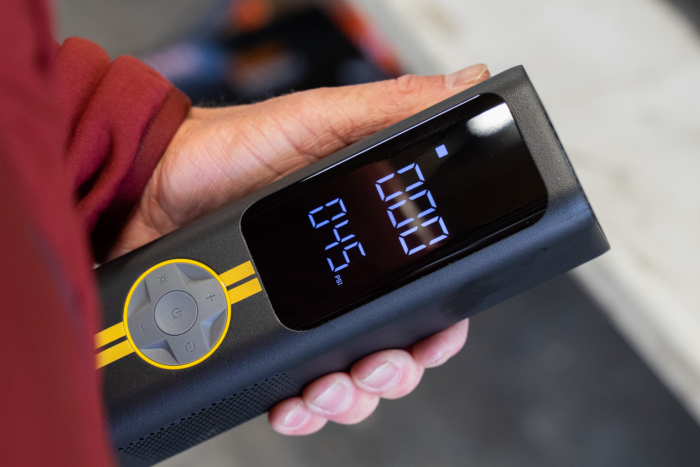
The Tech: Measuring 4.16 by 4.16 by 9.3 inches and weighing 4 pounds, 13 ounces, the Megaflow 24 has a clear LED screen with easy toggling buttons to adjust pressure up and down. It tops out at 150 psi, which is more than enough for most jobs. A 20-inch hose and an 11-foot car DC cable (which our tester was particularly enamored with) are included, along with a small LED light, auto-stop, a Presta adaptor, and a needle adaptor. It recharges via a standard USB-C port, so no external battery is needed, and the USB-C port can also charge a phone.
What We Like: Set a precise pressure, press the button, and walk away while it works — a feature we didn’t fully appreciate until we tested the Makita 18V LXT, which requires you to hold the trigger. It’s about the middle of the road on speed at 3:50 per tire to air up from 25 to 35 psi after rough dirt roads. The 11-foot DC cable lets you run it off a common accessory port, which is handy on long off-road stretches when battery power is at a premium.
What We Don’t: It’s not as fast as some other inflators, and its duty capacity is limited by battery size. It will run most of its charge down after inflating four tires back up to 35 psi.
Should You Buy It? If you value compact size, plenty of features, and the ability to walk away mid-inflation, it’s a solid choice that doesn’t need a separate battery or charger. It also outcompetes the Makita LXT on max pressure, 150 versus 120 psi.
Avid Power 20V Tire Inflator

Specifications
Pros & Cons
Pros
- Affordable
- Easy to use
- Extra batteries can be purchased separately (MSRP $35)
Cons
- Not powerful enough for routine use in large truck tires
- Bulky
- Uses a battery from an uncommon platform
- Cannot be used to charge other small electronics
Bottom Line: A cordless or corded inflator that handles small tires and fills two per charge, though it runs hot and can’t charge your phone.
The Avid Power 20V Tire Inflator ($69) has many of the same attributes as other inflators in this review: automatic shutoff, cordless or 12V corded power, and a small integrated light that only turns on while the compressor runs. It performed well in testing on smaller tires.
The Tech: The Avid weighs 4 pounds, maxes out at 100 psi, and runs on a 27Wh battery. It has a quick-release air chuck for Schrader valves with attachments for needle valves, Presta, and a small smooth-bore nozzle. The digital display gauge is accurate to within 1.7 psi, erring low, which is within the advertised ±2 psi. The 12V cable is 9 feet, giving the unit a total reach of 11 feet, 4 inches. The manufacturer calls for 3 minutes of cool-down for every 10 minutes of continuous use.
What We Like: It inflated our 215/70 R16 tire from 10 to 45 psi in an average of 8:08 and managed two inflations on the small tire before the battery was fully drained. On the larger truck tire, it went from 20 to 51 psi in around 16:38 before draining the battery. With the 12 V option, you could theoretically inflate an infinite number of tires. The handle is insulated well enough to hold comfortably even when the top of the inflator is hot.
What We Don’t: The battery can’t charge accessories, one reason the AstroAI scored higher. The unit also got pretty hot (158 degrees Fahrenheit) after just one inflation of a 215/70 R16 tire. It’s somewhat slower on 12V DC power than on the 20V battery, and the 9-foot cable barely reaches the rear tires of our F-250 extended cab if the wheel is rotated so the valve is close. We prefer a screw-on chuck for a more secure fit than this quick-release.
Should You Buy It? It’s a suitable choice for light to medium-duty tasks around the house or as part of an emergency vehicle kit. For heavy-duty use, we suggest the VIAIR 88P. If portability and lighter use (bikes and motorcycles) are your priorities, the Airmoto Smart Air Pump is a more suitable option.
Airmoto Smart Air Pump

Specifications
Pros & Cons
Pros
- Small
- Lightweight
Cons
- Limited applications
- Cannot be used to charge electronics
Bottom Line: A glove-box-sized inflator with a handy deflate button, though it runs out of juice before filling a full-size car tire.
The Airmoto Smart Air Pump ($89) is a sleek, lightweight tire inflator small enough to fit in a car’s glove compartment or a bicycle frame bag. While impressive for its size, it lacks performance.
The Tech: At 1 pound and about 6 by 1.5 by 2.5 inches, the Airmoto is undeniably compact and portable, with a user-friendly interface. It tops out at 120 psi. It’s the only inflator in this guide with a deflate button to let air out (passive deflation, not a vacuum) and a real-time pressure readout on the display. The automatic shut-off works well, and the integrated spotlight is bright enough to double as an emergency flashlight. It comes with a standard Schrader valve chuck and adaptors for Presta, a needle valve, and a small smooth nozzle.
What We Like: It performed satisfactorily on bike and motorcycle tires, and it inflated a 26-inch bike tire to 45 psi in just a few minutes. Its compact size makes it a viable option for on-the-go use, particularly for bike or motorcycle rides.
What We Don’t: It lacked the capacity to fill the 215/70 R16 tire from 10 to 45 psi, shutting off at 35 psi after an average of 21 minutes because the battery ran out. We would have appreciated improved battery life and the ability to serve as a backup charger.
Should You Buy It? If you prioritize portability and have light-duty inflation needs, it’s a suitable choice, best for small-volume items or topping off tires that already have decent air. If you want to fill a car tire from nearly flat, the Fanttik X8 APEX ($99) is a bit larger but got our 215/70 R16 tire to 45 psi in 11:52.
Other Great Portable Tire Inflators We Tested
Makita 18V LXT Cordless Inflator
-
-
(photo/Paul Mandell)


Specifications
Pros & Cons
Pros
- Precise pressure readings
- Equipped with an auto-stop function to prevent overinflation
- Convenient for folks already owning Makita 18V batteries and chargers.
Cons
- Must hold trigger during inflation
- You need to purchase a separate Makita 18V battery and charger
Bottom Line: A bright, accurate LCD inflator for people who already own Makita batteries, though you have to hold the trigger the whole time.
The Makita 18V LXT ($99) is a compact, lightweight inflator with a bright, clear LCD screen with an exact PSI/kPa indicator.
The Tech: The LXT weighs 3 pounds, and its 120 psi max is more than enough for truck tires and will easily inflate high-pressure road cycling tires. It has a 25.5-foot hose, an LED light, a pressure/autostop function, and a Presta adaptor and needle adaptor for balls. It requires a Makita battery and charger, which is good news if you’re already in the Makita camp. If you aren’t, expect to spend $75 or more to buy into the ecosystem.
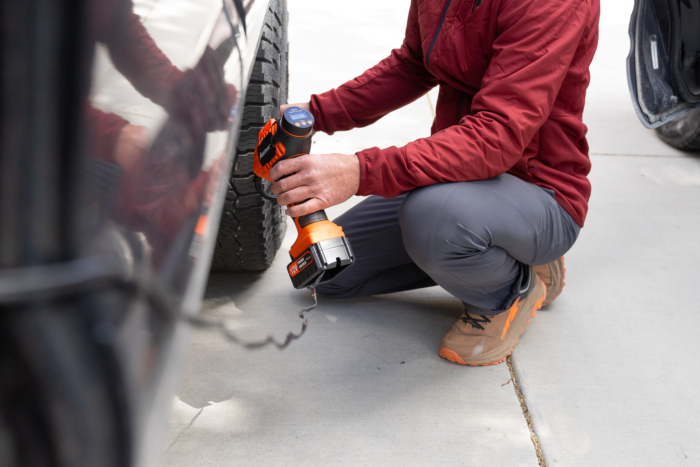
What We Like: We took it out on dirt roads to air down our tires for rough stretches. The digital screen made it easy to check exact pressures, and the auto-stop ensures you won’t accidentally overinflate when it’s time to air back up. Functionally, it’s a good inflator.
What We Don’t: It requires you to hold the trigger the whole time. We timed a truck tire to 10 psi at 3:30, which means about 15 minutes of being tied up with just the inflator. Several other inflators on this list inflate at a similar rate but let you walk away after pressing start.
Should You Buy It? If you’re a Makita person, it’s still a solid tool and worth grabbing. If you’d rather multitask while your tires fill, the Wolfbox Megaflow 24 ($89) lets you set the pressure, press start, and walk away, and it charges over USB-C with no extra battery.
Portable Tire Inflator Comparison Chart

DeWalt 20V MAX Tire Inflator |
AstroAI Handheld Cordless Air Compressor |
VIAIR 88P |
Fanttik X8 APEX |
Wolfbox Megaflow 24 Portable Tire Inflator |
Avid Power 20V Tire Inflator |
Airmoto Smart Air Pump |

Makita 18V LXT Cordless Inflator |
|
|---|---|---|---|---|---|---|---|---|
|
Compare |
|
|
|
|
|
|
|
|
|
Price |
$127 |
$64 |
$90 |
$99 |
$89 |
$69 |
$69 |
$99 |
|
Max PSI |
160 |
160 |
120 |
150 |
150 |
100 |
120 |
120 |
|
Power Source |
12V DC, or 110V AC, 20V MAX battery (20V MAX battery and 110V AC adaptor sold separately) |
20V 36Wh Li-Ion battery or 12V DC |
12V DC (vehicle’s starter battery) |
Integrated 28Wh Li-ion battery |
USB-C Rechargeable Battery, 12V DC |
20V 27Wh Li-ion battery or 12V DC |
14.8Wh Li-ion battery |
Makita 18V Battery |
|
Weight |
2 lbs., 15.4 oz. |
4 lbs., 3.2 oz. |
4 lbs., 12 oz. |
1 lb., 11.2 oz. |
4 lbs., 13 oz. |
4.0 lbs. |
1 lb., 3.2 oz. |
3 lbs. |
|
Ideal Use |
Bike, car, and truck tires, inflatable mattresses, rafts |
Balls and small inflatables, bikes, motorcycles, small to mid-sized vehicle tires |
Regular inflation of SUV and truck tires, airing up after off-road driving |
Small inflatables, bicycles, motorcycles, small vehicles, emergency use for mid-sized vehicles |
Light trucks, motorcycles, bicycles |
Balls and small inflatables, bikes, motorcycles, small to mid-sized vehicle tires |
Small inflatables, bicycle, motorcycle, and small car tires |
Light truck tires, motorcycles, bicycles, balls |
How We Tested Portable Tire Inflators
Our Expert Testers
For our guide to the best tire inflators, we tapped a few adventurers who enjoy working on their vehicles almost as much as they enjoy off-roading in the desert or braving old fire roads to access backcountry skiing and climbing objectives.
As an avid climber, skier, and traveler who enjoys exploring remote and off-the-beaten-path destinations, lead tester Alex Vaught has firsthand experience driving on rugged roads and facing unexpected challenges. His knowledge of vehicle mechanics, combined with practical insights gained from his adventures, makes Vaught a valuable resource for anyone seeking advice on vehicle maintenance, emergency preparedness, fashion, and safe travel in remote areas.
Assisting Vaught is DIY enthusiast and amateur mechanic Paul Mandell. When Mendell isn’t enjoying the Eastern Sierra Backcountry, he’s usually under one of his beloved trucks, engaged in all manner of off-road modding and repairs to get ready for his next adventure.
Our Testing Grounds
Both our testers reside in Bishop, Calif., a small town nestled in the Owens Valley between the Sierra and White mountain ranges. The valley has hundreds of miles of forest service roads in various states of disrepair, so there’s plenty of opportunity to get a flat far from cell service or any assistance, plus the occasional need to increase or decrease tire pressure to better suit the terrain.
Vaught has an onboard compressor on his F-250 and feels everyone should have some sort of inflation device in addition to a spare tire when off-roading in the desert.
Most of the testing happens in a controlled environment (the garage) where we can compare inflation times side by side with a stopwatch, measure hose lengths, and access different-sized tires on different vehicles.

Our Testing Process
Over our many years of using various portable tire inflators, on-board air compressors, and shop air compressors, as well as patching tires, performing vehicle maintenance, and experiencing all other manner of roadside emergencies, we’ve had ample opportunity to contemplate what features our ideal portable air compressor should have.
In our online searches, we’ve observed two recurring issues. First, there’s inconsistency among companies regarding the metrics they use to advertise the “number of inflations” achievable on a single charge. Second, the parameters they employ for testing often seem inadequate, such as considering raising tire pressure from 30 psi to 35 psi as a complete “inflation.”
Tires: Big & Small
We aimed to assess how these devices would perform under realistic conditions, where a tire goes from visibly flat to fully inflated according to the manufacturer’s specifications. To achieve this, we selected a compact vehicle, a 1997 RAV4, with a weight of 2,646 pounds and 215/70 R16 tires.
We deflated the front tires to 10 psi (just above the point where the rim is off the ground) and then inflated them to the maximum recommended psi rating for the tire, which in this case was 45 psi. We calculated the average time taken for this process. This was referred to above as the “light-duty vehicle test.”
For a more demanding test, we used a 2000 F250 Extended Cab Diesel weighing 8,800 pounds, fitted with 285/75 R16 E1-rated tires, and repeated the same test, this time inflating the tires from 20 to 80 psi. This was referred to above as the “heavy vehicle test.”
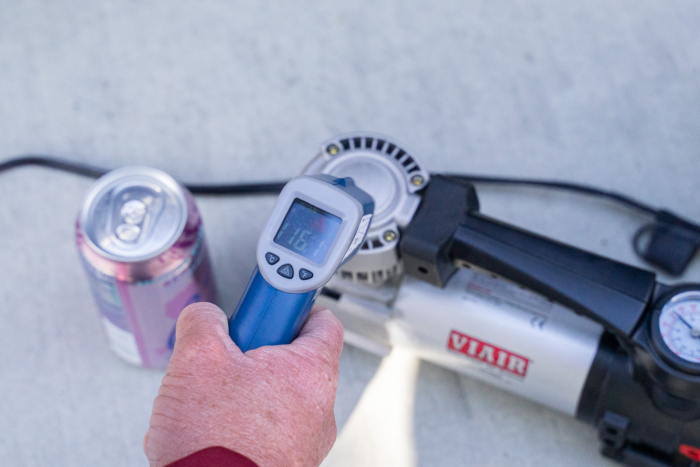
Overheating
To monitor the temperatures of the devices, we employed an infrared thermometer and recorded any instances where temperatures exceeded what would be considered “comfortable” to touch with a bare hand.
We also verified the accuracy of the gauges using a separate digital tire pressure gauge. All testing was conducted away from direct sunlight, with ambient temperatures ranging between 75 and 85 degrees Fahrenheit.
General User Experience
To make sure readers know exactly what they’re getting into, we measured air hoses, monitored battery charge times and life when applicable, played with each model’s special features, and even inflated a few rafts and basketballs. While the ability to reliably inflate a tire in a remote location is the main metric we judged these by, we made special note of any cool features or inconveniences of each model.
Buyer’s Guide: How to Choose a Portable Tire Inflator
Know What You Need
A portable tire inflator is an essential tool for every vehicle owner, providing convenience and peace of mind in case of emergencies or planned use. With the large number of options available on the market today, it’s important to consider several factors before making a purchase.
It’s important to understand the manufacturer’s intended use and to realize that many inflators available on the market might not be able to realistically meet your needs, especially if you’re rolling larger tires at higher pressures (even though they often advertise pictures of tiny cordless units attached to monster 33” tires).
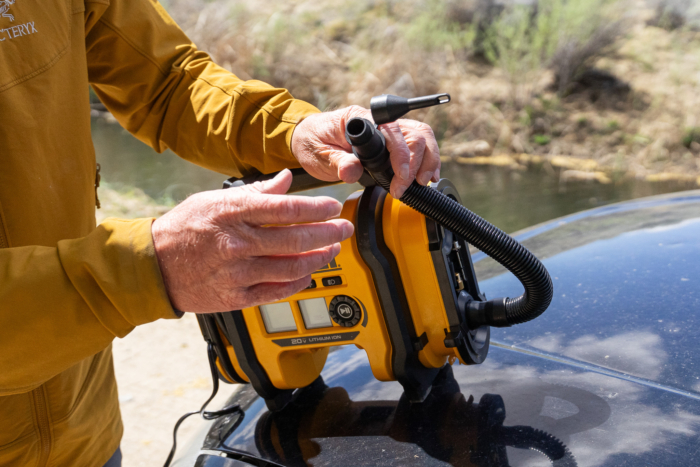
Just Because You Can Doesn’t Mean You Should
While much of the testing in this review was maxing out the capabilities of these inflators, our intent was not to try to encourage you to repeat the same thing in the real world. We simply wanted to see what they were capable of. With that being said, you are far better off overestimating your needs than underestimating them.
It’s also important to bear in mind that we tested these units with a fresh charge on days with reasonable ambient temperatures. You could expect a little less performance from an inflator that has been sitting in your car for 2 months without a fresh charge on a hot day in direct sunlight. The moral of the story: when in doubt, round up.
An Ounce of Prevention Is Worth a Pound of Cure
It seems like the moment you need something comes right after you let your guard down (just last week, our tester broke down on the side of the road after having just gifted an emergency tool kit to his girlfriend). With that being said, dialing in your emergency kit should not be put on the bottom of your to-do list.
But don’t be hasty in your choice of what to carry. Before hitting the send button, consider the following criteria for purchasing the best portable tire inflator for you.
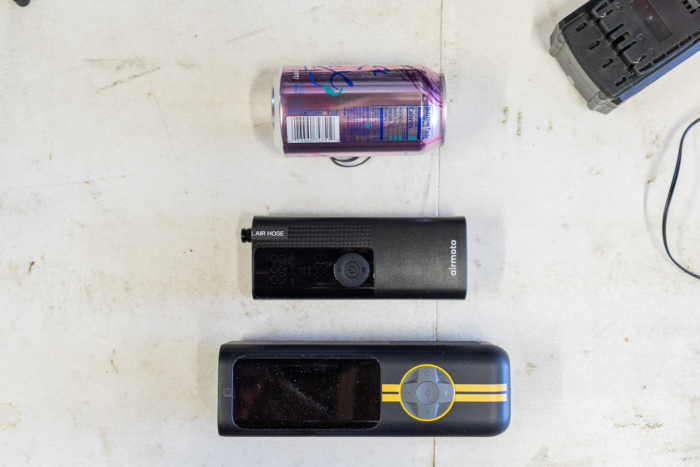
Portability
The amount of space on your emergency kit is an important consideration when purchasing a tire inflator. If you have a large vehicle with plenty of storage space, a larger unit such as the VIAIR 88P or DeWalt 20V MAX Tire Inflator will certainly outperform smaller units.
If you’re on a motorcycle or bike where size and weight are paramount, a smaller unit like the Airmoto Smart Air Pump or Fanttik X8 APEX will store much easier and can handle smaller-volume tires adequately.
Power Source
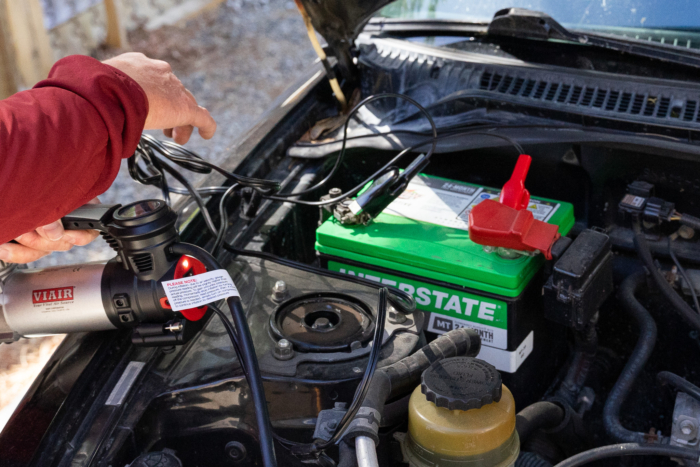
Determine whether you prefer a tire inflator powered by your vehicle’s 12V DC outlet (cigarette lighter socket or starter battery) or a rechargeable battery. Each option has its pros and cons, so choose based on your usage requirements.
For instance, cordless units, while convenient, do require some battery maintenance (i.e., you need to put them on the charger at least every few months to make sure the batteries are charged and keep the batteries conditioned), while units that run on 12V DC can be left in the trunk until needed without a problem (make sure the cord is long enough for your situation!)
Inflation Speed
Manufacturers often advertise the inflator’s inflation rate, measured in liters per minute (LPM) or cubic feet per minute (CFM). While these ratings are somewhat useful as a comparison, they are almost always calculated at 0 psi (i.e., the inflator is not under any load), and some units will perform worse than others when actually trying to achieve a desired pressure.
Faster inflation speeds can save you time during emergencies or when inflating multiple tires. If time is a factor or you intend to regularly reinflate tires after driving off-road, a unit such as the VIAIR 88P will save you as much as an hour when repressurizing four tires when compared to even the second fastest inflator in this review, the DeWalt 20V MAX Tire Inflator.
Maximum Pressure
Determine the maximum psi (pounds per square inch) rating of the inflator. Ideally, it should exceed the recommended psi for your vehicle’s tires, including any special requirements for off-road or heavy-duty tires.

Durability & Build Quality
Look for inflators constructed from high-quality materials that can withstand frequent use and rough handling. For build quality, the VIAIR 88P and DeWalt 20V Max stand above the rest. The Viar does this while maintaining a low cost at the price of fewer features and not having a cordless option.
With the DeWalt model, you accept a significantly higher price tag, especially considering the additional cost ($100 or more, depending on the Ah rating of the battery) of purchasing the separate components to make the device cordless. While warranties and good customer support are nice, they probably won’t help you much when you’re in a remote setting or even just stuck on the side of the road or in a parking lot.
User-Friendly Design
Opt for a tire inflator with intuitive controls and easy operation. All of the inflators in this review offer a user-friendly interface if you read the user manual and familiarize yourself with its features beforehand. For example, knowing the duty cycle of the unit you carry (located in the respective user manuals) will keep you from overheating the unit during use.
Consider all of the above before purchasing so you can confidently choose a portable tire inflator that meets your specific requirements and provides reliable performance whenever you need it.
Price & Value
As with many tools, balancing features and quality with affordability is the name of the game when selecting a portable tire inflator. For inflating large truck tires, you’ll need to spend a little more. But for cars, smaller trucks, and SUVs, some of the less expensive models will do nicely.
Budget
If your budget is tight but you still want cordless capabilities, a digital gauge, and automatic shut-off, the Astro AI ($90) is our pick for best on a budget. Certain sacrifices were made during manufacturing to cut costs, such as the included carrying case feeling of lesser quality than other models, thinner diameter brass used on the air chuck, and a lighter weight hose covered with braided nylon as opposed to the heavier gauge rubber used on the DeWalt and VIAIR models.
Time will tell how well these hold up. The least expensive offerings also come at the disadvantage of buying from companies that do not have a longstanding and well-known reputation behind them, such as DeWalt and Viair, which are known to deliver a certain level of quality.
The VIAIR 88P ($90) performs well and also has a nice price. It will need to be plugged into your car’s battery, but it does have enough power to inflate larger truck tires in around 15 minutes.
Premium
Spending above $100 gets you an inflator backed by the battery systems of larger, named-brand tool companies, our favorite being the DEWALT 20V MAX Air Inflator ($127). If you already own some DeWalt tools and have their battery charger, don’t sleep on this one.
We found it to be the easiest to use and most versatile, as you can run it off a battery when you’re out and about or a 110V adapter when you’re in the shop. It has plenty of power for inflating large truck tires, though it takes about 30 minutes if you’re running it off the battery. If you don’t already have a Dewalt charger, you’ll have to add another $100 to the price tag.

Frequently Asked Questions
The tire inflator’s capacity should match the tire size. Thus, if your vehicle is equipped with large tires, opting for a high-capacity inflator is recommended to minimize inflation time. Conversely, a lower-capacity inflator would be better suited for vehicles sporting smaller wheel diameters.
A tire inflator is a small, tank-less air compressor that’s usually kept in a car and is suitable for inflating tires or other small inflatables. An air compressor is usually much larger and has a higher air output and typically a tank, making it more versatile. Air compressors can be fitted with a range of air-operated tools, including an attachment for inflating tires.
If you’re running the inflator off of your vehicle’s 12V system then, yes! To avoid this, keep the vehicle running while in use.
Battery-powered items stored in cars are often forgotten about, that is until they’re needed. If you store any battery-powered devices in your car, such as an inflator or jump starter, it’s best practice to fully charge the battery every few months to keep the battery charged and extend its lifespan.

The Best Camping Lanterns of 2026
The Best Flashlights of 2026
Read the full article here
46 Comments
Silver leverage is strong here; beta cuts both ways though.
I like the balance sheet here—less leverage than peers.
I like the balance sheet here—less leverage than peers.
The cost guidance is better than expected. If they deliver, the stock could rerate.
Nice to see insider buying—usually a good signal in this space.
Good point. Watching costs and grades closely.
Good point. Watching costs and grades closely.
Silver leverage is strong here; beta cuts both ways though.
If AISC keeps dropping, this becomes investable for me.
Good point. Watching costs and grades closely.
Uranium names keep pushing higher—supply still tight into 2026.
Good point. Watching costs and grades closely.
Good point. Watching costs and grades closely.
Interesting update on The Best Portable Tire Inflators of 2026. Curious how the grades will trend next quarter.
Good point. Watching costs and grades closely.
Uranium names keep pushing higher—supply still tight into 2026.
Good point. Watching costs and grades closely.
Uranium names keep pushing higher—supply still tight into 2026.
Production mix shifting toward Tactical & Survival might help margins if metals stay firm.
Good point. Watching costs and grades closely.
Good point. Watching costs and grades closely.
Nice to see insider buying—usually a good signal in this space.
Silver leverage is strong here; beta cuts both ways though.
Good point. Watching costs and grades closely.
Production mix shifting toward Tactical & Survival might help margins if metals stay firm.
Good point. Watching costs and grades closely.
Good point. Watching costs and grades closely.
Interesting update on The Best Portable Tire Inflators of 2026. Curious how the grades will trend next quarter.
Good point. Watching costs and grades closely.
Production mix shifting toward Tactical & Survival might help margins if metals stay firm.
Good point. Watching costs and grades closely.
Interesting update on The Best Portable Tire Inflators of 2026. Curious how the grades will trend next quarter.
The cost guidance is better than expected. If they deliver, the stock could rerate.
Good point. Watching costs and grades closely.
Silver leverage is strong here; beta cuts both ways though.
Good point. Watching costs and grades closely.
The cost guidance is better than expected. If they deliver, the stock could rerate.
Good point. Watching costs and grades closely.
Good point. Watching costs and grades closely.
Silver leverage is strong here; beta cuts both ways though.
Interesting update on The Best Portable Tire Inflators of 2026. Curious how the grades will trend next quarter.
Good point. Watching costs and grades closely.
Good point. Watching costs and grades closely.
Uranium names keep pushing higher—supply still tight into 2026.
Silver leverage is strong here; beta cuts both ways though.
Good point. Watching costs and grades closely.