


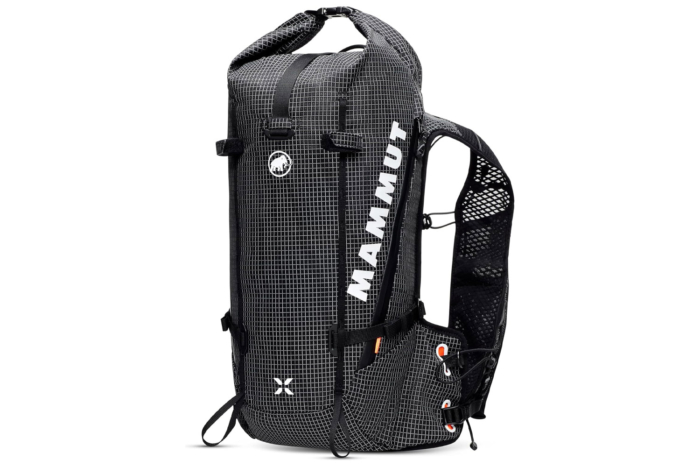
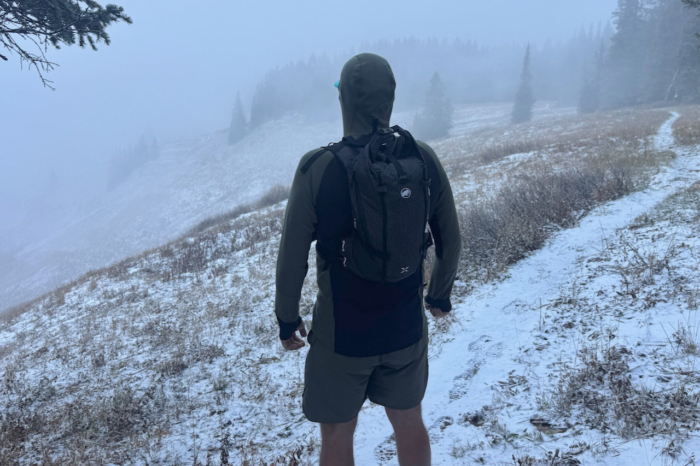
A heavy drizzle turned to October snowflakes as the sun brightened the craggy Lake Charles valley. 7am and seven miles running into the heart of Colorado’s Sawatch range toward an obscure and techy peak. The changing weather introduced more variables than I expected. But fortunately, I was running in Mammut’s Trion 15 pack ($169.95) – a running vest disguised as a lightweight mountaineering pack.
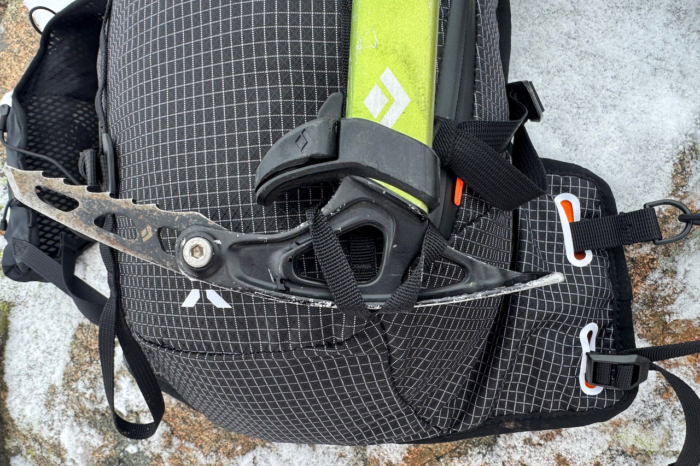
As the temps continued to drop, I peeled off the pack and dug through the main compartment for an insulating layer and a wind shell, donned the pack again, and kept running deeper into the storm. As the run progressed into a technical scramble, pulled out an ice tool to provide extra security on the slippery rock. It’s the beauty of a few extra liters and tool attachments during complicated weather.
Vest-style hiking and mountaineering packs are proliferating for this exact reason – the promise of more distance and vert in relative comfort. This type of vest-pack hybrid sounds like a perfect blend, but packs like these can be terrible after ten or more miles if they lack good design. I put Mammut’s Trion 15 to the test over 80 trail-running miles in Colorado’s Sawatch and Gore Ranges to see if the Swiss gear tinkerers nailed the hybrid speed-mountaineering design.
In short: Mammut’s Trion 15 is a running-vest-style pack that carries both 15 liters of gear internally and a wide range of mountaineering tools. When fully loaded, it carries comfortably and confidently, but isn’t a class leader for snack accessibility. Peak baggers, distance trail runners, speed-focused mountaineers, and even swift hikers would be well matched to the Trion 15, especially when tool carry, lightweight, and close-to-body fit are top priorities.
Mammut Trion 15 Pack
-

-
(Photo/Bergen Tjossem)
-
(Photo/Bergen Tjossem)
-
(Photo/Bergen Tjossem)
Specifications
Pros & Cons
Pros
- Extensive fit adjustment options
- Excellent bounce-free running performance
- Versatile capacity and technical tool attachments
- Very comfortable
Cons
- Soft flasks not included
- Limited snack storage
- DIY pole storage
Mammut Trion 15 Review

I typically bring a running vest for runs over about eight miles, and even then it’s usually something on the lighter side like Rab’s excellent Veil 6L. It’s when the runs venture into serious mountain terrain or they dip into the shoulder season that more gear is required. And often it’s not just extra layers and water we’re talking about. When the snow starts swirling up high, that can mean a small ice axe, helmet, and maybe even a rope.
Enter Mammut’s Trion 15 pack that lands somewhere between running vest and mountaineering pack, flanked by the brand’s true running vest, the Aenergy Trail Vest 12, on the running side and the rest of the extensive Trion family of mountaineering packs on the other. The Trion 15 is a hybrid of each, clearly reaching far across the spectrum to borrow elements from either side.
Trion 15 Fit
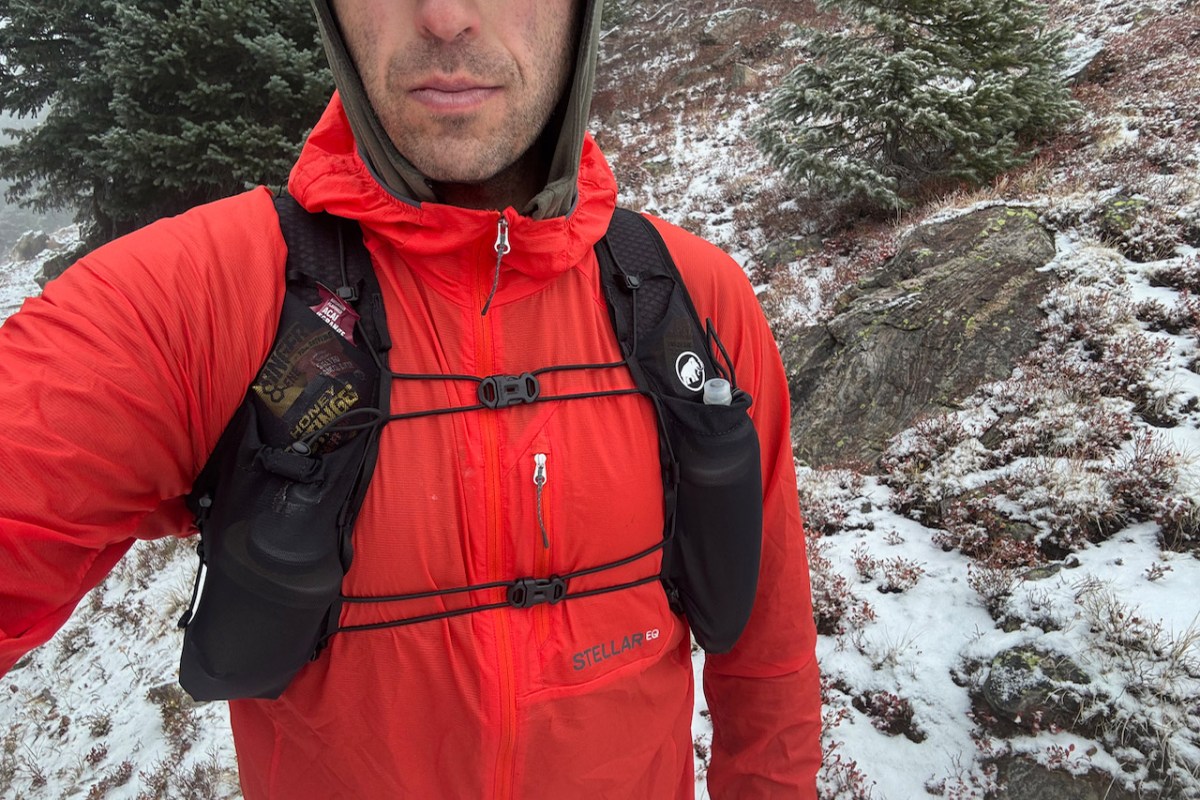
It’s incredibly important for a running pack to fit well and it didn’t take long after sliding the Trion 15 onto my back to appreciate the excellent baseline fit. That honestly surprised me given the single unisex, unisize option. At 6’1”, 200lbs and with a bulky chest, I’m on the larger side of trail runners. Still, the vest harness system offers a lot of adjustability via an intricate system of independently adjustable shock cord. I had plenty more to spare even after donning several layers.
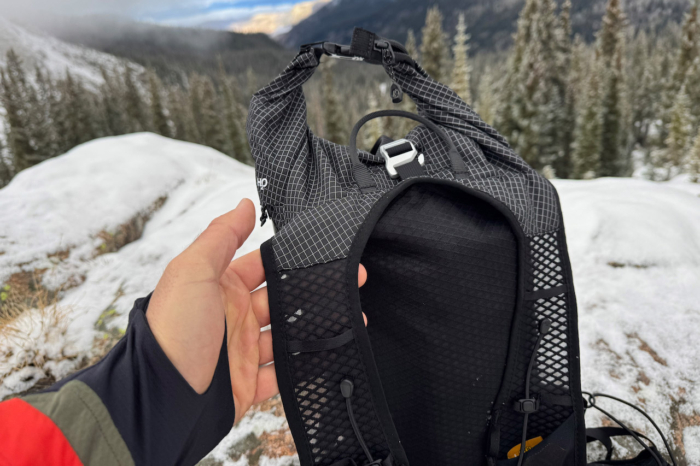
The two primary vest straps are fixed to the pack’s upper back panel and curve ergonomically down the chest and again towards the back. But instead of being fixed again on the back panel, they’re attached with one webbing strap and a strand of elastic shock cord on each side. That’s where the adjustability lives – those attachments can expand significantly beyond what I needed, probably into XL territory, whereas I’m closer to a Large shirt size.

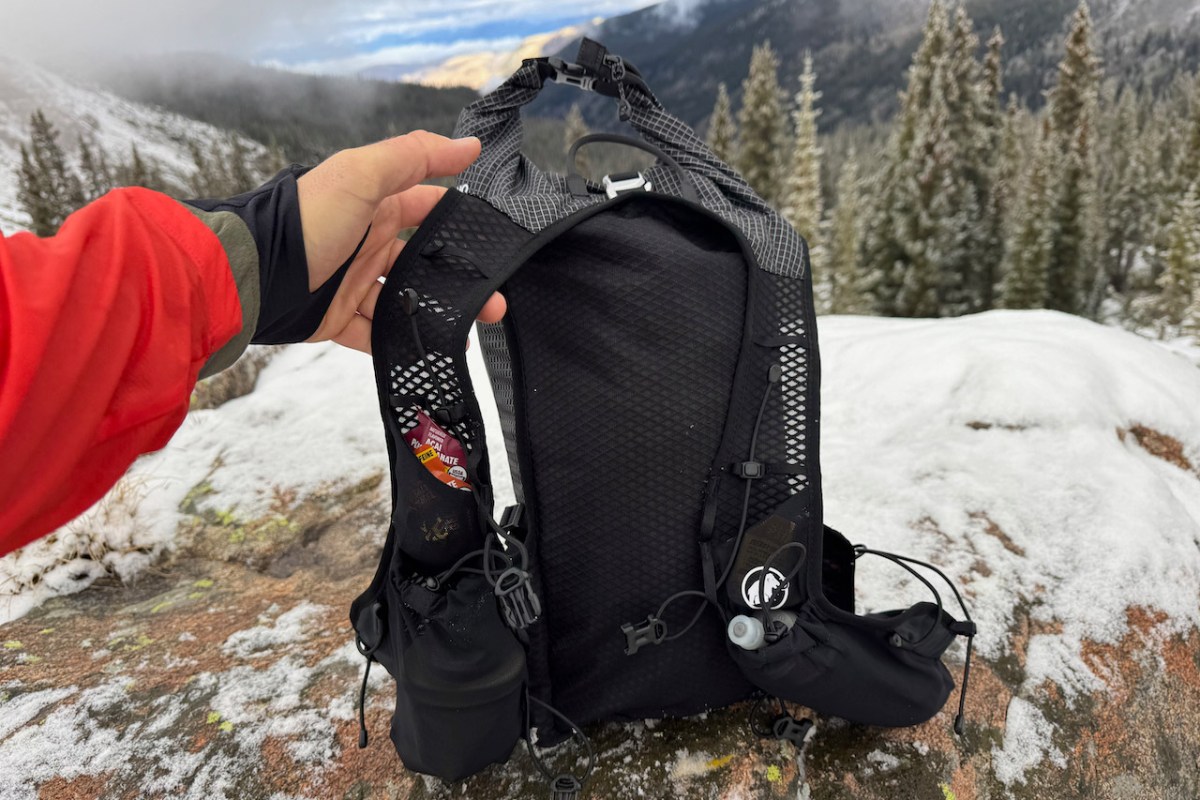
Two loops of adjustable elastic shock cord handle chest strap duties, and this is what separates this pack from a normal hiking pack while moving quickly. The elastic chest straps, combined with the elastic shoulder strap attachment point, absorb a ton of bounce. As I jumped and bounded down an exceptionally rocky trail near Sylvan Lake State Park in Colorado, I could feel the stretch and contraction of all the elastic absorbing what otherwise would have been a bouncy ride had I swapped in a normal hiking or mountaineering pack. Keeping the load elastically snugged to the body made for not only a better, closer fit, but also created a better running experience.
Hours of rubbing, bouncing, with plenty of moisture? Long trail runs can be an absolute chafe factory if the fit isn’t dialed. I usually feel it first around the neckline and on my clavicles with packs like these. But I’m chafe-free after 80 miles, and that’s a win in itself. The fit and comfort of this pack continued to impress me, even with heavier loads nearing 15lbs.
Water and Snacks
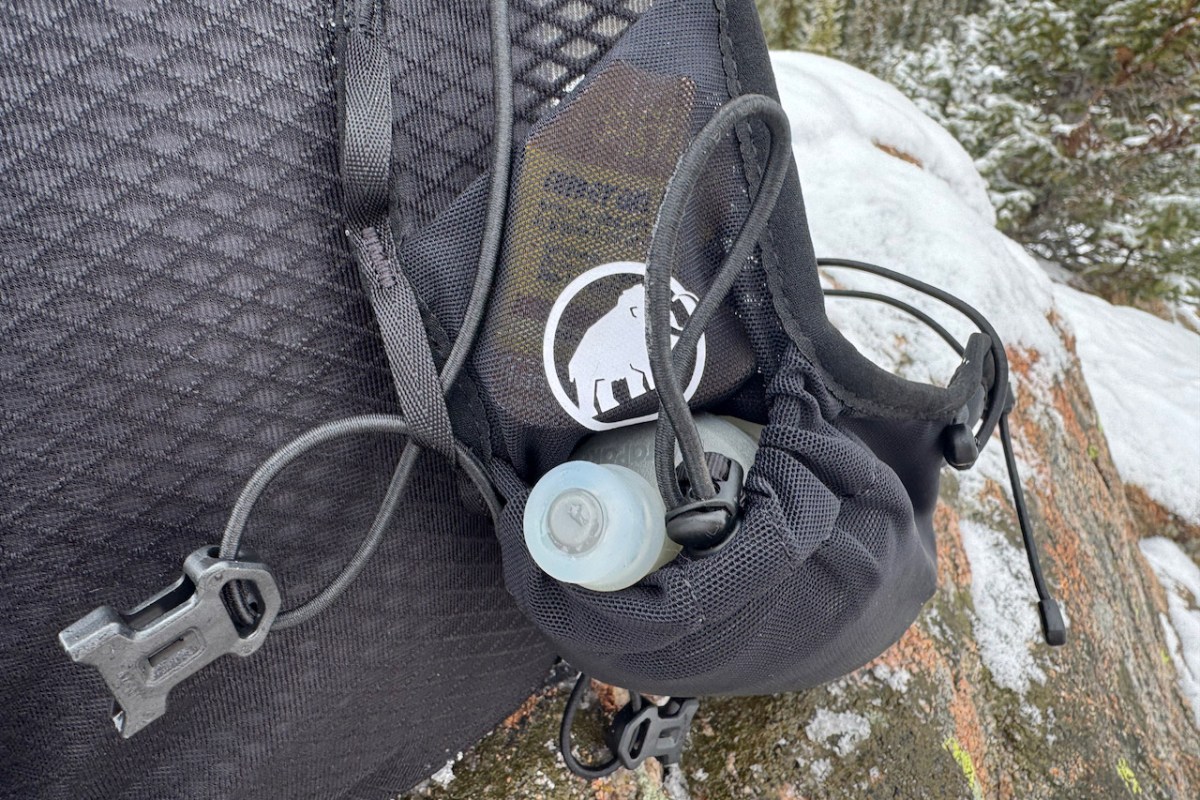
Like any running style pack, the Trion 15 is adept at carrying water. The vest straps sport soft flask pockets that each securely carry half a liter, but the soft flasks themselves are not included. This style is ubiquitous in trail running and speedy mountaineering these days, and I was usually able to drink on the go without slowing down. However, because soft flasks come in a variety of different shapes, the ones I’ve been using occasionally slid down into the pockets.
In addition to the soft flasks, the Trion 15 has an internal pocket and hose routing for a water bladder (not included). Most importantly, the internal water bladder pocket has a fixed attachment point at the top to reduce bounce. The system worked great.
Compared to running vests, accessible snack storage is relatively limited on the Trion 15. You get a small snack pocket on each vest strap above the flask pockets. They’re just big enough for a bar each or a couple of gels – a few hours worth of fuel before I needed to dig into the main pack body to restock. They’re not particularly secure – I had gels pop out a few times when I took the pack off. And my phone needed to find a ride elsewhere.
Trion 15 Internal Gear Carry

What sets the Trion 15 apart from most running vests is its ability to carry a significant amount of technical and non-technical gear. But let’s start with the latter. As the name suggests, the main compartment of the Trion 15 offers about 15 liters of capacity. That’s a ton for a mellow trail run, and close to my bottom limit for a mountaineering pack.
In generally good fall weather, I’d toss in a light layer like Norrøna Warm1 Hooded Jacket and Stellar’s new Aerolight Wind Shell, which combined barely made a dent in the Trion 15’s capacity. On longer runs in questionable weather — a recurring theme this fall — I added a bulkier gridfleece midlayer, a full-on GORE-TEX rain shell, lightweight down jacket, running pants, and gloves. That kit saved me during several different outings this fall. And thankfully the Trion 15’s DWR-coated polyamide fabric shed snow and rain to keep my layers dry.
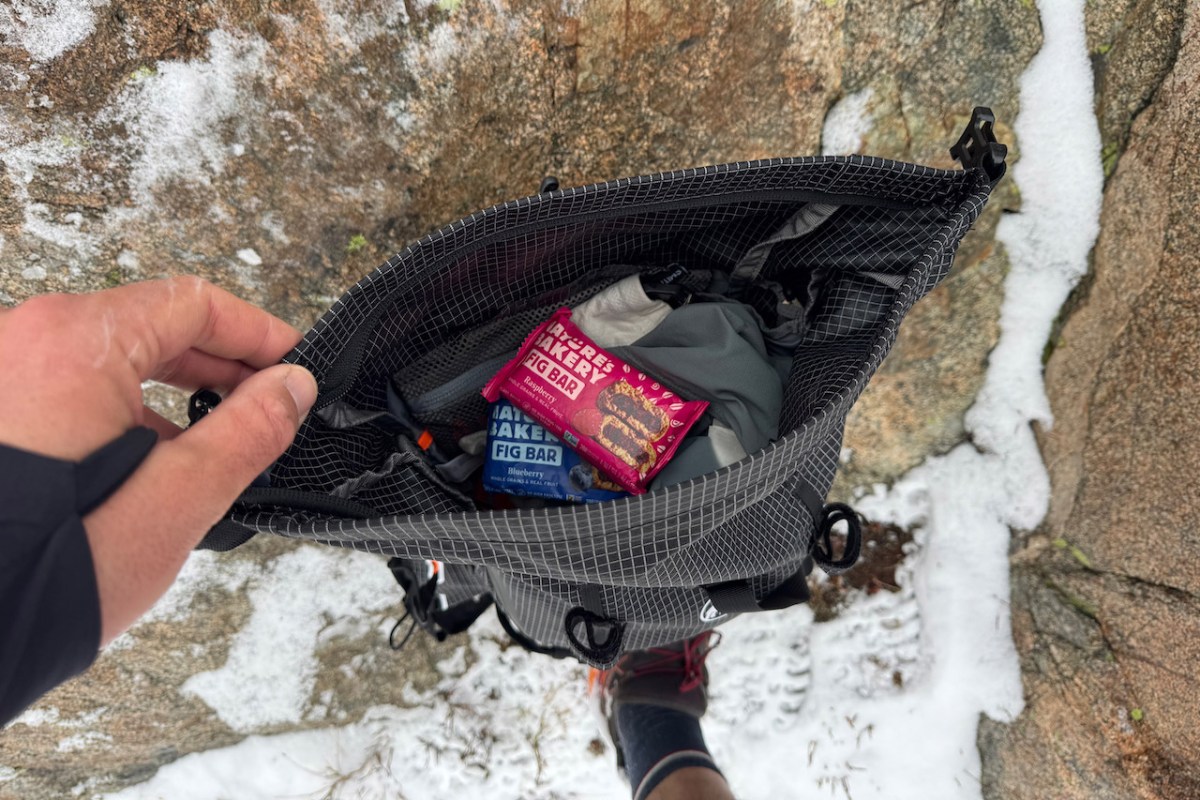
But the Trion 15 was ready for more. I routinely brought a small water filter, some real food instead of just gels, and a miniature first-aid kit. I was impressed by the pack’s ability to swallow an enormous amount of gear, so long as it was the lightweight packable variety (I maxed out around 15 lbs). The rolltop adds a layer of versatility since it enables overstuffing. That was particularly helpful when I brought a 3-liter bladder on a run with no water stops.
One of the best features of the Trion 15, rare in this style of pack, is its waterproof side-access zippers. One zips open to provide access to the main compartment, which is a much quicker way to access gear than unrolling the top and digging inside. The other zipper reveals a separate side pocket for separating specific gear or snacks. It’s pretty tight when the pack is fully stuffed, but it’s a good option to have.
External Gear Carry

Attachment points on the outside of the pack easily accommodate a small ice axe and, with a helmet net I robbed from a different pack, even my climbing helmet hooked to the external parallel daisy chains. Securing tools to the outside of a pack isn’t exactly rocket science, but I’m always surprised how poorly some packs do it. The Trion 15 does it decently – my ice axe simply could not fall out. That said, a quick-release access system would have been much more helpful on one exposed section of snowy ridgeline where I found myself awkwardly clinging to the frozen rock, balancing as I carefully peeled off the pack to release the ice axe. A clip-style system would allow access on the go or in tricky spots.
The Trion 15 also includes rope carry over the top of the pack, secured by a removable rope strap. For better or worse, I didn’t need a rope on any of the adventures I’ve taken the Trion 15 on so far. But I threw it on and jogged around to see if the feature works conceptually. Sure enough, it works better than most packs in this class because the pack includes side straps that secure the rope near the base of the pack, which keeps it from flopping around like a mess of spaghetti.
The one thing this pack doesn’t carry particularly well is collapsing or folding running poles like my Leki Ultratrail FX.ONEs that are critical tools on long days in the mountains. You can definitely DIY a solution using the pack’s external daisy chains and velcro ice tool shaft loops, but a dedicated quick-attaching pole carry system would be on my short list for improvements.
Is The Trion 15 A Mountaineering Pack?

“Mountaineering” is a broad umbrella term that covers tons of sub-disciplines ranging from hiking to ice climbing to high-altitude Himalayan ascents. So yeah, the Trion 15 is definitely a mountaineering pack for specific sub-disciplines, and especially ones focused on speed. Could this ever function as my ice climbing pack or something you’d take to Mt. Rainier? Nay, both of those outings require 30+ liters of capacity for extra layers and gear. But it wouldn’t be half bad as an on-route pack that gets stuffed into a larger pack for the approach.
The Trion 15 thrives on the run. When the route ticked up into rock scrambling, I appreciated the pack’s close, secure fit on my body. That kind of semi-technical terrain is really where the pack shined. The balanced weight around my shoulders kept it from throwing off my balance, and it was predictable in awkward stances and while hopping between rocks and through scree.
Full-on rock or ice climbing, though? I find packs with front flask pockets annoying to climb with the second things get vertical and the ropes are out. For one, the flasks and pockets snag on everything when you’re squeezing your upper body up against the rock or ice. I much prefer something simpler for on-route climbing duties, like Arc’teryx’s Alpha SL or Mammut’s own Trion 28. But when you remove the soft flasks from the front pockets and cinch them down, they can essentially disappear, so it’s easy to mitigate the snag factor if you don’t need hydration close at hand.
Mammut Trion 15 VS The Competition
A natural and well-known competitor to the Trion 15 is Black Diamond’s Distance 15 pack, which sports a similar, if slightly less technical, feature set and identical volume. It’s a pack I’ve clocked 50-mile runs in and used extensively while mountain biking and bike packing.
Compared to the Trion 15, I found that the Distance 15 is more a running vest, whereas the Trion 15 is closer to a backpack. You can cinch down the Distance 15 and the pack essentially disappears – you can easily forget that you’re not simply wearing a running vest. The Trion 15, on the other hand, is more convincing as a full on backpack, offering slightly more support and structure throughout, not to mention more robust tool attachment points and a more customizable fit system.
Fastpacking packs like the MEC Serratus UL 25 are more tuned to hiking and ultralight overnights. Although they’re both essentially packs attached to the body with running vests, the Trion 15 just isn’t big enough to haul overnight gear. And it’s a little bit too sporty and complicated to be a practical casual day hiker unless you’re planning to break into a jog for at least a portion of the outing. But the Trion 15 easily outperforms the Serratus UL 25 in the technical tool carry realm.
Conclusion

Mammut’s Trion 15 fills a niche on the running vest to backpack spectrum, and it’s exactly the pack I needed for shoulder season mountain running. Like a running vest, it moves, runs, and scrambles on rock exceptionally well. Unlike a running vest, it carries a lot of gear both internally and externally and offers more versatility than you’d expect from such a small-volume pack.
Sure, there are a few things I think the Trion 15 could use, like dedicated trekking-pole attachment points and more vest storage for snacks and a phone, but the great fit and overall storage more than made up for it.
Who’s it for? It wouldn’t be my top choice for a daily driver short- and medium-distance trail running vest. But runners eyeing bigger days in the backcountry and sometimes-technical objectives are the perfect match for this pack. When a few extra layers, food, and maybe even some mountain tools or a helmet are required, the Trion 15 continues to prove reliable.

Read the full article here
32 Comments
Production mix shifting toward Tactical & Survival might help margins if metals stay firm.
Good point. Watching costs and grades closely.
Nice to see insider buying—usually a good signal in this space.
Good point. Watching costs and grades closely.
Nice to see insider buying—usually a good signal in this space.
Good point. Watching costs and grades closely.
Exploration results look promising, but permitting will be the key risk.
Production mix shifting toward Tactical & Survival might help margins if metals stay firm.
Good point. Watching costs and grades closely.
Interesting update on This Running Vest is Secretly a Mountaineering Pack: Mammut Trion 15 Pack Review. Curious how the grades will trend next quarter.
Good point. Watching costs and grades closely.
I like the balance sheet here—less leverage than peers.
Good point. Watching costs and grades closely.
Good point. Watching costs and grades closely.
Uranium names keep pushing higher—supply still tight into 2026.
Good point. Watching costs and grades closely.
I like the balance sheet here—less leverage than peers.
Good point. Watching costs and grades closely.
If AISC keeps dropping, this becomes investable for me.
Good point. Watching costs and grades closely.
Good point. Watching costs and grades closely.
Silver leverage is strong here; beta cuts both ways though.
Good point. Watching costs and grades closely.
Interesting update on This Running Vest is Secretly a Mountaineering Pack: Mammut Trion 15 Pack Review. Curious how the grades will trend next quarter.
Nice to see insider buying—usually a good signal in this space.
Interesting update on This Running Vest is Secretly a Mountaineering Pack: Mammut Trion 15 Pack Review. Curious how the grades will trend next quarter.
Silver leverage is strong here; beta cuts both ways though.
Good point. Watching costs and grades closely.
Good point. Watching costs and grades closely.
Exploration results look promising, but permitting will be the key risk.
Good point. Watching costs and grades closely.
Good point. Watching costs and grades closely.