

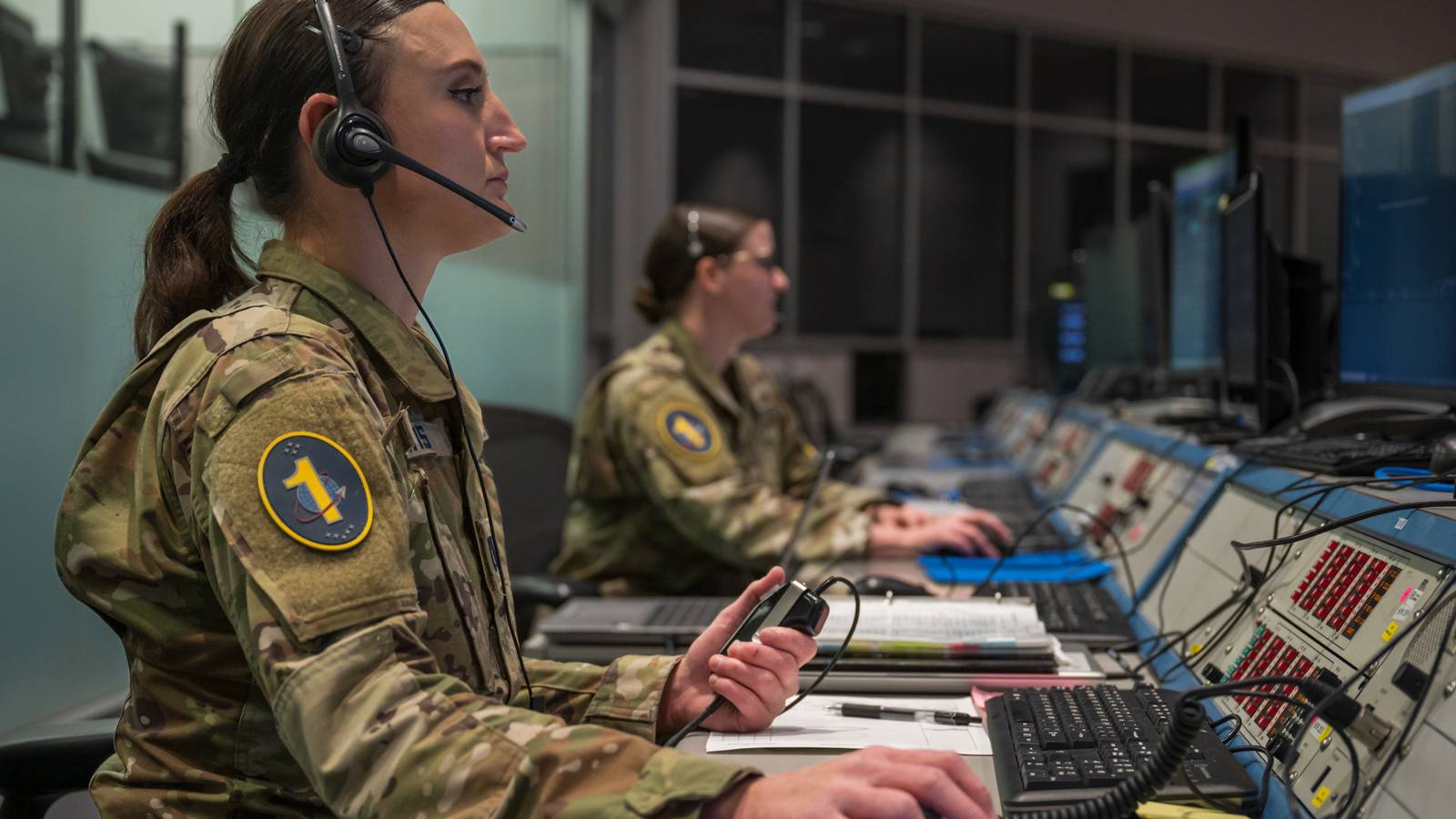
The Space Force has spent the past two years pushing artificial intelligence past pilot programs and into daily use, from launch control rooms to satellite operations centers. Some of it comes down from the Pentagon as enterprise-wide software; some of it is built by individual units solving staffing problems they’re living with day to day. Here are six ways AI is already up and running inside the Space Force.
The 1st Range Operations Squadron at Patrick Space Force Base, Florida, built two AI tools to keep pace with a launch schedule that grew from 19 launches in 2019 to more than 90 in 2024 without a matching increase in staff, according to the squadron’s account published by the Space Force.
The first, called Kinetic, is a chatbot integrated into the secure messaging platform Mattermost that pulls instant answers from a curated mission database so crew members can get launch-related information on or off console. The second, Echo, transcribes voice network communications during a launch in real time and generates AI-written summaries, cutting down the manual work of building crew logs and post-launch reports. “These tools enable us to do more with less, reducing stress and improving overall effectiveness,” said 2nd Lt. Ryan Hummel, the squadron’s range operations commander.
2. Guardians Testing AI-Recommended Combat Decisions Alongside the Air Force
Space Force guardians took part for the first time in a Shadow Operations Center-Nellis battle management experiment in mid-2026, working alongside Air Force airmen to test AI software built by six industry teams, according to DefenseScoop. The software was split into three linked tools: one that identified and categorized incoming battlefield entities, one that matched available military capabilities to the situation, and one that generated multiple optimized courses of action for a commander to choose from, all stitched together through an orchestration tool built by the Air Force Research Laboratory.
Capt. Adam Sochia, who took part in the experiment, said the tools let his team handle far more workload in the same amount of time: “In the amount of time that we can do one tasking, this tool gives us the data and accurate options to complete five or more additional taskings.”
Related: Space Force Is Building New Software to Track Satellites Faster, Even if the Data Isn’t Perfect
3. A Push Toward One Guardian Controlling Multiple Satellites at Once
The Space Force’s Rapid Capabilities Office is acquiring software under a program called Rapid and Resilient Command and Control, testing automated satellite operations on orbiting test satellites, according to Air & Space Forces Magazine. The goal is moving away from the traditional model of one operator per satellite toward a single, AI-aided operator overseeing several spacecraft at once. Officials have been candid that the shift is incremental: How much of that work can be safely automated, and how much trust to place in the software before expanding its role, is still being worked out.
4. Catching Satellite Problems Onboard Instead of on the Ground
Space Force officials are also looking at moving anomaly detection, the process of flagging when a satellite or sensor is behaving abnormally, off ground-based systems and onto the spacecraft, according to Air & Space Forces Magazine’s reporting on comments from Nate Hamet, CEO of the space software company Quindar. The idea is to process imagery, signals intelligence and orbital tracking data at the edge, on board the satellite, rather than waiting for all of it to be downlinked and analyzed on Earth, given the sheer volume of data modern sensors produce.
5. A DoD-Wide AI Portal Replacing the Air Force’s Original Chatbot
Guardians now have access to genAI.mil, the Department of War’s enterprise generative AI portal that formally launched Dec. 9, 2025, and replaced NIPRGPT, the Air Force Research Laboratory chatbot that both airmen and Guardians had used since June 2024, according to Air & Space Forces Magazine and DefenseScoop.
NIPRGPT was used by roughly 700,000 personnel across the Defense Department before it was retired Dec. 31, 2025. GenAI.mil launched with Google’s Gemini and has since added OpenAI’s ChatGPT Mil and Starshield AI’s Grok for Government, all cleared to handle sensitive unclassified data. The portal is built for document-heavy work: drafting reports, filling out travel and contracting paperwork, and other back-office functions that officials say let operators spend less time on paperwork and more time on their core mission.
Related: 1.2M US Troops, Pentagon Civilians Are Using GenAI.Mil — What That Is, What It Means
6. Annual Competition Turning Guardians Into AI Builders
The Space Force ran its first Generative AI Challenge in 2024, an eight-week program that drew more than 350 participants from the Space Force, Air Force, Army, Marine Corps, the National Reconnaissance Office, DARPA and U.S. Cyber Command, according to the Space Force’s account of the event.
One finalist team from the U.S. Air Forces in Europe-Air Forces Africa command built a secure translation tool covering NATO’s 28 languages and 32 dialects, projected to save roughly $100,000 per squadron by cutting down on individual linguist translation work. A second annual challenge opened registration in mid-2025 and ran through an awards ceremony at the Space Power Conference in Orlando that December. “This experience is designed to support innovation and encourage Guardians to leverage disruptive solutions like AI to gain advantage over the pacing threat,” said Col. Nathan Iven, acting deputy chief of Space Operations for Cyber and Data.
Interested in Joining the Military?
We can put you in touch with recruiters from the different military branches. Learn about the benefits of serving your country, paying for school, military career paths, and more: sign up now and hear from a recruiter near you.
Read the full article here
26 Comments
Exploration results look promising, but permitting will be the key risk.
Good point. Watching costs and grades closely.
Good point. Watching costs and grades closely.
The cost guidance is better than expected. If they deliver, the stock could rerate.
Good point. Watching costs and grades closely.
Good point. Watching costs and grades closely.
Production mix shifting toward USA might help margins if metals stay firm.
Good point. Watching costs and grades closely.
Production mix shifting toward USA might help margins if metals stay firm.
Good point. Watching costs and grades closely.
Good point. Watching costs and grades closely.
Uranium names keep pushing higher—supply still tight into 2026.
Uranium names keep pushing higher—supply still tight into 2026.
Good point. Watching costs and grades closely.
Interesting update on 6 Ways the Service Is Implementing New Tools. Curious how the grades will trend next quarter.
Good point. Watching costs and grades closely.
Exploration results look promising, but permitting will be the key risk.
The cost guidance is better than expected. If they deliver, the stock could rerate.
Good point. Watching costs and grades closely.
Good point. Watching costs and grades closely.
Interesting update on 6 Ways the Service Is Implementing New Tools. Curious how the grades will trend next quarter.
Good point. Watching costs and grades closely.
Interesting update on 6 Ways the Service Is Implementing New Tools. Curious how the grades will trend next quarter.
Good point. Watching costs and grades closely.
Good point. Watching costs and grades closely.
Exploration results look promising, but permitting will be the key risk.