

The 250th birthday of the United States is also a reflection of the nation’s global diplomacy, notably its long and friendly relationship with ally France. Both are coming together this weekend to honor American veterans.
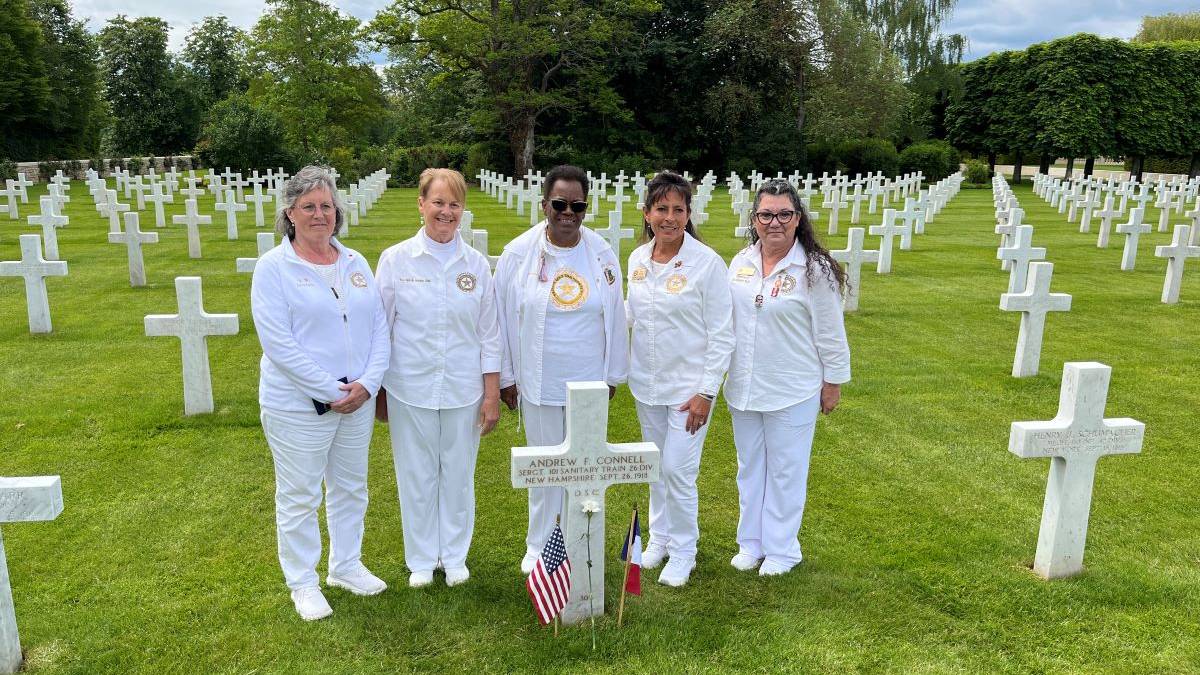
At 11 a.m. ET this Sunday, July 5, at Arlington National Cemetery representatives from both nations, including U.S. Gold Star Mothers who have lost children in recent conflicts, will mark 250 years of shared commitment to liberty by dedicating a restored World War I monument. Gold Star Mothers will place into the memorial “sacred soil” they gathered this past May from French and Belgian World War I battlefields.
The original marker was created in 1929 by French artist and WWI veteran Gaston Beblaize and gifted by French veterans in memory of the Americans who fought and died to defend France during “The War to End All Wars.” Beblaize’s first designed marker—a small ceramic piece of modest dimensions (13x5x3.5 cm)—was inspired by mileage stones he and his comrades reportedly encountered while marching along the roads.
The ceremony will include Gold Star Mothers from Virginia, New Mexico, California, Kansas and New York, as well as representatives from the American Battle Monuments Commission (ABMC), American Battle Monuments Foundation, Army National Military Cemeteries, United War Veterans Council, Souvenir Francais USA, the Friends of Renée and Gaston Deblaize, and the French Embassy.
“The American Battle Monuments Commission is honored to be a part of restoring this marker, originally placed at Arlington National Cemetery by the French in honor of America’s World War I fallen,” Robert Dalessandro, acting secretary of the ABMC, told Military.com. “It was born from remembrance. It carried within it soil from battlefields where American service members fought, sacrificed and died on French ground.
“It was a gesture from France to the United States: a recognition that the earth of those battlefields had become sacred because of the lives given there.”
From May 10 to 17, Gold Star Mothers were matched with a service member whose mother couldn’t participate in the original pilgrimage, marking the first time in more than 100 years they had been visited by a mom. The mothers, according to the AMBC, “introduced” their children to the fallen WWI service members.
“The grief and sacrifice of these mothers are identifiable human intangibles,” Eric McKenzie, superintendent at Flanders Field American Cemetery, said in a statement in May. “Their presence today at our site is relevant to anyone who witnesses their stories.”
History Behind the Markers
The markers’ purpose was to provide a tangible form of remembrance to families of soldiers who died on the field of honor, “those whose graves are made of wounded earth,” according to the U.S. embassy and France consulate.
Seven large Sacred Soil Markers were created in the late 1920s and early 1930s, with the only one placed outside France being presented to the Arlington National Cemetery in 1929. But that memorial was destroyed in 1938, leading to this new effort coinciding with the 250th U.S. birthday and longstanding U.S.-France relationship.
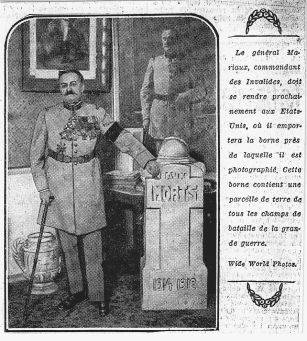
Beblaize, when designing the marker, added a French Adrian-style helmet on top and inside placed soil collected from the battlefield at Verdun. After laying the seed to the “Sacred Soil Marker,” he produced a series of the same model—each containing soil from a dozen battlefields: the Aisne, Alsace, the Argonne, Artois, Champagne, French Flanders, Lorraine, the Marne, the Somme, Belgium, the Yser, and Verdun.
“That soil is more than earth,” Dalessandro said. “It is a physical connection between battlefield and cemetery, between Europe and America, between the fallen and the living. It is a reminder that sacrifice has geography—but remembrance has no borders.”
Those markers were then sold “In Memory of the Dead of the Great War – To the Mutilated – To the Combatants.” Deblaize donated the copyright to the union of the wounded of the face and head, commonly known as the Gueules Cassées, or “Broken Faces.” Proceeds from the sales of the markers benefited soldiers needing facial reconstruction surgeries.
The box containing each memorial stone was accompanied by a certificate from the so-called Broken Faces and sealed with the mark of the association. On July 27, 1927, Gaston Deblaize and Albert Jugon, secretary general of the Broken Faces, presented French President Gaston Doumergue with a bronze version of the marker that contained soil from the legendary Trench of Bayonets near Verdun.
The history behind the markers is one piece of a long and delicate emotional weave involving countless individuals. That, of course, includes Gold Star Mothers who have lost their loved ones and remain committed to honoring their memory.
Ceremonies like these, being conducted in arenas where patriotism is abundant, are an emotional nod to the past and future.
“To our Gold Star Mothers: your presence gives this restoration its deepest meaning,” Dalessandro said. “You remind us that military service is never borne by the service member alone. Families serve. Families wait. Families grieve. And families carry forward the stories of those they love.
“By gathering this sacred soil, you have linked your children’s legacies with the legacy of Americans who served generations before them. You have shown that remembrance is not passive. It is an act of love, an act of courage, and an act of national responsibility.”
Read the full article here
37 Comments
Silver leverage is strong here; beta cuts both ways though.
Uranium names keep pushing higher—supply still tight into 2026.
If AISC keeps dropping, this becomes investable for me.
Silver leverage is strong here; beta cuts both ways though.
Good point. Watching costs and grades closely.
The cost guidance is better than expected. If they deliver, the stock could rerate.
Exploration results look promising, but permitting will be the key risk.
Good point. Watching costs and grades closely.
Good point. Watching costs and grades closely.
Production mix shifting toward USA might help margins if metals stay firm.
Good point. Watching costs and grades closely.
Good point. Watching costs and grades closely.
Silver leverage is strong here; beta cuts both ways though.
Good point. Watching costs and grades closely.
Good point. Watching costs and grades closely.
I like the balance sheet here—less leverage than peers.
If AISC keeps dropping, this becomes investable for me.
If AISC keeps dropping, this becomes investable for me.
Uranium names keep pushing higher—supply still tight into 2026.
Good point. Watching costs and grades closely.
Nice to see insider buying—usually a good signal in this space.
Good point. Watching costs and grades closely.
Good point. Watching costs and grades closely.
The cost guidance is better than expected. If they deliver, the stock could rerate.
Good point. Watching costs and grades closely.
Good point. Watching costs and grades closely.
Exploration results look promising, but permitting will be the key risk.
Good point. Watching costs and grades closely.
Silver leverage is strong here; beta cuts both ways though.
Good point. Watching costs and grades closely.
If AISC keeps dropping, this becomes investable for me.
Good point. Watching costs and grades closely.
Interesting update on 97-Year-Old WWI ‘Sacred Soil’ Marker at Arlington Gets Full Restoration. Curious how the grades will trend next quarter.
I like the balance sheet here—less leverage than peers.
Production mix shifting toward USA might help margins if metals stay firm.
Good point. Watching costs and grades closely.
Good point. Watching costs and grades closely.