

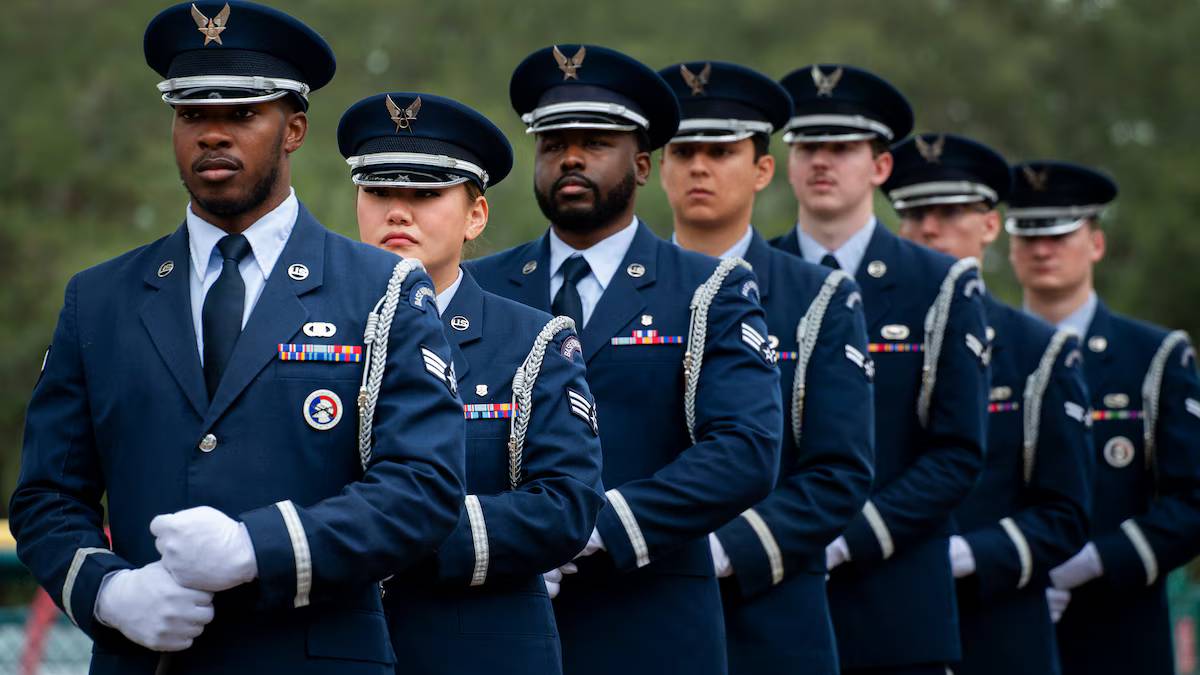
Air Force officers are entrusted with critical responsibilities that drive innovation, strategic planning and mission success around the world.
There are three roads that lead to a commissioned officer in the Air Force and those coveted gold bars: There are three roads that lead to a commissioned officer in the Air Force and those coveted gold bars: the U.S. Air Force Academy (USAFA), Air Force Reserve Officers’ Training Corps (ROTC), and Officer Training School (OTS).
If you are a college graduate, OTS is the path you will take. You may ask, what does it take to get selected? How competitive is the selection process? How can I increase my chances of getting into OTS?
Those are great questions, and they are ones I asked when I was a Staff Sergeant in the Air Force who had just completed my bachelor’s degree and had dreams of turning my stripes into gold bars.
In this article, I will try to put you in my shoes as I navigate the OTS application and selection process. This is my guide to getting selected for OTS.
Disclaimer: There are several factors that make up the OTS selection process, and even though I successfully made it through the selection and commissioning process, I cannot guarantee that information in this article will work for you.
Path to an Air Force Commission
There are three paths to becoming an officer in the Air Force. Depending on your education and experience, your best option may vary.
Academy, ROTC, and OTS At-A-Glance
|
U.S. Air Force Academy (USAFA) |
Air Force ROTC (AFROTC) |
Officer Training School (OTS) |
|
|---|---|---|---|
|
Applicant Pool |
High school seniors or recent graduates |
Incoming or current college students |
College graduates & prior-service enlisted |
|
Program Length |
4 years |
2 to 4 years |
8.5 weeks |
|
Location |
Colorado Springs, CO |
1,100+ participating colleges and universities |
Maxwell Air Force Base, AL |
|
Funding |
Fully funded |
Competitive scholarships available |
Paid as an active-duty trainee |
|
Age Requirement |
Must not reach 23rd birthday by July 1 of entry year |
Must commission before age 39 |
Must complete OTS before 42nd birthday |
|
Commission Earned |
Second Lieutenant |
Second Lieutenant |
Second Lieutenant |
Requirements to Apply for OTS
You need a four-year college degree in order to be eligible to begin OTS. In addition to earning your degree, you will need to take the Air Force Officer Qualifying Test (AFOQT) and pass a physical and mental health screening exam.
College Degree and GPA
While there are no specific college degree or GPA requirements to be considered for OTS, higher GPAs and technical degrees, particularly Science, Technology, Engineering, and Mathematics (STEM) degrees, are more desirable, and may increase your chances of being selected.
Note: When I applied to OTS, I had a Bachelor’s Degree in Occupational Education with a concentration in business, and a 3.10 GPA.
Medical Examination
Before your application can be forwarded to the OTS selection board, you must have a comprehensive medical examination and mental health screening. You will work through either the Military Entrance Processing Station (MEPS), if you are a civilian, or your base military medical facility if you are currently in the military.
What the OTS Selection Board Weighs
Once you have submitted your application, your records will be screened by a selection board that will review your application, medical exam results, education, AFOQT, and other factors.
Selection boards generally meet quarterly, though exact dates shift each fiscal year and depend on whether you are applying for a rated (pilot, combat systems officer, air battle manager, remotely piloted aircraft pilot) or non-rated board.
The OTS selection board is made up of senior officers who review and score your record. The board evaluates your application using the Air Force’s whole-person concept, considering:
- Aptitude: This includes your academic discipline, GPA, and academic awards, and AFOQT score.
- Leadership: The board will review your employment history, military experience, and job performance, and Personal Character Letters of Recommendation (LOR). Current military members will go through the commander’s Structured Interview Process (SIP).
- Potential: Board members review and evaluate your potential using your application, interview, and letters of recommendation.
Pro Tip: Contact your officer recruiter for information on upcoming boards.
Board & Leadership Interviews
Most OTS application pathways require a formal interview conducted by a board of officers. The interview assesses communication skills, judgment, and motivation. You may be asked about leadership challenges you have faced, how you respond to failure, and what you understand about the demands of the Air Force.
I had to sit through an interview with my current group commander (a Colonel). Some of the questions were:
- Tell me a little about yourself and why you want to be an Air Force officer?
- What are your long-term career goals?
- How would you describe your leadership style, and describe a time you led a team or project, focusing on collaboration and the final outcome.
- What are your strengths and weaknesses?
- How do you handle stress and conflict?
Of course, it is impossible to predict what questions you may be asked, but the best approach is to be open and honest with your interviewer
Air Force Officer Qualifying Test (AFOQT)
To be commissioned as an Air Force officer, you must pass the Air Force Officer Qualifying Test (AFOQT). The AFOQT is a standardized test that covers verbal and math skills, plus specific fields of interest, and is used to select applicants for Air Force commissioning programs. It evaluates your academic aptitude and skills necessary to be an officer.
Your officer recruiter will schedule the AFOQT for you. You may take it at the nearest MEPS location. If you are currently on active duty, contact your base education office. The test takes about 3 hours and 30 minutes. You can only take it twice, so study carefully.
AFOQT Subtests and Composites
The AFOQT consists of 12 subtests. Subtest scores are combined to generate one or more of five composite scores used to help predict success in certain types of Air Force training programs: Pilot, Navigator-Technical, Academic Aptitude, Verbal, and Quantitative.
|
Subtest |
No. of Items |
Pilot |
Navigator -Technical |
Academic Aptitude |
Verbal |
Quantitative |
|---|---|---|---|---|---|---|
|
Verbal Analogies |
25 |
x |
x |
x |
||
|
Arithmetic Reasoning |
25 |
x |
x |
x |
x |
|
|
Word Knowledge |
25 |
x |
x |
|||
|
Math Knowledge |
25 |
x |
x |
x |
x |
|
|
Instrument Comprehension |
20 |
x |
||||
|
Block Counting |
20 |
x |
||||
|
Table Reading |
40 |
x |
x |
|||
|
Aviation Information |
20 |
x |
||||
|
General Science |
20 |
x |
||||
|
Rotated Blocks |
15 |
|||||
|
Hidden Figures |
15 |
Minimum Required AFOQT Scores
- Verbal Composite: 15
- Quantitative Composite: 10
- Pilot Composite: 25
- Academic Aptitude Composite: No minimum required score.
Test-Day & Time Management Strategies
Here are some general tips for taking the AFOQT:
- Eat a high-protein, low-carb breakfast.
- Arrive early and relax.
- Read each question carefully before picking your answer.
- Know what the question is asking before looking at the answers.
- Read all answer options before selecting one.
- Don’t answer based on the frequency of previous answers. Answers are randomized, so there may be 5 “C” answers in a row.
- If you are stuck on a question, guess by eliminating clearly wrong answers. There are no penalties for wrong answers.
- Spend no more than 30 seconds on easier questions and one minute on harder ones.
What OTS Is Actually Like
The OTS experience will be different for everyone. If you are a civilian, OTS may take a bit of adjusting. I found OTS both exciting and challenging. Full disclosure: being prior-service enlisted, I had already gone through AF basic training, so I knew what to expect in a military training environment.
You will be assigned to a flight with other trainees, and you will go through the 8.5-week program together. I made some friendships that lasted my Air Force career. Your flight will be part of a larger organization under the training wing, that mirrors how Air Force bases are structured.
OTS is intense during your first couple of weeks to get you in the habit of paying attention to detail. After the initial shock, you will settle into a routine that allows more downtime and socializing.
There will be a Military Training Instructor (MTI) assigned to OTS that will not only teach you how to march, but you will have to successfully march your flight in a series of drills.
The Three Main Components of OTS
- Academics: Comprehensive coursework covering Air Force history, leadership principles, military law, and national security policy.
- Physical Fitness: Daily conditioning, physical training (PT) sessions, and physical readiness tests designed to build endurance and strength.
- Leadership Evaluations: Practical exercises and command opportunities where trainees lead their flights through tactical scenarios and drill evaluations under instructor supervision.
To learn more about what OTS is like, check out their Orientation Guide and webpage.
Officer Career Fields (AFSCs) Grouped by Specialty
Air Force Specialty Codes (AFSCs) define an officer’s specific operational area. Below are key officer career fields categorized by functional area:
|
Functional Area |
AFSC |
Specialty Title |
|---|---|---|
|
Operations & Aviation |
10C0 11BX 11EX 11FX 11GX 11HX 11KX 11MX 11RX 11SX 11UX 12BX 12EX 12FX 12GX 12KX 12MX 12RX 12SX 13AX 13BX 13MX 13NX 13SX 14FX 14NX 15AX 15WX 18XX 19ZX |
Operations Commander Bomber Pilot Experimental Test Pilot Fighter Pilot Generalist Pilot Rescue Pilot Trainer Pilot Mobility Pilot Reconnaissance / Surveillance / Electronic Warfare Pilot Special Operations Pilot Remotely Piloted Aircraft (RPA) Pilot Bomber Combat Systems Officer (CSO) Experimental Test CSO Fighter CSO Generalist CSO Trainer CSO Mobility CSO Reconnaissance / Surveillance / Electronic Warfare CSO Special Operations CSO Astronaut Air Battle Manager Airfield Operations Nuclear and Missile Operations Space Operations Information Warfare / Information Operations Intelligence Operations Research Analyst Weather RPA Pilot Special Warfare (Special Tactics, TACP, Combat Rescue) |
|
Cyber, Logistics & Support |
17DX 17SX 21AX 21MX 21RX 31PX 32EX 35PX 38FX |
Cyberspace Operations Cyber Warfare Operations Aircraft Maintenance Munitions and Missile Maintenance Logistics Readiness Security Forces Civil Engineer Public Affairs Force Support |
|
Medical Services |
41AX 42XX 43XX 44XX 45XX 46XX 47XX 48XX |
Health Services Administrator Biomedical Clinicians (Optometry, Podiatry, etc.) Biomedical Specialists (Aerospace Physiology, Audiology, etc.) Medical Corps Physicians (Pediatrics, Surgery, etc.) Surgery Nurse Corps Dental Corps Aerospace Medicine |
|
Professional & Science |
51JX 52RX 61AX 61CX 61DX 62EX 63AX 64PX 65FX 71SX |
Judge Advocate (Law) Chaplain Behavioral Sciences / Human Factors Scientist Chemist Physicist / Nuclear Engineer Developmental Engineer Acquisition Manager Contracting Financial Management Special Investigations (OSI) |
Once you understand which career fields align with your background and interests, the next big milestone is learning where the Air Force will actually send you. While your specialty plays a major role in shaping your career path, your initial duty station comes down to a mix of operational needs, base availability, and whether you are entering as a civilian or commissioning from active duty.
Your First Assignment
If you are a civilian OTS selectee, you do not have much control over your first assignment. For the most part, your first duty station is assigned based on the needs of the military and your assigned AFSC. The Air Force matches your AFSC with open slots available at installations worldwide. Your job specialty may limit where you can be stationed. Some specialties are concentrated on a limited number of installations. For example, if you are going to be a C-130 Pilot, you will be assigned to an Air Force Base that operates that aircraft.
If you are currently in the Air Force, your assignment will be managed by the Air Force Accessions Center through myFSS, the Air Force’s human resources and employee portal. You will be able to create a wish list, or “dream sheet,” that lets you select a region in the U.S., or ask for an overseas assignment. In some cases, you may be able to request a specific base or post. If an open slot matches your job, you may be assigned to that unit.
My undergraduate degree was in Education, and I was assigned as a Logistics Plans Officer, responsible for planning base deployments. My first assignment was to the 317th Tactical Airlift Wing at Pope AFB, NC.
Luckily, I had a wonderful mentor, a lieutenant colonel, who showed me the ropes of Logistics Plans, as well as how to lead and manage with professionalism and integrity. Those lessons carried with me my entire career.
Bottom Line
Although earning a slot at OTS is competitive, it is within your reach if you prepare well. Focus on building the strongest package possible, from your AFOQT scores and academics to your leadership experience and interview performance.
My path from Staff Sergeant to Second Lieutenant was one of the most rewarding experiences of my Air Force career. If becoming an officer is your goal, stay persistent and put in the work. The journey is challenging, but the opportunity to lead Airmen and serve your country makes it well worth the effort.
FAQ
What’s the age limit for OTS?
Generally, applicants must complete OTS before their 42nd birthday, although waivers may be available in certain circumstances.
Can enlisted airmen go to OTS?
Yes. Active-duty enlisted Airmen who earn a bachelor’s degree and meet OTS requirements may apply to become commissioned officers.
Does OTS require a specific degree?
No. Most applicants need a bachelor’s degree, but certain career fields may prefer or require specific academic disciplines, particularly STEM degrees.
How competitive is Air Force OTS?
OTS is highly competitive, and selection rates vary from board to board based on Air Force needs. Strong AFOQT scores, a solid GPA, leadership experience, strong letters of recommendation, and a successful interview can help improve your chances of being selected.
Can I apply to OTS while serving on active duty?
Yes. Active-duty enlisted Airmen can apply for after earning a bachelor’s degree and meeting eligibility requirements. Many successful OTS candidates, like me were prior-enlisted service members who demonstrated strong job performance and leadership potential.
Read the full article here
46 Comments
The cost guidance is better than expected. If they deliver, the stock could rerate.
Good point. Watching costs and grades closely.
Good point. Watching costs and grades closely.
Interesting update on A Former Officer’s Complete Guide. Curious how the grades will trend next quarter.
Good point. Watching costs and grades closely.
If AISC keeps dropping, this becomes investable for me.
Exploration results look promising, but permitting will be the key risk.
Good point. Watching costs and grades closely.
Good point. Watching costs and grades closely.
If AISC keeps dropping, this becomes investable for me.
Good point. Watching costs and grades closely.
Good point. Watching costs and grades closely.
Exploration results look promising, but permitting will be the key risk.
Good point. Watching costs and grades closely.
If AISC keeps dropping, this becomes investable for me.
Good point. Watching costs and grades closely.
Good point. Watching costs and grades closely.
The cost guidance is better than expected. If they deliver, the stock could rerate.
The cost guidance is better than expected. If they deliver, the stock could rerate.
Silver leverage is strong here; beta cuts both ways though.
Exploration results look promising, but permitting will be the key risk.
The cost guidance is better than expected. If they deliver, the stock could rerate.
I like the balance sheet here—less leverage than peers.
Nice to see insider buying—usually a good signal in this space.
Good point. Watching costs and grades closely.
Good point. Watching costs and grades closely.
Interesting update on A Former Officer’s Complete Guide. Curious how the grades will trend next quarter.
Good point. Watching costs and grades closely.
Good point. Watching costs and grades closely.
Interesting update on A Former Officer’s Complete Guide. Curious how the grades will trend next quarter.
Production mix shifting toward USA might help margins if metals stay firm.
Good point. Watching costs and grades closely.
Good point. Watching costs and grades closely.
Uranium names keep pushing higher—supply still tight into 2026.
Good point. Watching costs and grades closely.
Good point. Watching costs and grades closely.
If AISC keeps dropping, this becomes investable for me.
Good point. Watching costs and grades closely.
I like the balance sheet here—less leverage than peers.
Exploration results look promising, but permitting will be the key risk.
Nice to see insider buying—usually a good signal in this space.
Good point. Watching costs and grades closely.
I like the balance sheet here—less leverage than peers.
Production mix shifting toward USA might help margins if metals stay firm.
Good point. Watching costs and grades closely.
Good point. Watching costs and grades closely.