

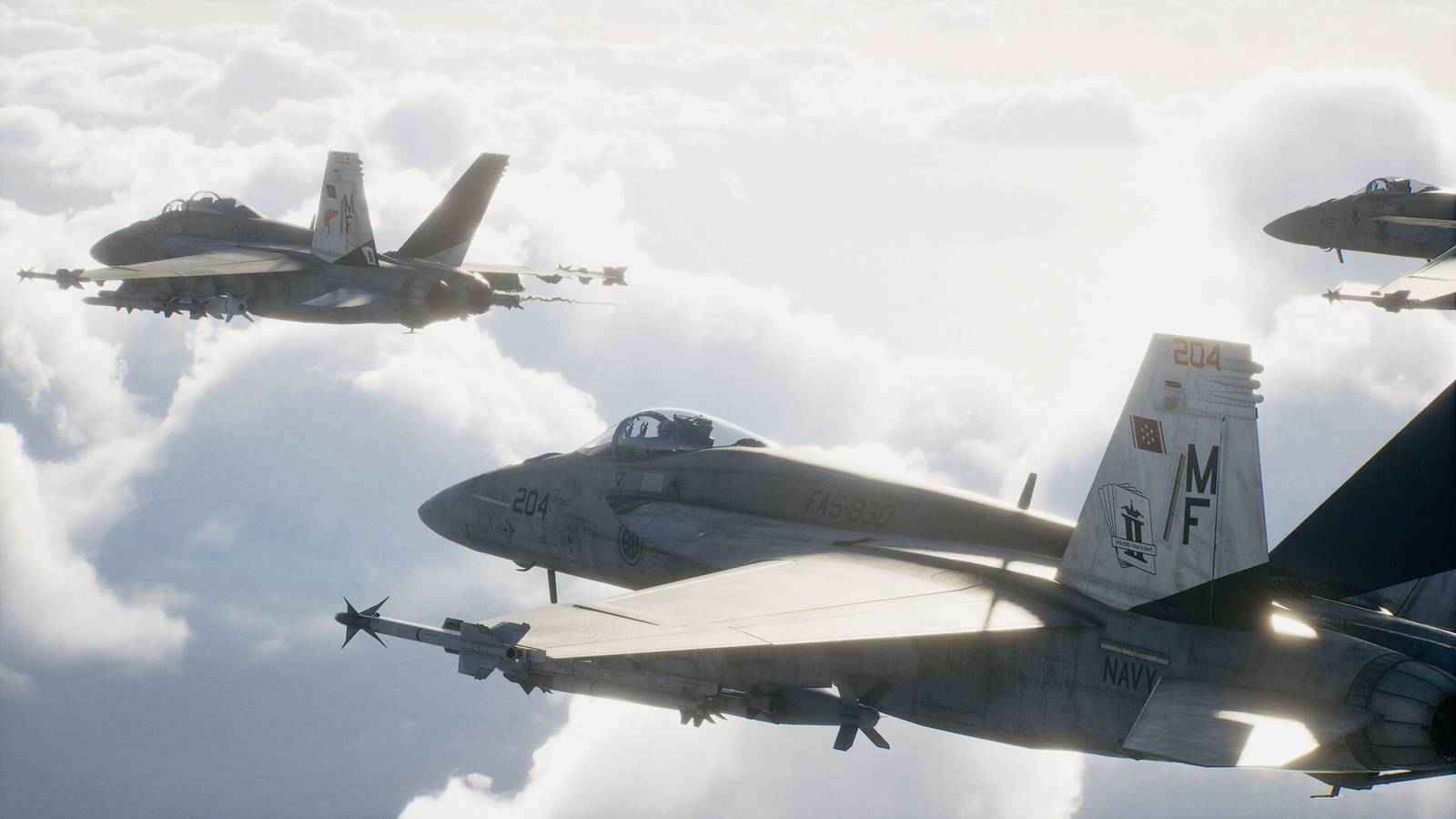
If you’re just now beginning to discover Ace Combat or, for the first time, actually considering giving it a shot, you’re likely not alone. Despite the fact that the series began over three decades ago, many players jumped on board for the first time only seven years ago, when Ace Combat 7: Skies Unknown‘s multi-platform launch allowed it to reach a broader audience—and it certainly helped that it arrived with a lower barrier to entry than previous installments. According to an official statement from Bandai Namco, Ace Combat 7 managed to reach 7.5 million players worldwide, making it the biggest launch in the series’ history. Now, Ace Combat 8: Wings of Theve looks to capitalize on that larger fan base with an even bigger, more accessible, and more immersive arcade flight combat experience than its predecessor.
Misunderstanding #1: Ace Combat Is a Flight Simulator
When I asked Kono about what he believes are the most common misunderstandings people have about Ace Combat, it was coming from the standpoint of someone whose first experience with one of the games was, in fact, Ace Combat 7 in 2019. I’m fully aware of the misconceptions that I had about it before I actually put my hands on the sticks, and based on the reviews I read and watched that ultimately convinced me to get it, my misconceptions clearly aligned with those of many others. But I wanted to hear directly from Kono what player feedback has been like on Bandai Namco’s side, as I felt that would give me a better understanding of why Ace Combat 8: Wings of Theve was seemingly going to even greater lengths to broaden its reach beyond what its predecessor was able to accomplish. Kono stated:
The first one is, at a glance, it looks like a flight simulator, and players often think, “Oh, the controls must be so nuanced and detailed that it’s going to be really hard, so I’m just not going to pick it up.” But when they actually pick it up, it feels more like an arcade shooter that’s very easy to immerse yourself in.
The first misconception he mentioned was right on the money for me. Prior to Ace Combat 7, I assumed the series was just a collection of flight simulation games, and I have never been interested in that concept. I can understand why some people are, but it doesn’t offer me the kind of rewarding gameplay experience I crave. However, when I played Ace Combat 7 for the first time, it took no time at all for me to become enthralled by its arcadey approach to aerial combat. It gave me the fantasy of being an ace pilot without asking me to understand the real-world complexity of actually flying a fighter jet, and that distinction is probably the biggest reason the series was able to grab me in the first place. Ace Combat looks far more intimidating from the outside than it actually feels once a player is in control, and, based on my hands-on time with it, that’s exactly the kind of misunderstanding Ace Combat 8: Wings of Theve seems built to address even more directly.
Misunderstanding #2: Ace Combat’s Eight Entries Creates a Huge Hurdle
The second misconception he mentioned is actually one that I had never thought of before, at least not in the way that he framed it. When I played Ace Combat 7 for the first time and fell in love with it, my first thought was, “How am I just now discovering this series? How did six installments go by without me realizing what Ace Combat actually is?” Obviously, that was all tied to the fact that I thought Ace Combat was just a flight simulation game, but Kono still had another perspective on why it has taken players like me so long to get into the cockpit:
The second is the fact that it has a number on it—8. And you look at 8, and I’m sure it feels very intimidating and a huge hurdle. But I would actually flip the script and say this franchise has withstood eight iterations, and it’s still going strong. In fact, it’s going stronger.
Of course, that makes complete sense. At first glance, seeing that Ace Combat has received eight mainline installments over the course of three decades is a lot to take in for a newcomer, especially considering that effectively makes it one of the longest running video game franchises ever made. It’s one thing to jump into a series with the second or even the third entry, but to think of walking through the door to its eighth installment is something else entirely. New players are bound to see that number 8 and assume they have too much catching up to do, so they avoid it at all costs. But, to Kono’s point, a better way of looking at it might be to admit that a series that has lasted so long is clearly successful for a reason, and it might be time to discovery why firsthand.
Read the full article on GameRant
This article originally appeared on GameRant and is republished here with permission.
Read the full article here
40 Comments
Nice to see insider buying—usually a good signal in this space.
Good point. Watching costs and grades closely.
Good point. Watching costs and grades closely.
If AISC keeps dropping, this becomes investable for me.
Good point. Watching costs and grades closely.
Good point. Watching costs and grades closely.
Silver leverage is strong here; beta cuts both ways though.
Good point. Watching costs and grades closely.
Good point. Watching costs and grades closely.
If AISC keeps dropping, this becomes investable for me.
Good point. Watching costs and grades closely.
Good point. Watching costs and grades closely.
Silver leverage is strong here; beta cuts both ways though.
Good point. Watching costs and grades closely.
Good point. Watching costs and grades closely.
The cost guidance is better than expected. If they deliver, the stock could rerate.
Good point. Watching costs and grades closely.
Production mix shifting toward USA might help margins if metals stay firm.
Good point. Watching costs and grades closely.
Good point. Watching costs and grades closely.
Nice to see insider buying—usually a good signal in this space.
If AISC keeps dropping, this becomes investable for me.
Interesting update on Ace Combat 8 Director Addresses Three Misunderstandings About the Series. Curious how the grades will trend next quarter.
Exploration results look promising, but permitting will be the key risk.
Exploration results look promising, but permitting will be the key risk.
Good point. Watching costs and grades closely.
Good point. Watching costs and grades closely.
I like the balance sheet here—less leverage than peers.
Good point. Watching costs and grades closely.
Nice to see insider buying—usually a good signal in this space.
Good point. Watching costs and grades closely.
Good point. Watching costs and grades closely.
Silver leverage is strong here; beta cuts both ways though.
Good point. Watching costs and grades closely.
Good point. Watching costs and grades closely.
If AISC keeps dropping, this becomes investable for me.
Good point. Watching costs and grades closely.
Good point. Watching costs and grades closely.
The cost guidance is better than expected. If they deliver, the stock could rerate.
Good point. Watching costs and grades closely.