

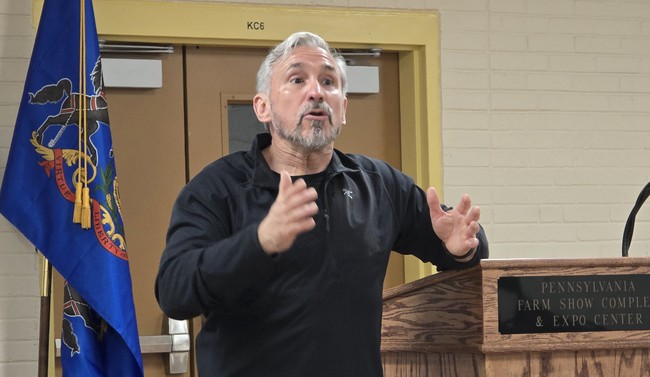
The annual Great American Outdoor Show is host to not only a ton of awesome vendors, but informed experts sharing their knowledge during seminars. This year, instructor Jeff Gonzales gave an “Active Shooter Readiness” presentation.
Gonzales is the owner and operator of Trident Concepts, LLC. Gonzales, a former U.S. Navy SEAL, says that he’s analyzed over 1,000 acts of terror in order to better understand what he calls the “terrorist mindset.” He worked through as much available data on these events, themes and patterns emerged.
Who was this seminar for? Anyone who has a vested interest in being prepared for and/or understanding an active shooter scenario. The class was offered to all attendees of the Great American Outdoor Show without any additional fee.
The purpose of Gonzales’ “Active Shooter Readiness” seminar is four-fold. It’s broken down into the following sections: understand active shooter dynamics, review past performance and outcomes, strengthen situational awareness and decision making, and identifying training priorities and capability gaps.
One of the first things that needs to be identified is: “What is an active shooter?” There’s no universally accepted definition of a so-called “mass shooter,” however, the nomenclature that the U.S. government uses through the FBI is “active shooter.”
The FBI says that an active shooter is “one or more individuals actively engaged in killing or attempting to kill people in a populated area.” Gonzales identified that the most frequently used weapon of choice in an active shooter scenario is a handgun or pistol, and following handguns are rifles — with “shotguns appear[ing] far less often in documented incidents.” Other elements that have been identified in active shooter scenarios are that they are “rapid, chaotic, and unpredictable,” and are “typically resolved before police arrive.”
When assessing the aftermath of an active shooter situation, the “major cause of victim mortality” is severe bleeding paired with delayed medical treatment. Time is not on your side, Gonzales says, and that a decision needs to be made: run, hide, or fight.
That time-to-treatment link was highlighted in a study that was funded in part through career development grants from the American College of Surgeons and the Robert Wood Johnson Foundation Physician Faculty Scholars Program.
“Of 11,744 [gunshot wound] patients during the study period, 4,782 were shot more than 5 miles from a trauma center,” the study observed, noting that “mean transport time and unadjusted mortality were higher for these patients (P < .001 for both). In a multivariate model, suffering a [gunshot wound] more than 5 miles from a trauma center was associated with an increased risk of death.”
On the training side of things, Gonzales is in good company in pointing out these facts. The proper triaging of wounded victims is something friends of Bearing Arms, FASTER Saves Lives, teaches in their programs.
“Learn how to treat multiple people with shooting/stabbing/blast injuries,” a FASTER class description notes. “You will learn the basics of tourniquet selection and use, chest seal application and wound packing. Your staff will be able to prioritize and begin immediate treatment of life-threatening extremity, junctional, and torso injuries.”
When it comes to planning response, Gonzales says that there are three different types of plans: tactical assault plan, emergency assault plan, and counter assault plan. Through the seminar, Gonzales continually emphasized the importance of both training and awareness.
Proper “training reduces panic and confusion” while an event occurs. That’s in addition to possessing the knowledge on how to treat injuries.
There were four skills that were discussed at length, along with methodologies and explanations. Improvised cover, head shots, dynamic shooting while on the move, and long range handgun skills were all explored.
Distance is your friend, was something that Gonzales imparted. While all of the skills he covered are important, he says that those who know how to use distance are at a true advantage.
Some of the other statistics that were reviewed in depth included a 2025 study conducted by Dr. John Lott and Dr. Carlisle E. Moody. Previously reported here at Bearing Arms, civilian responses to these types of scenarios statistically have better outcomes than police.
“The first takeaway is, assuming our count is complete, that armed citizens have stopped more active shooter incidents than the police have, although the difference is not significantly different from zero,” Lott and Moody noted. “Also, armed citizens do not appear to interfere with the police or blunder so badly as to get their weapon taken away by the shooter or kill the wrong person.”
At the end of the day, Gonzales highlights a grim statistic that everyone needs to be keenly aware of. And to be fair, he himself noted that the times cited by different sources do vary. But he said that in order for casualties to be in the single digits in these active shooter events, someone needs to respond within 90 seconds.
That 90 seconds is triple the 30 seconds that Ed Monk preaches in his book “First 30 Seconds,” reviewed HERE by Bearing Arms’ Ranjit Singh. The takeaway, no matter whose statistics are used to come up with a time and what methodology we’re looking at, experts agree that the quicker people are able to respond to an active shooter scenario, the quicker it will end and the lower the number of casualties.
If we’re looking at a half of a minute to a minute and a half, it’s hardly of any consequence when police response is in many minutes. Singh discussed this in his coverage of Monk’s book noting it takes “30-60 minutes to alert, assemble, gear up, and transport a SWAT team to an Active Shooter scene. …”
Jeff Gonzales’ presentation “Active Shooter Readiness” was a nice addition to the 2026 Great American Outdoor Show. Trying to cram in every bit of what he discussed in one article is impractical. Programs like Gonzales’ are offered at NRA events.
Previously, I did get to sit through Klint Macro’s “How To Train to Be Your Own Family First Responder” seminar at the 2024 GAOS. And, after sitting through Gonzales’ “Active Shooter Readiness,” I can say quite a bit of thought and diversity in content is being put into selected programming. It’s not just all skinning deer and tracking animals; there’s classes and seminars for those interested in things like self-defense and personal responsibility.
Gonzales’ seminar was great and I hope he’ll be doing more at other NRA events. You can visit him online at: TridentConcepts.com. The upcoming NRA Annual meeting will be April 17 – 19, and there’s a number of educational opportunities on the agenda that will likely interest you, and that you’re likely to enjoy.
Editor’s Note: The radical left will stop at nothing to enact their radical gun control agenda and strip us of our Second Amendment rights.
Help us continue to report on and expose the Democrats’ gun control policies and schemes. Join Bearing Arms VIP and use promo code FIGHT to get 60% off your VIP membership.
Read the full article here
36 Comments
Production mix shifting toward USA might help margins if metals stay firm.
Good point. Watching costs and grades closely.
Good point. Watching costs and grades closely.
Nice to see insider buying—usually a good signal in this space.
Good point. Watching costs and grades closely.
Interesting update on ‘Active Shooter Readiness’ Seminar at 2026 GAOS. Curious how the grades will trend next quarter.
Good point. Watching costs and grades closely.
Exploration results look promising, but permitting will be the key risk.
Good point. Watching costs and grades closely.
The cost guidance is better than expected. If they deliver, the stock could rerate.
Good point. Watching costs and grades closely.
Nice to see insider buying—usually a good signal in this space.
Good point. Watching costs and grades closely.
Good point. Watching costs and grades closely.
Silver leverage is strong here; beta cuts both ways though.
Nice to see insider buying—usually a good signal in this space.
Good point. Watching costs and grades closely.
Good point. Watching costs and grades closely.
Uranium names keep pushing higher—supply still tight into 2026.
Good point. Watching costs and grades closely.
Interesting update on ‘Active Shooter Readiness’ Seminar at 2026 GAOS. Curious how the grades will trend next quarter.
Good point. Watching costs and grades closely.
Interesting update on ‘Active Shooter Readiness’ Seminar at 2026 GAOS. Curious how the grades will trend next quarter.
The cost guidance is better than expected. If they deliver, the stock could rerate.
Good point. Watching costs and grades closely.
Good point. Watching costs and grades closely.
Nice to see insider buying—usually a good signal in this space.
I like the balance sheet here—less leverage than peers.
Good point. Watching costs and grades closely.
Good point. Watching costs and grades closely.
Interesting update on ‘Active Shooter Readiness’ Seminar at 2026 GAOS. Curious how the grades will trend next quarter.
Good point. Watching costs and grades closely.
Good point. Watching costs and grades closely.
Silver leverage is strong here; beta cuts both ways though.
Nice to see insider buying—usually a good signal in this space.
Good point. Watching costs and grades closely.