

For Joe Mantegna and Gary Sinise, supporting all aspects of the U.S. military is second nature.
The acclaimed actors spoke with Military.com in the days leading up to their annual co-hosting gig at the National Memorial Day Concert, taking place this year at 8 p.m. Sunday, May 24 from the west lawn of the U.S. Capitol Building in Washington D.C. Airing on PBS, the 35-year-long event is always one of the network’s most-watched programs.
Performers at this year’s festivities run the traditional gamut across entertainment, music and the military. They include actors Jonathan Banks, Melissa Leo, Mary McCormack and Noah Wyle; musicians Mickey Guyton, Alan Jackson and Jamey Johnson; and service-specific musicians. The Chairman of the Joint Chiefs of Staff and the Joint Chiefs of Staff also participate.
This year’s concert is also special, commemorating the United States’ 250th birthday as well as the 85th anniversary of Pearl Harbor and the 25th anniversary of the 9/11 attacks.
The Tony Award-winning Mantegna, known for roles on TV like FBI Special Agent David Rossi on Criminal Minds and as the voice of Fat Tony on The Simpsons and in films like The Godfather Part III, has been a mainstay for the annual event and first appeared following the tragic events at the World Trade Center and Pentagon.
Sinise, an Emmy Award winner who has had roles like Lt. Dan in the Academy Award-winning Forrest Gump and as President Harry Truman, started co-hosting with Mantegna in 2006. The pair have known one another for decades.
‘It Was Like the Dam Burst’
Military roots cemented decades ago have led to both Mantegna and Sinise carrying on not just their family legacies but the countless active-duty and veteran service members they have met, impacted in myriad ways.
Mantegna’s mother had four brothers, all four of them served in World War II—three in the Army, one in the Marine Corps. His father, who couldn’t serve due to a two-year case of tuberculosis, had a brother also in the Marines.
He said that it wasn’t until he began getting more involved, such as through the Memorial Day Concert, when that family history was passed down to him.
“Things kind of opened up and I started talking to my uncles about things, and all of a sudden it was almost like the dam burst,” Mantegna said. “I get all this information and find out the history of what they had all done, and some of it was pretty fascinating.”
It was a similar experience for Sinise, whose family history went even further back.
His grandfather and great uncle both served in World War I, with the former serving as an ambulance driver in France during the Battle of the Meuse-Argonne. When his grandfather returned, he went to a big military base in Rockford, Ill., called Camp Grant, named after President Ulysses S. Grant.
That was where he met Sinise’s grandmother, an Army nurse, roughly around January 1920. “They didn’t waste any time,” as Sinise described, as the couple got married the following April.
Then they had three sons: Sinise’s uncles Jack, Jerry, and then Sinise’s dad, Robert. Jack and Uncle Jerry served in World War II—Jack in the Army Air Corps in Europe, and Jerry on a ship in the Pacific during the invasions of Iwo Jima and Okinawa and the occupying force in Japan. Robert served in the Navy during the Korean War.
“Then, I met my wife and just a slew of veterans on that side of the family,” Sinise said. “That’s where so much of it begins, like for both Joe and I, with family history.
“Joe will say the same thing: The National Memorial Day concert became this tremendous opportunity for us to kind of come and be a part of it, tell the stories of sacrifice and service to our country, but also to bring our families to Washington, D.C.”
How Acting Opened Up Lanes for Advocacy
Both actors were asked how their careers as thespians have allowed them to uniquely connect with the broader military community, through different roles and opportunities.
“It’s been great,” Mantegna said. “I’m always especially moved when somebody will come up to me. I mean, look, Gary and I both have been doing what we do for many years. So, you’ll get people—I’m sure he gets a lot of, ‘Hey, Lt. Dan,’ or, ‘Hey, you were Truman,’ and people will talk to you about certain roles you’ve played.”
But I’m always most kind of touched when somebody will come up to me and say, ‘Hey, I just want you to know that Memorial Day concert is something we never miss, and it’s so important to our family. And that’s where it crosses over the line between what we do for a living and this concert.
Both Mantegna and Sinise have Chicago roots and, more specifically, the theater scene. Sinise was the artistic director of the Steppenwolf Theatre Company in the early-mid 1980s, and he had spent a good amount of time with his wife’s two brothers and her sister’s husband, all of whom were Vietnam veterans.
“I felt very badly for what they were telling me about how difficult it was for them to come home from war and to have the nation be so divided over that war,” Sinise recalled. “I felt terrible about that.
“So, as the artistic director and [the one] directing plays, I wanted to find a piece of material that I could direct that would speak to the Vietnam veteran experience. And I found one that was written by a group of veterans.”
He said a show in 1983 led to many local veterans coming to the theater, and it turned into free performances every Tuesday evening for veteran attendees. “Hundreds and hundreds of Vietnam veterans” were coming to see the play.
“It was very impactful, had a gigantic impact on me, just meeting them and engaging with them and hearing their stories and talking to them,” Sinise said.
Willing To Do More
Arguably, Sinise’s most recognizable on-screen role came in the 1994 film Forrest Gump when he played the Vietnam War Lt. Dan, opposite Tom Hanks. After the Sept. 11 attacks, Sinise said he felt “teed up” to do more to help veterans.
“I started raising my hand,” he said. “That’s how I ended up at the National Memorial Day concert, because I started raising my hand. And what do actors do? They go to the USO and do USO tours and shows and things.
“So, I started taking a band out and playing for them, and Joe knew about that. He started doing the concert a few years before that, and they were ironically going to do a segment on the USO.”
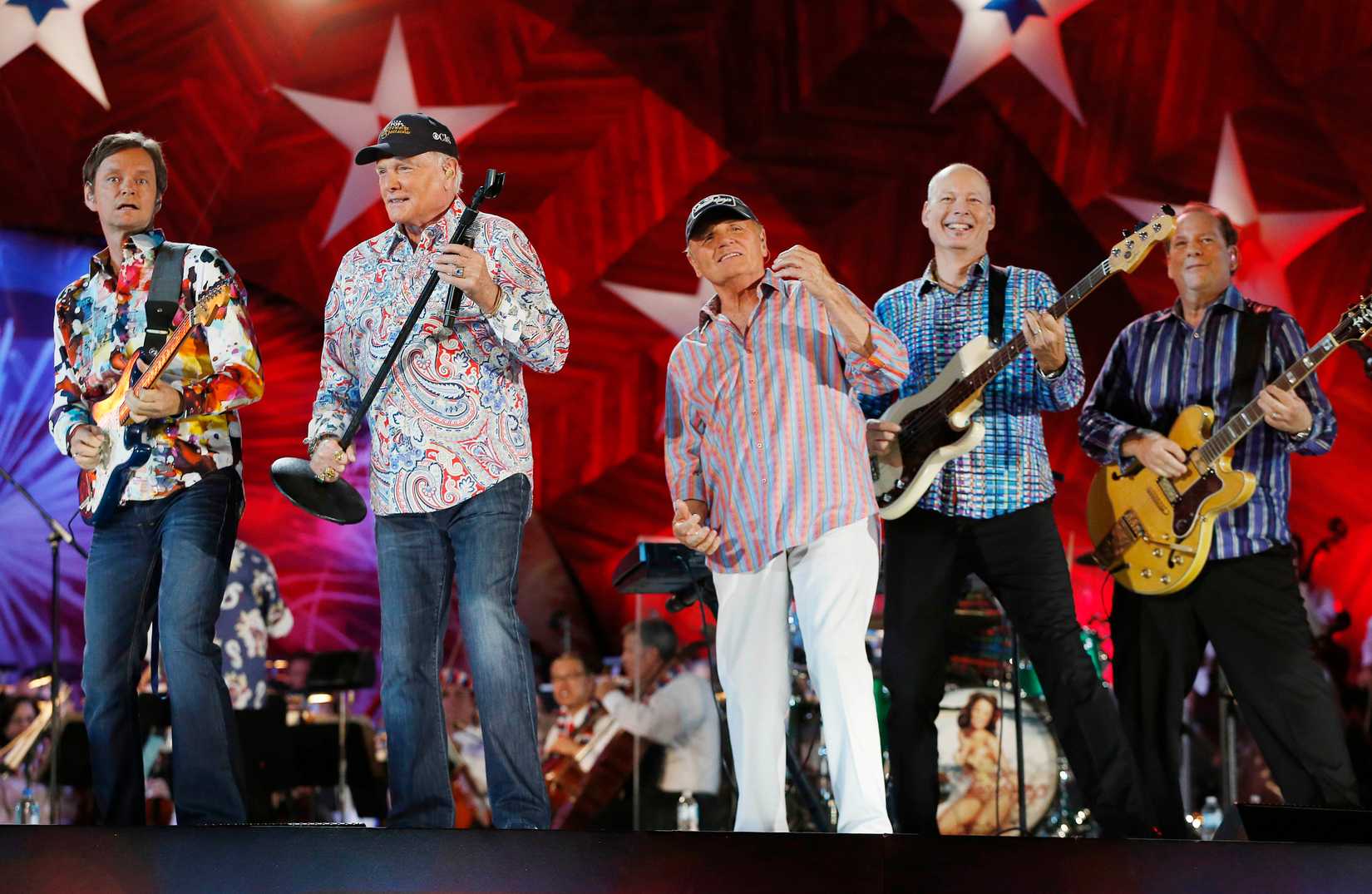
That was when Mantegna called him and asked if he knew about the Memorial Day Concert, to which Sinise responded he was unaware. Sinise, later calling the concert “a well-kept secret,” recalled how Mantegna cheekily joked about performing in front of 20,000 to 25,000 people in comparison to the audience at the Capitol.
Mantegna told Sinise to bring his band and perform live. Sinise and company ended up playing in front of some 200,000 people on the lawn of the Capitol. Ultimately, Mantegna soon invited him for the following year’s festivities.
“And that’s what we’ve been doing ever since,” Sinise said. “I can’t imagine sort of not doing it because it’s such a profoundly moving and important tribute to the sacrifices that have been made over the 250-year history of our country.”
‘Emotion You Can’t Describe’
Sinise said it also provides opportunities to showcase individuals’ contributions before it’s too late, specifically mentioning how the last World War II veterans are fast approaching 100 years of age.
Last year, the concert revealed a group of World War II veterans all sitting on stage. Meanwhile, the National Symphony Orchestra was playing a piece written by Sinise’s son, Max, called “The Rise.”
Mantegna called it a “no-brainer” to have Sinise be a part of it. In the many years since the collaboration began, they’ve told countless stories about heroes of various backgrounds and wars.
The partnership catapulted both men into roles bigger than themselves, or even of those they have played on the screen or stage.
“Sometimes, once you decide to walk through that door, all of a sudden things happen,” said Mantegna, who has worked closely with the U.S. Army Museum. “All of a sudden one thing leads to another, leads to another. You meet people of a like mind and they come to you.”
I think it was almost a natural evolution that if you put yourself in a position where you’re open to respond to this, what this is all about, things happen.
The Gary Sinise Foundation started in 2011 to serve and honor America’s military, their families and first responders. In the past 15 years or so, more than $650 million has been raised for efforts including community and rehabilitation programs. Mantegna is an ambassador for that foundation.
“I was narrating [a] particular segment, and to be hearing the National Symphony playing Max’s music and looking at the World War II veterans—it was a very, very powerful moment,” said Sinise, adding that another record of Max’s music will be utilized this year.
Sinise said the foundation came about from his willingness to help in any facet he could, be it through helping build memorials, providing care packages to active-duty troops, or spreading the word through the world of entertainment.
In the days preceding this year’s concert, Sinise will be visiting Dover Air Force Base for a concert before playing again at Fort Belvoir. He will serve food at the Walter Reed Medical Center. He and Mantegna will also record a podcast.
Among the aforementioned guests and activities, the concert will include a Vietnam veterans tribute as well as a Gold Star families tribute.
Mantegna called it “America, in its purest form.”
“What’s funny is at the end of it, we always go, ‘Wow, that seems to be the best one ever,’” Mantegna said. “And then, of course, the next year, [we] say the same thing all over again. … You look out and there’s a quarter of a million people standing there, some are in wheelchairs. It’s like, whoa, that’s taking it to a whole other level.
“It just fills you with an emotion that you can’t even describe.”
Read the full article here
20 Comments
Nice to see insider buying—usually a good signal in this space.
Good point. Watching costs and grades closely.
Good point. Watching costs and grades closely.
Production mix shifting toward USA might help margins if metals stay firm.
The cost guidance is better than expected. If they deliver, the stock could rerate.
Good point. Watching costs and grades closely.
Silver leverage is strong here; beta cuts both ways though.
Good point. Watching costs and grades closely.
Good point. Watching costs and grades closely.
Silver leverage is strong here; beta cuts both ways though.
If AISC keeps dropping, this becomes investable for me.
Good point. Watching costs and grades closely.
Silver leverage is strong here; beta cuts both ways though.
Production mix shifting toward USA might help margins if metals stay firm.
I like the balance sheet here—less leverage than peers.
Production mix shifting toward USA might help margins if metals stay firm.
Silver leverage is strong here; beta cuts both ways though.
Silver leverage is strong here; beta cuts both ways though.
Production mix shifting toward USA might help margins if metals stay firm.
Good point. Watching costs and grades closely.