

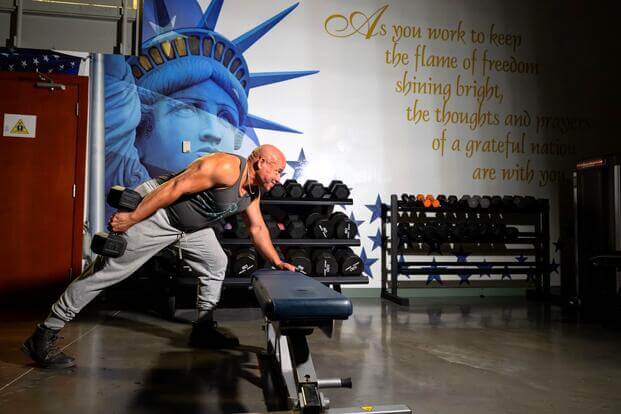
A typical weekly split routine when training hard with calisthenics and/or weights is the Push-Pull-Leg Split. In this, for the first three days of the week, you do all the upper-body exercises that target the “push” muscles: chest, triceps and shoulders. Then on Day 2, you do exercises targeting the upper-body “pull” muscles: biceps, forearms/grip, and upper back/lats. On Day 3 of the split, you do legs, including squats, lunges and leg machines. You could do dead lifts on leg day, but many place it in the “pull” day of the split, along with farmer walks and other grip/core exercises.
Here is a favorite “push” day with running we do for our special ops candidates.
Read More: Training to Fatigue? Rethinking Limits for Muscle Growth and Strength
Who Doesn’t Like a Good ‘Chest’ Day?
This is not your typical bodybuilding split routine.
Warm up with the Pushup/Jog Pyramid.
- Start with 1 pushup; jog 100 meters
- 2 pushups; jog 100 meters
- 3 pushups; jog 100 meters …
Continue up to 10 pushups for a total of 55 pushups. Follow it with a 1-mile jog to finish the warmup.
Lift First
With calisthenics, cardio, and lifting, do the more difficult activity first. Here is the first section of bench press and resting with core exercises:
Repeat 4 times:
- Bench 5-10 + pushups max (no rest)
- Abs of choice, 1 min.
For the bench press, pick a weight that you can barely complete 10 reps with. After you do the bench press reps, drop immediately into the pushup position for max reps with no rest after the bench. The reason for this weighted push with calisthenics immediately following is to help prepare for 2-minute pushup tests without having to do 2 minutes of pushups each set. The pushups after the bench press should feel like the last 20-30 seconds of a 2-minute pushup test as you struggle to get the final 5-10 reps. If you can do more than 10 pushups, you did not do enough bench press reps. Rest with a variety of core exercises, such as situps, flutter kicks, knee-ups or plank pose.
Auxiliary Pushing
The next set of pushing exercises represent auxiliary pushing, working the shoulders, chest and triceps in a different plane. Try this back-to-back-to-back with no rest other than the easy 400-meter run (or 2 minutes of other cardio) as active rest.
Repeat 3 times:
- Military press: 10
- Tricep extensions: 10
- Dips max
- Run 400 meters easy (or bike 2 minutes)
Fast Run + Rest With Pushups
This is a challenging calisthenics/run workout with active rest in the form of pushups. Do this as a fast 100-meter run (near full sprint), turning around and jogging back. Work to make it back in 50-60 seconds. Then do 10 pushups as your active rest. Take 10 more seconds and do the next set for 10 sets:
Repeat 10 times
- Run 100 meters fast
- Run 100 meters easy
- Pushups: 10
Death by Pushups
The grand finale of pushing consists of doing the 10-minute plank pose, but you do 10 pushups every minute on the minute (EMOM). We call this “Death by Pushups.” Most military fitness tests require a plank pose followed by pushups. Here is a way to get good at both.
PT Test Run
The final event is the 1.5-mile run or whatever your branch of service requires for its running fitness test.
This is a challenging push-and-cardio workout that combines several events. For more ideas, check out the Military.com Fitness Section for both group and individual training ideas for all levels of fitness.
Want to Learn More About Military Life?
Whether you’re thinking of joining the military, looking for fitness and basic training tips, or keeping up with military life and benefits, Military.com has you covered. Subscribe to Military.com to have military news, updates and resources delivered directly to your inbox.
Story Continues
Read the full article here
21 Comments
Interesting approach to combining upper-body strength training with running. How does this method help with endurance as well as strength?
I wonder how common this split routine is in other fitness programs. Have you tried it before?
Great question! It builds both by pushing the muscles while also maintaining cardiovascular fitness.
This seems like a rigorous workout. Any tips for beginners trying this for the first time?
Start with lighter weights and fewer reps, then gradually increase intensity as you get stronger.
I’ve never heard of the push-pull-leg split before. How does it differ from other workout routines?
It’s more structured to target specific muscle groups on different days for better recovery and growth.
I’m curious how this compares to circuit training. Any advantages to this push-pull-leg split?
Both have benefits, but this split allows for more targeted muscle growth and recovery.
I’ve always preferred pull exercises over push. Would this split still be effective for someone like me?
Yes, you can still benefit from push exercises even if you prefer pull. Balance is key.
Sounds like a tough workout. I’m not sure I could handle the pushup/jog pyramid, but I admire the dedication.
It’s definitely challenging, but the results are worth it. Maybe start with fewer reps and work your way up.
I like the idea of combining cardio with resistance training. Does this approach help prevent plateaus?
Yes, it adds variety and keeps your body adapting, which is key to avoiding plateaus.
Looks like an efficient routine. Do you recommend any specific warm-up drills beyond the pushup/jog pyramid?
Dynamic stretches and light mobility exercises can be great additions to the warm-up.
Sounds like a great routine for building functional strength. How long before someone sees noticeable gains?
With consistency, you can see improvements in strength and endurance within a few weeks.
What a creative way to structure a workout. Have you noticed any differences in recovery times compared to traditional splits?
Actually, this method can reduce recovery time since you’re not overworking one muscle group too much at once.