

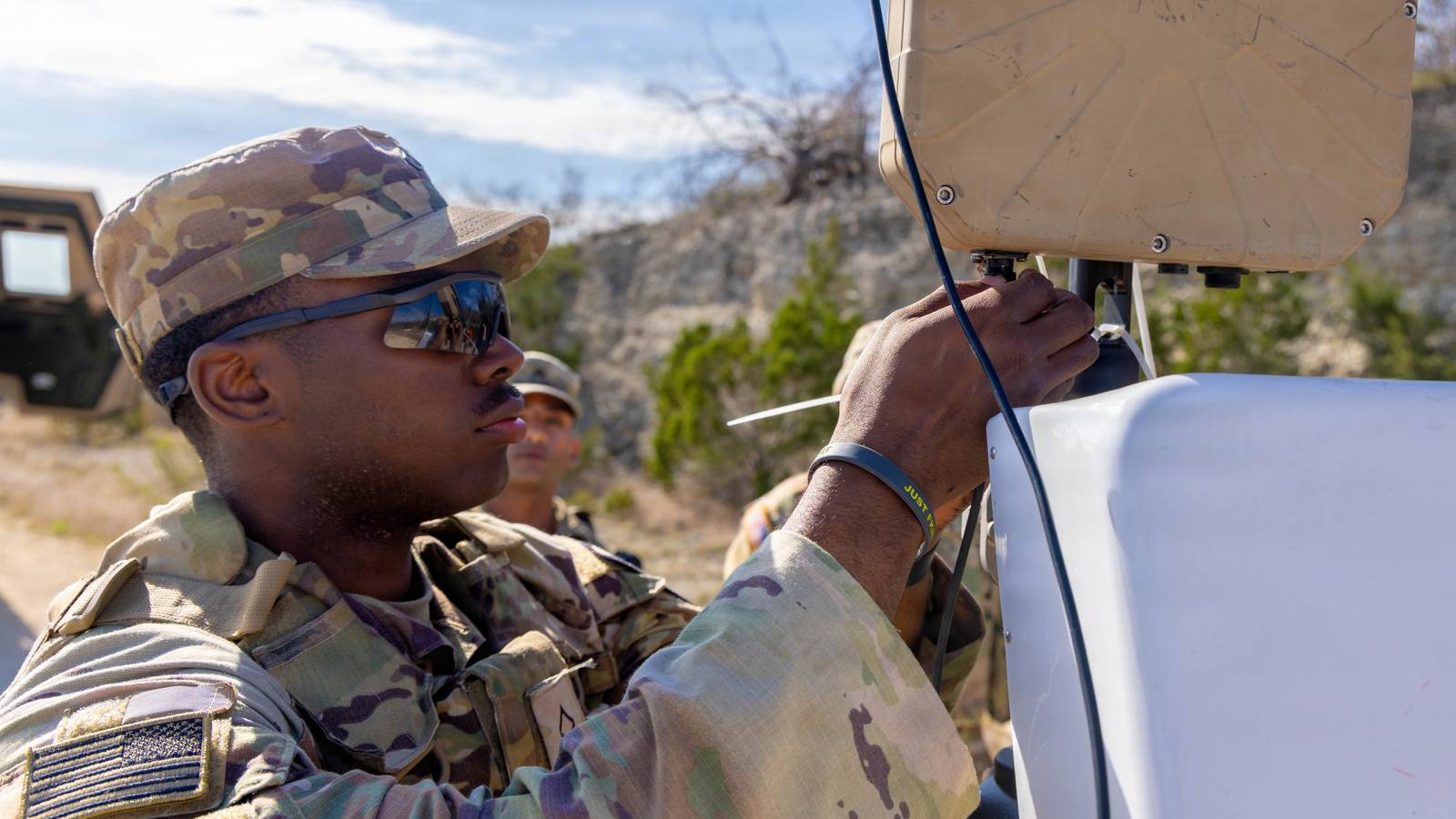
WASHINGTON — Army researchers are developing lightweight sensors that could warn soldiers when enemy drones are approaching, potentially giving troops time to react to aircraft they cannot see or hear.
The technology would recognize the distinctive sounds produced by different drones and alert soldiers to their presence, according to Beth Ferry, director of the Army’s Combat Capabilities Development Command C5ISR Center.
Ferry described the effort Wednesday during a media roundtable at the Association of the United States Army’s annual meeting in Washington, which Military.com attended.
The project remains in its early stages. Researchers are still working on the technology in the laboratory, and it has not undergone field testing with soldiers, Ferry said.
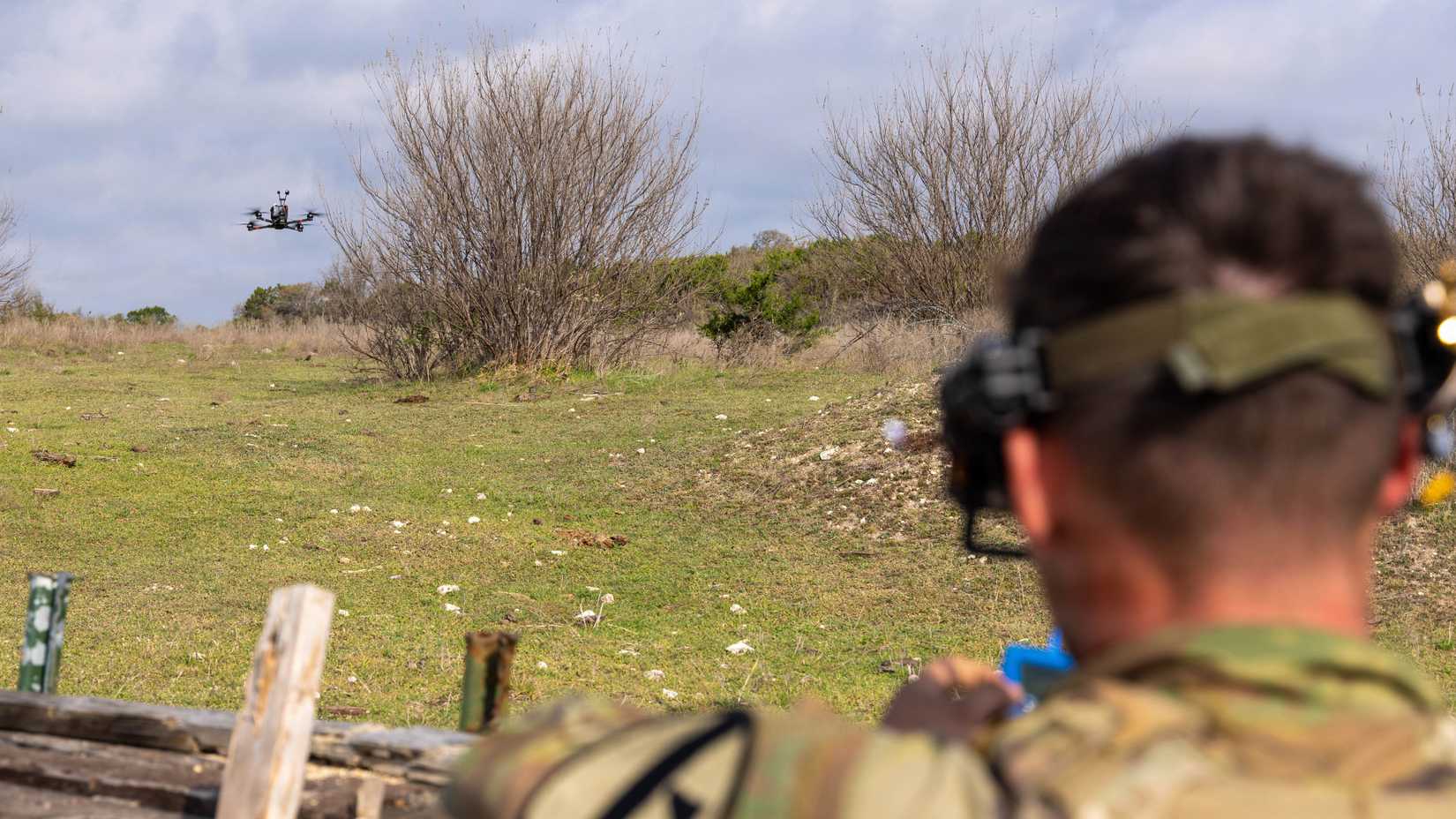
The work addresses a growing problem for ground troops. Small drones, including those carrying explosives or used to identify targets for artillery, have become a persistent battlefield threat. Their small size and ability to approach at low altitudes make them hard to spot before an attack.
The danger has already proved deadly for American troops. A 2024 Military.com investigation examined gaps in the Pentagon’s counter-drone defenses following an attack in Jordan that killed three U.S. service members and injured dozens more.
Ferry said the center is exploring whether lightweight sensors could recognize acoustic signatures from different unmanned aircraft and warn soldiers who might otherwise be unaware a drone is nearby.
The concept could give individual troops another way to detect aerial threats without constantly monitoring the sky or carrying additional specialized equipment.
Army Seeks Technology That Can Hear Enemy Drones
The research follows a broader Army effort to develop acoustic detection systems that soldiers can carry into combat.
In January, the C5ISR Center issued a request for information seeking technology that can detect small drones by the sounds they produce.
The solicitation specifically targeted Group 1 and Group 2 unmanned aircraft, generally weighing up to 55 pounds.
According to the request, the Army wants a system that can identify a drone’s location, direction and classification through passive acoustic detection. Ideally, it would alert soldiers through a smart device and display the aircraft’s location using the Tactical Assault Kit, software already used by military personnel to share battlefield information.
The Army also emphasized the need for systems that consume little power, weigh less and operate while troops move.
The January solicitation was intended to identify available technology and inform potential prototypes, rather than immediately purchase equipment. Officials did not establish during Wednesday’s roundtable whether Ferry’s laboratory project resulted directly from that solicitation.
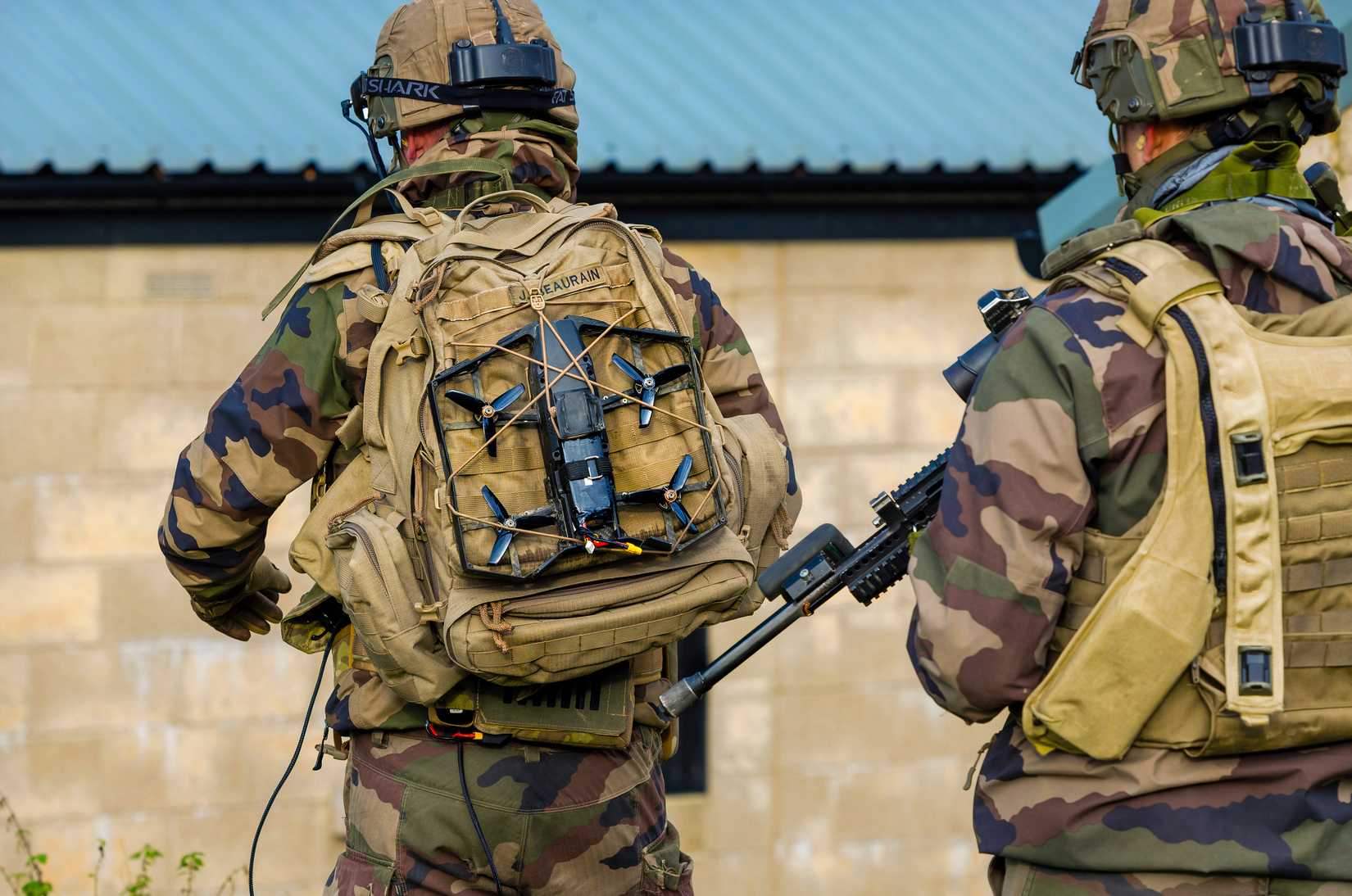
Jami Davis, the center’s assistant director for Soldier and Platform Mission Equipment, said researchers are particularly interested in technologies that can integrate with equipment soldiers already carry.
She explained that giving every soldier another specialized counter-drone device could add burdens, particularly for infantry units already carrying substantial gear.
One possible approach would allow soldiers, vehicles and unmanned ground systems to share information collected by different sensors, giving an entire unit greater awareness without requiring identical equipment for everyone.
Lessons From Ukraine’s Drone War
The Army’s interest in acoustic detection comes as the war in Ukraine continues to demonstrate how inexpensive drones can threaten troops, equipment and military installations.
Ukraine has developed networks of acoustic sensors designed to detect approaching aircraft and direct defensive responses. The developments are part of a larger transformation in military tactics, with the U.S. Army revising its battlefield doctrine based on lessons from Ukraine’s drone warfare, including the growing vulnerability of troops and armored vehicles to inexpensive unmanned aircraft.
An April report from the Army’s Center for Army Lessons Learned examined Ukrainian systems known as Sky Fortress, Zvook and FENEK.
The question of adopting Ukrainian technology also surfaced during Wednesday’s AUSA discussions.
At a separate Pentagon panel earlier in the day, Defense Secretary Pete Hegseth raised concerns about Chinese-made components used in Ukrainian drones. A reporter later challenged that assessment at the DEVCOM roundtable, asking Army researchers whether they agreed that such dependencies could prevent Ukraine from integrating its systems into American military technology.
The response acknowledged concerns about component sourcing and supply-chain security, while stressing that the Army is studying lessons from Ukraine’s battlefield experience.
Those concerns have not prevented all Ukrainian technology from reaching American forces. Reuters reported in April that the U.S. military had deployed Sky Map, a Ukrainian-developed counter-drone platform, at Prince Sultan Air Base in Saudi Arabia. The platform was developed by Sky Fortress, whose engineers also built an extensive acoustic drone-detection network in Ukraine.
Those networks use distributed microphones and related technology to identify the acoustic signatures of incoming drones. The information can help alert air defense units and guide responses to low-flying threats.
The report recommended examining similar detection networks for NATO’s eastern defenses and U.S. military operations in the Indo-Pacific.
However, Ukraine’s larger monitoring networks are different from the portable, soldier-focused technology Ferry described Wednesday. Adapting acoustic detection for individual troops presents additional challenges involving battlefield noise, processing power and the need to distinguish threatening aircraft from other sounds.
Keeping Drone Defense From Weighing Soldiers Down
The C5ISR Center has already been evaluating other counter-drone technologies intended for small military units.
In May, researchers conducted the Warden counter-drone experiment at Fort A.P. Hill, Virginia, where 17 industry partners tested emerging systems against simulated drone attacks.
European manufacturers have already developed compact alternatives, including wearable drone detectors that have been supplied to Ukrainian forces. Those systems use radio-frequency detection rather than the acoustic technology Army researchers are currently exploring.
The Army reported in July that those experiments included electronic jammers, lasers and interceptor drones. Developers collected performance data to improve detection algorithms and make systems easier for soldiers to use.
Some of the equipment evaluated was designed to work with wearable sensors or existing weapons, allowing soldiers to respond to drones without carrying entirely separate systems.
Those field experiments involved other counter-drone technologies and should not be confused with the acoustic warning project, which Ferry said has not yet reached that stage.
Researchers still need to establish whether the proposed warning sensors can reliably identify approaching drones outside controlled laboratory conditions.
Detecting an aircraft is also different from stopping it. Acoustic sensors could provide soldiers with additional warning, but the equipment itself would not necessarily disable or destroy a threatening drone.
Ferry did not provide a timeline for field testing or indicate when soldiers might receive the technology.
For now, the Army is pursuing a relatively straightforward capability: giving soldiers an earlier warning that something dangerous is approaching overhead, even when they cannot hear it themselves.
Read the full article here
39 Comments
The cost guidance is better than expected. If they deliver, the stock could rerate.
Exploration results look promising, but permitting will be the key risk.
The cost guidance is better than expected. If they deliver, the stock could rerate.
Good point. Watching costs and grades closely.
Good point. Watching costs and grades closely.
Uranium names keep pushing higher—supply still tight into 2026.
Interesting update on Army Developing Acoustic Sensors to Detect Enemy Drones. Curious how the grades will trend next quarter.
Nice to see insider buying—usually a good signal in this space.
Good point. Watching costs and grades closely.
Uranium names keep pushing higher—supply still tight into 2026.
Exploration results look promising, but permitting will be the key risk.
Good point. Watching costs and grades closely.
Good point. Watching costs and grades closely.
Nice to see insider buying—usually a good signal in this space.
Good point. Watching costs and grades closely.
Good point. Watching costs and grades closely.
Interesting update on Army Developing Acoustic Sensors to Detect Enemy Drones. Curious how the grades will trend next quarter.
Good point. Watching costs and grades closely.
Good point. Watching costs and grades closely.
The cost guidance is better than expected. If they deliver, the stock could rerate.
Good point. Watching costs and grades closely.
Good point. Watching costs and grades closely.
Exploration results look promising, but permitting will be the key risk.
I like the balance sheet here—less leverage than peers.
Good point. Watching costs and grades closely.
Production mix shifting toward USA might help margins if metals stay firm.
The cost guidance is better than expected. If they deliver, the stock could rerate.
Good point. Watching costs and grades closely.
Production mix shifting toward USA might help margins if metals stay firm.
Good point. Watching costs and grades closely.
If AISC keeps dropping, this becomes investable for me.
Good point. Watching costs and grades closely.
Uranium names keep pushing higher—supply still tight into 2026.
Good point. Watching costs and grades closely.
Good point. Watching costs and grades closely.
Nice to see insider buying—usually a good signal in this space.
Exploration results look promising, but permitting will be the key risk.
The cost guidance is better than expected. If they deliver, the stock could rerate.
Good point. Watching costs and grades closely.