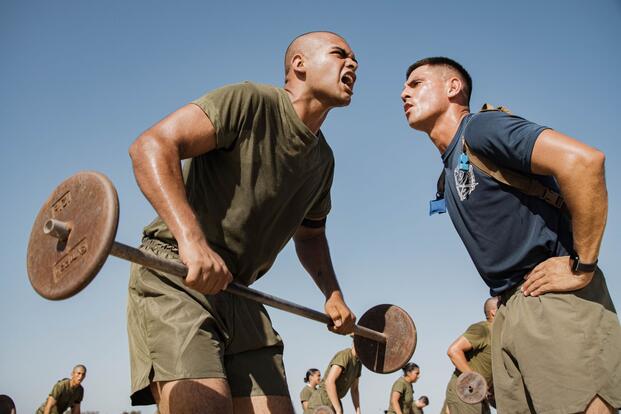
In weightlifting or calisthenics, an eccentric movement occurs when you lower the weight or lower your body, such as the downward portion of a pushup or the lowering of a dumbbell. A concentric movement occurs when you lift a weight or push your body up, such as pressing up from a squat or pushing yourself up during a pushup. Basically, eccentric means lengthening the muscle, and concentric means shortening it. Here is a question about the breathing process when doing the movements of weights or calisthenics:
Stew, Do you recommend exhaling while performing eccentric movements or concentric movements? Thanks, James.
James, typically, you want to “exhale on exertion,” and depending on the way you lift or do calisthenics, the exertion can be either the up or the down movement, or the concentric/eccentric part of the exercise. Most movements in weightlifting and calisthenics have the highest exertion during the concentric phase of the movement and the easier exertion during the eccentric phase. For instance, when doing a pullup by pulling your chin over a pullup bar, the harder movement is the upward movement, so the exhale is during that concentric movement, and the inhale is done in the easier downward/eccentric movement. However, in a similar movement with the pulldown machine, the harder movement is pulling the weight downward. It is still the concentric movement, so you exhale with that downward movement. The inhale is the upward movement of the weight. Think of it as bending the joint and shortening/flexing (contracting = concentric) the working muscles and then straightening the joint and lengthening/stretching (elongating = eccentric) the muscle, rather than just up or down movements.
Read More: If You Think Nasal Breathing Is Helpful, Try Left/Right Nostril Breathing
Slow Eccentric Exhale (with Negatives)
At times, you exhale during the eccentric movements. Any slower downward movement of weights or calisthenics may require an exhale, especially if the movement is a 5-10 slow repetition. For instance, a common exercise is the negative pull-up to improve pull-ups. This means you get yourself over the bar with an assisted pull-up if needed, then slowly lower yourself down 5-10 seconds in the eccentric phase of the movement. Normally, you would exhale on the upward movement of the pull-up. But these are slow eccentric movements that require a slow exhale, as this is the most significant part of the exertion during the lift or movement.
Bracing Breath (Hold)
When lifting heavy weights off the floor, as in the deadlift or back squat, when the core is under constant load and pressure, you need to perform a bracing breath. The bracing breath works like this: As you prepare for the lift, take a deep inhale into your belly (diaphragmatic breathing), tighten your core by squeezing your ab muscles as if you were about to take a punch to the stomach, then lift. Keep breath held and core tight throughout the lift. Exhale when the bar returns to the floor. If you are doing another deadlift rep, repeat the deep inhale, brace and lift process. So, when lifting heavily off the floor or squatting, you inhale before the lift and exhale after the lift. Here is a Squat University video on bracing.
Breathing properly is crucial for achieving optimal fitness as well as maintaining general health and wellness and mitigating stress. Breathing is a top tool we have biologically to help us with both optimal performance and longevity. Discover how to breathe more effectively and improve your overall performance in everything you do. Check out more articles on lifting weights and calisthenics at the Military.com Fitness Section.
Want to Learn More About Military Life?
Whether you’re thinking of joining the military, looking for fitness and basic training tips, or keeping up with military life and benefits, Military.com has you covered. Subscribe to Military.com to have military news, updates and resources delivered directly to your inbox.
Story Continues
Read the full article here
25 Comments
I’ve seen people hold their breath during heavy lifts. Is that ever a good idea, or should you always exhale on exertion?
Holding your breath (Valsalva maneuver) can be useful for heavy lifts, but it’s riskier for your blood pressure. Best to consult a trainer.
I always exhale on the concentric phase, but I wonder if there’s any research showing why this is the standard recommendation. Anyone know?
I think it’s to help maintain core stability and reduce pressure on the spine during exertion. At least that’s what I recall from a fitness seminar.
I’d be curious to see studies on whether eccentric breathing offers any benefits. Maybe it’s just convention without solid science.
I never paid attention to my breathing during workouts. Now I realize how important it is. Guess I’ll have to retrain myself.
It’s never too late to improve your form! Proper breathing can make a big difference in performance.
This is a great question. I’ve struggled with my breathing during squats. Now I know to exhale when standing up, not when sitting down.
Exactly! It’s all about matching your breathing to the exertion. Easier said than done at first, though.
I teach kettlebell classes and always emphasize exhaling on the explosive (concentric) phase. It just feels more natural during dynamic movements.
That matches what I’ve read. The explosive movement is when you need that core engagement most.
I’m still confused. What about exercises where the hardest part is the eccentric phase, like lowering during a bicep curl?
Great question! In that case, you’d exhale on the way down since that’s where the effort is.
I’ll never look at a pull-up the same way again. Thanks for the breathing tip—this makes total sense now.
Right? The upward movement is where all the work happens, so exhaling there makes perfect sense.
I always inhale on the way down and exhale on the way up. It just feels more natural to me, and it’s apparently the correct way to do it.
That’s the classic approach. Works for most lifts, especially compounds like squats and bench press.
This is so counterintuitive to me. I naturally breathe out when lowering weights. Is that bad? I’ve never had any issues though.
I think as long as you’re consistent and not feeling dizzy or lightheaded, you’re probably fine. Everyone is different.
I usually exhale when the movement feels hardest, whether up or down. Push-ups are up on the exhale, deadlifts are on the lift. Makes sense now that I think about it.
That’s exactly what the experts recommend. Inhale on the easy part, exhale on the hard part.
I’ve heard this before but never understood why until now. Do you have any tips for remembering which phase to exhale on?
Focus on exhaling when you’re applying force. That’s usually the concentric phase, but not always.
This should be common knowledge for anyone lifting weights. Good thing I’ve been doing it right all along!
Same here! It’s one of those things that feels right once you know the rules.