

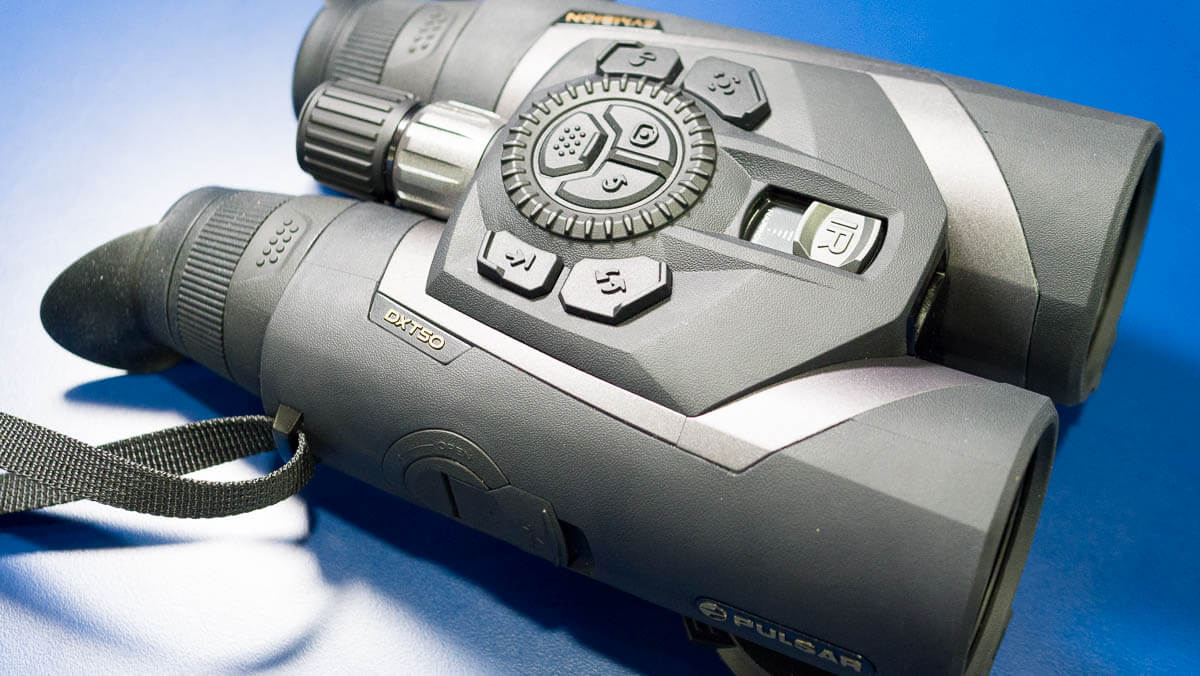
The Pulsar Symbion LRF DXT50 is a new multispectral binocular. That means it combines thermal imaging, digital day/night vision, and laser ranging into a single system. Recently, Pulsar introduced it as part of their new Symbion platform.
The DXT50 is aimed at hunters and professional users who need continuous visibility across changing light and terrain.
Rather than forcing users to move between separate optics, the Symbion integrates multiple sensing technologies into one binocular intended for continuous use from daylight through complete darkness.
Dual‑Channel Imaging in One Housing
At the core of the Symbion DXT50 is a 4K digital imaging system with a high‑res thermal sensor. The digital sensor shows full‑color daytime imaging and clear twilight performance, while the thermal channel reveals heat signatures independent of ambient light, fog, or vegetation.
Users can switch between channels or run them simultaneously using picture‑in‑picture modes, allowing thermal detection and visual identification to happen at the same time. I like that because it makes it easier to find a subject with my eyes outside the binos.
High‑Resolution Thermal Performance
The DXT50 uses a 1280×1024 pixel thermal sensor with a 12‑micron pixel pitch, prioritizing image detail and discrimination over long distances. Paired with a 50 mm F/1.0 thermal lens, the system is good at scanning mixed terrain where detection, identification, and ranging all matter.
Integrated Laser Rangefinder
A built‑in laser rangefinder allows the Symbion DXT50 to measure distance without an additional device. The system supports both single‑shot and continuous scanning modes, enabling users to range targets quickly while maintaining visual contact.
Distance data can be used for navigation, observation, or paired with external ballistic solutions when required.
Ergonomics, Controls, and Durability
Despite its sensor complexity, the Symbion retains a traditional binocular form factor with one‑handed operation. The controls are supposed to be pretty intuitive. There are focus knobs for both the visible and thermal lenses. The housing is constructed from magnesium alloy for hard field use, including resistance to dust and water immersion. You won’t have to baby these babies.
An internal AMOLED display presents a clear, high‑contrast image across all operating modes, while electronic image stabilization helps reduce motion at higher magnifications.
Power, Recording, and Connectivity
The Symbion DXT50 uses a removable battery system with USB‑C external power support for extended sessions. Internal photo and video recording, including audio, allows users to document observations directly to onboard memory.
SEE ALSO: Browning X-Bolt 2 Maple Prints Sub MOA
Wireless connectivity supports data transfer and live streaming to your smartphone.
The Takeaway
The Pulsar Symbion LRF DXT50 isn’t a single‑purpose optic. It’s a consolidated observation system designed to replace multiple devices in the field, reducing transitions, simplifying workflow, and maintaining context across changing conditions.
For users who move between daylight scanning, low‑light identification, and nighttime detection, the Symbion represents a shift toward continuous, multispectral observation rather than mode‑specific tools.
Pulsar Symbion LRF DXT50 — Specifications
- Manufacturer: Pulsar
- Model: Symbion LRF DXT50
- Device Type: Multispectral binocular
- Thermal Sensor: 1280 × 1024, 12 µm
- Thermal Lens: 50 mm F/1.0
- Digital Imaging: 4K digital day/night channel
- Magnification:
- Thermal: approx. 2× to 16×
- Digital: approx. 6.5× to 26×
- Display: AMOLED
- Laser Rangefinder: Integrated
- Max Ranging Distance: approx. 1,600 yards
- Imaging Modes:
- Digital (day, twilight, night)
- Thermal
- Multispectral picture‑in‑picture
- Stabilization: Electronic image stabilization
- Housing: Magnesium alloy
- Environmental Rating: IP67
- Power: Removable battery with USB‑C external power support
- Recording: Photo and video with audio
- Connectivity: Wi‑Fi and Bluetooth
*** Buy and Sell on GunsAmerica! ***
Read the full article here
48 Comments
Production mix shifting toward USA might help margins if metals stay firm.
Good point. Watching costs and grades closely.
I like the balance sheet here—less leverage than peers.
Uranium names keep pushing higher—supply still tight into 2026.
Exploration results look promising, but permitting will be the key risk.
Good point. Watching costs and grades closely.
Good point. Watching costs and grades closely.
The cost guidance is better than expected. If they deliver, the stock could rerate.
Good point. Watching costs and grades closely.
I like the balance sheet here—less leverage than peers.
Good point. Watching costs and grades closely.
Good point. Watching costs and grades closely.
I like the balance sheet here—less leverage than peers.
Uranium names keep pushing higher—supply still tight into 2026.
If AISC keeps dropping, this becomes investable for me.
Good point. Watching costs and grades closely.
Good point. Watching costs and grades closely.
Nice to see insider buying—usually a good signal in this space.
Good point. Watching costs and grades closely.
Nice to see insider buying—usually a good signal in this space.
Good point. Watching costs and grades closely.
Good point. Watching costs and grades closely.
I like the balance sheet here—less leverage than peers.
The cost guidance is better than expected. If they deliver, the stock could rerate.
Good point. Watching costs and grades closely.
Nice to see insider buying—usually a good signal in this space.
Good point. Watching costs and grades closely.
Good point. Watching costs and grades closely.
Production mix shifting toward USA might help margins if metals stay firm.
Good point. Watching costs and grades closely.
Good point. Watching costs and grades closely.
Uranium names keep pushing higher—supply still tight into 2026.
Interesting update on Binos — SHOT Show 2026. Curious how the grades will trend next quarter.
Uranium names keep pushing higher—supply still tight into 2026.
Good point. Watching costs and grades closely.
Good point. Watching costs and grades closely.
Nice to see insider buying—usually a good signal in this space.
Good point. Watching costs and grades closely.
Exploration results look promising, but permitting will be the key risk.
Good point. Watching costs and grades closely.
Nice to see insider buying—usually a good signal in this space.
Good point. Watching costs and grades closely.
Good point. Watching costs and grades closely.
The cost guidance is better than expected. If they deliver, the stock could rerate.
Good point. Watching costs and grades closely.
Silver leverage is strong here; beta cuts both ways though.
Good point. Watching costs and grades closely.
Good point. Watching costs and grades closely.