

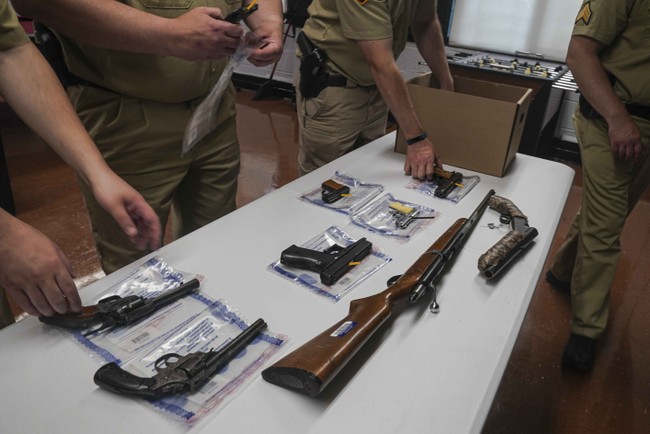
When the Liberal government in Canada launched its first test run of its “buyback” scheme in Cape Breton, Nova Scotia last fall, government officials predicted about 200 firearms banned under former Prime Minister Justin Trudeau would be handed in. Since guns have to be registered in Canada, authorities had a pretty good idea of how many newly-banned guns were in the area, as well as who owns them.
But shortly after the pilot program ended, the police chief in Cape Breton told reporters that the “buyback” effort had fallen far short of its goal, with only a few dozen firearms turned over to the government. Federal officials, meanwhile, were mum about how the compensated confiscation pilot program turned out, but this week the Liberals confirmed that they fell far short of their goal, with just 25 guns collected.
“It was an opportunity to test the program’s processes and systems, confirm what works well and identify and address any potential gaps or challenges before the program opens nationwide,” said Simon Lafortune, spokesperson for Public Safety Minister Gary Anandasangare, in a statement.
The government said there were a number of “lessons learned,” including the need for a clearer registration process and more instructions.
The pilot also flagged some “functional gaps” in the way the online portal worked “which may have been challenging and confusing for some participants in the program,” said the statement.
The government also announced Wednesday it will provide up to $12.4 million to cover costs incurred by Quebec to run the buyback program in the province.
The Liberals can try to spin their failure as the result of Nova Scotians being too dumb to figure out how the “buiyback” worked, but I think they’re ignoring the most obvious reason why so few gun owners took part in their scheme: they’re not interested in handing over their guns to the government.
Several provinces have come right out and said they won’t be cooperating with the “buyback” when it launches nationally, and opposition to the compensated confiscation scheme is widespread among Canadian gun owners. It shouldn’t come as a surprise to anti-gun politicians that so many Cape Breton gun owners declined to participate in the government’s compensated confiscation scheme, and if they think that the paltry number of firearms that were turned over is the result of confusion on the part of gun owners they’re in for a rude awakening when the “buyback” efforts launch nationwide.
There are some lessons to be learned for anti-gun politicians here in the States as well. Australia’s “buyback” program that took place three decades ago has been on the gun control lobby’s wish list ever since, and after the recent shooting at Brown University there were repeated calls from gun control activists here in the United States to replicate Australia’s confiscation efforts. But if Canadian gun owners, who are already subject to things like licensing and registration mandates, are broadly choosing not to participate in a compensated confiscation scheme, it should be painfully obvious to even the most clueless gun control activist that the vast majority of U.S. gun owners aren’t going to line up to hand over their firearms either.
The Canadian government has allocated $700 million for its “buyback” scheme, and officials insist that, despite repeated delays, the compensated confiscations will roll out nationwide in a matter of weeks. We’ll see if that deadline gets pushed back yet again, but whenever the Liberals do decide to take their confiscation efforts nationwide, I suspect that their failure in Cape Breton will be replicated across the country.
Editor’s Note: President Trump and Republicans across the country are doing everything they can to protect our Second Amendment rights and right to self-defense.
Help us continue to report on their efforts and legislative successes. Join Bearing Arms VIP and use promo code FIGHT to get 60% off your VIP membership.
Read the full article here
14 Comments
The low turnout shows that gun control measures might face strong resistance. People value their rights and aren’t easily swayed.
I’m curious how much money was spent on this failed pilot program. That would tell us more about the true cost of this initiative.
The spokesperson mentions lessons learned, but it’s unclear what those lessons are. More transparency would be helpful here.
This buyback program seems to be a failure. Only 25 guns turned in out of 200 expected? That’s a huge miss. What’s the point?
The pilot program was meant to assess the process. Even though the numbers were low, it might still provide valuable insights for future attempts.
Perhaps the numbers were unrealistic from the start. Setting expectations too high can lead to disappointment and wasted resources.
This program’s failure might have wider implications for other government initiatives. If people resist this, what else might they oppose?
This suggests that mandating gun buybacks might not be as effective in reality as it sounds in theory. At least in Canada.
Only a few dozen firearms turned in? That’s a significant shortfall. Maybe the compensation wasn’t enough to incentivize people.
Well, at least they tried. Sometimes pilot programs fail, and that’s part of the process. Better to find out now than after a full rollout.
The government should probably reassess their approach. Maybe focus on education and voluntary participation instead of forced measures.
I wonder if the low participation was due to distrust in the process. People might be skeptical about the government’s intentions.
I wonder if the government will scrap the nationwide program or push forward despite this failure. The decision could be telling.
A mere 25 guns? It’s clear that the majority of gun owners in Cape Breton weren’t interested in participating. Weren’t the gun owners notified before?