

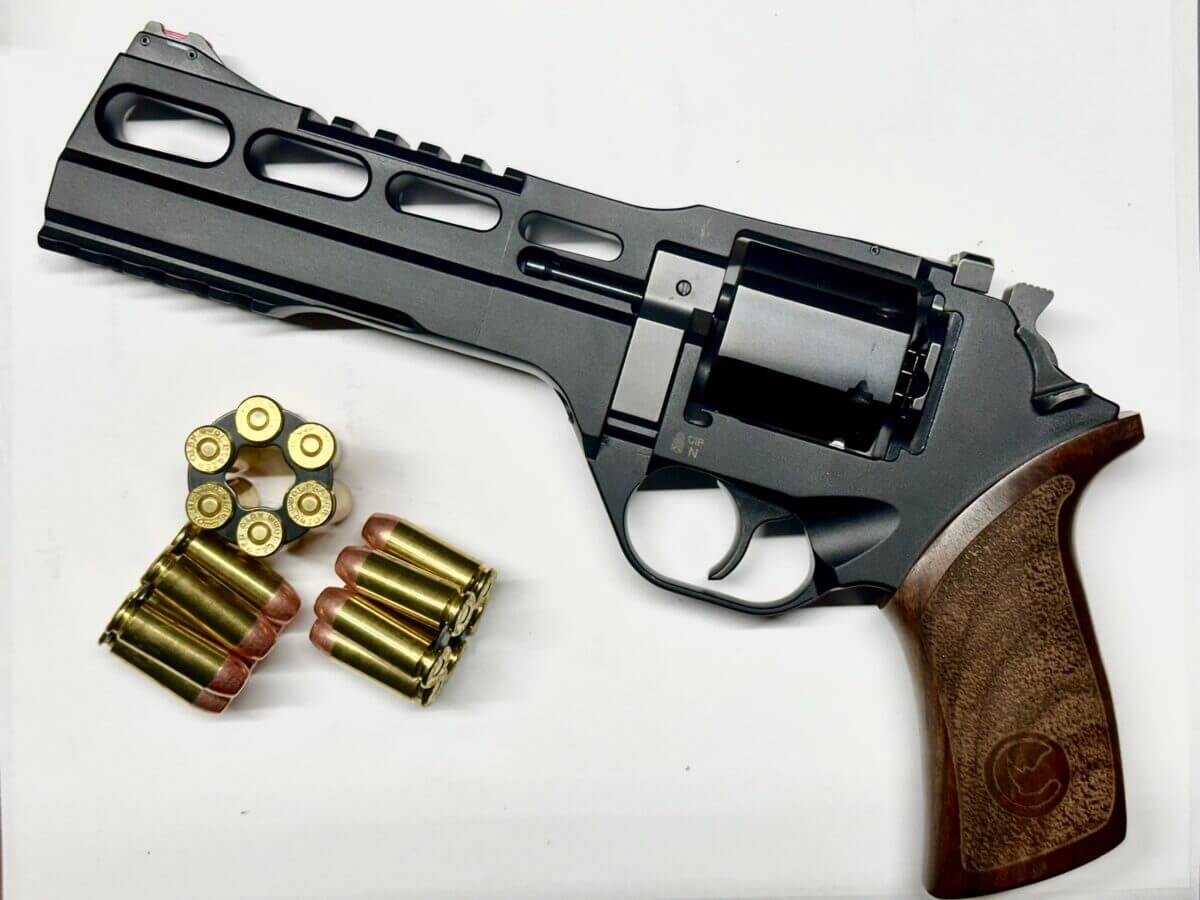
The Chiappa Rhino 60 DS 10mm looks like a sci-fi prop, fires from the bottom chamber, and somehow makes full-power 10mm Auto feel far more civilized than it should. I ran it with defensive, hunting, and range ammo to see if the weird design is real engineering or just revolver theater.
The Chiappa Rhino, pronounced “key-apa,” is a revolver with a twist: it fires out of the bottom chamber of the cylinder. This Rhino 60 DS fires the powerful 10mm cartridge, yet its design keeps recoil manageable.
The Chiappa Rhino 60 DS Brings Bottom-Chamber Weirdness to 10mm
The Chiappa Rhino is not a new pistol, but stuffing this strange, bottom-chamber wheelgun with 10mm Auto gives the old Rhino trick a fresh bite. In fact, it’s been in the U.S since 2009. This highly recognizable pistol is available in multiple colorways, with long or short barrels, and in a variety of calibers. I am lucky enough to have a brand new addition to the Rhino product line, and it’s chambered in 10mm!
Chiappa offers this 10mm Rhino with either a 3-inch or 6-inch barrel. The 3″ version is called the 30 DS, and the 6″ is called the 60 DS. The Rhino 60 DS 10mm that I am testing for this review came with a black anodized frame and blued cylinder. The model is also available in a beautiful nickel-plated finish.
🛒 Check Current Price for Chiappa Rhino 60 DS on GunsAmerica
Why the Chiappa Rhino’s Low Bore Axis Actually Matters
Revolvers have been around for a very long time. In fact, Samuel Colt applied for a U.S. patent in 1836 for the Colt Paterson Revolver. This was the first pistol that was commercially available with a revolving cylinder and a single, stationary barrel. Revolvers have been largely the same ever since.
The Rhino, however, integrates a principle that is popular in semi-auto pistols for decreased muzzle flip: a lower bore axis. This revolver still features a revolving cylinder and a single, stationary barrel. Instead of the traditional design with the barrel aligning with the top chamber of the cylinder, the Rhino’s barrel is located at the bottom of the cylinder. This moves the bore axis lower, reducing muzzle flip while shooting, and making the gun more manageable to shoot in general.
The Rhino looks similar to the traditional hammer-fired revolver in the sense that it has a visible hammer to cock back for single-action shooting. But looks can be deceiving. Because of the added complexity of getting a hammer that is located high on the gun to strike a chamber that is low on the gun, it functions differently than in other revolvers. This hammer doesn’t even stay cocked back when you use it. Instead, a red cocking indicator rises between the hammer and rear iron sight to show that the gun is cocked. The trigger also locks to the rear for single-action fire, and the cylinder rotates into the next firing position. Alternatively, you can just pull the trigger repeatedly for double-action fire.
Chiappa Rhino 60 DS 10mm Specs and Features
| Model | Rhino 60 DS |
|---|---|
| Caliber | 10mm Auto |
| Finish | black anodized frame, blued cylinder OR nickel plated |
| Barrel | 6 inches, 1:16 twist rate |
| Total Length | 10.5 inches |
| Material | 7075-t6 alloy frame, steel cylinder & barrel |
| Action | single/double |
| Capacity | 6 rounds |
| Loading Tools | 3 moon clips included |
| Grips | hand-oiled walnut |
| Safety | cylinder block, cylinder rotation, hammer block |
| front sight | red fiber optic |
| rear sight | green fiber optic, adjustable |
| MSRP | $1,360.00 |
25-Yard Accuracy: Which 10mm Loads the Rhino Liked Best
I chose to mainly test the accuracy of the Chiappa Rhino 60 DS with varieties of defensive and hot hunting ammunition. These included Hornady Handgun Hunter 135 grain Monoflex, Hornady Critical duty 175 grain FlexLock, Cor-Bon 150 grain JHP, Federal Punch 200 grain JHP, Winchester USA Ready 170 grain, and Underwood 200 grain hard cast flat nose ammunitions. I also included two of the most affordable plinking options for those who mostly spend their time at the range. These two were Blazer 180-grain FMJ and PMC Bronze 200-grain FMJ-TC.
The accuracy test was performed at a distance of 25 yards. I chose to shoot 5-round groups using a rear bag and a bipod. I also attached a red dot to squeeze every bit of precision out of the test that I could. The accessory rail and top Picatinny rail allowed me to mount these without any special adapters.
The most precise were Blazer 180 grain FMJ with a 1.42″ group and the Hornady Handgun Hunter 135 grain Monoflex with a 2.15″ group. On the flipside, the least precise were the Underwood 200 grain hard cast flat nose with a 5.59″ group and the Cor-Bon 150 grain JHP with a 3.99″ group. Check out the photos to see exactly how the rest performed.
Range Time: 10mm Power, Low Muzzle Rise, and One Abused Thumb
I am mainly a semi-auto pistol shooter. By that, I mean that I shoot about 15,000 rounds a year through semi-auto pistols. Because of this, I have some muscle memory that is ingrained within me that is not conducive to shooting revolvers, ESPECIALLY of this design. My very first shots with the Chiappa Rhino 60 DS were with my normal thumbs-forward grip, just not thinking about it. After just two or three shots, I was left with burnt powder and copper jacket spalling left embedded in my thumb. I bring this up to remind you to Google how to properly grip a revolver and to strictly adhere to this shooting style with the Rhino. My thumb suffered, so yours doesn’t have to.
With my grip corrected from that point onward, I really enjoyed shooting the Chiappa Rhino 60 DS in 10mm. This gun has a phenomenal trigger that I measured to be 2.5 lbs in single action and 8 lbs in double action. The recoil impulse was obviously different from other pistol designs I’ve used. I noticed the recoil being directed more into the web of my dominant hand. This made the gun have less muzzle rise, just as advertised. It also made the recoil impulse more manageable. By this, I mean my hand wasn’t sore and numb after shooting a dozen rounds, which is a not-so-rare symptom of shooting heavy recoiling pistols.
Iron Sights, Red Dots, and the Rhino’s Big Optics Rail
During my time with the Chiappa Rhino 60 DS, I used both iron sights and a mounted red dot. The iron sights are fantastic. The rear is a serrated, fully adjustable sight with green fiber optic. The fixed front sight features a red fiber-optic insert. These irons were precise and easy to use, especially with the long sight radius that this gun provides.
As mentioned, I also spent a lot of time with a red dot attached to this gun. The large Picatinny rail integrated into the top of the barrel made this easy to do. First, I mounted a Vortex Defender ST, but I had mechanical issues with the dot. I discovered this after shooting it a ton and realized my impacts were getting erratic. I’m unsure what the failure was within the optic, but I could probably attribute it to the sharp recoil impulse that 10mm has to offer. I just removed the optic at this point and used the iron sights.
Later on, I mounted a Sig Sauer dot that would conventionally be used on a rifle. I did this for the accuracy test and removed it immediately after because it looked ridiculous and felt even weirder. By the end of my testing, I preferred to use this gun without a red dot. Still, you’ve got options, and that’s very nice.
How a Rimless 10mm Cartridge Works in This Revolver
The Chiappa Rhino in 10mm comes with 3 moon clips. These are little spring metal disks that you can clip the rim of a cartridge into. These are helpful for faster reloads and are traditionally used on rimless cartridges in revolvers to keep the ammo secured in the cylinder so that it would otherwise fall through. The Rhino does have a ledge inside the cylinder that sets headspace, so if you desired, you could use this pistol without the moon clips. If you decided against using moon clips, the only downside would be the necessity of manually extracting each case from the cylinder since the ejector rod pushes the moon clip out conventionally.
Final Verdict: The 10mm Rhino Is Expensive, Strange, and Seriously Cool
The Chiappa Rhino 60 DS is a unique pistol platform that is incredibly recognizable. Although it looks cool, its design applies engineering principles that reduce muzzle flip and improve the overall shooting experience. The design achieves this by firing from the bottom cylinder and positioning the barrel lower. This small difference puts the recoil more in line with the web of the shooter’s hand, completely changing the feel of this gun. Even though my Rhino 60 DS was chambered in 10mm Auto, it was a pleasure to shoot. Experiencing this gun firsthand is the only way to understand just how impactful these design choices were in improving the time-tested revolver platform.
The Chiappa Rhino 60 DS in 10mm Auto has an MSRP of $1,360.00, making it anything but a budget gun. Still, I don’t think that this price is out of line for what you are purchasing. The fit and finish of the Rhino is superb. The laser-etched wood grips look and feel amazing. The blued cylinder and black anodized barrel match very well in color. The trigger is light, and the operation in double-action is smooth. When you buy the Rhino, you pay partially for the quality and partially for the advanced design of this unique gun. Getting three moon clips and a nice hard case with this pistol is a nice final touch to the whole package.
Learn more about the Chiappa Rhino 60 DS in 10mm here!
Pros and Cons: What the Chiappa Rhino 60 DS 10mm Gets Right
- Pros: Low bore axis reduces muzzle rise, 10mm recoil is surprisingly manageable, single-action trigger measured 2.5 lbs, double-action trigger measured 8 lbs, strong fit and finish, hand-oiled walnut grips, useful accessory rail and Picatinny optics rail, 3 moon clips included, hard case included.
- Cons: $1,360.00 MSRP keeps it far from budget territory, thumbs-forward semi-auto grip can punish you fast, rimless 10mm cases require moon clips for conventional extraction, large optics can look ridiculous and feel even weirder.
Read the full article here
54 Comments
Production mix shifting toward USA might help margins if metals stay firm.
Good point. Watching costs and grades closely.
Uranium names keep pushing higher—supply still tight into 2026.
Exploration results look promising, but permitting will be the key risk.
Good point. Watching costs and grades closely.
Good point. Watching costs and grades closely.
Interesting update on Chiappa Rhino 60 DS 10mm: The Weird Recoil Killer. Curious how the grades will trend next quarter.
Good point. Watching costs and grades closely.
The cost guidance is better than expected. If they deliver, the stock could rerate.
Good point. Watching costs and grades closely.
Good point. Watching costs and grades closely.
Nice to see insider buying—usually a good signal in this space.
Silver leverage is strong here; beta cuts both ways though.
The cost guidance is better than expected. If they deliver, the stock could rerate.
Good point. Watching costs and grades closely.
Good point. Watching costs and grades closely.
Production mix shifting toward USA might help margins if metals stay firm.
Exploration results look promising, but permitting will be the key risk.
Good point. Watching costs and grades closely.
Good point. Watching costs and grades closely.
Nice to see insider buying—usually a good signal in this space.
Good point. Watching costs and grades closely.
Production mix shifting toward USA might help margins if metals stay firm.
If AISC keeps dropping, this becomes investable for me.
Nice to see insider buying—usually a good signal in this space.
Good point. Watching costs and grades closely.
Exploration results look promising, but permitting will be the key risk.
Good point. Watching costs and grades closely.
Good point. Watching costs and grades closely.
Exploration results look promising, but permitting will be the key risk.
Good point. Watching costs and grades closely.
Production mix shifting toward USA might help margins if metals stay firm.
Good point. Watching costs and grades closely.
Good point. Watching costs and grades closely.
The cost guidance is better than expected. If they deliver, the stock could rerate.
Good point. Watching costs and grades closely.
Good point. Watching costs and grades closely.
I like the balance sheet here—less leverage than peers.
Good point. Watching costs and grades closely.
Good point. Watching costs and grades closely.
Production mix shifting toward USA might help margins if metals stay firm.
Good point. Watching costs and grades closely.
Good point. Watching costs and grades closely.
Production mix shifting toward USA might help margins if metals stay firm.
Good point. Watching costs and grades closely.
Good point. Watching costs and grades closely.
Exploration results look promising, but permitting will be the key risk.
Good point. Watching costs and grades closely.
Interesting update on Chiappa Rhino 60 DS 10mm: The Weird Recoil Killer. Curious how the grades will trend next quarter.
Good point. Watching costs and grades closely.
Good point. Watching costs and grades closely.
Uranium names keep pushing higher—supply still tight into 2026.
Production mix shifting toward USA might help margins if metals stay firm.
Good point. Watching costs and grades closely.