

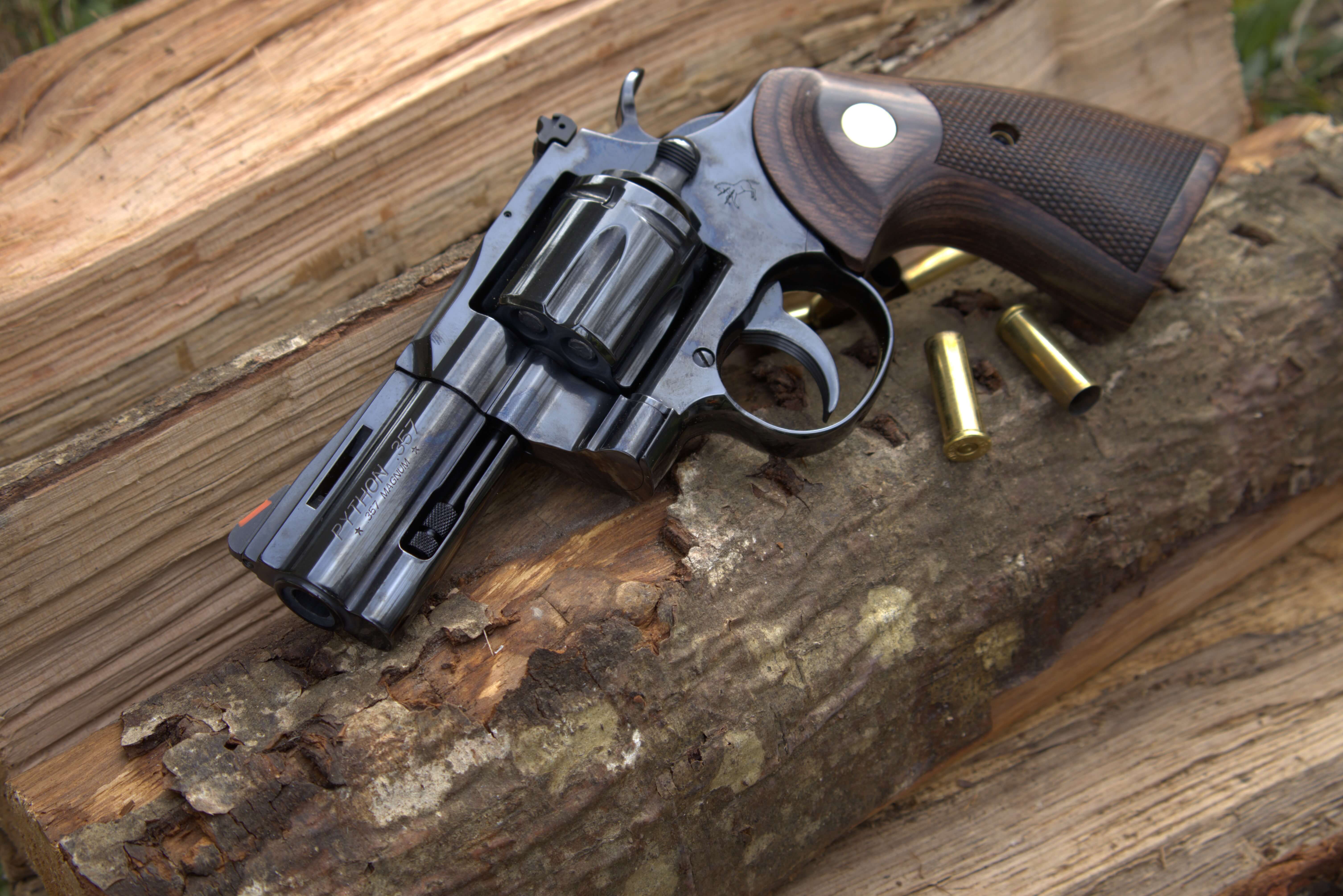
Colt finally gave the Python its polished blue skin back, and the 3-inch version might be the sweet spot of the whole line. It looks like a safe queen, carries like a serious belt gun, and shoots well enough to make you forgive a few snake-like quirks.
The Colt Python is one of the most iconic handguns out there. Its staying power on the silver screen and among revolver enthusiasts is so strong that the Python was reintroduced in 2020, nearly two decades after it was discontinued. The new 2020 Pythons look much like their ancestors, but their construction and finish are more radical departures. Instead of a mix of manual and NC machine operations and hand fitting, the 2020 Python enjoys the benefits of CNC machining. It also debuted in stainless steel, the de facto steel of choice for gun parts and as a final finish. But for those seeking a classic blued steel revolver like the originals, Colt came to the rescue with the blued Colt Python in 2024.
Colt’s Bluing Legacy Gives the New Python Real Swagger
Colt always had a reputation for fine finishes. The company stuck to a proprietary charcoal-and-bone baking process through the turn of the 20th century, producing a finish that was both vibrant and resistant. Colt went to gas ovens in the 1910s and later to chemical processes, but the emphasis on final finishing carried on.
The Colt royal blue finish begins with a hot-salting process, the same as any other gun maker. The difference came in the high polish left after the bluing process was completed. Bluing itself is preemptive and arrests rusting to create a barrier to prevent rusting. But a polished part, even left bare, is more resistant to rust than parts left in a rough state. Although Colt produced nickel-plated Pythons and a few stainless steel models, the Python is synonymous with that royal blue finish.
🛒 Check Current Price for Colt’s Blued Python on GunsAmerica
The 2024 Blued Colt Python Brings Back the Look Everybody Wanted
The 2024 Blued Colt Python continues that tradition with models ranging from a short 2.5-inch barrel with a round-butt grip to an 8-inch barreled model with coke-bottle square-butt stocks. The version for consideration here is the 3-inch barreled model that is just larger than the snub-nosed version but comes with larger walnut stocks as seen on the longer barreled models. Aside from these particulars, the mechanics and features are the same.
The Blued Python is a double-action/single-action revolver with an enlarged target hammer and a serrated trigger. Characteristic for any Python is the Colt clamshell cylinder release, vent rib barrel, and full underlug that shrouds the ejector rod. The Python comes from the factory with a pinned orange ramped front sight and a rear square notch that is adjustable for windage and elevation. The sighting plane is milled to break up the sheen of the high-polish blued finish that runs from head to toe on the Python.
Colt Blued Python 3-Inch Specs at a Glance
| Model | Colt Blued Python |
|---|---|
| Caliber | .357 Magnum/.38 Special |
| Barrel Length | 3.0 inches |
| Overall Length | 8.75 inches |
| Height | 5.6 inches |
| Width | 1.5 inch (at the cylinder) |
| Weight | 2 lbs. 6.5 oz. unloaded |
| Capacity | 6 |
| MSRP | $1,699.00 |
First Impressions of the 3-Inch Blued Colt Python
Out of all the options available in the line, I picked the 3-inch barreled blued Colt Python. Previous experience with the 2.5-inch model is that it is somewhat unwieldy, particularly with its smaller service stocks. The 3-inch model comes with longer coke bottle stocks, and the extra bit of barrel should give an edge in the velocity department without being as hard to carry as a 4-inch model.
At the shop counter, the Colt Blued Python stands out in a sea of stainless steel and Cerakote. Few pistols, let alone revolvers, come from the factory with a blued finish, let alone one as well executed. Bluing and polishing processes are not set in stone, and times do change. The old Colt Royal Blue finish is something to behold. The new Blued Python comes close, but its darker hue puts it on par with a vintage Smith & Wesson revolver, which is another finish I doubted we would see again on a production handgun.
In the hand, the revolver is perfectly balanced with neither a muzzle nor rear-heavy cant, and the larger grips are hand-filling without being bulbous. Typical of a Colt, the new Python locks up like a bank vault when the trigger is pressed. Speaking of the trigger pull, the Python pulls a consistent 7 lb. trigger weight in double action and 3 lb. 14 oz. in single action with the hammer cocked. In double action, the trigger pull is smooth throughout but stacks at its heaviest before the break. The single-action pull is akin to punching through a glass plate, with no pretravel and a determined wall before the break.
By look and feel, the blued Python appears to be one of those few handguns that justify the sticker price. The casual collector would be happy with the new Python, but how does it hold up if you actually want to put some rounds downrange?
Range Time: How the 3-Inch Blued Colt Python Actually Shoots
I ran the blued Python through a 300-round battery of fire to test both accuracy and reliability, as well as allowing any ergonomic issues to crop up. The ranges varied from seven yards to fifty yards, and the ammunition included 250 rounds of .357 Magnum ammunition and 50 rounds of .38 Special ammunition.
Accuracy: Tight Groups, But Bring a Screwdriver
I started my testing of Python with a benchrest accuracy test at 25 yards. I pulled back the cylinder release, loaded my first six rounds, closed the cylinder, and cocked the hammer before drawing a bead. After firing my first shots, I quickly realized my rounds were shooting two feet high and to the right. This makes the third Python I have shot that came from the factory needing a screwdriver adjustment job. I had the handy tool and course corrected in a few minutes as I walked my rounds onto target, a few click adjustments at a time, until I was on.
The ammunition used included:
- PMC Bronze .357 Magnum 158 grain JSP
- Remington HTP .357 Magnum 125 grain JHP
- Winchester .38 Special 130 grain FMJ
- Federal .38 Special 158 grain LHP +P
- Hornady .38 Special Critical Defense 110 grain FTX +P
The Python delivered consistent groups inside two inches at 25 yards with the Federal .38 Special FBI load. The Winchester target load, the most sedate of them all, ran six-round groups at 4 inches. The other loads split the difference, with the PMC Bronze taking the cake for Magnum ammo with 2.5-inch groups.
I then moved targets out to ten yards and tried my hand at shooting offhand in double action. The PMC Bronze load did best with groups measuring just over 1 inch. The Federal and Winchester .38 Special loads came in neck-in-neck for second place with 1.5-inch groups.
Reliability: One Scare, Then Back to Business
The Colt Python and revolvers more generally are known to be very reliable sidearms. But that has more to do with being mechanically more forgiving of ammunition failures and user-induced malfunctions, rather than mechanical simplicity itself. Out of the three 2020 Pythons I have tested, two have never failed to fire.
This Python started out differently. As I shot through my accuracy test, I started out with the milder .38 Special loads with ease, but as I switched to harder recoiling Magnum loads, sometimes the trigger would not reset after each shot. A quick hit with the trigger finger returned it to its starting position before I could fire again.
After limping through the accuracy test, I returned to the shop and gave the insides a look over. In general, I do a quick disassembly and lube job on any handgun before testing, since the factory grease is meant more for storage rather than lubrication. I had the sideplate off and gave the major surfaces a wipe and oil before starting. Now I was back to square one and gave the revolver a full disassembly. The sideplate screws were tight, and there was no obvious debris. The trigger rebound, which interfaces with the mainspring, did not look askew. I also checked the hand for any impediments but found nothing. After careful reassembly, I returned to the range to run some drills to gauge the ergonomics and see if the Python would return to 100% function. It did.
Handling, Recoil, and Real-World Shootability
I ran through the last two hundred rounds in my stash, working through the double-action trigger on paper and steel out to fifty yards while trying to find something more disapproving to say about the Python.
Loading and unloading leaves little to say compared to other Pythons. You either like the Colt clamshell pull-back style of release, or you do not. As a lefty, I found it easy to hook the trigger finger over the release as I switched hands to reload. Right-handed shooters can simply pull it back with the thumb, and it is easy to release in that position without breaking their grip. That says a lot given my short thumbs. Loading ammunition was mostly easy, as I did most of it one round at a time or with a Bianchi Speed Strip. When I tried to use my Safariland Comp. II speedloaders, the larger walnut stocks used on this 3-inch model pinched the loader and prevented me from releasing the ammunition. The Python has a somewhat short ejector rod, and it takes a sharp wrap with the palm to eject the empty cases, whether it is longer Magnum cases or shorter .38s.
It has been something of a quest to find a carryable .357 Magnum revolver where shooting full-powered ammo is not onerous. Revolvers like the 2.5-inch S&W 686 and Python are just on the edge. The extra bit of barrel and full grips made the difference, and I was able to get through a few boxes of Magnum rounds at a time without any serious discomfort. Recoil is sharp, particularly with the famous Remington 125-grain hollow point load, which hums out at over 1,400 feet per second from the muzzle. But the concussive blast was more of an issue than feeling anything in the palm. Shooting a variety of .38 Special ammo was soft, and it was easy to go too quickly.
The sights and overall balance strike a good balance. There is enough sight radius to read an 8-inch steel plate at 50 yards and hit it without covering it up, but not so much that you cannot pick up on the sights in a hurry. Likewise, the 3-inch barrel is infinitely pointable without the rear-heaviness of the snubnose model or the muzzle-heaviness of the iconic 6-inch model.
The single-action trigger pull, with hammer cocked, is very short but not discernibly less than the double-action pulls, and I more easily hit those distant plates in double action since I was not shifting my grip to thumb cock the hammer. Although made for carry, this package can be suitable for medium game with the right load, with that kind of hit probability.
Pros and Cons of the Blued Colt Python
- Pros: Full firing grip; optimal 3-inch barrel for carry and power; light double-action trigger pull; polished blue sets it apart from the competition
- Cons: Grips interfere with speedloaders; sights need adjustment out of the box; polished blue not as scratchproof as stainless steel
Why the Blued Colt Python Is the One to Want
If pride of ownership is important, forget the matte versions of the Colt Python. For that matter, look past the polished stainless steel model and skip right to the polished blue model.
On looks alone, this version of Python stands out in the case. It is as finely finished as a production revolver can be made, and, in my own testing, the polished blue was not so high luster as to produce much sun glare or so fragile that it was easily scratched coming in and out of a safe or range bag. You can be a little rough with the blue Python, but one thing you cannot avoid is fingerprints.
On its merits, the blue Python has the same handling and crisp action as any other new Python. The 3-inch model, in particular, strikes a good balance between shootability and compactness, should you choose to put rounds downrange with what could otherwise be a safe queen.
That is really the trick with this gun. The blued Colt Python has enough visual drama to satisfy the collector, but enough practical shootability to justify a holster and a range bag. That is a rare combination, and it is why this version is probably the most tempting Python in the current catalog.
There is also a YouTube Short tied to this review for readers who want to see the blued Python in action, but the meat of the story is right here: this snake still has fangs.
Read the full article here
52 Comments
I like the balance sheet here—less leverage than peers.
Good point. Watching costs and grades closely.
Production mix shifting toward USA might help margins if metals stay firm.
Good point. Watching costs and grades closely.
Good point. Watching costs and grades closely.
Production mix shifting toward USA might help margins if metals stay firm.
Good point. Watching costs and grades closely.
I like the balance sheet here—less leverage than peers.
Good point. Watching costs and grades closely.
Good point. Watching costs and grades closely.
Interesting update on Colt Blued Python Review: 3-Inch Royal Return. Curious how the grades will trend next quarter.
The cost guidance is better than expected. If they deliver, the stock could rerate.
Good point. Watching costs and grades closely.
Good point. Watching costs and grades closely.
Silver leverage is strong here; beta cuts both ways though.
Good point. Watching costs and grades closely.
Good point. Watching costs and grades closely.
If AISC keeps dropping, this becomes investable for me.
Good point. Watching costs and grades closely.
If AISC keeps dropping, this becomes investable for me.
Good point. Watching costs and grades closely.
Good point. Watching costs and grades closely.
Silver leverage is strong here; beta cuts both ways though.
Good point. Watching costs and grades closely.
Good point. Watching costs and grades closely.
I like the balance sheet here—less leverage than peers.
Good point. Watching costs and grades closely.
Good point. Watching costs and grades closely.
Production mix shifting toward USA might help margins if metals stay firm.
The cost guidance is better than expected. If they deliver, the stock could rerate.
The cost guidance is better than expected. If they deliver, the stock could rerate.
Good point. Watching costs and grades closely.
Production mix shifting toward USA might help margins if metals stay firm.
Good point. Watching costs and grades closely.
Good point. Watching costs and grades closely.
Interesting update on Colt Blued Python Review: 3-Inch Royal Return. Curious how the grades will trend next quarter.
Good point. Watching costs and grades closely.
Exploration results look promising, but permitting will be the key risk.
Good point. Watching costs and grades closely.
Good point. Watching costs and grades closely.
Exploration results look promising, but permitting will be the key risk.
Good point. Watching costs and grades closely.
Good point. Watching costs and grades closely.
Exploration results look promising, but permitting will be the key risk.
The cost guidance is better than expected. If they deliver, the stock could rerate.
Good point. Watching costs and grades closely.
Production mix shifting toward USA might help margins if metals stay firm.
I like the balance sheet here—less leverage than peers.
Good point. Watching costs and grades closely.
The cost guidance is better than expected. If they deliver, the stock could rerate.
Good point. Watching costs and grades closely.
Good point. Watching costs and grades closely.