

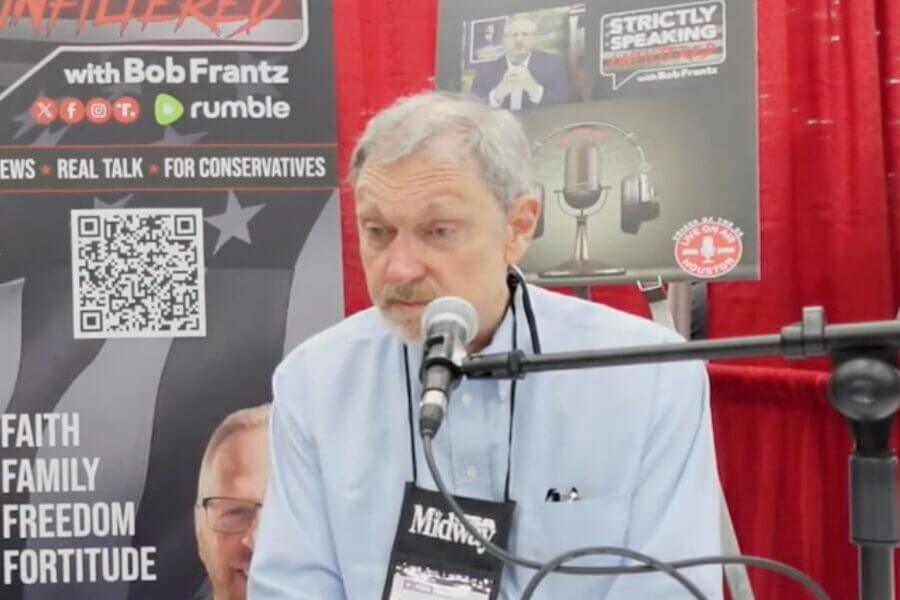
If there was one theme that kept surfacing during Dr. John Lott’s sit-down on Strictly Speaking: Unfiltered with Bob Frantz at the NRA Convention, it was this: the facts are out there but good luck getting anyone to debate them.
Lott, the economist and founder of the Crime Prevention Research Center, didn’t hold back. From his academic career to the reliability of FBI crime data, the conversation hit nearly every pressure point in today’s gun debate.
And if you’ve followed Lott for any amount of time, none of it will surprise you.
“You Just Can’t Get People to Debate”
Lott made it clear early; this isn’t just a disagreement over policy. It’s a refusal to engage.
“You just can’t get people to debate,” Lott said, pointing out that many critics rely on talking points rather than understanding how crime data is actually compiled.
According to Lott, that’s where he separates himself. He doesn’t just cite statistics, he explains how they’re built, where they fall short, and how they’re often misused.
That, he says, is exactly why critics avoid him.
The Academic Fallout
Lott also pulled back the curtain on something many in the 2A world already suspected: his research didn’t just spark controversy. It cost him.
He detailed stints at major institutions like the University of Chicago and Yale, where political pressure followed his work on guns.
At one point, he says Chicago leadership told him his presence would cause “irreparable harm” to the school’s relationship with the city.
Later, after testifying about Hawaii’s gun laws (highlighting that licensing systems solved no crimes while consuming massive police resources) he found himself on the outs again.
From there, he says, the doors in academia started closing.
FBI Crime Data: “A Hot Mess”
If there was a centerpiece to Lott’s current work, and his NRA seminars, it’s this: the way crime data is presented to the public.
Lott argued that the FBI’s reporting helped shape a misleading narrative heading into the 2024 election.
Here’s the breakdown he gave:
- FBI data (reported crime) showed an 8% drop
- But only about 43% of violent crimes are reported
- The Bureau of Justice Statistics’ victimization survey showed a 59% increase in violent crime
That’s not a rounding error. That’s a completely different reality.
“For a whole year you had headlines saying violent crime is down,” Lott explained, noting that revised data flipping a reported decrease into an increase was buried in footnotes and largely ignored.
His claim? The narrative stuck and few in media bothered to revisit it.
Even Conservative Media Isn’t Calling
One of the more surprising moments came when Lott admitted he’s not just iced out by CNN or MSNBC, he’s barely showing up on conservative outlets either.
“MSNBC and CNN just don’t call anymore,” he said, adding that even Fox appearances have dried up over time.
That’s a problem, according to host Bob Frantz, who pointed out that Lott isn’t built for quick sound bites. He’s an “explainer.”
And in a debate this complex, that matters.
Gun Control Myths and “Soft Targets”
Lott also hit one of his longtime talking points: how mass shootings are framed.
He argues the U.S. is often portrayed as uniquely dangerous without proper context.
“People don’t put it in per capita rates… we’re ranked around 64th,” he said when comparing mass public shootings internationally.
But the bigger issue? Where attacks happen.
Lott says attackers repeatedly choose gun-free zones, not randomly but because they expect less resistance and more casualties.
It’s a pattern he says shows up again and again in manifestos, but rarely makes headlines.
“If I Didn’t Do It, Nobody Would”
Despite the career hits, media blackouts, and constant pushback, Lott says he never seriously considered backing off.
Why? Because he believes the alternative is worse.
“I had never seen so much misinformation… I convinced myself if I didn’t go and argue those things, nobody would.”
That mindset has made him a lightning rod but also a fixture in the gun rights debate.
The Bottom Line
Love him or hate him, Lott isn’t going anywhere.
And if his appearance at NRA Houston proved anything, it’s that there’s still a strong appetiten(at least among this crowd) for long-form, data-driven arguments in a debate that’s often reduced to headlines and hashtags.
The bigger question? Why aren’t more people willing to engage with them.
*** Buy and Sell on GunsAmerica! ***
Read the full article here
33 Comments
I like the balance sheet here—less leverage than peers.
Good point. Watching costs and grades closely.
The cost guidance is better than expected. If they deliver, the stock could rerate.
Good point. Watching costs and grades closely.
Uranium names keep pushing higher—supply still tight into 2026.
Good point. Watching costs and grades closely.
If AISC keeps dropping, this becomes investable for me.
Good point. Watching costs and grades closely.
If AISC keeps dropping, this becomes investable for me.
Silver leverage is strong here; beta cuts both ways though.
Good point. Watching costs and grades closely.
Good point. Watching costs and grades closely.
Nice to see insider buying—usually a good signal in this space.
Production mix shifting toward USA might help margins if metals stay firm.
Good point. Watching costs and grades closely.
Exploration results look promising, but permitting will be the key risk.
Exploration results look promising, but permitting will be the key risk.
Good point. Watching costs and grades closely.
If AISC keeps dropping, this becomes investable for me.
Silver leverage is strong here; beta cuts both ways though.
Good point. Watching costs and grades closely.
Production mix shifting toward USA might help margins if metals stay firm.
Good point. Watching costs and grades closely.
Good point. Watching costs and grades closely.
I like the balance sheet here—less leverage than peers.
If AISC keeps dropping, this becomes investable for me.
Good point. Watching costs and grades closely.
Good point. Watching costs and grades closely.
If AISC keeps dropping, this becomes investable for me.
Good point. Watching costs and grades closely.
Exploration results look promising, but permitting will be the key risk.
Good point. Watching costs and grades closely.
Good point. Watching costs and grades closely.