

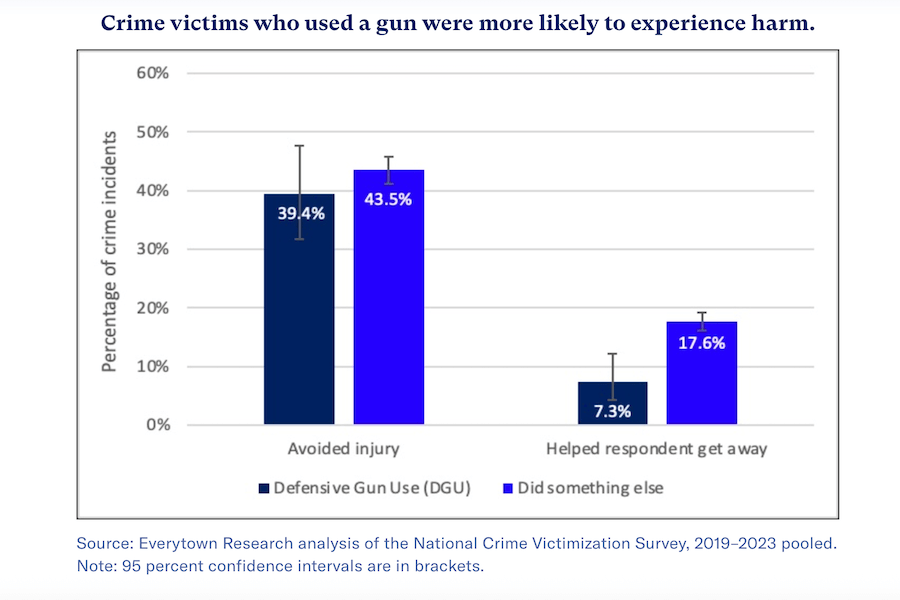
Everytown for Gun Safety’s latest report argues that defensive gun use is “exceedingly rare,” offers no meaningful protection, and carries serious “personal and social risks,” setting the stage for yet another push to convince Americans they’re safer unarmed.
The document leans heavily on selective data, mischaracterized anecdotes, and a familiar narrative: ordinary Americans should trust criminals to behave better while trusting the state to arrive on time.
But the report avoids the most important question: what happens when citizens are left defenseless?
The opening examples — a series of mistaken-identity shootings — are tragedies, not representative of lawful self-defense.
Lumping these incidents into the “defensive gun use” category creates a distorted picture from the start.
Millions of responsible gun owners carry lawfully every day without harming anyone.
Holding them responsible for criminal or negligent acts is no different than blaming sober drivers for the conduct of drunk ones.
Everytown’s report leans on National Crime Victimization Survey (NCVS) estimates to downplay DGU frequency.
But NCVS data are self-reported, limited to incidents where the victim recognized a crime in progress, and incapable of accounting for deterrence, cases where a criminal simply avoids a potentially armed target.
Criminologists have documented for decades that criminals routinely avoid armed victims, and surveys of incarcerated offenders consistently show fear of armed resistance as a major factor in choosing targets.
A crime prevented before it begins never appears in the NCVS.
The report also argues that violent crime is “falling,” as if national averages eliminate personal risk.
Crime trends fluctuate widely by region, and even during periods of national decline, everyday Americans still face carjackings, sexual assaults, home invasions, and armed robberies.
Averages do not stop the worst-case scenario from happening to a single mother parked at a gas station at 10 p.m.
Everytown’s claim that using a gun for self-defense “does not reduce harm” overlooks reality on the ground.
Thousands of verified cases each year show armed citizens stopping violent criminals: carjackers, home invaders, repeat offenders released early, and attackers who would have otherwise continued harming innocent people.
These events are documented by police departments, prosecutors, and local news outlets, and they often involve people who would not have survived without immediate resistance.
The report also reframes the presence of firearms in the home as a threat rather than a safeguard.
Responsible firearm ownership (secure storage, training, and situational awareness) dramatically reduces preventable accidents.
Millions of families keep firearms without incident because safety practices work when they are practiced.
Everytown concludes that Americans should rely on “affordable” security systems (not guns!) and wait for the authorities.
But when seconds matter, a lock, a light, or a camera does not stop an attacker.
Defensive gun use is not a myth, a marketing slogan, or a statistical inconvenience. It is a fundamental right, and, for many Americans, the only thing standing between survival and becoming the next victim in a headline.
Check out the full report below and let us know your thoughts. Are you at all persuaded by Everytown’s report and the data it presents?
*** Buy and Sell on GunsAmerica! ***
Read the full article here
21 Comments
Comparing responsible gun owners to drunk drivers is a weak analogy. Responsible ownership is key to preventing misuse.
The vast majority of gun owners handle their firearms safely and legally.
It’s ironic that a group advocating for safety is pushing policies that could make citizens more vulnerable.
True safety comes from being able to protect yourself, not relying on incomplete government responses.
The argument that ordinary Americans should trust the state completely ignores the reality of response times.
How many lives would be lost if people had to rely solely on law enforcement arriving in time?
The report seems to cherry-pick data to fit a predetermined narrative rather than presenting a balanced view.
In any debate, it’s important to consider all available evidence, not just what supports one side.
Mistaken-identity shootings are tragic, but they don’t represent the majority of lawful self-defense cases.
Using isolated incidents to paint a broader picture is a logical fallacy.
Disarming law-abiding citizens leaves them vulnerable to criminals who won’t follow gun laws anyway.
History shows that gun control measures don’t stop criminals—only disarm the innocent.
The selective use of anecdotes weakens the credibility of the report. A more comprehensive analysis is needed.
Without a full context, these examples don’t prove the central claim.
The argument that criminals will behave better without armed citizens is wishful thinking at best.
Criminals don’t follow laws—they exploit legal loopholes and gaps in enforcement.
This post conveniently ignores the statistical evidence showing that defensive gun use is a significant deterrent to crime.
The National Crime Victimization Survey data is self-reported and not always reliable.
But even under their own metrics, defensive gun use happens thousands of times a year.
The report downplays the positive impact of defensive gun use, which is well-documented in other studies.
Ignoring contrary evidence doesn’t make it disappear.