

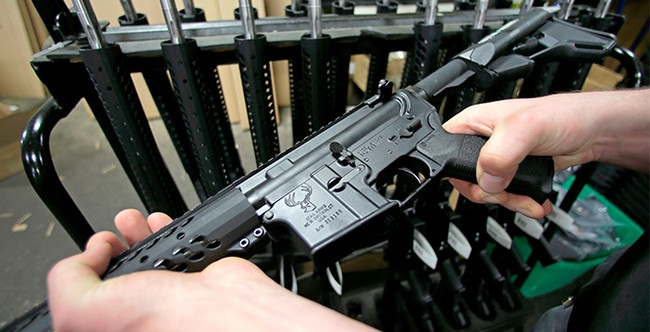
Well, that didn’t take long. Just a few days after the Third Circuit Court of Appeals struck down New Jersey’s ban on semi-automatic rifles deemed to be “assault weapons” by the state legislature (along with the state’s ban on ammunition magazines that can hold more than 10 rounds), the Department of Justice’s Civil Rights Division is asking a federal judge to block enforcement of a similar ban recently enacted in the U.S. Virgin Islands.
The USVI’s magazine ban prohibits the possession, receipt, purchase, sale, import, or transfer of magazines that can hold more than 15 rounds, not 10, but other than that the law is essentially the same. As the DOJ argues, “ANJRPC squarely holds that this is unconstitutional.”
Secondly, “AR-15s and similar sports rifles in circulation . . . typically come standard with twenty- or-thirty-round magazines.” Under Act 9113, no firearm in the USVI may contain a magazine of 15 rounds or greater. Accordingly, the USVI bans standard-capacity AR-15 rifles. Moreover, owners of firearms that were “manufactured to hold” more than fifteen-rounds cannot sell or transfer their firearm. The restriction on the private purchase, sale, or other transfer of constitutionally protected arms is itself unconstitutional. “Common sense dictates that the right to bear arms requires a right to acquire arms, just as the right to free press necessarily includes the right to acquire a printing press, or the right to freely practice religion necessarily rests on a right to acquire a sacred text.”
The DOJ goes on to argue that the Virgin Islands Police Department’s implementation of Act 9113 is “only the latest chapter in a years-long pattern or practice of law enforcement misconduct in which the VIPD has deprived the people the USVI of their Second Amendment rights,” and that the agency is entitled to obtain injunctive relief against “such law enforcement misconduct,” since the DOJ is tasked with ensuring that governmental agencies or individual members of law enforcement do not engage in a pattern or practice of conduct that deprives individuals of their constitutional rights, privileges, or immunities.
Plaintiff is certain to prevail on the merits regarding USVI’s arms ban as explained above. Plaintiff and the citizens of the Virgin Islands will also unquestionably suffer irreparable injury without relief. Act 9113 “grandfathers” firearms that were owned when it was passed. But it does not grandfather the magazines. Therefore, anyone who currently owns a banned magazine is faced with the Hobsons’ choice of destroying his constitutionally protected arm or keeping it and risking arrest and incarceration.
The DOJ’s brief closes with a “respectful request” for the following injunctive relief:
A prohibition on the USVI and VIPD (1) enforcing any prohibition on possession, receipt, purchase, sale, import, or transfer of magazines that hold 30 or fewer rounds; and (2) enforcing any ban on selling or transferring a firearm merely because it was manufactured to hold more than 15 rounds.
This injunctive request kind of forces the issue of whether the DOJ Civil Rights Division is empowered to file suit against governments for a pattern or practice of infringing on the Second Amendment rights of their constituents. To me, that’s a no-brainer, but since the Civil Rights Division has never actually done so until now, anti-gunners claim that the DOJ has no authority to do so.
The other interesting part of the injunction is the decision by DOJ to limit the scope of its desired relief to magazines that can hold no more than 30 rounds of ammunition. The Third Circuit decision in ANJRPC didn’t delve into the question of whether a magazine ban of any size could be justified by a historical tradition of gun regulation, and I’m curious as to why the DOJ decided to draw the line at 30 rounds.
In fact, the Third Circuit held that “nothing in text of the Second Amendment suggests that the capacity of a magazine bears on whether it receives constitutional protection.”
So it cannot be that amagazine that can hold ten rounds is an “Arm[]” covered bythe plain text of the Second Amendment but a magazine that can hold eleven rounds is not. Although magazines of different capacities may implicate different public policy concerns, “the enshrinement of constitutional rights necessarily takes certain policy choices off the table.” At least at Bruen’s first step, policy choices have no bearing on whether magazines of any size are covered by the text of the Second Amendment.
What about at Bruen‘s second step? The court pointed out that New Jersey’s only real analogues were laws regulating the storage of gunpowder, which embodied both a different “how” and “why” than the Garden State’s magazine ban. But the court also noted that “there are over 100 million 30-round AR-15 magazines in circulation,” which means they’re in common use.
Now, we don’t know how many magazines that can hold more than 30 rounds are in circulation, but even if the number is in the millions or even hundreds of thousands, there are no historical analogues pointing to a restriction on magazine capacity of any kind.
It may be that DOJ went with a 30-round limit simply because that was the largest capacity magazine the Third Circuit referenced as being in common use. Still, it does raise some questions. Do DOJ and the Civil Rights Division believe there is a point at which magazines can be banned because of their capacity? And if so, where is that point and what is the historical justification for drawing the line at “x” number of rounds?
Editor’s Note: President Trump and Republicans across the country are doing everything they can to protect our Second Amendment rights and right to self-defense.
Help us continue to report on their efforts and legislative successes. Join Bearing Arms VIP and use promo code FIGHT to receive 60% off your membership.
Read the full article here
29 Comments
If AISC keeps dropping, this becomes investable for me.
Good point. Watching costs and grades closely.
Good point. Watching costs and grades closely.
Production mix shifting toward USA might help margins if metals stay firm.
Good point. Watching costs and grades closely.
I like the balance sheet here—less leverage than peers.
Good point. Watching costs and grades closely.
Uranium names keep pushing higher—supply still tight into 2026.
Interesting update on DOJ Seeks to Block Virgin Islands’ ‘Assault Weapon’ and Magazine Ban. Curious how the grades will trend next quarter.
Silver leverage is strong here; beta cuts both ways though.
Good point. Watching costs and grades closely.
Good point. Watching costs and grades closely.
Nice to see insider buying—usually a good signal in this space.
Good point. Watching costs and grades closely.
Good point. Watching costs and grades closely.
Exploration results look promising, but permitting will be the key risk.
Uranium names keep pushing higher—supply still tight into 2026.
Good point. Watching costs and grades closely.
Production mix shifting toward USA might help margins if metals stay firm.
If AISC keeps dropping, this becomes investable for me.
Good point. Watching costs and grades closely.
Good point. Watching costs and grades closely.
Exploration results look promising, but permitting will be the key risk.
The cost guidance is better than expected. If they deliver, the stock could rerate.
Good point. Watching costs and grades closely.
Silver leverage is strong here; beta cuts both ways though.
The cost guidance is better than expected. If they deliver, the stock could rerate.
Interesting update on DOJ Seeks to Block Virgin Islands’ ‘Assault Weapon’ and Magazine Ban. Curious how the grades will trend next quarter.
Good point. Watching costs and grades closely.