

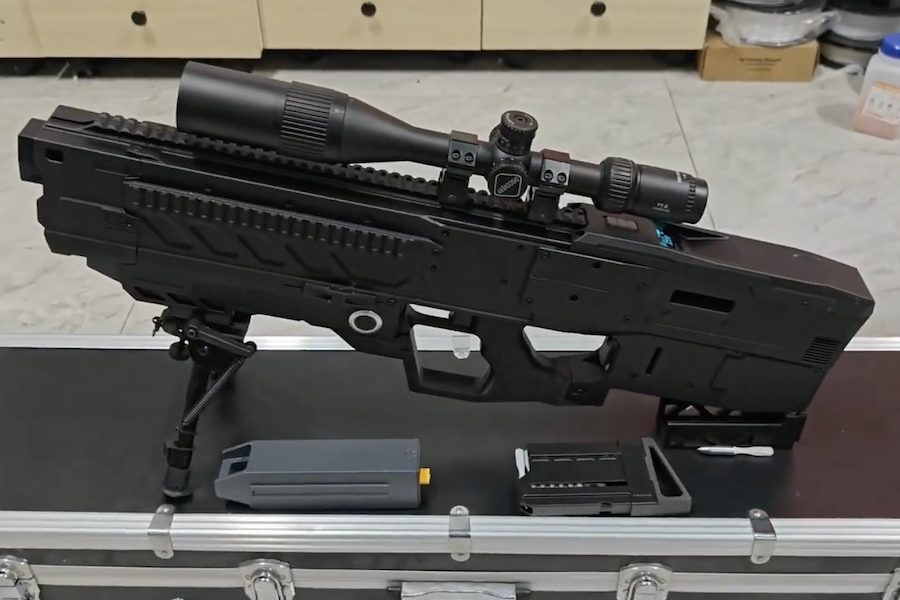
It sounds like something straight out of sci-fi but it’s starting to look a lot more real.
A recent breakdown from the YouTube channel East Tech Now dives into the growing world of electromagnetic launchers, and the takeaway is pretty clear:
This tech isn’t stuck in the lab anymore.
We’re now seeing it show up across three lanes at once, civilian products, garage-level innovation, and even early military deployment.
Let’s start with what’s actually on the market.
One of the most developed civilian options right now is the CA-9 coil-based launcher, built around a multi-stage Gauss system that uses electromagnetic fields instead of gunpowder to accelerate a projectile. That means no cartridge, no combustion, and almost no recoil.
But before anyone jumps to conclusions, this isn’t replacing your AR. Not even close.
The CA-9 is capped at under 16 joules of energy, with velocities around 97 meters per second and an effective range of roughly 15–30 meters. In other words, we’re talking recreational use, maybe non-lethal applications. Not anything approaching traditional firearms in terms of power.
That said, it does bring some interesting trade-offs.
The system can theoretically hit rates of fire up to 2,400 rounds per minute, runs on lithium batteries, and delivers around 100–200 shots per charge. It’s lightweight, relatively simple to operate, and doesn’t produce muzzle flash or spent casings.
But there are limits. Heat buildup becomes an issue with sustained fire, and durability is still firmly in the “civilian-grade” category, not something built for hard use or harsh environments.
Now here’s where things get more interesting. Beyond commercial products, the barrier to entry is dropping fast.
The report highlights a Chinese university student who independently designed and built a multi-stage electromagnetic launcher from scratch. Handling everything from coil timing systems to structural design and live-fire testing.
That’s a big shift. What used to require military-level resources is now being tackled with 3D printing, basic machining, and off-the-shelf components.
And then there’s the third lane: Military.
According to the report, China has already moved beyond prototypes and into early deployment of a handheld electromagnetic small arm, with adjustable power levels that can range from non-lethal applications up to armor-penetrating capability, including the ability to punch through 10mm steel at 50 meters in high-power mode.
Performance-wise, it’s pushing 1,000–2,000 rounds per minute, minimal recoil, low noise (around 65 decibels), and no visible muzzle signature, features that would clearly matter in specialized operations.
It’s also reportedly been tested in extreme conditions, from cold weather to high humidity, suggesting this isn’t just a concept piece anymore. So what does all this mean?
Right now, these systems exist in very different worlds. Civilian versions are limited, controlled, and more novelty than replacement. DIY builds show how fast the tech is becoming accessible. Military versions (at least on paper) are where things start getting serious.
But the bigger picture is hard to ignore. Electromagnetic launch tech is moving (slowly, but steadily) from experiment… to application. And while it’s not replacing traditional firearms anytime soon, it’s definitely something to keep an eye on.
*** Buy and Sell on GunsAmerica! ***
Read the full article here
33 Comments
Uranium names keep pushing higher—supply still tight into 2026.
Good point. Watching costs and grades closely.
Good point. Watching costs and grades closely.
I like the balance sheet here—less leverage than peers.
Uranium names keep pushing higher—supply still tight into 2026.
Good point. Watching costs and grades closely.
Good point. Watching costs and grades closely.
Interesting update on Electromagnetic Guns Are Here!. Curious how the grades will trend next quarter.
Good point. Watching costs and grades closely.
Good point. Watching costs and grades closely.
If AISC keeps dropping, this becomes investable for me.
Good point. Watching costs and grades closely.
Good point. Watching costs and grades closely.
I like the balance sheet here—less leverage than peers.
Production mix shifting toward USA might help margins if metals stay firm.
Good point. Watching costs and grades closely.
Exploration results look promising, but permitting will be the key risk.
Exploration results look promising, but permitting will be the key risk.
Good point. Watching costs and grades closely.
Good point. Watching costs and grades closely.
Silver leverage is strong here; beta cuts both ways though.
Good point. Watching costs and grades closely.
Good point. Watching costs and grades closely.
Nice to see insider buying—usually a good signal in this space.
Good point. Watching costs and grades closely.
Exploration results look promising, but permitting will be the key risk.
Uranium names keep pushing higher—supply still tight into 2026.
Good point. Watching costs and grades closely.
If AISC keeps dropping, this becomes investable for me.
Exploration results look promising, but permitting will be the key risk.
If AISC keeps dropping, this becomes investable for me.
Good point. Watching costs and grades closely.
Good point. Watching costs and grades closely.