

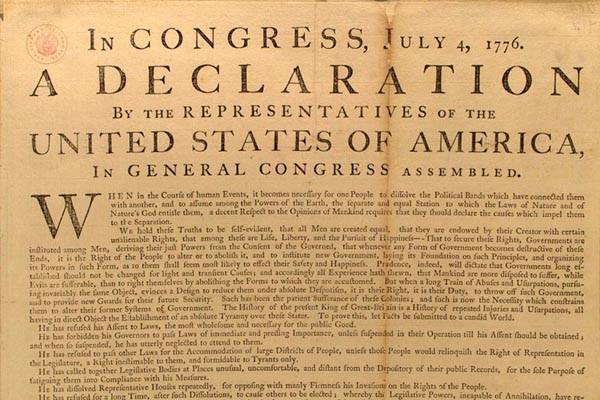
America’s revolutionary Charter of Freedom, the Declaration of Independence is a document upon which our nation’s founding principles were established. The Declaration of Independence set the course for our nation on a journey of freedom, which also led this historic document on its own journey. For example, did you know:
Who Authored the Declaration of Independence?
Thomas Jefferson wrote the first draft of the Declaration of Independence, which was then edited by John Adams and Benjamin Franklin. Jefferson took their edits and incorporated them into what would become the version finally adopted.
Independence Day Should Have Been July 2
July 2, 1776 is the day that the Continental Congress actually voted for independence. John Adams, in his writings, even noted that July 2 would be remembered in the annals of American history and would be marked with fireworks and celebrations. The written Declaration of Independence was dated July 4 but wasn’t actually signed until August 2. Fifty-six delegates eventually signed the document, although all were not present on that day in August.
Who Signed and In What Order?
John Hancock signed first, with a large hand right in the middle because he was the President of the Congress. The others signed by state delegation, beginning in the upper right in one column, and then proceeding in five other columns, arranged from the northernmost state (New Hampshire) to the southernmost (Georgia).
Who Signed Last?
It is believed Thomas McKean of Delaware was the last person to sign. When Congress authorized the printing of an official copy with the names attached in January 1777, McKean’s name was not included. He signed after that date, or the printer made a mistake by omitting him.
On The Road Again
The Declaration of Independence spent many years on the road. After the signing ceremony on August 2, it was most likely filed in Philadelphia. On December 12, threatened by the British, Congress adjourned and reconvened 8 days later in Baltimore, MD, where the document remained until its return to Philadelphia in March of 1777. In the years to follow, it traveled widely with the Continental Congress throughout the Northeast, then moving to Washington, DC in 1800. In 1814, again threatened by war, it was moved to an unused gristmill in Virginia for protection. On August 24, as the British burned the White House, it was moved to Leesburg, VA until September, when it returned to the nation’s capital. With the exception of a trip to Philadelphia for the Centennial and to Fort Knox during World War II, it has remained there ever since.
If By Land or By Sea
The document has also experienced many modes of travel. Initially, like other parchment documents of the time, the Declaration was probably stored in a rolled format. Each time the document was used, it would have been unrolled and re-rolled. It likely traveled by light wagon and by horseback with the Continental Congress it its early years. When it was first brought to Washington, it traveled by boat, down the Delaware River and Bay, out into the ocean, into the Chesapeake Bay, and up the Potomac to the new capital city. During World War II, it was moved by Pullman train to Louisville, KY and transferred under armed guard to Fort Knox for safety and protection.
Line of Descent
Actress Reese Witherspoon is a direct descendant of John Witherspoon, one of the 56 signers of the Declaration of Independence. John Witherspoon is pictured in a Barry Faulkner Mural, entitled “The Declaration of Independence,” which illustrates 28 delegates to the Continental Congress of 1776. This newly restored mural is hanging in the Rotunda of the National Archives.
Visit www.archives.gov for a complete schedule and updated information on all National Archives public programs.
Read the full article here
41 Comments
Interesting update on Fun Facts About the Declaration of Independence. Curious how the grades will trend next quarter.
If AISC keeps dropping, this becomes investable for me.
Interesting update on Fun Facts About the Declaration of Independence. Curious how the grades will trend next quarter.
Good point. Watching costs and grades closely.
Good point. Watching costs and grades closely.
Production mix shifting toward USA might help margins if metals stay firm.
I like the balance sheet here—less leverage than peers.
Interesting update on Fun Facts About the Declaration of Independence. Curious how the grades will trend next quarter.
Good point. Watching costs and grades closely.
Good point. Watching costs and grades closely.
Exploration results look promising, but permitting will be the key risk.
Good point. Watching costs and grades closely.
Nice to see insider buying—usually a good signal in this space.
Good point. Watching costs and grades closely.
The cost guidance is better than expected. If they deliver, the stock could rerate.
Good point. Watching costs and grades closely.
Good point. Watching costs and grades closely.
The cost guidance is better than expected. If they deliver, the stock could rerate.
The cost guidance is better than expected. If they deliver, the stock could rerate.
Exploration results look promising, but permitting will be the key risk.
Good point. Watching costs and grades closely.
Good point. Watching costs and grades closely.
Uranium names keep pushing higher—supply still tight into 2026.
Good point. Watching costs and grades closely.
Good point. Watching costs and grades closely.
Exploration results look promising, but permitting will be the key risk.
Good point. Watching costs and grades closely.
Good point. Watching costs and grades closely.
Nice to see insider buying—usually a good signal in this space.
Good point. Watching costs and grades closely.
Good point. Watching costs and grades closely.
Interesting update on Fun Facts About the Declaration of Independence. Curious how the grades will trend next quarter.
Good point. Watching costs and grades closely.
Good point. Watching costs and grades closely.
Production mix shifting toward USA might help margins if metals stay firm.
Good point. Watching costs and grades closely.
Good point. Watching costs and grades closely.
Production mix shifting toward USA might help margins if metals stay firm.
The cost guidance is better than expected. If they deliver, the stock could rerate.
Good point. Watching costs and grades closely.
Good point. Watching costs and grades closely.