
Shot down in a hostile landing zone, blasted apart, and stabbed through the leg, Gary Wetzel still fought his way back to an M60 machine gun. What happened next earned him the Medal of Honor and made his Vietnam story almost impossible to believe.
Gary Wetzel’s Medal of Honor Fight Began in a Huey
Gary Wetzel was born in 1947 in South Milwaukee, Wisconsin. In 1965, he was an 18-year-old soldier working in ordnance. He enlisted for three more years to serve as a door gunner on UH1 Huey helicopters in Vietnam. Wetzel was assigned to the 173d Assault Helicopter Company near Ap Dong An.
A group of four Australian helos flew into Wetzel’s firebase and got badly shot up for their trouble. Most of the hostile ground fire they had taken originated a mere kilometer from the perimeter. Realizing the imminent threat this represented, Wetzel’s commander put together a quick reaction mission to seek out the local VC force and eliminate it. On January 8, 1968, PFC Wetzel climbed aboard his Huey and charged his M60 machine gun. They took off as a flight of fourteen aircraft. Ten were American UH1s. The four Australian helicopters took part as well.
The Guns Gary Wetzel Carried Into a Vietnamese Killing Zone
By 1968, Vietnam was a mature war zone. That meant weapons were absolutely everywhere. The M16 was and is a solid combat rifle. However, at 39 inches overall, it is a bit bulky for the confines of a tactical helicopter.
The XM177E2 was the stubby carbine version of the M16 that was just seeing widespread issue to Special Forces troops. It would yet be a while before there were enough carbines to filter down to aviation units. In the meantime, Wetzel and his mates scrounged whatever they could find.
The US gifted untold tons of WW2-surplus ordnance to the South Vietnamese. Among these weapons were huge numbers of vintage M3 Grease Guns as well as M2 carbines and Thompson SMGs. Many of these weapons ended up available for barter among American troops.
Among aircrews, folding stock Kalashnikovs were prized but hen’s-teeth rare. I have heard of captured cut-down RPD belt-fed machine guns being used as well, but they were about as common as Bigfoot or fiscally responsible Congressmen. Flight crews not infrequently tucked an M79 40mm grenade launcher into their birds for a little serious thump. However, WW2-vintage .45ACP submachine guns were not uncommon. Wetzel packed a Tommy Gun himself.
The Thompson really was a niche tool. Those big, fat .45ACP rounds lost energy quickly at long ranges, and the thing was heavier than Aunt Edna’s prize Christmas fruit cake. Additionally, the ergonomics were all wrong, so it took some attention to technique to run the gun accurately and well. However, for a generation raised on Saturday afternoon gangster movies, the Thompson carried some undeniable sex appeal.
RPG Impact: Gary Wetzel’s Huey Falls Into a Kill Zone
Standard Operating Procedure had Huey gunships in the lead to sterilize the landing zone with machine gun fire and rockets. However, in this case, the gunships inexplicably fell behind. Wetzel’s slick was one of the first aircraft into the LZ. As they were on final approach, VC streamed out of the jungle like ants and opened fire. Wetzel noticed the RPG-2 rocket just before it impacted his aircraft.
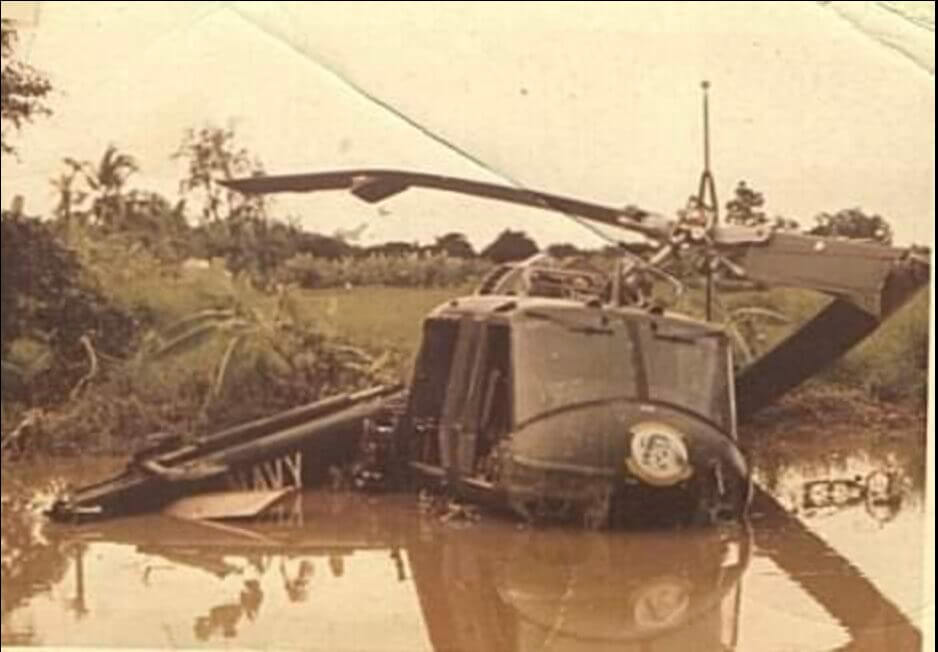
I used to fly Army helicopters myself. They are amazingly capable machines. However, they were never designed to withstand hits from anti-tank weapons. The RPG struck the Huey solidly in the left front. Wetzel’s pilots got the stricken bird to the ground more or less intact, but they were in a world of hurt.
One of the pilots had his legs shot to pieces. Wetzel and his crew chief wrestled the stricken officer out of the aircraft and took cover behind the disabled machine. At that moment, one of the VC threw a Combloc grenade that exploded among them. The blast liberally peppered Wetzel with shrapnel and shattered his left arm, leaving it dangling uselessly at an unnatural angle.
One Arm Ruined, Thompson Roaring: Wetzel Fights Back
So, imagine the scene. One moment, you’re making a low-level approach into a hostile LZ. Next, your aircraft is shot to pieces, and your pilot is bleeding to death. Then the VC blows your arm off. Most normal guys would have just rolled over and quit. However, Gary Wetzel was no normal guy.
The VC soldier who threw the first grenade was now readying a second. Firing his Thompson one-handed, Wetzel stitched the man up, causing him to drop his primed grenade. The little sputtering bomb exploded among the attacking VC and caused a brief lull in the incoming fire.
Wetzel and his crew chief took advantage of the respite to get tourniquets on the legs of the grievously wounded pilot. Then Wetzel noticed half a dozen VC struggling to remove his M60 from its pedestal mount on the side of the crashed helicopter. Once again, taking his Tommy Gun in his one remaining good hand, the badly wounded gunner took out all six with a long full-auto burst.
Despite their best efforts, the young pilot bled out and died. This was more than Gary Wetzel had signed up for this day. Now simply angry, he stuffed his useless left hand into his pistol belt so it wouldn’t flop around while he ran, stood up, and charged back over to the smoldering aircraft.
Back to the M60: Gary Wetzel Charges Through Enemy Fire
The VC had not been idle throughout all of this. They marshalled in the treeline and prepared for a massed attack. The enemy well appreciated that the greatest strength of the American military was its essentially unlimited close air support. If they had any hope of defeating the American assault, they had to get in close, too close for helicopter gunships and fast mover jets to lay down effective supporting fires. What happened next would determine whether Wetzel and his buddies lived or died.
Under suffocating enemy fire, Gary Wetzel charged across the open rice paddy toward his pedestal-mounted machine gun. Communist bullets sleeted across the space by the hundreds. Then one of the charging VC stabbed him through the leg with a bayonet, knocking him to the ground.
I saw an interview with Gary Wetzel where he related what happened next in his own words. His left arm was essentially shot off, and he had just taken a bayonet to his leg. His chest was thoroughly ventilated with shrapnel, as was his remaining good arm. He claimed he had no idea how he cleared the distance to the downed helicopter. He just said that the bayonet wound knocked him to the ground and that the next conscious memory he had was behind his gun.
The aircraft was dead, but Wetzel’s pig was just fine. He also had access to plenty of ammunition and was savvy enough to run his gun one-handed. Despite multiple horrific wounds, PFC Wetzel poured fire into the enemy emplacements. He eventually suppressed and then destroyed the VC gunners that had taken them under fire.
Bleeding Out, Wetzel Still Dragged His Buddies to Cover
With the major threat eliminated, there was still plenty to do. The VC kept shooting into the LZ, and there were scads of American wounded. Despite having his arm blown to pieces and having taken a stab wound through the leg, PFC Wetzel dragged injured American troops across the slippery mud of the rice paddy so that the medic could work to stabilize them. He lost consciousness several times due to his own bleeding, but refused to stop until his fellow soldiers were behind cover.
PFC Wetzel was eventually medevac’d. He lost his left arm but saved an LZ full of GIs. Here is his Medal of Honor citation:
Gary Wetzel’s Official Medal of Honor Citation
“Sp4c. Wetzel, 173d Assault Helicopter Company, distinguished himself by conspicuous gallantry and intrepidity at the risk of his life above and beyond the call of duty. Sp4c. Wetzel was serving as door gunner aboard a helicopter which was part of an insertion force trapped in a landing zone by intense and deadly hostile fire. Sp4c. Wetzel was going to the aid of his aircraft commander when he was blown into a rice paddy and critically wounded by two enemy rockets that exploded just inches from his location. Although bleeding profusely due to the loss of his left arm and severe wounds in his right arm, chest, and left leg, Sp4c. Wetzel staggered back to his original position in his gun-well and took the enemy forces under fire. His machine gun was the only weapon placing effective fire on the enemy at that time. Through a resolve that overcame the shock and intolerable pain of his injuries, Sp4c. Wetzel remained at his position until he had eliminated the automatic-weapons emplacement that had been inflicting heavy casualties on the American troops and preventing them from moving against this strong enemy force. Refusing to attend his own extensive wounds, he attempted to return to the aid of his aircraft commander but passed out from loss of blood. Regaining consciousness, he persisted in his efforts to drag himself to the aid of his fellow crewman. After an agonizing effort, he came to the side of the crew chief who was attempting to drag the wounded aircraft commander to the safety of a nearby dike. Unswerving in his devotion to his fellow man, Sp4c. Wetzel assisted his crew chief even though he lost consciousness once again during this action. Sp4c. Wetzel displayed extraordinary heroism in his efforts to aid his fellow crewmen. His gallant actions were in keeping with the highest traditions of the U.S. Army and reflect great credit upon himself and the Armed Forces of his country.”
Source: Congressional Medal of Honor Society, Gary George Wetzel recipient record and official citation.
Gary Wetzel Comes Home: A Medal of Honor Legacy
Gary Wetzel returned home to Milwaukee after he recovered to take a job as a heavy equipment operator. Gary Wetzel is a freaking animal, the kind of amazing American hero who made America what it is today. This one-armed military machine would not quit when quitting was the only reasonable thing to do. In so doing, he showed us all what it means to truly be a man.
Read the full article here
55 Comments
Exploration results look promising, but permitting will be the key risk.
Good point. Watching costs and grades closely.
Good point. Watching costs and grades closely.
Silver leverage is strong here; beta cuts both ways though.
Good point. Watching costs and grades closely.
Nice to see insider buying—usually a good signal in this space.
Good point. Watching costs and grades closely.
Production mix shifting toward USA might help margins if metals stay firm.
Silver leverage is strong here; beta cuts both ways though.
Good point. Watching costs and grades closely.
Exploration results look promising, but permitting will be the key risk.
Production mix shifting toward USA might help margins if metals stay firm.
Good point. Watching costs and grades closely.
Good point. Watching costs and grades closely.
Nice to see insider buying—usually a good signal in this space.
Good point. Watching costs and grades closely.
If AISC keeps dropping, this becomes investable for me.
Good point. Watching costs and grades closely.
Good point. Watching costs and grades closely.
Nice to see insider buying—usually a good signal in this space.
Good point. Watching costs and grades closely.
Interesting update on Gary Wetzel’s M60 Medal of Honor Stand. Curious how the grades will trend next quarter.
Good point. Watching costs and grades closely.
Production mix shifting toward USA might help margins if metals stay firm.
Good point. Watching costs and grades closely.
Silver leverage is strong here; beta cuts both ways though.
Good point. Watching costs and grades closely.
Uranium names keep pushing higher—supply still tight into 2026.
Good point. Watching costs and grades closely.
Good point. Watching costs and grades closely.
Nice to see insider buying—usually a good signal in this space.
Good point. Watching costs and grades closely.
Uranium names keep pushing higher—supply still tight into 2026.
Good point. Watching costs and grades closely.
If AISC keeps dropping, this becomes investable for me.
The cost guidance is better than expected. If they deliver, the stock could rerate.
Good point. Watching costs and grades closely.
Good point. Watching costs and grades closely.
Interesting update on Gary Wetzel’s M60 Medal of Honor Stand. Curious how the grades will trend next quarter.
Good point. Watching costs and grades closely.
Good point. Watching costs and grades closely.
Production mix shifting toward USA might help margins if metals stay firm.
Good point. Watching costs and grades closely.
Good point. Watching costs and grades closely.
Interesting update on Gary Wetzel’s M60 Medal of Honor Stand. Curious how the grades will trend next quarter.
Good point. Watching costs and grades closely.
Good point. Watching costs and grades closely.
Silver leverage is strong here; beta cuts both ways though.
Good point. Watching costs and grades closely.
Good point. Watching costs and grades closely.
Production mix shifting toward USA might help margins if metals stay firm.
Production mix shifting toward USA might help margins if metals stay firm.
Good point. Watching costs and grades closely.
I like the balance sheet here—less leverage than peers.
Good point. Watching costs and grades closely.