

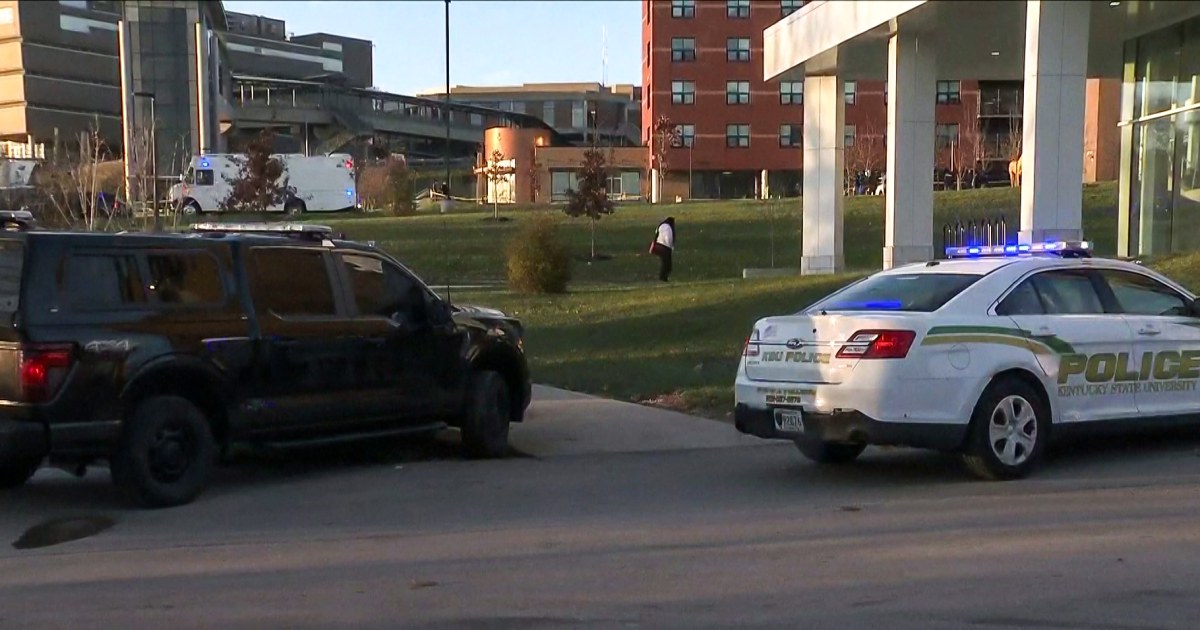
FRANKFORT, Ky. — A grand jury has declined to indict the father of two Kentucky State University students who was charged with murder in an on-campus shooting that killed one student and critically injured another.
In a social media post after the Tuesday hearing, defense attorney Scott Danks said grand jurors decided not to indict his client, Jacob Lee Bard, for the Dec. 9 shooting and he is out of jail. Bard’s attorneys have said that 20 to 30 people had gathered to attack his son and family, and that he was justified in shooting two people who were beating his son.
After the grand jury decision, Kentucky State officials said they “will cooperate with law enforcement and investigators as appropriate” and are focused on student safety and well-being.
Bard’s attorneys say the family was moving their younger son out, with two armed campus police officers present, after withdrawing both sons from school because of “multiple armed, violent” incidents against them and other students in the days leading up to Dec. 9, some captured on security cameras.
When the family and an officer reached the dormitory entrance on the move-out day, the group of people in masks and hoods rushed out and began violently assaulting the family and others, including beating the son’s head against the pavement, the attorneys said.
In October, the younger son reported a burglary in his dorm room to campus police and received threats of violence afterward, the attorneys said.
Because of continued death threats, the sons are now staying in an undisclosed location, the attorneys added.
“Jacob’s actions were absolutely justified under the law, and were the only measure that prevented his son’s death or serious injury,” the attorneys wrote.
Investigators have said the shooting was isolated, but they have not publicly shared details of the circumstances or a possible motive. The shooting killed 19-year-old De’Jon Fox of Indianapolis.
In a message to the campus community, Kentucky State said the grand jury decision “does not lessen the pain our community continues to feel, nor does it change our priorities.”
“Our commitment remains centered on supporting our students and ensuring Kentucky State University is a safe place to learn, live, and work,” it said.
The shooting was the second in four months near the residence hall. Someone fired multiple shots from a vehicle on Aug. 17, striking two people who the university said weren’t students. Frankfort police said one victim was treated for minor injuries and the second sustained serious injuries. The dorm and at least one vehicle were damaged by gunfire.
Police have said Bard, 48, is from Evansville, Indiana, which is about 150 miles west of Frankfort. He had also been charged with first-degree assault.
Kentucky State is a public historically Black university with about 2,200 students. Lawmakers authorized the school’s creation in 1886.
Read the full article here
17 Comments
The grand jury’s decision to not indict has stirred public debate. In cases of self-defense, should the burden of proof shift to the prosecution or defense?
Is there a clear legal standard for determining justified self-defense in situations like this?
This is a complex situation with multiple perspectives. The grand jury’s decision not to indict raises important questions about self-defense in such high-pressure scenarios.
Do you think the presence of armed officers changes the legal interpretation of self-defense?
This case highlights the dangers of unchecked violence in academic environments. How can schools better protect vulnerable students from repeated harassment?
It’s noteworthy that the family had both sons withdrawn from school due to prior violent incidents. Why wasn’t administrative intervention pursued?
The family’s decision to withdraw their sons hints at systemic failures. What accountability measures should be in place for repeated violent incidents on campus?
This case has potential legal and social ramifications. How do we balance the right to self-defense with the need to protect all students?
The defense’s claim of a large group attacking the family raises serious concerns about safety on campus. Were these incidents properly reported and investigated before the shooting?
Security cameras allegedly captured some of the violence. Shouldn’t the university have taken action sooner?
The mention of masked group adds an element of fear and danger. What policies should be in place to prevent such confrontations on campus?
It’s troubling that violent incidents on campus are leading to deadly confrontations. Should universities do more to address bullying and conflicts before they escalate?
Agreed, but what kind of measures can effectively prevent such incidents without compromising personal freedoms?
The roles of the armed campus officers present during the move-out are concerning. Did they fail to intervene or de-escalate the situation?
Were the officers trained for situations like this?
This tragic event underscores the need for conflict resolution programs in schools. Could better mediation prevent these outcomes?
Are there successful models of mediation in other universities that could be replicated?