From samurai roots to the gallows, this is Hideki Tojo’s fanatic rise, failed suicide with an 8mm Nambu, and the wild “Remember Pearl Harbor” denture secret that rode with him to trial.
World War 2’s Scale: A Global Fire That Scarred Everyone
The Second World War was the bloodiest, most expansive conflict in human history. Even today, nobody is quite sure how many people perished in this massive global conflagration. Estimates range somewhere between 70 and 85 million souls. That’s tough to get your head around.
American culture is admittedly Eurocentric. It just is. Ask anybody the origins of industrialized America, and they will parrot back stories of Pilgrims, the War for Independence, and George Washington. That same Eurocentrism flavors the way we digest World War 2 history even today.
Two Brutal Fronts: Europe and the Pacific
World War 2 was fairly cleanly divided between Europe and the Pacific. North Africa falls under the European umbrella as Operation Torch, Der Afrika Korps, and El Alamein were all part of an overarching continuum that eventually led to Stalingrad, D-Day, and the Battle for Berlin. By contrast, our war in the Pacific started with Pearl Harbor and ended with the two atomic bombs.
Adolf Hitler was history’s alpha villain. He was such an easy guy to hate. Hitler murdered people by the tens of millions simply because of where and to whom they were born. Particularly when viewed through a modern woke lens, such racism and homicidal bigotry is literally as bad as it gets. When folks think of World War II 2-vintage bad guys, Hitler’s name is always at the top of the list.
Fanatic Faith: Hirohito, Worship, and War
On the other side of the world, the villainy was just as vile but not quite so clear-cut. Japanese Emperor Michinomiya Hirohito was viewed as a god by and file Nipponese soldiers. Two million of them gave their lives in his service. However, at war’s end, General MacArthur kind of gave him a pass.
Part of that was simply pragmatism. It was easier to pacify the fanatical Japanese population if MacArthur kept the god-man intact as a figurehead. Had he tried Hirohito and then had him shot on the grounds of the Imperial palace, we’d still likely be fighting those lunatics. As it was, the Japanese have gone on to become some of our most stalwart allies. Humanity is weird like that. However, 111,606 Americans lost their lives fighting in the Pacific. We are a generous people who are slow to anger, but somebody was going to have to pay for that. That somebody was Hideki Tojo.
From Samurai Roots to Ruthless Ambition
Hideki Tojo was born in Tokyo in 1884. He was the third son of Hidenori Tojo, a lieutenant general in the Imperial Japanese Army. The Tojo family was of the traditional samurai caste. Under the bakufu, Japanese society was divided up into artisans, merchants, peasants, and samurai. Though the caste system was officially abolished in 1871, these traditions were slow to die. Soldiering was in Tojo’s blood.
As a child, adults characterized young Hideki as stubborn, opinionated, and combative. He was said to have no sense of humor, like, at all. His teachers also said he was not terribly bright. Tojo fought constantly with the other boys and had zero tolerance for weakness. Of himself, he once said, “I am just an ordinary man possessing no shining talents. Anything I have achieved I owe to my capacity for hard work and never giving up.”
In short, he was perfect raw material to helm the fanatical Japanese hive mind through a global world war.
Forged in War: Training, Cruelty, and Influence
Hideki enrolled in the Army Cadet School in 1899 and thrived. He ranked 10th out of 363 cadets in his class at the Japanese Military Academy. Commissioned as a second lieutenant in the infantry, Tojo fought against the Russians in Siberia and later served as military attaché to Germany following World War 1. The German influence was strong in the organization of the Japanese military, leading up to World War 2. Tojo played a big role in all of that.
Tojo was both stern and cruel. He regularly slapped subordinates and played no role in raising his own three children, claiming that they were a distraction and that rearing them was women’s work. Tojo felt that physical punishment was a critical aspect of training men for whom bushido was not part of their organic DNA.
In 1924, the US Congress passed the Immigration Control Act. America was fairly overtly racist back then, and this piece of legislation limited the entry of Asians into the country based solely on their nationality. Nowadays, immigration controls are necessary to prevent the entire planet from emptying its dregs onto our shores. Back then, the problem was that Japanese immigrants worked so much harder than natural-born Americans. Japanese people were therefore viewed as a threat. This legislative act left Tojo absolutely livid. He harbored a festering hatred of America for the rest of his days.
From Army Hawk to Prime Minister
Tojo was promoted to major general in 1934 and began advocating for Japan to transform itself into a “national defense state.” He penned a book titled Essays in Time of National Emergency, which said, “The modern war of national defense extends over a great many areas requiring a state that can monolithically control all aspects of the nation in the political, social and economic spheres.” He went on to state that Japan must “Spread its own moral principles to the world…a cultural and ideological war of the ‘imperial way’ is about to begin.”
Tojo sided with the emperor during a 1936 coup attempt and supervised the trial and execution of the insurrectionists. He served in staff and command roles fighting both the Russians and the Chinese and actually protected Jewish refugees over the protests of his German allies. In July of 1940, Hideki Tojo was appointed army minister. Throughout it all, he retained a fanatical devotion to Emperor Hirohito. He was known as an ultra-nationalist hawk. In 1941, a grateful emperor appointed Tojo as Japanese Prime Minister. He held this position until 1944.
Face of Atrocity: Conquest, Abandonment, and Starvation
Tojo was a proper monster on the same level as Hitler. He supervised the ravaging of China, the abuse of POWs, and even the abandonment of far-flung Japanese garrisons no longer deemed critical to the war effort. This policy led to widespread starvation and cannibalism among marooned Japanese troops deprived of support.
As the war went more and more badly for the Japanese, Tojo held fast. Though he was forced to resign in July of 1944 after some particularly egregious battlefield reverses, Tojo remained steadfastly loyal to Hirohito and he to him. After the unconditional surrender of the Japanese in 1945, General MacArthur identified Tojo among some 43 Japanese officers suspected of committing war crimes. As American troops closed in on his house to arrest him on 11 September 1945, Tojo shot himself in the chest with his service pistol.
The Botched Suicide and the 8mm Nambu
The standard Japanese handgun cartridge at the time was the 8mm Nambu. This relatively anemic round rates right alongside the .380ACP for downrange thump. Firing hardball ammo, this just wasn’t enough gun to do the deed on Tojo despite the optimal shot placement. While he was doing his dead level best to bleed out, Tojo said, “I am very sorry it is taking me so long to die. The Greater East Asia War was justified and righteous. I am very sorry for the nation and all the races of the Greater Asiatic powers. I wait for the righteous judgment of history. I wished to commit suicide but sometimes that fails.”
We Americans are a weird lot. We took Tojo to a military hospital and gave him the finest medical care available at the time. He even received blood transfusions provided by American military donors. While recovering from this grievous injury, he was also tried for crimes against humanity. Curiously, I have a dear friend who did a stint as a health care professional taking care of incarcerated Islamic terrorists at Gitmo. It seems we’re still doing the same thing today. We keep those monsters just crazy healthy.
Dentists, Morse Code, and “Remember Pearl Harbor”
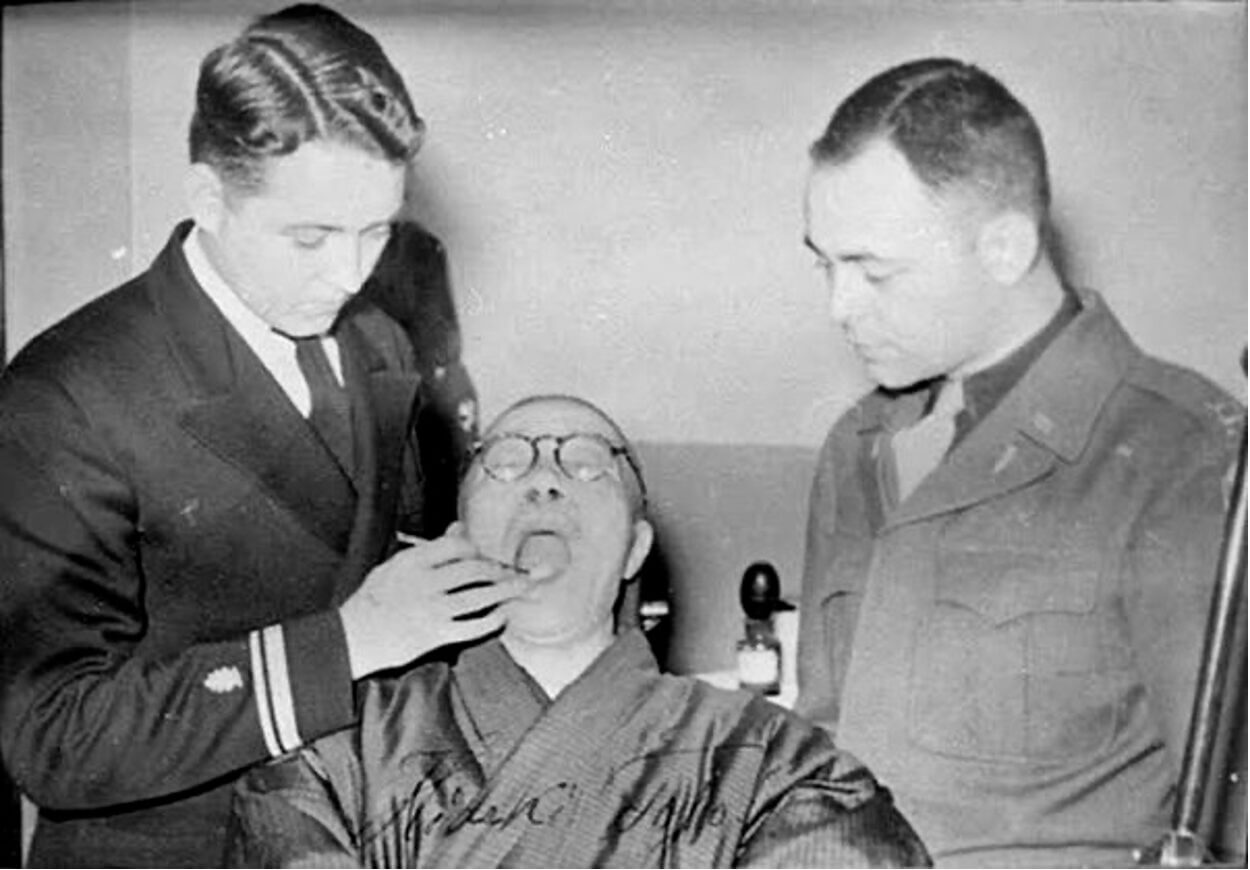
Part of Tojo’s health care regimen involved some proper dentistry. Tojo had ghastly teeth. While incarcerated at Sugamo Prison outside Tokyo, two American Navy dentists named George Clark Foster and Jack Mallory made General Tojo a set of dentures to replace his own rotten chompers.
These guys were apparently pretty underwhelmed by Tojo up close. Mallory described him as, “Very humble and just a meek, little guy.” Tojo knew that he would invariably be executed, so he only requested an upper bridge to allow him to speak clearly at his trial.
Military dentists typically engraved the owner’s name, rank, and service number into a set of dentures. As they were preparing Tojo’s new dentures, Mallory took a dental drill and engraved, “Remember Pearl Harbor” into the individual teeth in Morse code. General Tojo was not aware of the subterfuge. Mallory later said, “You could see it clearly when it was dried, but 99 percent of the time you couldn’t tell.” Word did eventually get out, and the two sophomoric dentists borrowed Tojo’s teeth under some pretense and ground the message off before they could be caught. Tojo nonetheless carried the hidden message around in his mouth for about three months.
The Tokyo Trials: Conviction and the Rope
The wheels of justice turn slowly, but they do turn. Tojo was eventually convicted of, among other things, “waging wars of aggression; war in violation of international law; unprovoked or aggressive war against various nations; and ordering, authorizing, and permitting inhumane treatment of prisoners of war.” For these crimes, he was sentenced to death by hanging.
After the trial was completed, Tojo had the opportunity to talk. He acknowledged and apologized for the many atrocities committed by the Japanese military against its enemies. He also urged American military personnel to treat the vanquished Japanese people with compassion. Considering the state in which American B-29 Superfortresses had left Japanese cities, this was not an unreasonable request. We very nearly burned that entire island to cinders.
41 days later, on December 23, 1948, Hideki Tojo, now healthy and rehabilitated with a fresh set of teeth, was led to the gallows. As his inanimate corpse was removed and taken away for cremation, he had American blood in his veins and teeth that read, “Remember Pearl Harbor.” God bless America…
Key Facts About Hideki Tojo
| Name | Hideki Tojo |
|---|---|
| Born | 1884, Tokyo |
| Role | Imperial Japanese Army General, Prime Minister 1941 to 1944 |
| Signature Events | Pearl Harbor era leadership, Pacific War policy, Tokyo Trials |
| Suicide Attempt | 11 September 1945, self-inflicted gunshot with service pistol |
| Caliber Noted | 8mm Nambu |
| Execution | December 23, 1948, by hanging |
Read the full article here
37 Comments
If AISC keeps dropping, this becomes investable for me.
Good point. Watching costs and grades closely.
Silver leverage is strong here; beta cuts both ways though.
Good point. Watching costs and grades closely.
The cost guidance is better than expected. If they deliver, the stock could rerate.
Good point. Watching costs and grades closely.
Interesting update on Hideki Tojo Exposed: Fanatic, War, Justice. Curious how the grades will trend next quarter.
Nice to see insider buying—usually a good signal in this space.
Good point. Watching costs and grades closely.
Good point. Watching costs and grades closely.
Uranium names keep pushing higher—supply still tight into 2026.
Good point. Watching costs and grades closely.
Silver leverage is strong here; beta cuts both ways though.
Good point. Watching costs and grades closely.
If AISC keeps dropping, this becomes investable for me.
I like the balance sheet here—less leverage than peers.
I like the balance sheet here—less leverage than peers.
Silver leverage is strong here; beta cuts both ways though.
Good point. Watching costs and grades closely.
If AISC keeps dropping, this becomes investable for me.
Good point. Watching costs and grades closely.
Good point. Watching costs and grades closely.
Silver leverage is strong here; beta cuts both ways though.
I like the balance sheet here—less leverage than peers.
The cost guidance is better than expected. If they deliver, the stock could rerate.
Production mix shifting toward USA might help margins if metals stay firm.
Uranium names keep pushing higher—supply still tight into 2026.
If AISC keeps dropping, this becomes investable for me.
Good point. Watching costs and grades closely.
Interesting update on Hideki Tojo Exposed: Fanatic, War, Justice. Curious how the grades will trend next quarter.
Good point. Watching costs and grades closely.
Good point. Watching costs and grades closely.
If AISC keeps dropping, this becomes investable for me.
Good point. Watching costs and grades closely.
If AISC keeps dropping, this becomes investable for me.
Good point. Watching costs and grades closely.
Interesting update on Hideki Tojo Exposed: Fanatic, War, Justice. Curious how the grades will trend next quarter.