

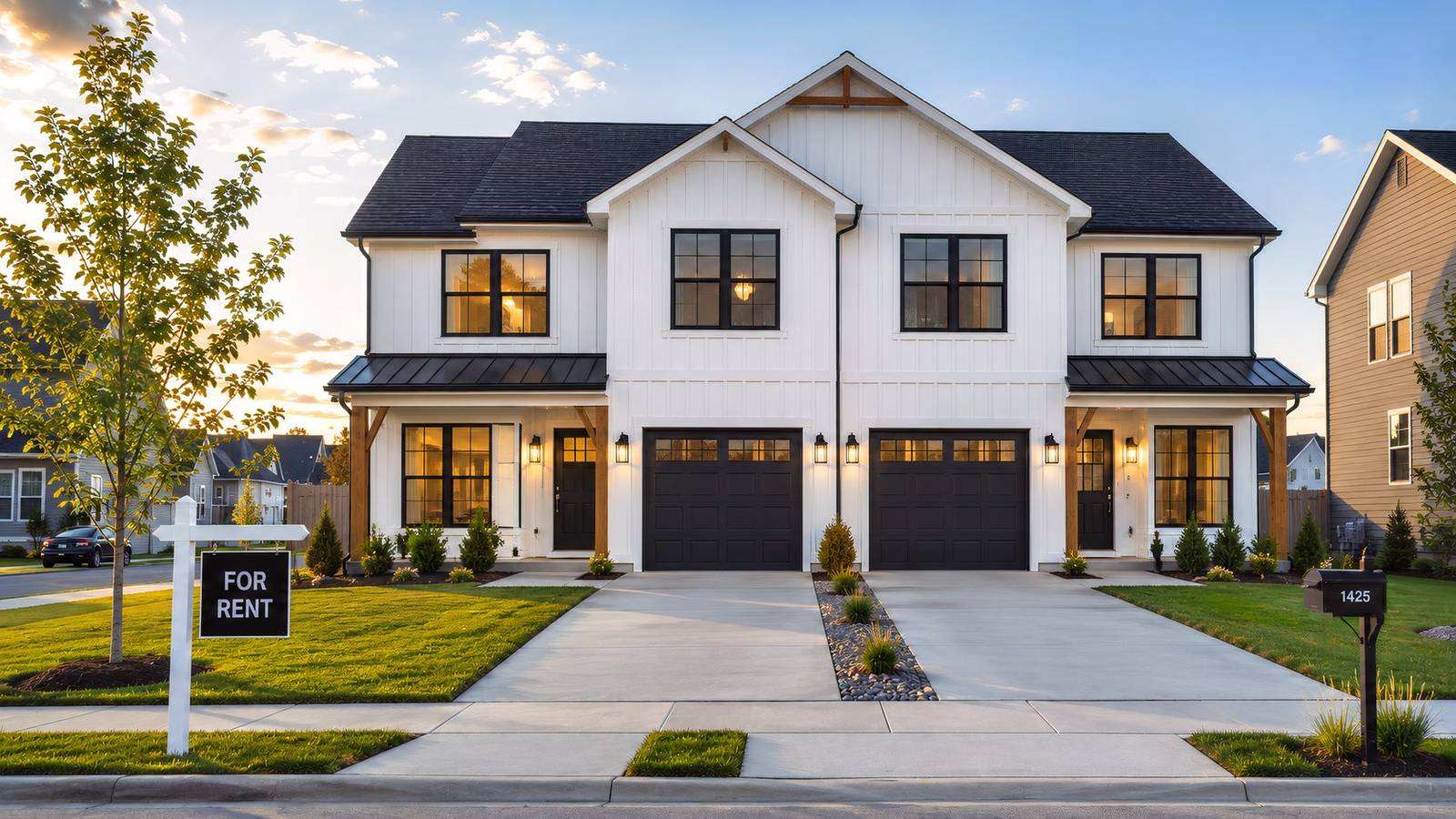
Here is a real estate secret that most people don’t know about. VA loans are one of the best house-hacking tools around! They allow eligible veterans and active-duty service members to buy a multi-unit property, live in it, rent out the other units, and turn it into an income-producing venture, with no money down.
This house-hacking process can often cover your entire mortgage, and produce passive income, all while building equity in your property.
Read on to see how you can buy a multi-unit property with a VA loan and build equity with very little investment.
Can You Buy a Duplex with a VA Loan?
Yes. Buying a duplex is one of the most popular ways to house-hack using your VA loan benefits. However, you will need to meet VA guidelines before the loan will be approved.
If you have your full VA entitlement, there is no limit on how much you can borrow (you have to qualify first) with zero money down. If you have a partial entitlement, your zero-down payment formula is tied to Federal Housing Finance Agency (FHFA) conforming loan limits.
The duplex must also pass a VA appraisal and meet Minimum Property Requirements (MPRs). These are VA baseline standards to ensure the home you are buying with a VA loan is safe, structurally sound, and sanitary. The appraiser will check that the home meets these guidelines.
How Many Units Does the VA Allow?
For a standard VA mortgage, you can use the loan for up to four residential family units, plus one business unit. However, you must occupy one of those units as your primary residence and qualify for a full mortgage. House-hacking does not apply to investment property; it’s designed to support homeownership.
This is the rule, but there are exceptions. For example, if two eligible veterans went in on a multi-unit property together, they could purchase a residential property of up to six family units plus one business unit (seven-plex). This equates to the basic four units plus one additional unit for each veteran, plus one business unit.
VA Multifamily Occupancy Rules
The VA multifamily occupancy rules require the veteran to live in one unit of the two – four-unit property as their primary residence. They must occupy the unit within 60 days of closing, unless there are exceptional circumstances. Extensions may be approved if the member is deployed at closing, the home needs major repairs, or you are retiring from the military within 12 months of closing.
Your lender may also require you to sign mortgage documents that state that you plan to live in the home as your primary residence for at least 12 months to show intent to use it as your primary residence.
Using Rental Income to Qualify for the VA Loan
Whether you are converting your current home to a rental or buying a multi-unit property, you may want to use projected rent from the other units to help you pay for your mortgage.
If you want to use rental income to qualify, you will need signed lease agreements or an appraiser’s Form 1025 (Small Residential Income Property Appraisal Report) to verify the expected income. Also, your lender may also ask for cash reserves equal to six months of mortgage payments or documented proof that you have experience as a landlord. Finally, the lender typically will only use 75% of gross rental income for loan qualification.
House Hacking Strategies for Military Buyers
House hacking is a simple concept. You use your VA loan benefits to buy a multifamily property (up to a fourplex), live in one unit, and rent out the rest. The rental income then helps cover your mortgage. The result: you live for free (or close to it) while building equity.
It gets even better. Your VA loan comes with these advantages:
- No down payment
- No private mortgage insurance (PMI)
- Low interest rates
- Rental income to help qualify for a bigger mortgage
Variants on the Multi-Unit Purchase
Single-family roommate hack: Buy a large single-family home and rent out the spare rooms to service members. You can also rent out finished basements or detached garages using this hack.
Pro Tip: Verify local zoning ordinances in your area. Some municipalities have restrictions on how many people can legally share a single-family home.
The Live-In/Reno Hack: Use a VA Renovation Loan to buy a multi-unit fixer-upper and finance needed repairs or upgrades in a single mortgage (vice a mortgage and a construction loan). When the renovation is done, you live in one unit and rent out the others. You can finance up to 100% of the property’s anticipated post-renovation value.
Pro Tip: VA renovation loans are not for cosmetic upgrades (high-end appliances, pools), but for repairs that improve the safety, accessibility, and livability of the property.
Officers vs. Enlisted: The Advantage Gap
Basic Allowance for Housing (BAH) and base pay drive purchasing power and debt-to-income (DTI) ratio when qualifying for a mortgage, presenting an advantage gap between officers and enlisted members.
- Officers: Officers have higher base pay and BAH rates, giving them an advantage in qualifying for multi-unit properties. Higher income means it is easier to come up with funds needed for earnest money and closing costs.
- Enlisted: Enlisted members face steeper hurdles. Lower enlistment ranks may face stricter loan limits (based on income and DTI), often restricting them to duplexes or single-family roommate hacks. Coming up with upfront costs and cash reserves is a challenge, often relying on seller concessions.
Cash-Flow Example
Here is a realistic cash-flow example for a duplex in a mid-cost market like San Antonio, TX, or Jacksonville, FL. Property prices are reasonable enough that tenant rent can offset your primary mortgage. You live in Unit A and rent out Unit B.
The Property:
- Purchase Price: $380,000 ($0 Down Payment)
- Estimated Mortgage (PITI): $2,900/month (Includes Principal, Interest, Taxes, and Insurance) (6.2%/30 year; 1.25% property tax)
- Your BAH (e.g., O-3 with dependents): $2,127/month
The Cash-Flow Breakdown:
- Rental Income (Unit B): $1,500/month
Your Out-of-Pocket Cost = Mortgage – Rental Income
$2,900 – $1,500 = $1,400/month
The BAH Impact:
Your share of the mortgage is $1,400, but the military provides you with $2,127 in BAH:
Leftover BAH = $2,127 – $1,400 = +$727/month
Bottom Line: Your housing cost is completely covered. You get to live in your half of a duplex while pocketing an extra $727 of tax-free BAH every single month.
Note: This does not take into account vacancy gaps or maintenance and repair costs. You will need to budget for these factors.
PCS Strategies
If you lived in your current home, purchased with a VA loan for at least 12 months, and you get Permanent Change of Station (PCS) orders, you can rent out your side of the duplex.
Looking back at the cash-flow example (the $380k Duplex), once you move out and rent Unit A for another $1,500 per month:
- Gross Rent (Both Units): $3,000/month
- Mortgage Payment: $2,900/month
- Monthly Cash Flow: +$100/month
At this point, you have a cash-flowing asset building wealth while you move on to your next duty station. Depending on your remaining VA loan entitlement, you can start all over again.
VA vs FHA Multifamily Comparison Table
If you are also looking into an FHA loan to buy a multifamily property, it might help to look at both VA and FHA loan features so you can choose the option that is best for your financial and personal situation.
|
VA Multifamily |
FHA Multifamily |
|
|---|---|---|
|
Max Units |
4 units |
4 units |
|
Occupancy |
Owner-occupied |
Owner-occupied |
|
Down Payment |
0% |
3.5% (580+ credit) |
|
Mortgage Insurance |
None |
Mortgage Insurance Premium (MIP) required |
|
Funding/Upfront Fee |
1.5 to 3.3% VA Funding Fee |
1.75% Upfront MIP |
|
Max Loan Amount |
No county loan limit (full entitlement) |
FHA county loan limits apply |
|
Multi-Unit Caps |
Up to 4-units with 75% rental offset |
Up to 4-units with 75% rental offset |
|
Interest Rates |
Typically lower than FHA |
Typically higher than VA |
|
Closing Costs |
Sellers can pay all normal closing costs. Concessions are capped at 4% |
Seller capped at 6% |
|
Credit Score |
No VA minimum (lender overlays) |
580 for 3.5% down |
|
DTI |
Flexible; residual income test |
Standard DTI caps |
|
Ideal Borrower |
Eligible veterans seeking 0% down house-hack |
Borrowers with limited savings but stable credit |
|
Advantage |
No mortgage insurance and lower interest rates |
Low down payment + flexible credit |
|
Downside |
Must be an eligible veteran |
MIP increases long-term cost |
FAQ
Q: Can you buy a duplex with a VA loan?
Yes. Eligible veterans and service members can buy up to a four-unit property with a VA loan as long as they live in one of the units as their primary residence.
Q: How many units does the VA allow?
The VA allows financing for up to four residential units, plus one business unit. Exception: If two eligible veterans purchase together, they can buy up to six residential units plus one business unit.
Q: Do I have to live in the property?
Yes. VA loans are for primary residences only. You must occupy one unit within 60 days of closing, unless granted an extension for deployment, major repairs, or upcoming retirement from the military.
Q: Can I use rental income to qualify for a VA multifamily loan?
Yes. But lenders typically allow only 75% of projected rental income from the other units to count toward qualification.
Q: Can I use a VA loan for an investment property?
Not directly. VA loans cannot be used for second homes, vacation homes, Airbnb/short-term rentals you don’t live in. However, you can live in one unit and rent out the others. Also, if you PCS, lived in the house for 12 months, you can rent out the property (your VA entitlement is still tied to the house).
Read the full article here
45 Comments
Nice to see insider buying—usually a good signal in this space.
Uranium names keep pushing higher—supply still tight into 2026.
The cost guidance is better than expected. If they deliver, the stock could rerate.
Exploration results look promising, but permitting will be the key risk.
Silver leverage is strong here; beta cuts both ways though.
If AISC keeps dropping, this becomes investable for me.
Good point. Watching costs and grades closely.
The cost guidance is better than expected. If they deliver, the stock could rerate.
Good point. Watching costs and grades closely.
Good point. Watching costs and grades closely.
The cost guidance is better than expected. If they deliver, the stock could rerate.
Good point. Watching costs and grades closely.
Nice to see insider buying—usually a good signal in this space.
Good point. Watching costs and grades closely.
Good point. Watching costs and grades closely.
The cost guidance is better than expected. If they deliver, the stock could rerate.
Good point. Watching costs and grades closely.
Good point. Watching costs and grades closely.
Interesting update on How to House Hack a Duplex. Curious how the grades will trend next quarter.
Production mix shifting toward USA might help margins if metals stay firm.
I like the balance sheet here—less leverage than peers.
Good point. Watching costs and grades closely.
The cost guidance is better than expected. If they deliver, the stock could rerate.
Good point. Watching costs and grades closely.
Good point. Watching costs and grades closely.
Interesting update on How to House Hack a Duplex. Curious how the grades will trend next quarter.
Good point. Watching costs and grades closely.
Good point. Watching costs and grades closely.
I like the balance sheet here—less leverage than peers.
Good point. Watching costs and grades closely.
Good point. Watching costs and grades closely.
Production mix shifting toward USA might help margins if metals stay firm.
Good point. Watching costs and grades closely.
Good point. Watching costs and grades closely.
The cost guidance is better than expected. If they deliver, the stock could rerate.
Interesting update on How to House Hack a Duplex. Curious how the grades will trend next quarter.
Good point. Watching costs and grades closely.
Good point. Watching costs and grades closely.
I like the balance sheet here—less leverage than peers.
Interesting update on How to House Hack a Duplex. Curious how the grades will trend next quarter.
Good point. Watching costs and grades closely.
Uranium names keep pushing higher—supply still tight into 2026.
Good point. Watching costs and grades closely.
Good point. Watching costs and grades closely.
If AISC keeps dropping, this becomes investable for me.