

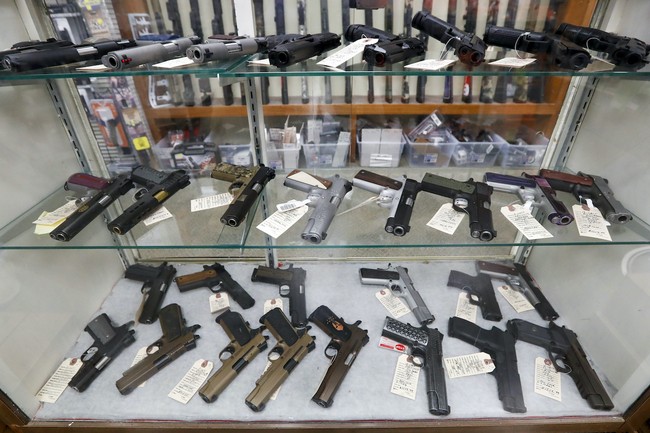
Dr. Anthony Douglas, a surgical resident in Chicago, is leading the push for lawmakers to adopt a bill called the RIFL (Responsibility in Firearm Legislation) Act, which would require firearms manufacturers to obtain a license from the Department of Financial and Professional Regulation before they can sell guns in the state of Illinois.
As we’ve previously detailed, the cost of obtaining a license would vary from company to company, and would be based on two factors. First, the DFPR would determine the amount of all licensing fees based on an estimate that is “is equal to the public health costs and financial burdens borne by the State and its residents as a result of firearm injuries.” In the first year, that amount is capped at $866 million dollars.
How much of that an individual company would be required to pay is based on the number of firearms recovered by police, as determined by the DFPR. If a company accounts for 14% of guns recovered in the state, for instance, then their license could cost $121,240,000. Even a 1% share could result in a $8.66 million license fee.
If the RIFL Act becomes law, we’d almost certainly see a mass exodus of gun makers from the Illinois market, and the few that remain would have to jack up their prices to an outrageous degree; one that would place firearms out of the reach of many residents. During his recent testimony in support of the RIFL Act, Douglas suggested that would be a good thing.
The lead proponent of the RIFL Act, Dr. Anthony Douglas— an anti-2A advocate said the quiet part out loud during a hearing in Springfield:
“I think poor people don’t benefit from owning firearms…” pic.twitter.com/QPrleh2KNn
— Illinois State Rifle Association (@ISRA) April 9, 2026
Douglas went on to say that poor people benefit from a good education and services that allow them to lead healthy lives, and claimed lawmakers who are concerned about the impact that his bill would have on lower-income residents are “distracted” from what poor people and poor communities “actually need.”
It’s not an either/or situation, though. Yes, poor people need functional schools that provide real education and genuine opportunities to find gainful employment, but that doesn’t mean they should have to sacrifice access to any of their fundamental rights in order to get that.
Poor people, especially those living in high-crime communities, need to be able to protect themselves just like rich folks in gated communities or the uber-wealthy who can afford their own private security. If the RIFL Act becomes law, criminals would still be able to acquire guns on the illicit market, through theft, or straw buys. It would be the law-abiding who’d feel the impact, and working class Illinois residents and those on the lowest rungs of the economic ladder would likely lose all legal access to firearms.
Douglas’s arrogance and elitism is compounded by his inability to understand the unintended consequences of the RIFL Act; an increase in illegally purchased and possessed firearms, not only by violent criminals but by Illinois residents who know of no other way to protect themselves or their families. Legal gun sales would plummet, just as he envisions, but guns would hardly disappear from the state or the city of Chicago.
Douglas has previously claimed that the RIFL Act wouldn’t substantially increase the cost of a firearm in Illinois, arguing that a company like Smith & Wesson would pay about $20 million each year in order to obtain a license. According to Douglas, that would amount to about a $20 increase in the price of a Smith & Wesson firearm in Illinois, but I think his math is deeply flawed and operates on the assumption that Smith & Wesson would pass on the cost of their Illinois license to every gun buyer across the United States, not just those customers in Illinois.
Douglas also ignores the fact that if every Democrat-controlled state adopted the RIFL Act, Smith & Wesson wouldn’t be paying $20 million each year. It would be more like $200 million. That’s hardly a “modest” burden to the company or the customers who would likely end up bearing the increased cost.
As Douglas has now revealed, he doesn’t really care if the RIFL Act increases the cost of a firearm by $20, $200, or $2000. In fact, based on his comments it seems the bigger the increase the better as far as he’s concerned, since he believes poor people don’t benefit from having access to their Second Amendment rights.
The RIFL Act is a blatant attack on our right to keep and bear arms, and given the Democrat majorities in the Illinois legislature there’s a real chance it could be enacted into law this year. Anti-gunners in other states are already looking at introducing the RIFL Act as well, so Douglas’s bad idea could soon be coming to a statehouse near you.
Editor’s Note: President Trump and Republicans across the country are doing everything they can to protect our Second Amendment rights and right to self-defense.
Help us continue to report on their efforts and legislative successes. Join Bearing Arms VIP and use promo code FIGHT to get 60% off your VIP membership.
Read the full article here
26 Comments
I like the balance sheet here—less leverage than peers.
If AISC keeps dropping, this becomes investable for me.
Good point. Watching costs and grades closely.
Silver leverage is strong here; beta cuts both ways though.
Good point. Watching costs and grades closely.
Good point. Watching costs and grades closely.
Interesting update on Illinois Doctor and Anti-2A Activist Says Poor People Better Off Without Guns. Curious how the grades will trend next quarter.
Good point. Watching costs and grades closely.
Good point. Watching costs and grades closely.
I like the balance sheet here—less leverage than peers.
Good point. Watching costs and grades closely.
Good point. Watching costs and grades closely.
I like the balance sheet here—less leverage than peers.
If AISC keeps dropping, this becomes investable for me.
Production mix shifting toward USA might help margins if metals stay firm.
Good point. Watching costs and grades closely.
Good point. Watching costs and grades closely.
Nice to see insider buying—usually a good signal in this space.
The cost guidance is better than expected. If they deliver, the stock could rerate.
Exploration results look promising, but permitting will be the key risk.
Good point. Watching costs and grades closely.
Good point. Watching costs and grades closely.
I like the balance sheet here—less leverage than peers.
Exploration results look promising, but permitting will be the key risk.
Good point. Watching costs and grades closely.
Good point. Watching costs and grades closely.