

A U.S.-brokered agreement between Israel and Lebanon is being presented as a step toward ending months of war.
It may also leave the hardest facts unresolved: Israeli forces remain on Lebanese territory, many in Lebanon have been killed or displaced, and Lebanon is being asked to disarm Hezbollah before Israel fully withdraws.
The current conflict began on March 2, when Hezbollah launched rockets and drones into northern Israel after U.S. and Israeli strikes in Iran killed Iranian Supreme Leader Ayatollah Ali Khamenei. Hezbollah said the attack was retaliation for the strikes on Iran and for Israel’s continuing military operations inside Lebanon following the 2024 ceasefire. Israel responded with widespread airstrikes across Lebanon before launching a ground offensive that expanded into southern Lebanon.
In recent months, Israeli forces have pushed deeper into southern Lebanon, establishing what Israeli officials describe as a security buffer zone while striking Hezbollah positions throughout the country. By June, Israel had made its deepest incursion into Lebanon in more than 25 years. Israeli forces controlled roughly 2,000 square kilometers—nearly one-fifth of Lebanon— prompting accusations from Lebanese officials that Israel intended to maintain a long-term military presence on Lebanese territory.
The fighting has taken a heavy toll on civilians. Humanitarian organizations estimate that more than 1 million people have been displaced since the conflict escalated, with more than 4,000 people killed in Lebanon. Many residents of southern Lebanon remain unable to return home because Israeli forces continue to control portions of the region, setting the stage for the framework agreement announced in Washington.
The framework links Israel’s withdrawal from southern Lebanon to Hezbollah’s disarmament.
Israel would first pull back from two “pilot zones,” while the Lebanese army would gradually take over security there. A security annex exists, but it has not been made public.
That structure gives Israel no immediate deadline to leave all Lebanese territory. Israeli Prime Minister Benjamin Netanyahu has said Israel will remain in southern Lebanon until Hezbollah disarms. Hezbollah has rejected the deal and says it will continue resisting until Israel withdraws.
International Law Limits Displacement and Occupation
The fighting is governed by the four 1949 Geneva Conventions, to which both Israel and Lebanon are parties, as well as customary international humanitarian law. Those rules apply regardless of which side initiated the conflict.
International law distinguishes between the legality of using force (ius ad bellum) and the legality of how force is used (ius in bello), meaning every party to an armed conflict remains bound by the same rules even after acting in self-defense.
The laws of war require parties to distinguish between military objectives and civilians, prohibit attacks expected to cause incidental civilian harm that would be excessive in relation to the concrete and direct military advantage anticipated, and require commanders to take all feasible precautions to reduce civilian casualties.
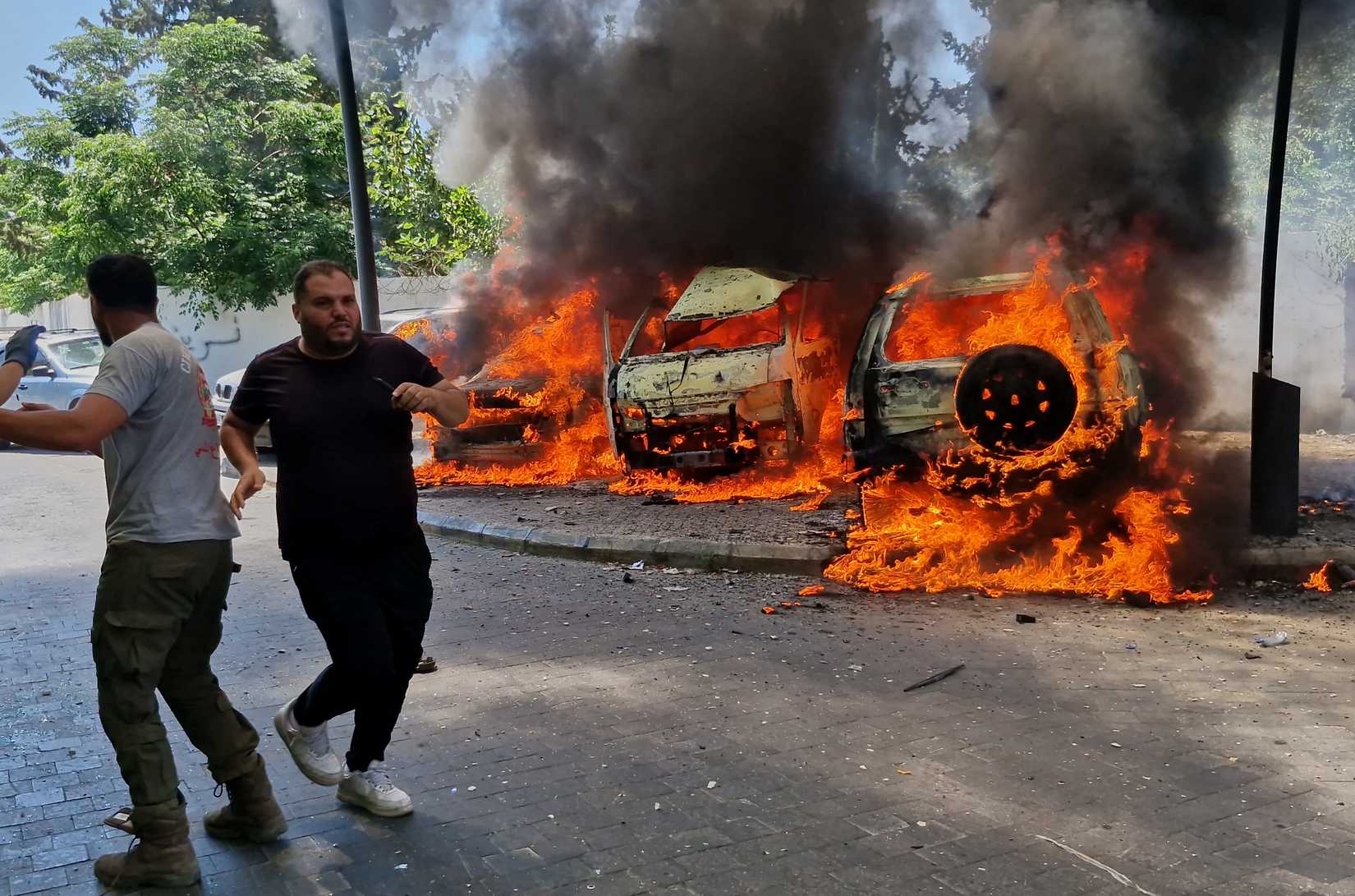
A man runs past burning cars following an Israeli airstrike in the southern port city of Sidon, Lebanon, Wednesday, June 10, 2026. (AP Photo/Mohammed Zaatari)
These rules apply to each attack individually; they are not measured by comparing the overall number of casualties suffered by each side.
Although Israel has not ratified Additional Protocol I to the Geneva Conventions, many of these principles are widely recognized as customary international law, which binds states based on generally accepted international practice.
A separate body of law governs military occupations. Under Article 49 of the Fourth Geneva Convention, an occupying power generally may not forcibly transfer civilians from occupied territory except when civilian safety or imperative military necessity requires a temporary evacuation.
The convention further provides that evacuated civilians should be permitted to return once the reasons for their evacuation no longer exist and the occupying power may not transfer its own civilian population into the area. Article 53 also prohibits the destruction of private or public property unless military operations make such destruction absolutely necessary.
Those legal standards are central to the dispute in southern Lebanon. Humanitarian organizations estimate that more than 1 million people have been displaced since the conflict escalated, and many residents remain unable to return because Israeli forces continue to control parts of southern Lebanon.
Israel argues that its strikes, evacuation orders and continued military presence are lawful because Hezbollah continues to operate in the area, creating an ongoing military necessity to protect Israeli civilians and prevent future cross-border attacks. Israel also maintains that its armed forces are bound by the laws of armed conflict and employ legal advisers during military operations to help ensure compliance with international law.
Critics argue that military necessity is not an exception to the laws of war, but merely one factor considered within them. They contend that each military operation must comply with the principles of distinction, proportionality and precautions, and argue that prolonged restrictions on civilians returning home, together with extensive destruction of civilian property, may violate the Fourth Geneva Convention. Amnesty International has accused Israel of issuing unlawful mass evacuation and no-return orders in parts of Lebanon, allegations Israel rejects.
Protests, American Sentiment
The agreement has drawn criticism in both Lebanon and Israel, though for different reasons.
In Lebanon, protesters have condemned the framework for allowing Israeli forces to remain on Lebanese territory until Hezbollah disarms, arguing that it conditions the return of occupied land on requirements the Lebanese government may not be able to enforce.
In Israel, public demonstrations have largely centered on the strain of the country’s prolonged military campaigns rather than the agreement itself. Thousands of ultra-Orthodox Israelis have protested efforts to expand mandatory military service as reservists continue serving repeated deployments across multiple fronts, exposing growing political divisions over how long Israel can sustain its military operations.
There is also a large impact on the U.S., which brokered the agreement after months of negotiations. U.S. Secretary of State Marco Rubio observed Israeli and Lebanese ambassadors sign it in Washington. As part of that framework, the United States committed $100 million in humanitarian assistance for Lebanon.
For Washington, the agreement is a high-risk diplomatic bet. The Trump administration is tying U.S. credibility to a framework that aims to reduce the fighting, restore Lebanese sovereignty, and create conditions for Israel’s eventual withdrawal from southern Lebanon.
A major question of the framework’s stability remains: What happens if Hezbollah refuses to disarm and Israel refuses to withdraw?
Read the full article here
38 Comments
Interesting update on Israel-Lebanon Deal Sparks Protests, Raises Fears of Lasting Occupation. Curious how the grades will trend next quarter.
The cost guidance is better than expected. If they deliver, the stock could rerate.
If AISC keeps dropping, this becomes investable for me.
Good point. Watching costs and grades closely.
Production mix shifting toward USA might help margins if metals stay firm.
Good point. Watching costs and grades closely.
The cost guidance is better than expected. If they deliver, the stock could rerate.
Good point. Watching costs and grades closely.
Good point. Watching costs and grades closely.
Interesting update on Israel-Lebanon Deal Sparks Protests, Raises Fears of Lasting Occupation. Curious how the grades will trend next quarter.
If AISC keeps dropping, this becomes investable for me.
Good point. Watching costs and grades closely.
Silver leverage is strong here; beta cuts both ways though.
Good point. Watching costs and grades closely.
Uranium names keep pushing higher—supply still tight into 2026.
The cost guidance is better than expected. If they deliver, the stock could rerate.
Good point. Watching costs and grades closely.
I like the balance sheet here—less leverage than peers.
If AISC keeps dropping, this becomes investable for me.
If AISC keeps dropping, this becomes investable for me.
If AISC keeps dropping, this becomes investable for me.
Good point. Watching costs and grades closely.
Production mix shifting toward USA might help margins if metals stay firm.
Good point. Watching costs and grades closely.
Nice to see insider buying—usually a good signal in this space.
Good point. Watching costs and grades closely.
Uranium names keep pushing higher—supply still tight into 2026.
Good point. Watching costs and grades closely.
The cost guidance is better than expected. If they deliver, the stock could rerate.
Good point. Watching costs and grades closely.
Silver leverage is strong here; beta cuts both ways though.
I like the balance sheet here—less leverage than peers.
Nice to see insider buying—usually a good signal in this space.
Good point. Watching costs and grades closely.
Good point. Watching costs and grades closely.
Nice to see insider buying—usually a good signal in this space.
Good point. Watching costs and grades closely.
Production mix shifting toward USA might help margins if metals stay firm.