Five shots, one old-school cylinder, and 30+ years of carry experience make the CCW revolver harder to dismiss than the high-capacity crowd wants to admit. The J-Frame is not for everyone, but in the right role, this little wheel gun still has teeth.
Today, when wonder nines with magazine capacity in the high teens, is the wheel gun still relevant? Is 5 or 6 shots enough for the everyday person? If we take a look, for an armed citizen, a revolver just might be the ticket in certain circumstances.
The Wheel Gun Question: Is Five Shots Still Enough?
OK, I know that the above statement is respectfully borrowed from a Star Wars movie, but I feel like this is a very relevant saying when we talk about the role of a revolver in the concealed carry world. Does the venerable wheel gun still have a place at the table, or is it obsolete in today’s world?
There was a time not that long ago, when I remember all law enforcement carried revolvers. Watch any cop show on TV from the 80’s back…most carried a revolver. Almost all detectives or PIs on TV carried a snub-nose, with a nodding respect to the outlier Thomas Magnum with his 1911. It was the standard.
From Duty Holsters to History: How the Revolver Lost the Badge
Back in the 1980’s, most officers carried a 6-shot revolver out on patrol; semi-autos like the Smith and Wesson 659 / 5906 and Beretta 92 F were just starting to come onto the duty weapon scene; very few people had adopted them yet. At the time, a semi-automatic pistol was seen as less reliable than a revolver. However, the wheel gun was just about to see its time in the sun come to an end.
The impact of the revolver’s capacity played out in police shootings as well. Far fewer rounds were fired in those times as officers had less opportunity to reload. Even with reloading all your rounds, you only had 18. Conserving ammo was much more of a concern, as was the slower speed of reloads. However, as bad guys were starting to show up with bigger guns with more capacity, law enforcement saw the need to change was clear.
The civilian market followed suit. Today, you go into any gun store, and you see a few revolvers, but what do most shooters go to… semi-autos. While the semi-auto used to be fairly expensive and the revolver quite a bargain back in the day, that has flipped, with most decent duty or self-defense grade revolvers being at around $700-$1000 while a quality semi-auto will set you back around $400-$600.
Why Carry a Revolver When Micro 9s Rule the Gun Counter?
When I began in the police academy, mine was one of the first classes to get semi-autos, sporting our shiny new Second Generation Glock 17’s. It was here that I saw the true value of the semi-auto as a duty gun. They were reliable, lighter on the hip, and the revolver shooters were on their third reload while I dropped my first mag. So yes, the semi-auto has a lot of advantages over the old wheel gun.
But…there is an argument even today for the revolver. As an example, let’s look at my first lesson from back in the 1990’s.
When I went into the local gun store in December 1991 to get my first backup / off-duty gun, there were really two options: a .380 like the Walther PPK/S, Browning BDA, etc., or a 5-shot snubby J-Frame. While I was looking through the display case, I saw the shiny Walther, and was enamored with the gun of James Bond.
Then the guy behind the counter, who was also a police officer, was watching me and asked if I was part of the graduating police academy. I told him I was, and he looked at me and said, “get something big enough to get you out of trouble, not so big you get yourself into trouble.” He then nudged a new S&W Model 640 (no dash) towards me. The J frame was almost $200 cheaper than the Walther. He also mentioned, “this thing will go bang every time until it’s empty…way more reliable than the little semi auto.” This was the truth back then, as semi-autos were still getting their footing at reliability, and the idea of “Glock Perfection” was still a ways off.
That 5-shot went with me everywhere for a long time. I sold it when times got tough, many years later, in a fit of stupidity that I still regret. I now have the .357 Magnum version of the 640 that I bought in 1995. While I was an active cop, I began to carry it less due to my belief that I needed more firepower.
When I retired, I still carried my semi’s and was happy. But as time went on, I fell into the routine of “civilian life,” and I began to look at my concealed carry (CCW) routine more from the non-law enforcement side. Concealed carry is a defensive posture, and what firearms fulfil that role best? In that train of thought, I began to look at the 5-shot snubbie again. Was this a reasonable alternative? Since I had nothing to tell me otherwise, I decided I’d try a little experiment. What would it be like carrying nothing but revolvers for one week? Would I feel undergunned? Would it change anything?
So began this little experiment, we’ll call it the Revolver for a Week Project. Is the revolver a reliable or even good choice for the civilian concealed carrier? I was going to try to find out. I soon realized I was fine with the revolver in many situations, and it was even an advantage in some ways over my semi-auto.
The 640-1 I have was still pretty heavy, and after 30+ years with a gunbelt, I decided it was time to look for something a little lighter. Smith makes several lightweight versions, such as their Airweight (Aluminum/steel) and Air Light (Scandium/Titanium) series. Since the scandium frame guns are quite expensive, I looked at the S&W 442 Airweight, which can still be had for a reasonable cost in the neighborhood of $500 +/-. Later, I settled on the S&W 642 UC, a lightweight revolver with excellent sight upgrades.
If the Smiths don’t do it for you, there are many other options. Ruger and Taurus make good revolvers. Kimber makes an excellent wheel gun, and their lightweight K6XS gives you a great lightweight package with 6 rounds. The Colt Cobra / King Cobra offer well suited six shot .38’s and .357 Magnums for concealed carry. There is also the new Diamondback SDR.
Another aspect that doesn’t get a lot of notice is the caliber choices; revolvers in .38 or .357 Magnum give you options. The 9mm, while an excellent defensive caliber, may not give you as reliable penetration and expansion when fired from the shorter barrel of a micro gun. In .38 Special (+P), there are loads specifically made for the short-barreled guns that are made to perform properly and have lots of street results. They have enough speed to get the expansion they need. I am thinking of the Speer Gold Dot .38 +P 135 gr short-barreled load, which was developed with law enforcement, NYPD, if my memory serves, for snub nosed revolvers. There are also others just as suitable, such as the now-discontinued Federal HST .38 +P load. Here’s a hint, Federal, bring it back… There are many options.
If you’re dealing with four-legged problems, you can up the ante with certain revolvers. Many are built to support magnum cartridges that are effective on big critters. If you want a bird/snake shot, there are cartridges that are made to do that, and they function quite reliably with a revolver. My 686 4-inch is a great solution for the woods and four-legged predators if needed.
Why I Chose to CCW a J-Frame After 30+ Years
So, say you’re looking at carrying a J-Frame revolver like I was for this project. It was a platform I had carried on and off for over 30 years. Many will ask, quite legitimately, why go with an antiquated system with limited capacity and that’s so difficult to reload; all of which are valid arguments. I will try to explain.
First off, I’ll admit to being a fan of revolvers. For several reasons I mention below, they are great for CCW. They are also something I have a bit of nostalgia for, as a revolver was the first handgun I bought for myself to carry off-duty and as a backup in my 30+ years in law enforcement.
Remember, guns are tools, and these in particular fit a specific niche.
The Hard Truth: J-Frames Are Not Beginner Guns
I must add one caveat when it comes to revolvers, specifically J Frames or other small-frame revolvers. As many gun-tubers and other experts will say, the J-frame is an advanced shooter’s gun. This is not for the beginner; it’s for the experienced or skilled shooter who would decide to carry a revolver, usually a J Frame or similar. There was a time when people at gun stores would push the little J Frame as a first gun in ignorance. Maybe this made sense when revolvers dominated the market.
But today, very few people have exposure to a revolver, and mastering the trigger pull on one takes time. They generally have a long double action, some getting to 12 lb. pulls or more. Additionally, the diminutive size of the gun and its light weight can make for punishing recoil, to put it nicely. In a recent CCW class I taught, one shooter, new to the gun, struggled to hit center mass, but I soon realized that he was so used to his semi-auto that he had not adjusted to the long trigger pull.
Another struggle is the lack of a good sight picture, like we’re used to on most semi-autos. Most small revolvers for CCW have a small front sight with a trough rear sight. I have learned to bury the front sight in the trough so the front tip is even with the edges…it feels odd, but it is how they are usually meant to shoot. Also, since the front and rear sights are machined into the barrel and frame on many of these revolvers, you may need to play around with the ammo/gun combo to find what hits at your point of aim. New revolvers are coming with better sights, making them far easier to aim and shoot well.
Finally, the accuracy of these is not near what a micro 9 is for the novice. The gun itself is mechanically capable of great accuracy, but the combination of trigger pull and poor sights makes revolvers like the S&W J-Frame a close-in defensive pistol.
I would argue that to carry a revolver for CCW, you should already be an experienced shooter, ready to work through the above issues with training and practice. Even then, weapon choice and some minor modifications might be needed to get the most out of your wheel gun. For instance, I’d stay away from the ultra-light .357 Magnum revolvers using scandium and titanium. They’re outstanding pieces of workmanship, but the cost is over double that of the lightweight aluminum .38 Special guns, and you only save a couple of ounces. On top of that, while these scandium/titanium guns are chambered for .357 magnum, the guns in that caliber are the only ones I’ve seen make a man bleed. It’s just brutal for recoil, which means it takes a lot longer to get back on target for follow-up shots.
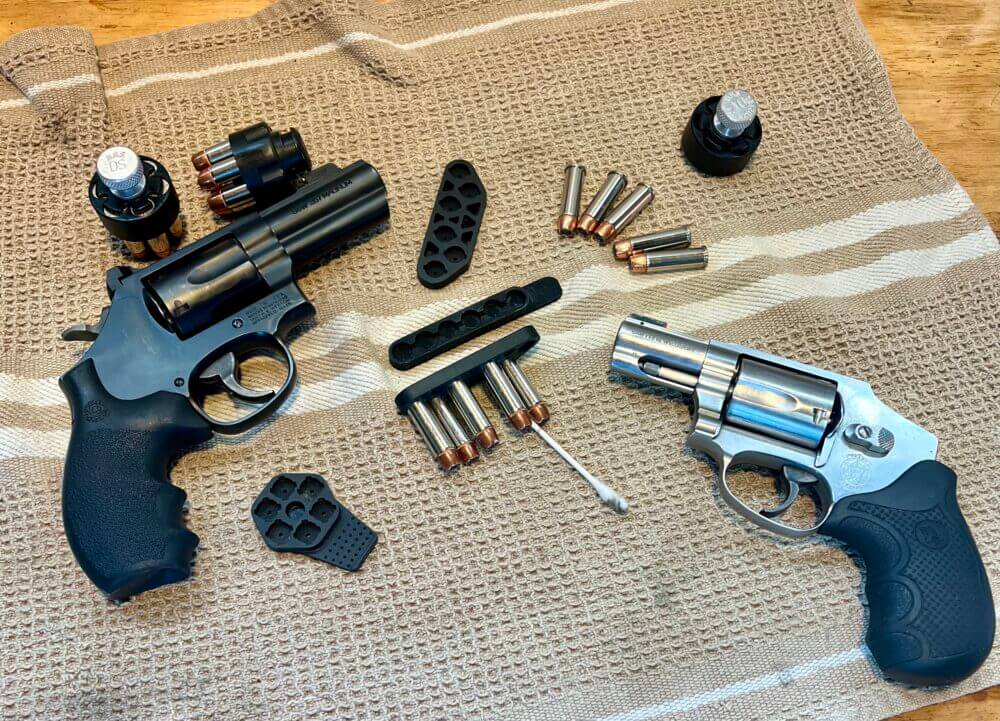
As a last note, while your revolver does not have a magazine to fail, reloading is much, MUCH slower than a semi-auto. There are now lots of accessories to help in that, such as speed loaders, speed strips, and some really imaginative but simple strips made by Zeta 6 that do help. But the reality is that it still will take longer than grabbing a spare magazine, inserting it, and releasing the slide.
The Revolver Payoff: When the Juice Is Worth the Squeeze
After all that, you’re probably asking yourself why you would ever bother carrying a wheelgun as a CCW option? As a friend of mine, and later my Captain, used to ask, “is the juice worth the squeeze?”
If you can maneuver the above downsides, the revolver has some very attractive upsides. First off, the .38 Special Aluminum J Frame is as light as 14.6 ounces, with the scandium insanity models going down to 11.8 ounces. The lightweight makes them easy to carry and not notice. By comparison, my Sig P365, fully loaded, was almost 24 ounces.
The revolver’s non-linear shape aids in concealment. A semi-auto has straight lines that I have found print a little more easily through clothing. The revolver with a sub-1-inch frame and its wider cylinder breaks up its outline, and really makes it blend in. They can also be carried safely in a pocket with a good holster. I even know some who don’t bother with the holster, but for safety reasons, I don’t advise it.
One aspect that used to be touted on the revolver was its simplicity and reliability. Back when I started in the early 1990’s, semi-autos were cautiously trusted, and a revolver’s system of operation was seen as more reliable. Today, most modern semi-auto pistols are far more reliable than earlier weapons, and this is much less of a concern…except in one aspect. If a semi-auto’s slide is pushed out of battery, it will not fire. So, in a close-in grappling fight with an assailant, if the slide of your gun makes contact with their body, it can get pushed out of battery, and I could end up with a dead trigger. With a revolver, I can do a contact shot against the person trying to kill me and pull the trigger repeatedly until they stop what they were doing. It can also fire from inside a pocket reliably, and until it is empty. In this aspect, I valued my revolver above all else as a backup gun when I drove a patrol car.
Ammunition is specifically developed for these short-barreled revolvers. While your HST may work great in your full-size Glock 19 or 17, the shorter barrel of, say, a P365 may leave velocity lacking. Speer Gold Dot has created a round specific to short-barreled revolvers, as have others.
There are many, many holsters made for the revolvers, especially the J-Frame. For an ankle gun, they are excellent, and Galco makes an outstanding holster for that. Pocket carry, there are many options. Belt, there are everything from leather classy ones to kydex. Inside the waistband, Harry’s Holster or Four Brothers, to name a few, have good setups.
I also live in the most litigious, bluest of blue states. It has gone kicking and screaming into the shall-issue CCW space, sort of. As a result, one thought is that the image of a self-defense shooting using the J-Frame versus a tricked-out full-size gun will run differently for the DA. It shouldn’t make a difference, but it will here. Please take this as one individual’s perspective with the 30+ years of experience behind it. Your situation and threat environment may dictate otherwise.
The Five-Shot Mindset: Carry Smarter, Not Louder
One thing I go back to are the words of the sage officer back in 1991. The revolver keeps me in a position where I don’t get myself overconfident with my firearm. And we should never go there, regardless of what firearm you carry. The .38 loads I carry are effective, but they are not something I’m going to a war zone with. My five shots mean I’m purposeful, and very conscious of every shot I make, because I only have 5. Even with larger revolvers, you’ll get as many as 6 to 8 rounds…but that’s it.
I need to consider, as a civilian, retired LEO, my mindset needs to be a little different from what it used to be. As much as it pains me, I need to dial back my posture. I am no longer hunting for the criminal element; I am scanning for deadly force threats that are after my loved ones and me. Will I come to the aid of others, of course, when possible, but I’m not the one chasing bad guys for a shoplifting call anymore.
As I said before, these guns should be considered a specific niche, as a CCW. If I have a full gamut of pistols to carry, the revolver is the gun I carry when I don’t think I’ll need one, or concealment / light weight is paramount. To be frank, a J-Frame or similar revolver is part of a CCW system, but may not be acceptable to be your “whole system”, depending on the threat environment you are in. For home defense, a compact to full-size semi-auto, or even a full-sized revolver, is a much better choice.
Real-World J-Frame Carry: Light, Hidden, and Surprisingly Capable
I regularly carry a 642 UC now in my rotation. The sights on the gun are outstanding and gave me far better results than my earlier trough sight guns. Accuracy was far better than I expected. The Gold Dot shot right at the point of aim, as did the 148-grain Wadcutters.
The lightweight revolver hides easily in the Harry’s Holsters Icon 2. I carried it appendix and could almost forget it was on. I thought the added width of the revolver cylinder would make it more noticeable, but I was wrong. It concealed better than my P365 due to its shape. The rounded silhouette of the J Frame makes for a naturally concealable gun. I tried a DeSantis Nemesis pocket holster in cargo pockets, but found the AIWB carry much more comfortable. This revolver can go anywhere and be comfortably concealed.
One note on carrying the 642 with the stock grips. This model comes with the excellent VZ grips. The standard J frame has very small boot grips that are for concealment first, and comfort a distant second. I found the draw from the holster had to be a more deliberate motion to get a proper shooting grip from the holster. I adapted by putting on my preferred grips, the Pachmayr Compac. They were able to conceal just as well with a little effort, but gave me a far better grip on the draw, and mitigated recoil enough to make shooting the revolver pleasant.
A revolver does cause you to be very conscious of the fact that you only have five shots at your disposal before you’d need to reload. It caused me to be much more defensive in how I looked at things. But that is what my role is as a CCW holder…my gun is for my defense. While the gun is mechanically accurate to make longer shots, the sights and my aging eyes would make me really think hard about shooting out beyond 15 yards.
Am I under-gunned with the 642? No, in most situations. It’s lighter and easier to conceal, which is your greatest advantage with this gun. No one should know you have it, so if, God forbid, you do need it, surprise will be on your side. Another thing I found was that the ammo I chose was made for the short barrel of the J Frame, which should give me a better chance at a round that will do what it’s designed to do and stop the threat.
The Downside: Recoil, Capacity, and Bad Habits Bite Back
OK, one of the best sides to this revolver is its so light. That does, however, cut both ways…especially with recoil. The recoil was punishing for my somewhat arthritic hands when shooting +P loads in a 442 I once owned, and a day or two after shooting it for about 100 rounds of stouter 158-grain rounds, my hand ached considerably. It took about 2 weeks to get back to normal. It has been said often that these guns are to be carried often but shot infrequently. I did find the Gold Dots to be less harsh with recoil, even though they were +P loads.
There is still the nagging issue with capacity. One night, while carrying my older 442, I was at home with a circling police helicopter that was warning us of an armed suspect in the area with the usual admonition to stay inside, lock our doors, etc. I will say that this was when I felt one of the bigger shortcomings of the J-frame. I want more than a 5-shot gun when I have a recognized threat on the horizon. Luckily for me, my “at-home” gun is a bit…well, more capable for these types of situations. As you evaluate your personal carry and the threats you face, and my biggest or most likely threat is something like an active shooter, I would choose a small auto like a P365 at a minimum. That’s assuming I cannot avoid that area in the first place.
There is also the matter of the gripping of a revolver. Many shooters, myself included, shoot with a “thumbs forward” grip when shooting our semi-auto pistols. This is a problem for revolvers. The space between your cylinder and the forcing cone of the barrel can be a source of muzzle flash, or even bullet fragments that get shaven off in the transition from the cylinder to the barrel. A thumbs-forward grip will put your forward thumb right under or to the side of this gap, potentially exposing you to at least a mild flash burn but possibly far worse, depending on the caliber. I adapted by moving my thumbs back a bit, about 1 inch behind the front of the cylinder.
But as far as downsides, these are mitigatable. I plan to reload wadcutter ammunition for practice and use the Gold Dots for carry. The 158 Gr rounds can be used with bigger and heavier guns.
Final Verdict: The CCW Revolver Still Has Teeth
So, is the 642 J-Frame my main carry gun? Should it be? If I’m going somewhere I need to be as discreet as possible, or I need something lighter than a semi-auto, then yes. It has a definite and necessary place in the weapons I carry for CCW. As a backup or ankle gun, it is a perfect solution. It’s durable, reliable, and will work whenever you pull the trigger. It also is legal in every state, without the hassle of determining if it has too high a capacity, or is somehow banned in a state you’re visiting or just traveling through.
Perhaps you want a larger revolver, more of a mid-size gun. A 3” model, like the S&W 686+ or the Ruger GP-100, might be a great option. I have a 3’ Model 19 K-Comp that has been a great gun, and the comp on that gun legitimately works. There are many options.
Revolvers are dependable, can be perceived as less “offensive” in an anti-2A environment, and still fire a potent round. With the more realistic 1-3 shots fired in a real-world defensive gun use, their capacity is adequate. However, you must evaluate your threat environment. They are a viable and capable option, with the caveat that they need practice and some real work to be truly proficient with. They are truly a more civilized weapon in a world of flashy choices. If you meet a shooter who is a proficient revolver carrier, you have met a true and cultured master of the gun. And no…I’m not there yet either…
Smith and Wesson J-Frame Specs: The Classic CCW Revolver Benchmark
| Manufacturer Name | Smith and Wesson |
| Model | Multiple, (Internal, shrouded of external hammer) |
| Category | Revolver |
| Caliber | .38 Special, .357 Magnum, .32 Magnum, 9mm |
| Capacity | 5 or 6 rounds |
| Sights | Trough and front fixed sight, some models with 3-dot sights |
| Overall Length | 6.3- inches – 7.5 inches |
| Barrel Length | 1.88 inches – 3 inches |
| Finish | various |
| MSRP | $569-$1199 |
| Frame | Aluminum, Scandium, or Steel |
| Grip | Black Polymer, G-10, wood. |
Kimber K6XS Specs: Six Shots in a Lightweight Wheel Gun
| Manufacturer Name | Kimber |
| Model | K6XS |
| Category | Revolver |
| Caliber | .38 Special +P |
| Capacity | 6 rounds |
| Sights | Trough and front fixed sight, |
| Overall Length | 6.8- inches |
| Barrel Length | 2 inches |
| Finish | Matte Stainless |
| MSRP | $679 |
| Frame | Aluminum, with steel cylinder/barrel |
| Grip | Rubber Hogue |
Colt King Cobra Specs: The Six-Shot Snake Gun Option
| Manufacturer Name | Colt |
| Model | King Cobra |
| Category | Revolver |
| Caliber | .357 Magnum |
| Capacity | 6 rounds |
| Sights | Trough and front fixed brass bead sight |
| Overall Length | 7 – inches – 8 inches |
| Barrel Length | 2 inches – 3 inches |
| Finish | Stainless, blued |
| MSRP | $1119 – $1149 |
| Frame | Steel |
| Grip | Black Hogue |
Pros and Cons: The Honest CCW Revolver Reality Check
- Pros: Lightweight, extremely concealable, simple to carry, strong close-contact capability, excellent pocket or ankle gun potential, ammunition flexibility, durable J-Frame track record, and a serious niche role for experienced CCW holders.
- Cons: Limited 5 or 6 round capacity, slower reloads than semi-autos, punishing recoil in lightweight models, long double-action trigger pull, basic sights on many models, and a learning curve that makes the J-Frame an advanced shooter’s gun.
Read the full article here
22 Comments
If AISC keeps dropping, this becomes investable for me.
I like the balance sheet here—less leverage than peers.
Good point. Watching costs and grades closely.
Good point. Watching costs and grades closely.
Uranium names keep pushing higher—supply still tight into 2026.
Good point. Watching costs and grades closely.
Interesting update on J-Frame CCW Revolver Test: Five Shots, Real Talk. Curious how the grades will trend next quarter.
I like the balance sheet here—less leverage than peers.
Good point. Watching costs and grades closely.
Good point. Watching costs and grades closely.
Nice to see insider buying—usually a good signal in this space.
Silver leverage is strong here; beta cuts both ways though.
Good point. Watching costs and grades closely.
Interesting update on J-Frame CCW Revolver Test: Five Shots, Real Talk. Curious how the grades will trend next quarter.
Good point. Watching costs and grades closely.
Uranium names keep pushing higher—supply still tight into 2026.
Good point. Watching costs and grades closely.
Interesting update on J-Frame CCW Revolver Test: Five Shots, Real Talk. Curious how the grades will trend next quarter.
Good point. Watching costs and grades closely.
Nice to see insider buying—usually a good signal in this space.
Good point. Watching costs and grades closely.
Nice to see insider buying—usually a good signal in this space.