

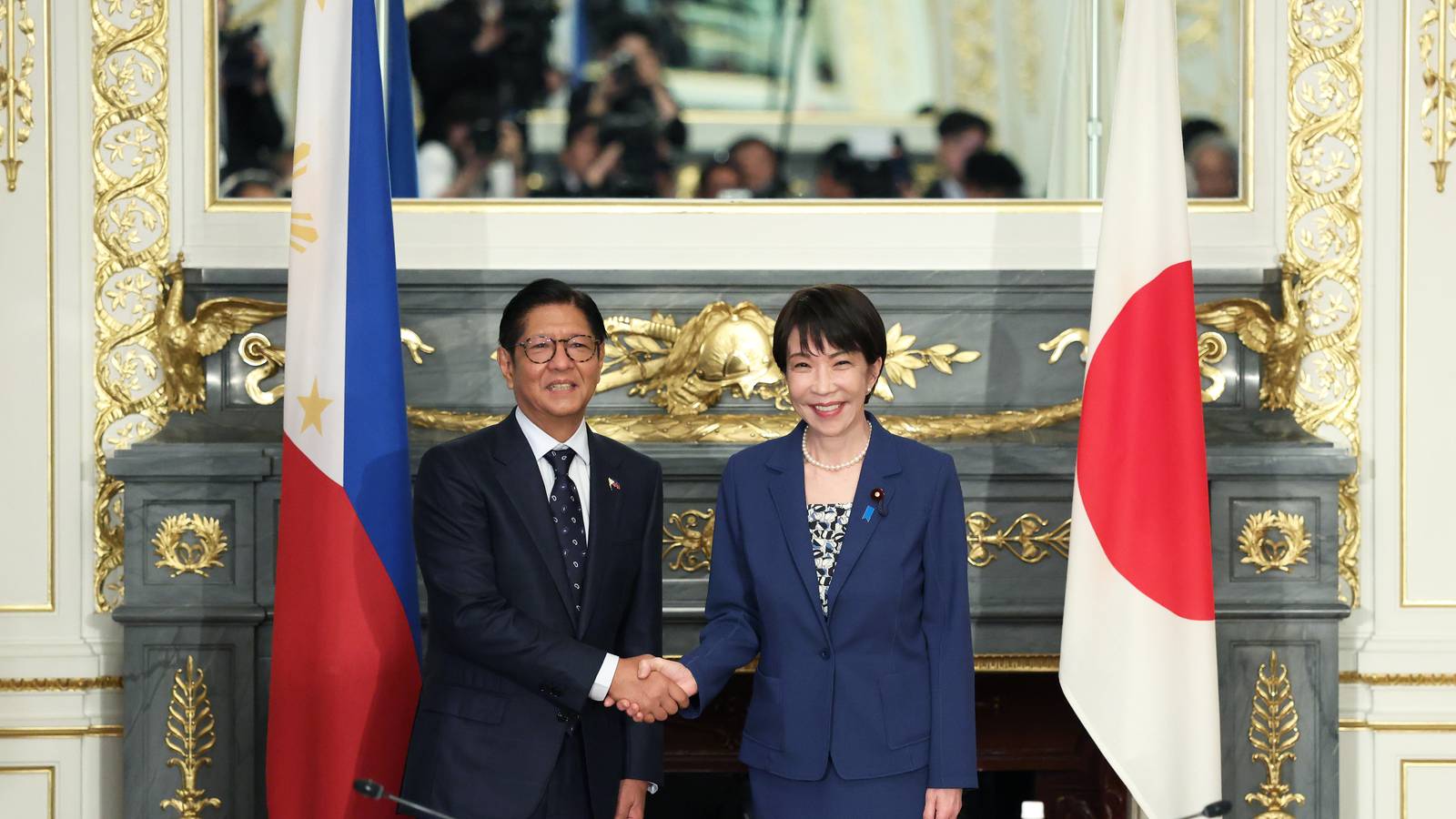
TOKYO (AP) — Philippine President Ferdinand Marcos Jr. is receiving an exceptional level of hospitality that included a palace banquet during a four-day state visit to Japan that culminated Thursday.
The visit sends a clear message that Tokyo is keen to upgrade ties with a nation it sees as a key defense partner — and major arms customer — at a time of fears over China’s military activity in Asia.
Marcos’ visit, which ends with his departure Friday, included a meeting Wednesday with Emperor Naruhito, who gave him the Grand Cordon of the Supreme Order of the Chrysanthemum, one of Japan’s highest decorations.
On Thursday, Marcos held talks with Japanese Prime Minister Sanae Takaichi, agreeing to further strengthen cooperation in defense and weapons, as well as other areas.
Both nations have China firmly in mind as they tighten a military relationship that the United States hopes will act as a bulwark against Beijing’s ambitions in the East and South China Seas and its designs on Taiwan, the self-governing island China claims as its own.
In his address to the Upper House of the Japanese parliament earlier Thursday, Marcos said his country and Japan “chose reconciliation over division and cooperation over indifference,” overcoming the scars of Japanese wartime aggression. That choice still defines their partnership today “in an increasingly complex Indo-Pacific, where tensions test the resilience of rules-based order,” he said.
Marcos said they have “significant potential for deeper collaboration” in defense, economic security and other global challenges. “We must work together to reduce undue dependencies and ensure that progress is not held hostage to disruptions or to coercion.”
Red carpet for a big weapons customer
Marcos is the first potential major customer of Japanese arms since Takaichi’s government scrapped a ban on lethal weapons exports. The change in April was a break from Japan’s postwar pacifist policy as the nation accelerates its military and arms industry buildup.
The nations agreed to pursue negotiations on a sale of multiple Abukuma-class destroyers and Japanese navy TC-90 training aircraft. Philippine Defense Minister Gilberto Teodoro Jr., who observed joint live-fire exercises with his Japanese counterpart earlier this month, also expressed interest in Type-88 surface-to-ship missiles.
Japanese officials say Marcos’ state visit also is linked to the 70th anniversary of diplomatic ties between the two countries and to the Philippines this year holding the rotating presidency of the Association of Southeast Asian Nations.
Military intelligence sharing
Marcos and Takaichi also are expected to arrange formal talks meant to achieve a military intelligence sharing pact, which would enable closer communication and help tighten trilateral military cooperation with the U.S., their mutual ally, Japanese officials said.
Japan has provided a set of five coastal surveillance radars to the Philippines as part of official security assistance and intelligence-sharing would enhance reconnaissance cooperation.
Japan wants strong ties beyond Marcos
Japan wants to enhance its partnership with the Philippines beyond Marcos’ presidency, which ends in 2028, as Tokyo looks to avoid what is considered flip-flopping on China policy by some previous Philippine governments.
Marcos has taken a hard-line stance against China over maritime disputes in the South China Sea. During his presidency, the Philippines and Japan have rapidly bolstered their security ties bilaterally and trilaterally with the U.S.
Japan and the Philippines signed a pact in 2024 allowing their forces to smoothly visit each other’s country for joint military drills. This paved the way for Japan to deploy 1,400 military personnel as regular participants in joint military exercises.
The two countries signed a separate defense pact this year that would allow the tax-free provision of ammunition, fuel, food and other necessities when their forces stage joint training.
Energy security and oil reserves
During the state visit, Marcos and Takaichi also are set to discuss energy cooperation and a Japan-initiated multinational funding framework announced in April.
That framework is designed to help Southeast Asian countries, including the Philippines, stabilize oil reserves through financial assistance to build necessary infrastructure as they struggle from the fallout of the Iran war that has halted oil transports through the Strait of Hormuz.
___
Associated Press writer Jim Gomez in Manila, Philippines, contributed to this report.
Read the full article here
18 Comments
Uranium names keep pushing higher—supply still tight into 2026.
Silver leverage is strong here; beta cuts both ways though.
Good point. Watching costs and grades closely.
Nice to see insider buying—usually a good signal in this space.
Uranium names keep pushing higher—supply still tight into 2026.
Good point. Watching costs and grades closely.
Interesting update on Japan Woos Visiting Philippine Leader During State Visit with Arms Sales and China in Mind. Curious how the grades will trend next quarter.
Nice to see insider buying—usually a good signal in this space.
If AISC keeps dropping, this becomes investable for me.
Nice to see insider buying—usually a good signal in this space.
Good point. Watching costs and grades closely.
If AISC keeps dropping, this becomes investable for me.
Good point. Watching costs and grades closely.
Good point. Watching costs and grades closely.
I like the balance sheet here—less leverage than peers.
Good point. Watching costs and grades closely.
I like the balance sheet here—less leverage than peers.
Good point. Watching costs and grades closely.