

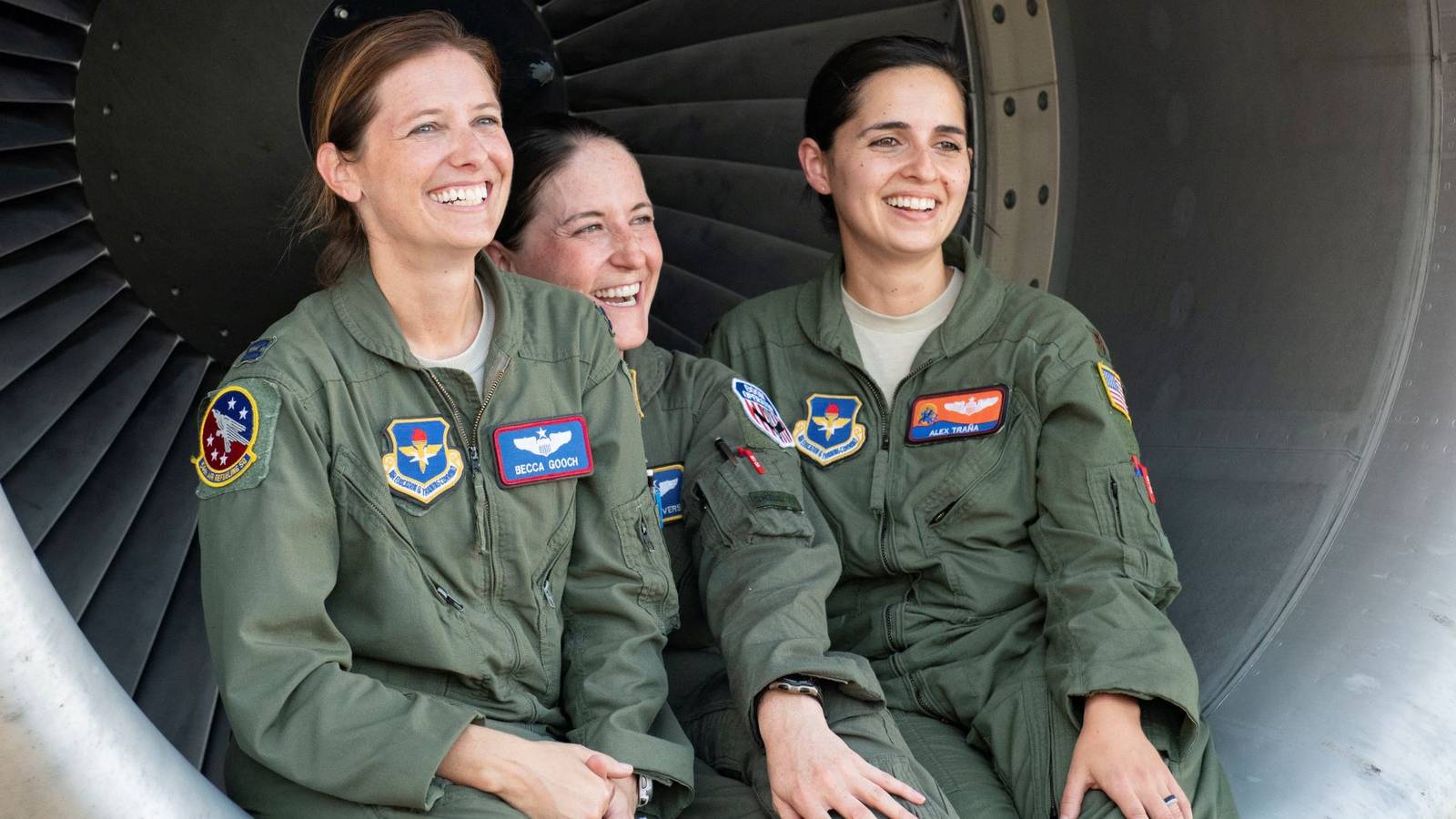
If you’re interested in joining the U.S. Air Force, you’ll find a branch full of opportunities as an enlisted member or a commissioned officer. Find out how you can fill a position in a wide range of exciting careers in aviation, health care, aircraft maintenance, science, technology, and more. Be part of a community serving a mission built on air and space power.
Nearly 500,000 active-duty, Air National Guard, and Reserve men and women serve in the U.S. Air Force, tasked with defending the United States through their core mission: to fly, fight, and win – airpower anytime, anywhere. Opportunities include aviation and flight, health care, maintenance and repair, cyber warfare, intelligence, and many more.
Requirements to Join the Air Force
Enlisted
Enlisted airmen are the backbone of the Air Force, making up about 80% of the service. Each member has his or her own specialized training and fills a specific job role.
Air Force requirements to join as an enlisted airman are as follows. You must:
- Be between 17 and 41 years old; applicants must not have reached their 42nd birthday. Applicants who are 17 need parental consent.
- Hold U.S. citizenship.
- Have a high school diploma or GED equivalent.
- Be free of any serious law violations or drug use.
- Meet the physical standards of the Air Force.
- Earn a minimum AFQT score of 31 on the Armed Services Vocational Aptitude Battery (ASVAB).
- Follow the Air Force tattoo policy: Some tattoos are allowed, but they cannot be extreme. See more details here.
Read More: Everything You Need to Know About Joining the Air Force
Officer
Officers, who make up about 20% of the Air Force, are the branch’s leaders. Commissioned officers handle a variety of duties, including planning missions, providing orders and assigning tasks.
To join the Air Force as an officer, you must:
- Be between 17 and 39 years old (17-48 to join as a health care or ministry professional).
- Have a four-year degree from an accredited university.
- Attend Officer Training School (OTS), Air Force ROTC or the Air Force Academy after completing college or a postgraduate degree.
- Hold U.S. citizenship.
- Be physically fit and of high moral character.
- Pass the Air Force Officer Qualifying Test (AFOQT), when required for your commissioning path.
- Hold additional academic qualifications for some career choices.
Several specialized programs exist to help currently serving enlisted members to become an officer, including:
Read More: Become an Air Force Officer
How to Join the Air Force
The Air Force recruitment process begins with working with an Air Force recruiter. Recruiters know the ins and outs of the service and can help you navigate the process and make important decisions along the way.
The Air Force recruiting process comes with no strings attached. There is no obligation when working with a recruiter. They will help you decide whether the Air Force is right for you, and will help shed light on which job opportunities within the service might be of interest if you sign up.
The Armed Services Vocational Aptitude Battery (ASVAB)
The Armed Services Vocational Aptitude Battery (ASVAB) is an aptitude test that helps airmen narrow down which field of work is best suited for them. It is designed to evaluate skills in several areas. In addition to your overall qualifying score, you will be scored in four ASVAB categories: mechanical, administrative, general and electronics The Air Force uses composite scores from ASVAB subtests to determine what Air Force jobs you are qualified for.
High school seniors or graduates must have a minimum 31 overall ASVAB Armed Forces Qualification Test (AFQT) score, and GED holders must have a minimum of 50 overall ASVAB score.
Physical Examination
Once an applicant has taken the ASVAB and passed with a qualifying score, the recruiting process moves on to a medical exam at the Military Entrance Processing Station (MEPS).
The basic physical examination includes alcohol and drug testing; a urine check for indicators of glucose, protein, pregnancy and other health indicators; an HIV test; a vision test, including color perception; an ear exam and hearing test; blood pressure and pulse rate; an orthopedic and neurological demonstration and exam; plus an overall exam of the main body systems and organs.
Military Training
Enlisted Airmen
The Air Force version of boot camp, called Basic Military Training, or BMT, lasts eight and a half weeks and takes place at Joint Base San Antonio. The focus of BMT is physical preparation, but it also covers the fundamentals of military life, including weapons use and basic defense, and airmen and expeditionary skills.
Enlisted airmen begin earning college credits from Day 1 of BMT. When they finish, they have four semester hours in physical education.
BMT lays the groundwork for enlisted airmen before they move on to technical training.
Commissioned Officers
Officers attend the eight-week Officer Training School (OTS); or alternatively, the U.S. Air Force Academy or Air Force Reserve Officer Training Corps.
OTS is held at Maxwell Air Force Base in Alabama, and involves daily physical training and requires a passing score on a physical fitness test.
Air Force Jobs
Active-duty is similar to working at a full-time civilian job. You will have your own specialty, and you will fill a specific role within your unit.
Jobs in the Air Force are classified by the Air Force Specialty Code (AFSC). To find what jobs you qualify for, the Air Force breaks down your ASVAB subtest scores into line scores that determine which jobs you are qualified to hold. Qualification areas include math, science, language skills, and specialized areas such as electronics and mechanics.
Read More: ASVAB Scores and Air Force Jobs
To be sworn into the Air Force, you will take the Oath of Enlistment, which is a pledge to defend the Constitution throughout your military career.
Promotions
Enlisted
For promotion to Senior Airman (E-4), you must meet time in grade (TIG) and time in service (TIS) requirements, and meet job performance and fitness requirements. Airmen competing for ranks E-5 (Staff Sergeant) through E-6 (Technical Sergeant) must also take two tests as part of the Weighted Airman Promotion System (WAPS): the Specialty Knowledge Test (SKT), to test your job knowledge, and the Promotion Fitness Examination (PFE), to determine your overall Air Force knowledge. For promotion in E-7 (Master Sergeant) and above, promotions are similar to officer promotions, using a central evaluation board.
Officer
Officers also must meet TIG and TIS requirements for promotion up to Captain (O-3). For promotion to Major (O-4) and above, your records go before a promotion board.
Related: Air Force Ranks: A Complete Guide to Enlisted and Officer Ranks
Physical Fitness
The Air Force uses the Physical Fitness Assessment (PFA) to assess your physical fitness and is based on a 100-point scoring system across four categories:
• Cardiorespiratory (50)
• Waist-to-Height Ratio (20)
• Muscle Strength (15)
• Muscle Core Endurance (15)
You will have to take the PFA every six months, regardless of your score, however, you only need to perform the two-mile run once a year.
Air Force Height and Weight: Weight requirements are based on height and gender. The service uses a Body Mass Index (BMI) range of 17.5 to 27.5 to determine height-to-weight ratio for body composition. When a recruit is outside of this BMI range, recruiters will use a body fat measurement (BFM) with a maximum range of 26% for males and 36% for females.
Read More: Air Force Fitness Requirements and Scoring
Benefits of Joining the Air Force
Joining the Air Force comes with a variety of benefits.
Basic Pay and Allowances
When you join the Air Force, your paycheck grows as you gain more experience and rise up the ranks. As of 2026, basic pay for an Airman Basic (E-1) begins at $2,407.20 per month, or $28,886.40 annually. Initial basic pay for an Air Force Second Lieutenant’s (O-1) is $4,150.20, or $49,802.40 per year.
In addition to your salary, as an airman you will also receive paid vacation time, travel assistance, a retirement plan and a full package of benefits, including allowances for housing, food and clothing.
Bonuses
Bonuses are offered for certain enlisted and officer jobs. For example, in 2026, enlistment bonuses up to $40,000 are offered for a variety of roles, including those in cyber warfare operations, heavy aircraft integrated avionics, pararescue and nuclear weapons.
For even higher-demand jobs, much larger bonuses are possible: up to $20,000 for some cyber careers, and up to $40,000 for some special warfare operators. View more about current bonuses here.
Educational Benefits
Airmen have access to a range of educational programs that are either free or that can come with tuition assistance. There are many programs to help airmen continue working toward a college degree and beyond.
For those who become officers, many programs are available to help you continue working toward advanced college degrees if desired. Officers in legal or health care careers have specialized educational opportunities.
Air Force educational opportunities begin just after BMT with technical training, which can last anywhere from a month to a year, and offers college credits as well as on-the-job experience. These college credits are counted toward an associate’s degree in applied science (AAS) through the Community College of the Air Force, the world’s largest community college.
Healthcare Benefits
Airmen receive full health, dental and vision care, as well as paid time off for illness. Family members may receive medical care at military or civilian facilities through various options for little or no cost.
Active-duty service members and their dependents are eligible for coverage under the Tricare health insurance program. There are several Tricare programs to choose from, depending on your status and location.
Other Benefits
Air Force bases offer a variety of services as well as social and recreational activities, like stores, places of worship, financial institutions, gyms, golf courses, bowling alleys, tennis courts and swimming pools. Available amenities vary by installation.
Housing Benefits
Those who live off base receive a tax-free housing allowance monthly to help pay for living expenses.
For airmen with families, on-base housing is provided, as well as schools, parks and more. Many bases also support families with day care, after-school programs, youth sports teams and playgrounds. Air Force spouses may also receive priority for on-base employment.
Read More: Learn About Air Force Benefits
Interested in Joining the Military?
We can put you in touch with recruiters from the different military branches. Learn about the benefits of serving your country, paying for school, military career paths, and more: Sign up now and hear from a recruiter near you.
Information from AirForce.com and other info previously published on Military.com was used in compiling this report.
FAQ
How long is Basic Military Training (BMT)?
BMT is eight and a half weeks long and is held at Joint Base San Antonio, TX. Training includes physical conditioning, weapons instruction, and military customs.
What training will I complete after joining the Air Force?
Enlisted airmen attend Basic Military Training (BMT) for eight and a half weeks, followed by technical training in their job specialty. Officer candidates attend Officer Training School (OTS) or commissions through ROTC or the Air Force Academy.
What benefits does the Air Force offer?
Benefits include competitive pay, housing allowances, health care, education programs, paid leave, retirement plans, and access to base amenities such as gyms, childcare, and recreational facilities.
Can Airmen live off base?
Yes. Many Airmen live off base and receive a tax-free Basic Allowance for Housing (BAH) to help cover rent or mortgage costs. Airmen with families may also choose on-base housing, which includes access to schools, parks, childcare, and community services.
Read the full article here
43 Comments
Exploration results look promising, but permitting will be the key risk.
Production mix shifting toward USA might help margins if metals stay firm.
If AISC keeps dropping, this becomes investable for me.
Production mix shifting toward USA might help margins if metals stay firm.
Interesting update on Join the Air Force. Curious how the grades will trend next quarter.
Good point. Watching costs and grades closely.
Nice to see insider buying—usually a good signal in this space.
Good point. Watching costs and grades closely.
Good point. Watching costs and grades closely.
If AISC keeps dropping, this becomes investable for me.
Good point. Watching costs and grades closely.
Exploration results look promising, but permitting will be the key risk.
Good point. Watching costs and grades closely.
Exploration results look promising, but permitting will be the key risk.
Good point. Watching costs and grades closely.
Production mix shifting toward USA might help margins if metals stay firm.
Good point. Watching costs and grades closely.
Nice to see insider buying—usually a good signal in this space.
Good point. Watching costs and grades closely.
Good point. Watching costs and grades closely.
Uranium names keep pushing higher—supply still tight into 2026.
Exploration results look promising, but permitting will be the key risk.
Good point. Watching costs and grades closely.
Good point. Watching costs and grades closely.
If AISC keeps dropping, this becomes investable for me.
Good point. Watching costs and grades closely.
Nice to see insider buying—usually a good signal in this space.
If AISC keeps dropping, this becomes investable for me.
Good point. Watching costs and grades closely.
Good point. Watching costs and grades closely.
Exploration results look promising, but permitting will be the key risk.
Good point. Watching costs and grades closely.
Good point. Watching costs and grades closely.
Production mix shifting toward USA might help margins if metals stay firm.
Interesting update on Join the Air Force. Curious how the grades will trend next quarter.
Good point. Watching costs and grades closely.
Silver leverage is strong here; beta cuts both ways though.
Silver leverage is strong here; beta cuts both ways though.
Good point. Watching costs and grades closely.
Good point. Watching costs and grades closely.
Silver leverage is strong here; beta cuts both ways though.
Good point. Watching costs and grades closely.
Good point. Watching costs and grades closely.