

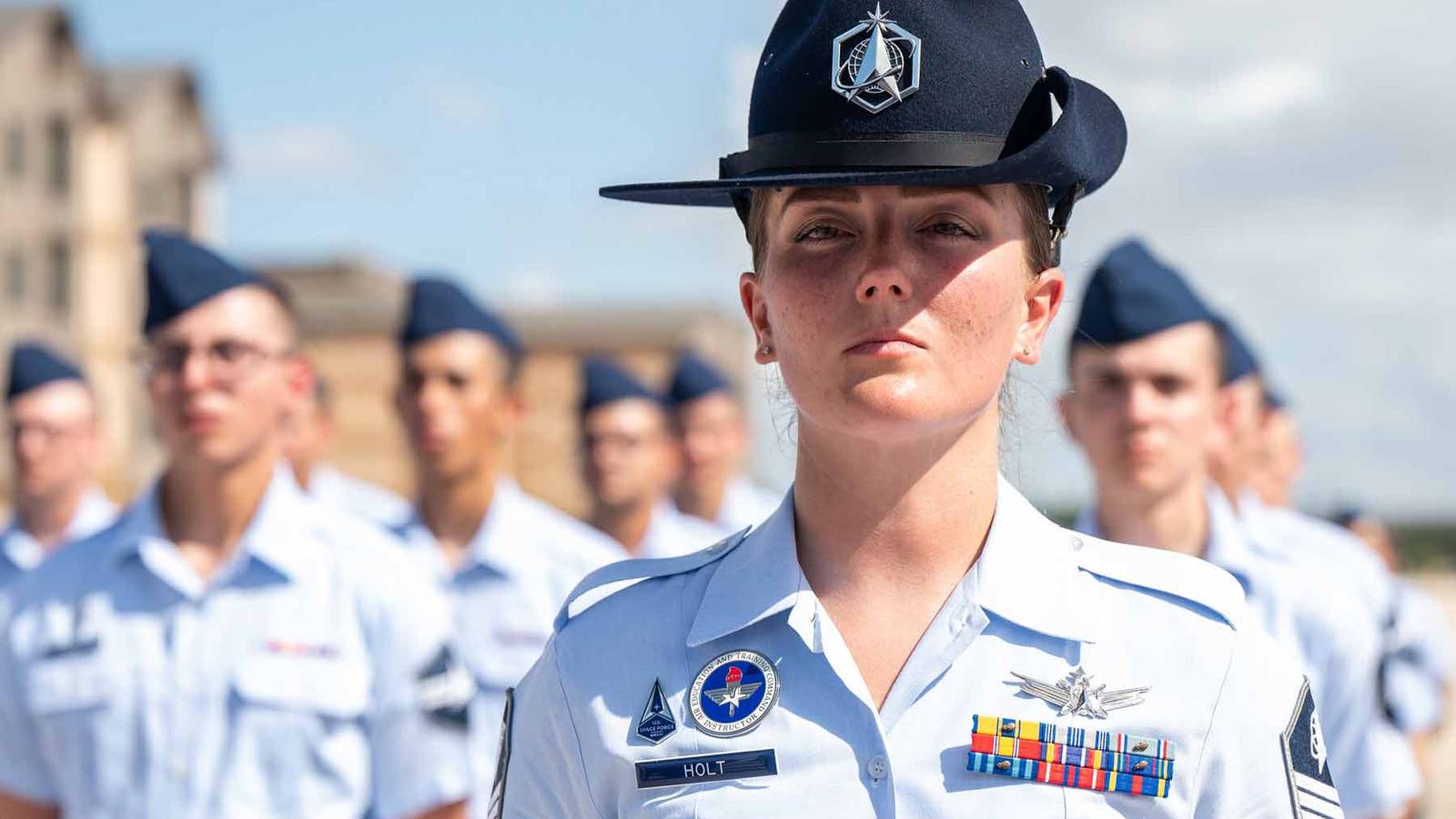
The United States Space Force (USSF) is the sixth, smallest, and newest military service branch, created in 2019 from the Department of the Air Force. It consists of about 9,400 active-duty members, all known as Guardians.
The Space Force is tasked with protecting U.S. and allied interests in space, most notably protecting and defending the massive U.S. satellite fleet. Its domains include the Global Positioning System (GPS), cyber operations, advancing defense technology and more.
The Space Force evolved from the Air Force Space Command, which was activated in 1982. All airmen who were previously assigned to Air Force Space Command were assigned to the USSF at the inception of the new branch.
The USSF also manages the command and control of many Department of Defense (DoD) space systems, ensuring continuous global coverage. Guardians track orbital debris, provide early missile warnings, and conduct defensive and offensive cyberspace operations.
Check out Becoming a US Space Force Guardian in 2026: Requirements and Career Paths for more information on how to join the Space Force.
Requirements to Join the Space Force
Enlisted
Enlisted Guardians, who participate in and support operations, make up about half of the military service. Each member receives specialized training and fills a specific job role.
Space Force requirements to join as an enlisted Guardian are as follows. You must:
Note: Since the Space Force is more competitive, you may need a much higher score than 31 to qualify. Check with your local recruiter.
Read More: Space Force Enlisted Ranks
Since the USSF consists only of full-time enlisted, officer and civilian personnel, it does not have a National Guard or reserve component. The service employs about 8,000 civilians, making a total force of around 16,000.
Commissioned Officers
Space Force officers plan and manage personnel, and make up about half the service because of the technical mission of the USSF. Because of the close relationship between the Air Force and Space Force, officers will go through commissioning through Air Force programs.
To join the Space Force as an officer, you must:
- Be between the ages of 17 and 42
- Hold U.S. citizenship
- Pass the Air Force Officer Qualifying Test (AFOQT) if required
- Have a clean background investigation
- Pass medical examinations
There are several routes to becoming an officer, including the U.S. Air Force Academy, the Reserve Officers’ Training Course (ROTC) and Officer Training School (OTS).
The Air Force Academy offers free tuition in exchange for Space Force service. Another of these options, Air Force ROTC, also allows officer hopefuls to enroll in a scholarship program available at about 1,000 colleges and universities across the country.
Read More: Space Force Officer Ranks
How to Join the Space Force
The Space Force recruitment process begins with working with an Air Force recruiter. Recruiters know the ins and outs of the service and can help you navigate the process and make important decisions along the way.
The Space Force recruiting process comes with no strings attached. There is no obligation when working with a recruiter. They will help you decide whether the Space Force is right for you, and shed light on which job opportunities within the service might be of interest if you sign up.
The Armed Services Vocational Aptitude Battery (ASVAB)
The Armed Services Vocational Aptitude Battery tests your knowledge of basic concepts and skills and produces two types of scores. One determines what branch in the military you are eligible for through the Armed Forces Qualification Test (AFQT),
In addition to your overall qualifying score, you will be scored in four ASVAB categories: mechanical, administrative, general and electronics which determines specific jobs you are qualified for through line scores.
Many enlisted careers are available with a minimum score around 31, but it may take a score in the 60s to qualify for many of the jobs in the Space Force.
Physical Examination
Once an applicant has taken the ASVAB and passed with a qualifying score, the recruiting process moves on to a medical exam at the Military Entrance Processing Station (MEPS).
The basic physical examination includes:
- Height and weight measurements
- Hearing and vision examinations
- Urine and blood tests
- Drug and alcohol tests
- Muscle group and joint maneuvers in underwear (Not exercises and running. Just a few simple flexibility and balance tests to make sure you have proper ranges of motion.)
- Complete physical examination and interview
- Specialized tests if required. (e.g., body fat percentage test if you’re overweight)
- Secondary vision and hearing tests; other tests if you have an unusual medical history
Military Training
Enlisted
Space Force basic training, formally known as Basic Military Training (BMT), lasts 8.5 weeks and takes place at Joint Base San Antonio, TX. You will train side-by-side with Air Force recruits, getting the same training as future Airmen, but you will go through an additional 21 hours of Space Force-specific training. You will learn about the origins of the newest military service branch, the global threats in space and the various satellites under the USSF’s control.
Once you have completed basic military training, the Space Force will send you to technical training (tech school), which lasts from four to nine months, depending on your job. Tech school will involve classroom instruction, specialized simulations, and hands-on practice to ensure you are fully proficient in your job before heading to your first duty station.
Officer
If you are selected for OTS, you will be assigned a class start date to begin your journey into the USSF as a commissioned officer and attend an 8.5-week program at Maxwell Air Force Base in Montgomery, AL. OTS is designed to prepare leaders for a career in the US Space Force. Guardians who attend the U.S. Air Force Academy or the Reserve Officers’ Training Course (ROTC) will have their own training curriculum.
Once commissioned, Space Force Officers are required to attend the U.S. Space Force Officer Training Course at Peterson Space Force Base, CO during their first year of service. This year-long training program replaces traditional tech schools, and is designed to create multidisciplinary officers, by integrating training in satellite, cyber, and intelligence operations, and space acquisitions.
Read More: Inside Recruits’ Journey to Space Force’s First Boot Camp
Space Force Jobs
Active duty is similar to working at a full-time civilian job. Space Force career options vary based on your skills and interests. You will have your own specialty, and you will fill a specific role within your unit. Individual job roles within the Space Force are classified by the Space Force Specialty Code (SFSC).
The USSF can be broken down into these primary fields:
- Space Operations: Responsible for satellite control, orbital warfare, space electronic warfare, and battle management.
- Intelligence: Perform data and imagery analysis to protect US space interests.
- Cyber Operations: Defend space infrastructure, and conduct defensive/offensive cyber operations
- Engineering (Astronautical, Aeronautical, Mechanical, Electrical, Computer): Conduct research, and design/deploy space systems and spacecraft
- Acquisitions/Logistics: Responsible for procuring mission-ready technology and oversees their lifecycle.
To be sworn into the Space Force, you will take the Oath of Enlistment, which is a pledge to defend the Constitution throughout your military career. If you are entering as an officer, you’ll instead take the officer’s oath.
Promotions
Enlisted
For promotion to Specialist 4 (E-4), you must meet time in grade (TIG) and time in service (TIS) requirements, and meet job performance and fitness requirements. Airmen competing for ranks above E-4 must also take two tests as part of the Weighted Airman Promotion System (WAPS): the Specialty Knowledge Test (SKT), to test your job knowledge, and the Promotion Fitness Examination (PFE), to determine your overall Air Force knowledge.
Officer
Officers also must meet TIG and TIS requirements for promotion up to Captain (O-3). For promotion to Major (O-4) and above, your records go before a promotion board.
Related: Space Force Ranks: A Complete Guide to Enlisted and Officer Ranks
Physical Fitness
The Space Force introduced its own physical fitness program in 2025 called the Human Performance Assessment (HPA). The HPA will augment Guardians enrollment in the Continuous Fitness Assessment that uses fitness wearables, like Apple Watches or Fitbits, to help track exercise, diet and sleep
Guardians will have to complete two HPAs annually, and consists of:
- Cardiorespiratory Fitness: Guardians will complete either a 2-mile run or the 20-meter-High Aerobic Multi-Shuttle Run. At least one of the two annual assessments must consist of the 2-mile run.
- Muscular Strength: Exercises include tempo push-ups or hand-release push-ups.
- Endurance: Exercises include sit-ups, cross leg reverse crunches, or a timed forearm plank.
- Body composition: Guardians will be assessed using a waist-to-height ratio measurement.
The HPA is based on a 80-point test: 50 points for the cardio portion and 15 points each for the endurance and strength portions. Guardians who score:
- 72 points or higher are deemed “Fit to Fight.”
- Between 60 and 71.9 are rated in “Health Maintenance.”
- Below 60 are considered a “Health Concern,” and must enroll in a fitness improvement program and retest in three months.
Benefits of Joining the Space Force
Joining the Space Force comes with a variety of benefits.
Basic Pay and Allowances
When you join the Space Force, your paycheck grows as you gain more experience and rise up the ranks.
Every Guardian will be paid based on rank and years of service. You will get paid twice a month, and your basic pay is taxed.
As of 2026, basic pay for a Specialist 1 (SPC1) (E-1) begins at $2,407.20 per month, or $28,886.30 annually. A Space Force Second Lieutenant’s (O-1) initial basic pay is $4,150.20, or $49,802.40 per year.
In addition to your salary, as a Guardian, you will also receive 30 days of paid vacation a year low-cost insurance, retirement benefits and allowances to help offset the cost of uniforms, food, housing and more.
Bonuses
The Space Force offers enlistment bonuses are based on jobs that are highly technical, or are experiencing crucial shortages. For 2026, bonuses of $20,000 and $40,000 were offered to select Guardians in Space Systems and Cyber Operations.
Selective Retention Bonuses (SRB)
The Space Force can provide up to $360,000 (max of $180,000 per contract) over a career for officer and enlisted Guardians who reenlist in critical career fields, such as Space Systems Operations, Cyber Warfare Operations, and Intelligence.
Note: Since the list of eligible job specialties changes based on recruiting and training quotas, check with your local recruiter for the current eligible list of enlistment and reenlistment bonuses.
Educational Benefits
Guardians have access to a range of educational programs that are either free or can come with financial assistance. Many programs help Guardians continue working toward a college degree and beyond.
Those who join as an officer have access to a variety of graduate-level educational opportunities that are STEM-focused and involve space-related research.
Guardians can also take advantage of the Tuition Assistance (TA) program: up to $4,500 per fiscal year for voluntary, off-duty educational opportunities.
After service, the Post-9/11 GI Bill provides up to 36 months of benefits for education and training opportunities outside the Space Force, which may be used for undergraduate and graduate degree programs, vocational and technical training, tutorial assistance, books, supplies and monthly housing.
For USSF officers, the Space Force partners with the Johns Hopkins University School of Advanced International Studies (SAIS) for officer Intermediate Level Education (ILE) and Senior Level Education (SLE) programs.
Other training opportunities and benefits include:
- Air Force Institute of Technology (AFIT): Lets Space Force officers pursue graduate studies as a full-time, active-duty assignment. Its Graduate School of Engineering and Management is among the nation’s top engineering schools.
- Air Force Institute of Technology Center for Cyberspace Research (CCR): Trains future Guardians for cyber careers.
- Full-time paid internships with hands-on training and available tuition assistance: Available for civilian college students and recent college graduates, with possible full-time Space Force jobs upon successful completion.
Healthcare Benefits
Guardians receive full health, dental and vision care, as well as paid time off for illness. Family members may receive medical care at military or civilian facilities through various options for little or no cost.
Active-duty service members and their dependents are eligible for coverage under the Tricare health insurance program. There are several Tricare programs to choose from, depending on your status and location.
Other Benefits
Most Space Force bases offer a variety of services as well as social and recreational activities, like golf courses, tennis courts, swimming pools, gyms and arts-and-crafts facilities, either for free or at discounted rates.
Guardians and their family can also travel on Air Force aircraft to almost any U.S. state and many international destinations. They also qualify for low-price hotels near military facilities.
Read More: Learn About Space Force Benefits
Interested in Joining the Military?
We can put you in touch with recruiters from the different military branches. Learn about the benefits of serving your country, paying for school, military career paths, and more: sign up now and hear from a recruiter near you.
Information from www.spaceforce.mil and other info previously published on Military.com was used in compiling this report.
FAQ
How long is Space Force basic training?
Space Force Basic Military Training is 8.5 weeks at Joint Base San Antonio, TX. Guardians train alongside Air Force recruits and complete an additional 21 hours of Space Force‑specific instruction.
What ASVAB score do I need to join the Space Force?
The minimum qualifying ASVAB score is 31, some specialties require scores above 60. Check with a recruiter for current competitive score ranges.
Are there enlistment or reenlistment bonuses in the Space Force in 2026?
Yes. In 2026, the Space Force offers $20,000–$40,000 enlistment bonuses for certain specialties and up to $360,000 in Selective Retention Bonuses over a career for fields such as Space Systems Operations and Cyber Warfare Operations.
Read the full article here
50 Comments
Nice to see insider buying—usually a good signal in this space.
I like the balance sheet here—less leverage than peers.
Good point. Watching costs and grades closely.
Good point. Watching costs and grades closely.
Nice to see insider buying—usually a good signal in this space.
I like the balance sheet here—less leverage than peers.
Good point. Watching costs and grades closely.
If AISC keeps dropping, this becomes investable for me.
Good point. Watching costs and grades closely.
Nice to see insider buying—usually a good signal in this space.
Good point. Watching costs and grades closely.
Production mix shifting toward USA might help margins if metals stay firm.
Good point. Watching costs and grades closely.
Good point. Watching costs and grades closely.
Uranium names keep pushing higher—supply still tight into 2026.
Good point. Watching costs and grades closely.
Good point. Watching costs and grades closely.
If AISC keeps dropping, this becomes investable for me.
If AISC keeps dropping, this becomes investable for me.
Good point. Watching costs and grades closely.
The cost guidance is better than expected. If they deliver, the stock could rerate.
Exploration results look promising, but permitting will be the key risk.
Good point. Watching costs and grades closely.
Good point. Watching costs and grades closely.
Nice to see insider buying—usually a good signal in this space.
Good point. Watching costs and grades closely.
Good point. Watching costs and grades closely.
Interesting update on Join the Space Force. Curious how the grades will trend next quarter.
Good point. Watching costs and grades closely.
The cost guidance is better than expected. If they deliver, the stock could rerate.
Nice to see insider buying—usually a good signal in this space.
Interesting update on Join the Space Force. Curious how the grades will trend next quarter.
Good point. Watching costs and grades closely.
Good point. Watching costs and grades closely.
Exploration results look promising, but permitting will be the key risk.
Good point. Watching costs and grades closely.
Exploration results look promising, but permitting will be the key risk.
Production mix shifting toward USA might help margins if metals stay firm.
Good point. Watching costs and grades closely.
Good point. Watching costs and grades closely.
Interesting update on Join the Space Force. Curious how the grades will trend next quarter.
Production mix shifting toward USA might help margins if metals stay firm.
Good point. Watching costs and grades closely.
Good point. Watching costs and grades closely.
Interesting update on Join the Space Force. Curious how the grades will trend next quarter.
Good point. Watching costs and grades closely.
I like the balance sheet here—less leverage than peers.
Good point. Watching costs and grades closely.
Good point. Watching costs and grades closely.
Uranium names keep pushing higher—supply still tight into 2026.