

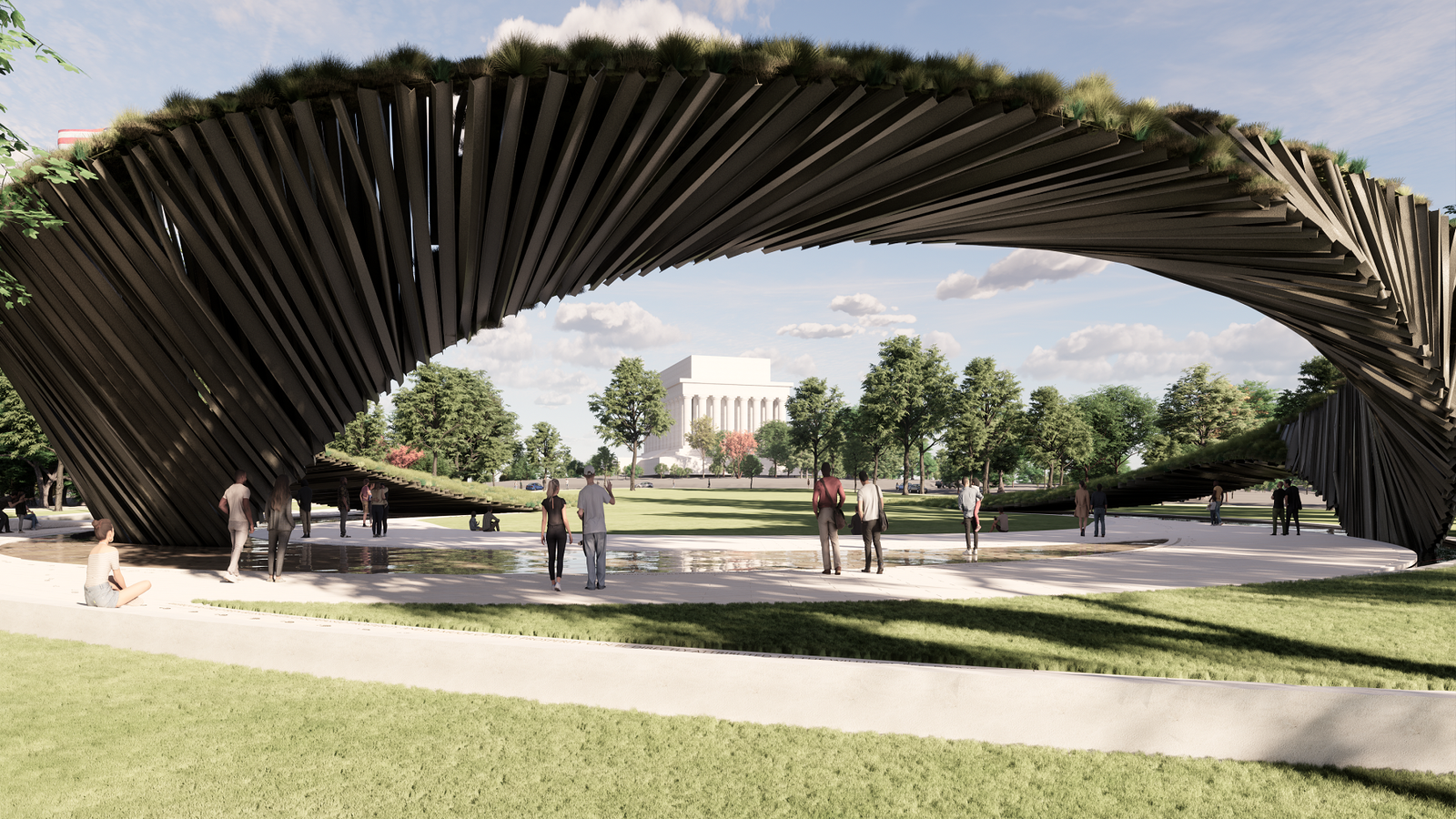
Sen. Jim Banks (R-Ind.), an Afghanistan veteran, did not mince words this week about the initial design concept for the Global War on Terrorism Memorial on the National Mall: “This proposal is a disgrace.”
The lawmaker is among some members of Congress speaking out against the concept of the memorial. Artist renderings were unveiled June 10 and designed by renowned Japanese architecture firm Kengo Kuma & Associates. While the foundation has highlighted years of input from more than 20,000 Americans, including veterans and Gold Star families, some lawmakers and many post-9/11 veterans have said the modern, abstract elements fall short of what is needed to properly honor those who served and sacrificed in America’s longest war.
The backlash centers on the design’s perceived lack of direct recognition for the fallen—such as inscribed names like those on the Vietnam Veterans Memorial—and a feeling that it prioritizes artistic abstraction over solemn representation of service and loss.
“Thousands of heroic Americans sacrificed everything in service to our nation during the Global War on Terror,” Banks said on X. “I served in Afghanistan. These were real people with real stories. They deserve to be honored with dignity, not disconnected abstract art.”
Banks was not alone. Sen. Mike Lee (R-Utah) wrote a post on X calling the concept a “disappointing landscape feature better suited to a hotel courtyard or mini golf course than a monument to the courageous men and women who fought, and the lives lost, to radical Islamic terrorism.” He urged the foundation to “start over and hire” American designers.
Rep. Derrick Van Orden (R-Wis), a retired Navy SEAL, labeled the concept as an “abomination” and a “Jazz Hands monument to our fallen brothers and sisters.” He said there is now “bipartisan/bicameral” support in Congress to stop the design and warned he would hold the Global War on Terrorism (GWOT) Memorial Foundation “organizationally and personally accountable” if it proceeds.
The criticism from the three lawmakers has amplified voices already active on social media. Many GWOT veterans have expressed frustration that the abstract, park-like elements do not sufficiently honor the 7,054 service members killed or adequately represent the realities of service, including IEDs, burn pits, and the emotional toll.
Calls for inscribed names of the fallen and more traditional, representational elements have been common themes, with some comparing the design unfavorably to the solemnity of the Vietnam Veterans Memorial wall.
Van Orden’s statement that bipartisan support exists in both the House and Senate to halt the current concept adds a congressional dimension, though specific Democratic lawmakers have not yet publicly joined the outcry.
Design Shaped by Extensive Veteran and Family Input
The foundation has long emphasized that the concept was not created in isolation.
Since 2018, the “Help Design History” campaign gathered input from more than 20,000 Americans across all 50 states and territories, every service branch, and veterans of conflicts since World War II. A 23-member Design Advisory Council of Gold Star family members, veterans, and service members guided the process to ensure the memorial reflected lived experiences.
“This design was shaped by history and held sacred from the beginning—forged by sacrifice and informed by the voices of warriors and their families,” said Michael “Rod” Rodríguez, president and CEO of the Global War on Terrorism Memorial Foundation and a retired U.S. Army Green Beret.
The four guiding tenets—honor, heal, empower, and unite—aim to create a reverent, apolitical space on the National Mall near the Vietnam Veterans Memorial and the planned Desert Storm and Desert Shield site. The memorial is intended to serve as a “living” tribute that illuminates at night and invites reflection, healing, and unity for generations to come.

In pre-recorded remarks, President George W. Bush, honorary chair of the memorial foundation, stated: “We must always honor those who answered the call and served, care for those who bear the wounds of war, and uphold the freedoms they defended.”
Kengo Kuma & Associates was selected after a global search. The Japanese architect, whose team includes members with personal connections to the Sept. 11 attacks, focused on blending materials from the conflict with natural elements.
Key Elements of the Proposed Design
Renderings released with the concept show several distinctive features:
- The Embrace: A curved ribbon or arch structure made of reclaimed steel from combat operations, draped in native vegetation. Light filters through the structure, creating shadows and a sense of connection.
- Path of Honor: A marble pathway with embedded footprints symbolizing the weight of war carried by service members and their families.
- Reflecting Pools: Shallow, interactive water features where visitors can leave their own footprints alongside imprinted ones, intended for reflection and reconnection with those lost or served.
- Entrances: Feature sacred steel and stone relics from the 9/11 attack sites as a reminder of where the journey began.
- Orientation: The design aligns with Section 60 at Arlington National Cemetery, the burial site for many who died in the post-9/11 conflicts.
The foundation describes it as a “sacred space” for remembrance that bridges civilian and military lives and acknowledges the multi-generational nature of the conflict across Iraq, Afghanistan, Syria, Somalia, and other theaters.

Foundation board member Gen. Joseph Votel (Ret.) stated: “It is personal. It is the brothers and sisters we served beside and the families who carried the weight while we were gone. It is those who made the ultimate sacrifice and the gold star families who miss them every day.”
The privately funded project, financially estimated in the range of $125 million and funded without federal dollars, has a target of groundbreaking as early as 2027, with completion eyed for late 2028, pending final federal approvals in the 24-step process.
The foundation has invited additional public input through an open survey as the project advances toward formal reviews by the National Capital Planning Commission and other bodies.
Foundation Vision and Response to Criticism
Foundation leaders have stressed that the design prioritizes healing and the full human impact of the war, including for families and those bearing invisible wounds.
In response to the criticism levied by lawmakers, Rodríguez provided the following statement to Military.com: “From day one, our mission has been to listen to the warrior culture that emerged from this conflict, give voice to those who lived it, and ensure their experiences helped shape what this Memorial would become.”
He mentioned gathering input from tens of thousands of Americans beginning in 2018, adding that it “didn’t just inform our process; it is embedded in every element of this design.”
While veterans in Congress and in social media spaces have scrutinized the concept, Rodriguez noted how the 23-member advisory council runs the military gamut of Gold Star parents, spouses, and children; combat veterans; active-duty service members; and military families—all of whom worked alongside the design team to ensure that their lived experience and feedback guided every decision.
“Our listening continues, which is why the Global War on Terrorism Memorial Foundation launched a survey immediately after releasing the initial design concept to encourage continued, constructive dialogue,” he added. “The same spirit of listening that began in 2018 and shaped this memorial will carry us forward. We welcome the conversation as we continue this sacred no-fail mission to honor all those who served, sacrificed, and carried the burden of this war.”
In a video response posted June 12, Rodríguez acknowledged one of the most common criticisms:
“One of the questions we’re most often asked is how names of fallen will be represented in this memorial. As we honor all who served in global war on terrorism, both uniform and non-uniform, we must recognize that many gave their lives in ways they cannot always be publicly named, including those lost in classified missions. This war came home. Some have been lost to suicide and others to illness. With these things in mind, we have chosen to honor their service and sacrifice symbolically through footsteps, creating a space where all of us can walk alongside them again.”
The foundation’s accompanying statement noted that in the days and weeks ahead they will share more about the design’s meaning and how it ensures “every sacrifice is remembered and no one is left behind.”
It continues to welcome feedback as it moves forward with the design concept developed in close consultation with those it seeks to honor.
The Global War on Terrorism Memorial Foundation has a survey open for public feedback on the initial design concept.
Read the full article here
22 Comments
Nice to see insider buying—usually a good signal in this space.
Good point. Watching costs and grades closely.
Exploration results look promising, but permitting will be the key risk.
Silver leverage is strong here; beta cuts both ways though.
Good point. Watching costs and grades closely.
If AISC keeps dropping, this becomes investable for me.
Good point. Watching costs and grades closely.
Interesting update on Lawmakers Criticize Global War on Terrorism Memorial: ‘Disgrace’ & ‘Abomination’. Curious how the grades will trend next quarter.
I like the balance sheet here—less leverage than peers.
Good point. Watching costs and grades closely.
Good point. Watching costs and grades closely.
Production mix shifting toward USA might help margins if metals stay firm.
Good point. Watching costs and grades closely.
Good point. Watching costs and grades closely.
Production mix shifting toward USA might help margins if metals stay firm.
Nice to see insider buying—usually a good signal in this space.
Good point. Watching costs and grades closely.
Nice to see insider buying—usually a good signal in this space.
Good point. Watching costs and grades closely.
Production mix shifting toward USA might help margins if metals stay firm.
Good point. Watching costs and grades closely.
Good point. Watching costs and grades closely.