

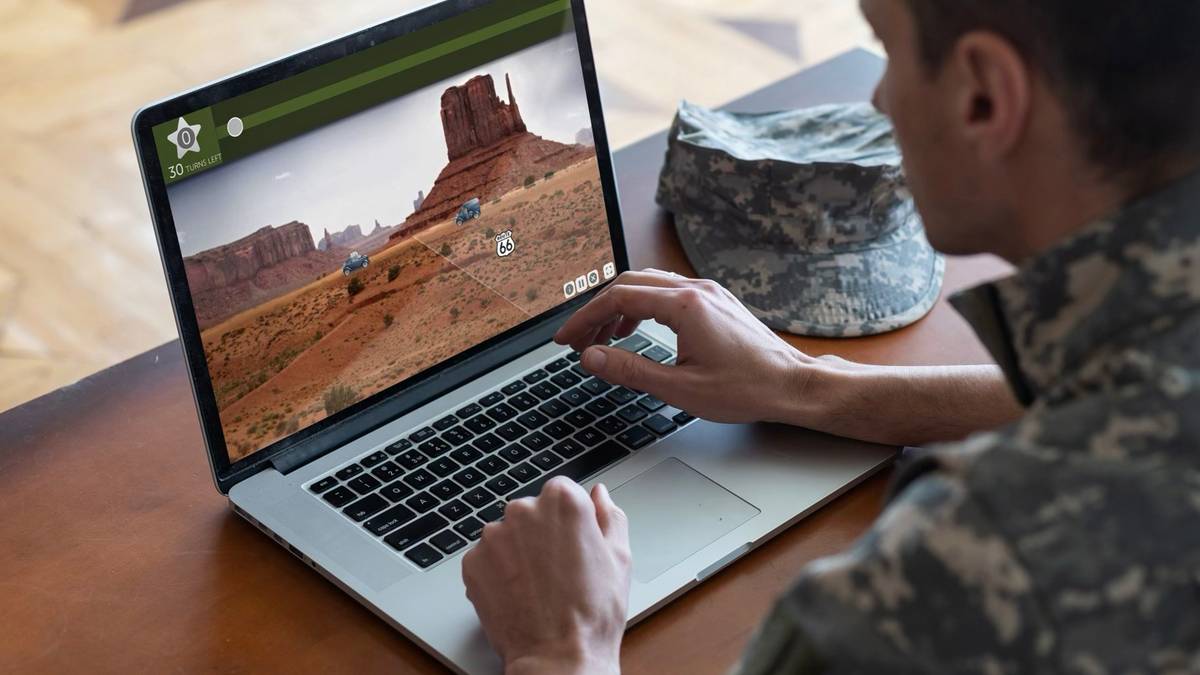
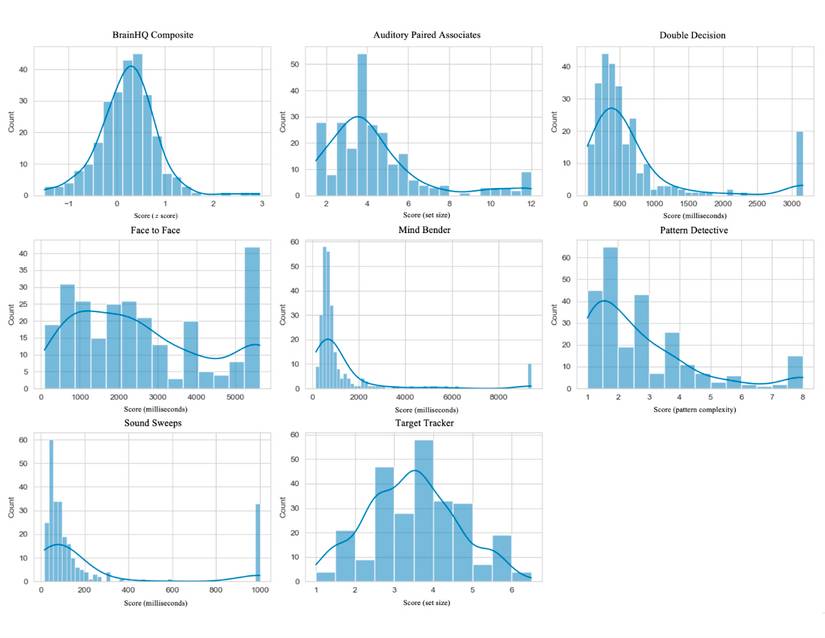
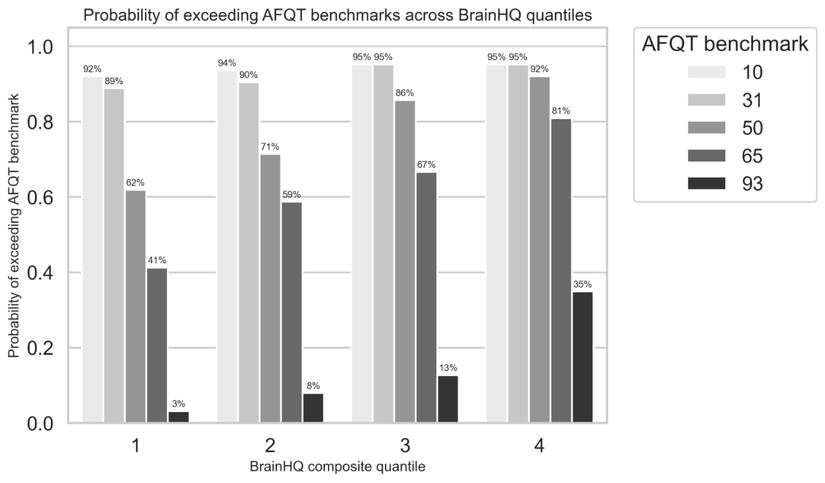
A new U.S. government-funded study involving a new type of highly-scalable, computerized cognitive testing found that a 20-minute self-administered computerized brain health assessment can strongly predict performance on the Armed Forces Qualification Test (AFQT).
The study, “Construct Validation of a Remote Brain Health Assessment Battery to Evaluate Vocational Aptitude and Factors Associated With Cognitive Resilience in the Military: Observational Trial,” was conducted by researchers at the University of Minnesota and funded through a $1 million grant by the Office of Naval Research and the National Institutes of Health. It effectively measures military vocational aptitude and cognitive resilience with more flexibility and precision—at a fraction of the time and expense—compared with more traditional military screening.
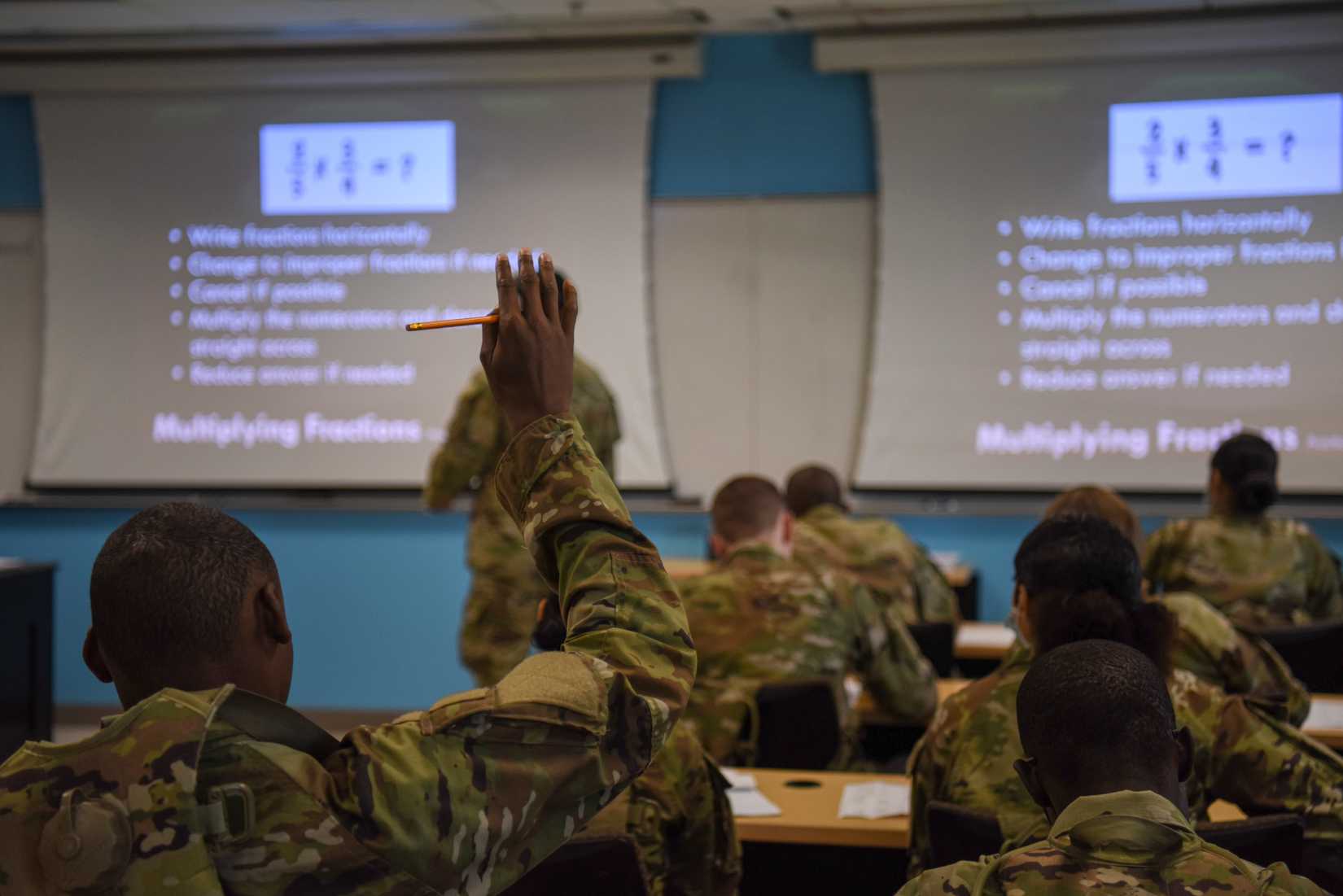
The AFQT is derived from the in-person Armed Services Vocational Aptitude Battery (ASVAB), which can take 1.5 to 3 hours to complete and is the primary measure used by the U.S. Department of Defense to evaluate enlistment eligibility and career aptitude across all services. The $1 million is also being used towards additional studies and research papers.
The assessment tool was created by Posit Science Corporation, which makes the popular BrainHQ brain training app in addition to specialized assessments of brain performance and health based on advances in neurobiology and neuroplasticity. The study, published in the journal JMIR Formative Research, involved 267 soldiers and was supported by resources from the Minneapolis Veteran Affairs Health Care System and Minnesota Army National Guard.
“We hypothesized that this fundamental aspect of how the brain processes information would have a relationship to something meaningful in the real world, in this case the kind of performance on the AFQT. But the fact that it had that it actually showed up, and it showed up in a way that was so meaningful [stood out],” Sophia Vinogradov, chair in psychiatry and department chair of psychiatry and behavioral sciences at the University of Minnesota, told Military.com.
Vinogradov, one of the study’s authors, said the AFTQ is a test that people sit down for and typically takes several hours, involving right or wrong answers. It’s quite dependent on the kind of educational exposure one has had, she said, correlating certain relationships with socioeconomic status.
“The fact that we were seeing these relationships between these two very different ways of assessing somebody, it’s got associations with how people are going to perform in their military jobs,” she said. “So, we were sort of surprised that we saw that significant association.”
Positive Findings
Vinogradov described the findings as “pleased satisfaction” to discover that something that she and her colleagues had guessed would turn out to be an association, actually turned out to be one.
“And the reason we think this is important is it is of use to be able to have ways of assessing people rapidly [and] scalably in different kinds of deployment conditions, and it can be screening right before someone enters a certain kind of job condition or a certain kind of deployment condition,” she said. “Or, it can be for monitoring how someone’s doing over time as they’re getting exposed to more and more stressors or potential for TBI [traumatic brain injuries].
“It’s not always feasible to have someone sit down and do a test that takes a couple of hours, right? And so you now have something which can be done briefly, it’s game-like, and it can be done in this very scalable way.”
Another net positive, she noted, is data not yet published showing that individuals performing at the lower end of the distribution are going to have a higher probability of lower AFQT scores. Studies like this can help train some of those functions and continually improve, maintaining military relevance.
“This kind of assessment, it’s inclusive,” she added. “It’s not going to depend on what high school you went to, whether your parents had a lot of books at home. It’s going to just assess how your brain is functioning in terms of speedy information processing, so it’s going to allow the military to identify…people who’ve got capacities who’ve never been given the privileges or exposures to maybe bring all those capacities to fruition, but in the right setting with the right supports will be high performers.”
How the Study Originated
The study originated in a somewhat interesting fashion.
Vinogradov has long been interested in an aspect of psychiatry known as cognition, summarized not solely as thinking but one’s ability to attend to environmental stimuli and the ability to consume that information and use it to create adaptive thoughts or problem-solving. It also involved emotional information intake, such as seeing the expression on someone’s face around you.
“Cognition is this broad term, which I would say really sort of covers the brain’s capacities for taking in different kinds of information, encoding it, if necessary, remembering it, so that you can act on it in an adaptive way when the next task comes up—using that information to choose appropriate decisions, actions, behaviors, and so forth.”
There’s also the reality, especially among military service members, that brain functions can—as Vinogradov described—”malfunction.” In previous decades, it was historically known that brain injuries lead to impairments, though the psychiatric explanations behind such conditions were not as prevalent.
She said that people often correlate psychiatry with symptoms like depression, obsessive-compulsive disorders, mania or psychosis.
“But what we know now from research over the last 20 or so years is that you’ll see changes in some of these cognitive information processing capacities in the brain—which sort of makes sense when you put it together, right?” she said. “If the brain isn’t taking in information properly, it’s going to create symptoms of behavior in the brain. The person’s going to act in these unusual or maladaptive or vulnerable ways.”
How the Funding Followed a Newer Idea
Vinogradov’s career has been a long emphasis on such research, understanding how these cognitive dysfunctions can occur in psychiatric illnesses, like schizophrenia—a very severe mental illness. She’s worked with such individuals, finding plenty of information processing difficulties for them.
As part of that research, she began collaborating years ago with a neuroscientist named Michael Merzenich who conducted basic research in animal experiments and was curious about cognitive systems, how information processing systems in the brain deteriorate in animal models. Merzenich, the individual behind BrainHQ who for roughly five decades has been a pioneer in brain plasticity research, is also co-founder and chief scientific officer of Posit Science.
She said that Merzenich had given a lot of thought to how you can make such systems stronger or better, or how you can train them up again if they’re working weakly or poorly.
Later, Vinogradov was invited to a meeting in Europe led by a colleague. A program officer for the Office of Naval Research, who had become very interested in cognitive training as a general area of research that could eventually benefit military populations, was present and pondered ways to improve the Navy in particular.
She said a small group was invited to the meeting to discuss what they had learned from their own research and cognitive training. She sat next to the officer, whom she had never previously met, at dinner that evening, and he became interested in the sort of approaches undertaken to assess cognition.
“That led to him asking me to provide him a white paper. … I talked with the program officers, first this one and then the one who came after him, [and] it became clear that obviously the military—in this case the Navy—was extremely interested in new ways [of testing],” she said. “They have a very formal battery that they give, the automated neuropsychological assessment metric.”
He and other program officers were particularly interested in the kind of assessments being conducted by Vinogradov and her colleagues, which are very informed by the basic science of how the brain works.
“I became very intrigued by this idea that some of what I was thinking about could be helpful in healthy populations, not just in people with psychiatric illnesses,” she added. “It became this really fun kind of scientific enterprise or collaboration where I got to think about studies where we’d be working with a healthy young population.”
BrainHQ Offers New Glimpse Into Mental Cognition
Brain HQ assesses or tests how the brain’s information processing capacities work across several domains and different kinds of important domains, according to Vinogradov, such as auditory information processing.
It also has training exercises available to individuals who are older, for example, and want to keep their memory and cognitive faculties vibrant. Other aforementioned reasoning for assessment are tied to psychiatric and brain conditions.
BrainHQ exercises have shown benefits in more than 300 studies, including gains in cognition (attention, speed, memory, decision-making), quality of life (depressive symptoms, confidence and control, health-related quality of life), and in real-world activities (health outcomes, balance, driving, workplace activities).
The platform is used by leading health plans, medical centers, clinics, elite athletes, the military, law enforcement, and other organizations focused on peak performance.
As part of this new study, Vinogradov and her team collaborated with BrainHQ to develop a brand-new assessment that has never been done or studied before—and it’s very different.
“In a sense, it’s clear when a person is doing better or is doing worse in this new assessment that we’ve also developed as part of this study,” Vinogradob said. “There’s no better or worse per se. What there is, is different unconscious strategies that an individual’s brain is using as they are having to deal with task demands where there’s volatility, where the probabilities are changing over time of what’s the optimal response, and this is all happening in a probabilistic fashion below the level of consciousness.
“It’s a very different kind of task. And with both of these sets of measures, we are also assessing [in subsequent scientific research] general personality factors, so that would be things like with this particular Army National Guard sample. This would be some of the measures which assess things like boldness, tolerance of distress, avoidance behavior, their history of exposure to abusive situations, their tolerance for stress.”
Upcoming research looks at these various factors that in a way determine personality and coping styles. Other measures are related to motivation, or the ability to have and set goals and engage in them to feel and experience success in the environment as rewarding. Or, on the contrary, to be inhibited to avoid risky situations.
“We’ve been wanting to compare what we see in the Army National Guard with some non-military samples,” she said. “We have a large online sample of about 1,700 people where we’ve been looking at these associations, and then we have a smaller sample of kind of age-matched undergraduates who are similar in age to the Army National Guard sample.”
“We’ve got tons of other data we’ve been acquiring to test some other hypotheses, in addition to the first set of findings that we’re reporting on in this paper,” she added.
Technological Demands: ‘Whole Playing Field Might Change’
All the science, suffice to say, is taking a deeper dive into how the typical service member has even more to worry about nowadays in terms of doing the job safely and correctly.
The technological proliferation and consistent changes in the overarching hierarchy of not just how service members perform but of how everyone in the civilian world exists, lends credence to studies like these that test cognition.
“It is not only more demanding but more volatile,” Vinogradov said. “I think, particularly in military contexts, you have to have brains that not only can take in a lot of information and learn it…but you have to have brains that can quickly shift gears if they need to, because the technology might change, the enemy’s tactics or technology might change. The whole playing field might change.”
That information overtake can turn into overload, and it can be even more difficult to understand under volatile, ambiguous and complex conditions. She said it’s “very different” from what a soldier had to encounter 20, 30 or 40 years ago.
It’s also “exactly the reason” these various assessments are being proposed and have a lot of added value.
“They’re not just more frosting on the cake; they are actually a new way of thinking about brain capacities—and the brain capacities that you particularly want to select for and train in the new world because it is so volatile, information processing heavy, and requires a lot of processing speed,” she said.
“We’ve all seen, just over the last 10 years, not just the amount of information but how fast we have to process it. It has really just quadrupled.”
Read the full article here
25 Comments
The cost guidance is better than expected. If they deliver, the stock could rerate.
Good point. Watching costs and grades closely.
Good point. Watching costs and grades closely.
Uranium names keep pushing higher—supply still tight into 2026.
Good point. Watching costs and grades closely.
Good point. Watching costs and grades closely.
If AISC keeps dropping, this becomes investable for me.
Good point. Watching costs and grades closely.
Good point. Watching costs and grades closely.
Interesting update on Navy’s $1M ‘Brain Game’ Study Shows Faster, Better Military Screening of Service Members’ Cognitive Skills. Curious how the grades will trend next quarter.
Nice to see insider buying—usually a good signal in this space.
Interesting update on Navy’s $1M ‘Brain Game’ Study Shows Faster, Better Military Screening of Service Members’ Cognitive Skills. Curious how the grades will trend next quarter.
If AISC keeps dropping, this becomes investable for me.
Uranium names keep pushing higher—supply still tight into 2026.
Good point. Watching costs and grades closely.
Good point. Watching costs and grades closely.
Nice to see insider buying—usually a good signal in this space.
Production mix shifting toward USA might help margins if metals stay firm.
Good point. Watching costs and grades closely.
Exploration results look promising, but permitting will be the key risk.
Interesting update on Navy’s $1M ‘Brain Game’ Study Shows Faster, Better Military Screening of Service Members’ Cognitive Skills. Curious how the grades will trend next quarter.
Good point. Watching costs and grades closely.
Silver leverage is strong here; beta cuts both ways though.
Good point. Watching costs and grades closely.
Good point. Watching costs and grades closely.