

On Feb. 11, 1917, Woodrow Wilson was the nation’s president. World War I was still more than a year and a half away from ending.
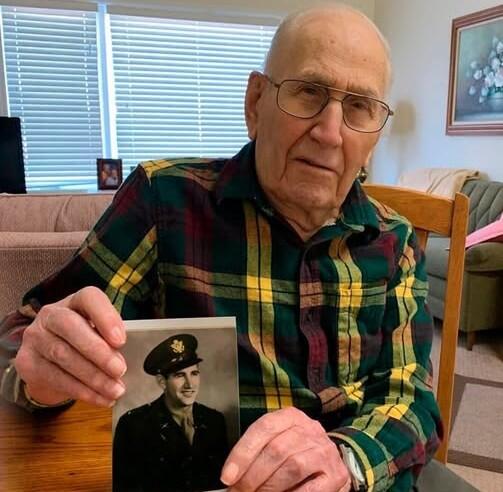
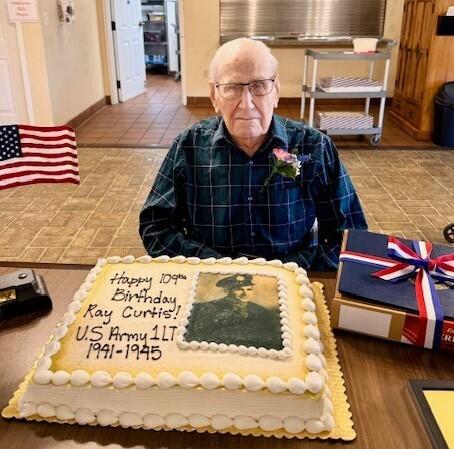
And in a small town in northwestern North Dakota, near the Canadian border, Ray Curtis was born. The state’s oldest veteran recently celebrated his 109th birthday.
Curtis survived the Great Depression, the Dust Bowl that tore through the High Plains in the 1930s, and life as a World War II soldier.
Growing up in Columbus, North Dakota, Curtis was one of four children raised on a grain farm. The depression hit farmers particularly hard, and Curtis’ family was not immune. Harsh weather conditions, combined with a bear market, made selling crops difficult.
Curtis began selling potatoes on his own to make a few dollars.
“I sold those potatoes for a dollar a bushel, and that’s the only money I had in those six years,” he said.
While the Great Depression softened, the threat of war wasn’t far off, and Curtis decided to enlist in the military for one year.
“They started the draft in 1940, and I thought, I’d better well enlist in January for one year training,” Curtis said.
The U.S. wasn’t yet involved in World War II. That all changed on Dec. 7, 1941.
“So, I enlisted for one year. But it so happened the Japanese bombed Pearl Harbor, so my years in the army extended to 1945,” Curtis said.
His service time was a month from ending when Pearl Harbor was attacked, but it no longer mattered to Curtis; it was time to join the war effort. He became an Army officer, serving most of his time stateside but also overseas.
Meeting a Girl
While his mind was occupied with military duties, his thoughts sometimes drifted to a girl he met back home – Ellen.
“She only lived about seven miles from me,” Curtis said. “I met her at her card party; we had card parties in the wintertime in those days.”
Serving in the Army during wartime, time off was limited, and Curtis was often based in areas far away from Ellen. But his commitment to marry her didn’t waver, and one day they found a way to tie the knot.
“I got a 24-hour leave, that was all the time we had, and we drove to Reno, Nevada,” Curtis recalls. “And got to Reno, Nevada, Sunday morning, and went up to the courthouse, got our marriage license, went to the judge’s office, and got married.”
The marriage lasted 72 years, until Ellen’s death, and the couple welcomed five daughters. Their rock-solid marriage was admired by many, including Rebecca Gray, one of their daughters.
“I never heard a harsh or nasty word between them. Not that they didn’t disagree, but they did it very respectfully; there was never a raised voice that I remember,” Gray said. “Even to this day, when I go and sit with my dad, I just feel that calmness and that you know I’m at home here, and their faith played a big role in that.”
Life After the War
Following his military discharge in 1945, Curtis returned to North Dakota and worked the farm with his brother and other family members.
“Then we moved up to the farm, and I farmed ever since,” he said.
Curtis’ family wasn’t known for longevity. He said many of his siblings died before they reached old age. His parents both lived for 82 years, which was the longest in the family until Curtis surpassed that mark by 27 years.
“I had taken all their years,” he said.
Upon celebrating his birthday, Curtis received many honors. Not only is he North Dakota’s oldest veteran, but he’s also believed to be among the 11 oldest World War II veterans in America.
Despite his age, Curtis’s mind and wit are still sharp as a tack. He kept several items from World War II, including a few he probably shouldn’t have left the Army with.
“This was my blanket. I’m not supposed to have it, have to turn it in, I think,” Curtis said.
Curtis is also very active and still walks as much as possible. He believes it’s the key to a long life.
“I exercise a lot,” he said. “I used to walk a lot and exercise, and I used to eat a good diet, I guess.”
He advises younger generations to keep moving, to stay fit, and to raise families with a strong emphasis on faith. Curtis has 10 grandchildren, 17 great-grandchildren, and three great-great-grandchildren.
Read the full article here
30 Comments
Silver leverage is strong here; beta cuts both ways though.
Good point. Watching costs and grades closely.
Good point. Watching costs and grades closely.
Nice to see insider buying—usually a good signal in this space.
Uranium names keep pushing higher—supply still tight into 2026.
Good point. Watching costs and grades closely.
Good point. Watching costs and grades closely.
Exploration results look promising, but permitting will be the key risk.
Good point. Watching costs and grades closely.
Good point. Watching costs and grades closely.
Interesting update on North Dakota’s Oldest Veteran, 109, Shares Story of Resilience. Curious how the grades will trend next quarter.
Good point. Watching costs and grades closely.
Good point. Watching costs and grades closely.
Production mix shifting toward USA might help margins if metals stay firm.
Good point. Watching costs and grades closely.
Good point. Watching costs and grades closely.
Silver leverage is strong here; beta cuts both ways though.
Good point. Watching costs and grades closely.
Uranium names keep pushing higher—supply still tight into 2026.
Good point. Watching costs and grades closely.
Nice to see insider buying—usually a good signal in this space.
Good point. Watching costs and grades closely.
If AISC keeps dropping, this becomes investable for me.
If AISC keeps dropping, this becomes investable for me.
Good point. Watching costs and grades closely.
Good point. Watching costs and grades closely.
Exploration results look promising, but permitting will be the key risk.
Good point. Watching costs and grades closely.
Good point. Watching costs and grades closely.
Uranium names keep pushing higher—supply still tight into 2026.