
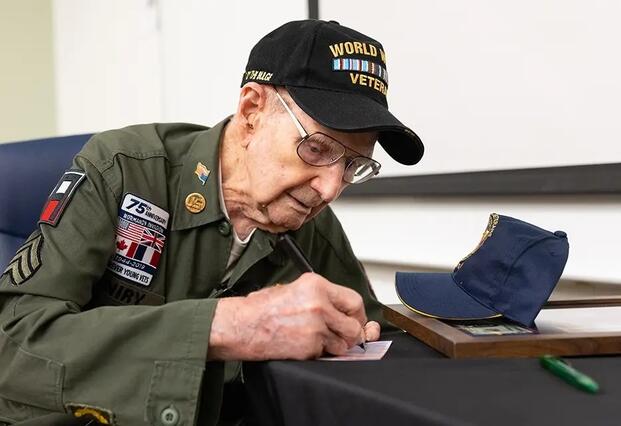
Heading into his final months as a World War II combat medic, Sgt. Andrew “Tim” Kiniry thought he had seen enough carnage to haunt him for the rest of his long life.
After all, Kiniry landed on Omaha Beach along the French coastline on June 16, 1944, just 10 days after the bloody D-Day invasion. In the brutal winter of 1944-45, the Army soldier was in the thick of the Battle of the Bulge, Hitler’s last stand to salvage his crumbling Third Reich.
Despite the devastation he had already witnessed, it paled in comparison to the hell he would walk into as the 45th Evacuation Hospital Combat Unit entered the Buchenwald Concentration Camp on April 28, 1945.
“We were put in the back of trucks and not told anything, which was the Army’s deal – you never knew where you were going,” Kiniry said on April 16 at Stockton University. “I didn’t know the first thing (about Buchenwald). We pulled inside the gates and we came across an odor of which I can never describe. It was terrible.”
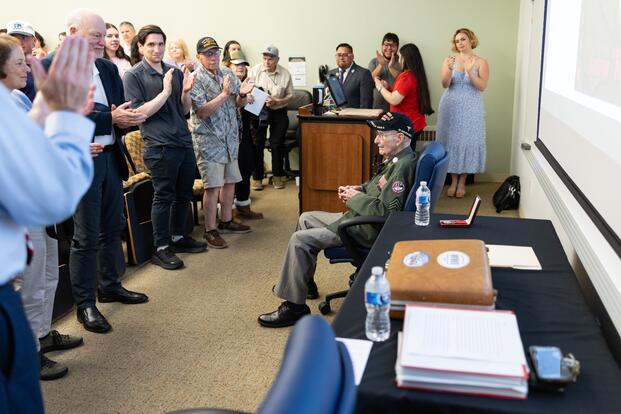
Kiniry, 104, captivated an audience of more than 100 students and local residents during a presentation at Stockton University in New Jersey. The discussion was moderated by Doug Cervi, a Stockton adjunct professor, and sponsored by the Sara and Sam Schoffer Holocaust Resource Center (HRC), the Jewish Federation of Atlantic and Cape May Counties and the Board of Jewish Education of Atlantic and Cape May Counties.
Kiniry’s story was recorded by the center to inform future generations of the Holocaust through first-person stories from survivors and liberators living in southern New Jersey. April 14 was Holocaust Remembrance Day in the U.S.
With less than 45,000 American World War II veterans still alive, Kiniry’s account of the war and Buchenwald is vital.
“Tim’s courage helped shape the world we inherited, and his presence reminds us that history is not distant, it is sitting right here,” said Irvin Moreno-Rodriguez, director of the HRC. “We stand here today because heroes like you sir stood firm when the world needed you the most.”
‘Are They Real?’
During last week’s presentation, Kiniry spoke at length about the two weeks he served at Buchenwald, treating about 21,000 prisoners following liberation of the Germany concentration camp on April 11.
“We saw the people standing there and I thought, ‘Are they real? Are their clothes real?’ Because a lot of their clothes were tattered,” he said.
Shocked by what they were seeing, most of the medics weren’t sure what to do first, so they set up showers in tents to help clean the survivors. But they had a problem getting them into the tents. Since so many prisoners had been tricked by the Nazis believing they were getting showers when really they were entering chambers of death.
“They were afraid of being gassed,” Kiniry said.
Following likely the first shower they’ve had in months, survivors dried off and were sprayed with DDT because lice were crawling over their bodies.
“Some of them had to be washed by hand, but you had to be careful because without much trouble you could push their bones through their skin. They were just skin and bones. It was terrible,” he said.
Feeding the prisoners was another challenge.
“Some of them got a hold of some food and they ate it, but it killed them. They just took too much, too quick and their stomachs couldn’t handle it,” Kiniry said. “We had to give them chocolate milk, eggnog and candy bars to build them up, which did help.”
Beyond Just Remembrance
While Kiniry’s testimony was powerful, Moreno-Rodriguez said it must go beyond simply remembering the Holocaust survivors and what Kiniry and his fellow troops did to save thousands from death.
“It is now our obligation, our responsibility, to ensure that the courage of those who came before us continues to illuminate a path forward,” he said. “May we honor Tim’s service and the service of other American service members. Let us honor them not only with our words, but with the choices we make and the responsibilities we now, all in this room, choose to accept.”
Kylie Fitzpatrick, a junior at Stockton, was emotionally moved hearing Kiniry’s story. Fitzpatrick majors in Historical Studies and produces social media posts for the HRC. She said it was vital to capture the World War II veteran’s discussion for those who couldn’t attend the event.
“I really appreciate that he came and took the time to talk to us, and I feel like he didn’t want to stop, which was a good thing,” Fitzpatrick said. “I was just excited to hear the next thing that he was going to talk about. Now, it’s our responsibility to share it.”
Té Sammons, an HRC graduate assistant, also said it’s important to hear from WWII veterans while they’re still here.
“We have people that are from this era that are unfortunately passing and their stories will pass with them if we aren’t able to hear them,” said Sammons, who, like Kiniry, is from Minotola, New Jersey. “Events like this are super important and especially timely. We are at a point, especially in our political environment, that we in the younger generation would say history looks like it’s repeating in many ways.”
After his presentation, Kiniry fielded questions from the crowd, which included Leah Lederman whose father was held captive in Buchenwald during WWII.
“The importance is that (the Holocaust) isn’t forgotten. It should be told. It should be taught. It should be understood,” she said. “Stockton is playing a crucial, crucial part of history now for the future, documenting the history of survivors.”
Read the full article here
40 Comments
Exploration results look promising, but permitting will be the key risk.
Good point. Watching costs and grades closely.
Good point. Watching costs and grades closely.
If AISC keeps dropping, this becomes investable for me.
Good point. Watching costs and grades closely.
Uranium names keep pushing higher—supply still tight into 2026.
Interesting update on ‘Nothing Prepared Me’: WWII Medic, 104, Reflects on Liberating Buchenwald. Curious how the grades will trend next quarter.
Good point. Watching costs and grades closely.
I like the balance sheet here—less leverage than peers.
Good point. Watching costs and grades closely.
Exploration results look promising, but permitting will be the key risk.
Good point. Watching costs and grades closely.
I like the balance sheet here—less leverage than peers.
Production mix shifting toward USA might help margins if metals stay firm.
Interesting update on ‘Nothing Prepared Me’: WWII Medic, 104, Reflects on Liberating Buchenwald. Curious how the grades will trend next quarter.
Good point. Watching costs and grades closely.
Production mix shifting toward USA might help margins if metals stay firm.
Good point. Watching costs and grades closely.
Good point. Watching costs and grades closely.
Uranium names keep pushing higher—supply still tight into 2026.
Good point. Watching costs and grades closely.
Nice to see insider buying—usually a good signal in this space.
Good point. Watching costs and grades closely.
Good point. Watching costs and grades closely.
Nice to see insider buying—usually a good signal in this space.
Good point. Watching costs and grades closely.
I like the balance sheet here—less leverage than peers.
Good point. Watching costs and grades closely.
The cost guidance is better than expected. If they deliver, the stock could rerate.
Good point. Watching costs and grades closely.
Silver leverage is strong here; beta cuts both ways though.
Good point. Watching costs and grades closely.
Good point. Watching costs and grades closely.
Uranium names keep pushing higher—supply still tight into 2026.
Good point. Watching costs and grades closely.
Exploration results look promising, but permitting will be the key risk.
Nice to see insider buying—usually a good signal in this space.
Production mix shifting toward USA might help margins if metals stay firm.
Good point. Watching costs and grades closely.
Good point. Watching costs and grades closely.