

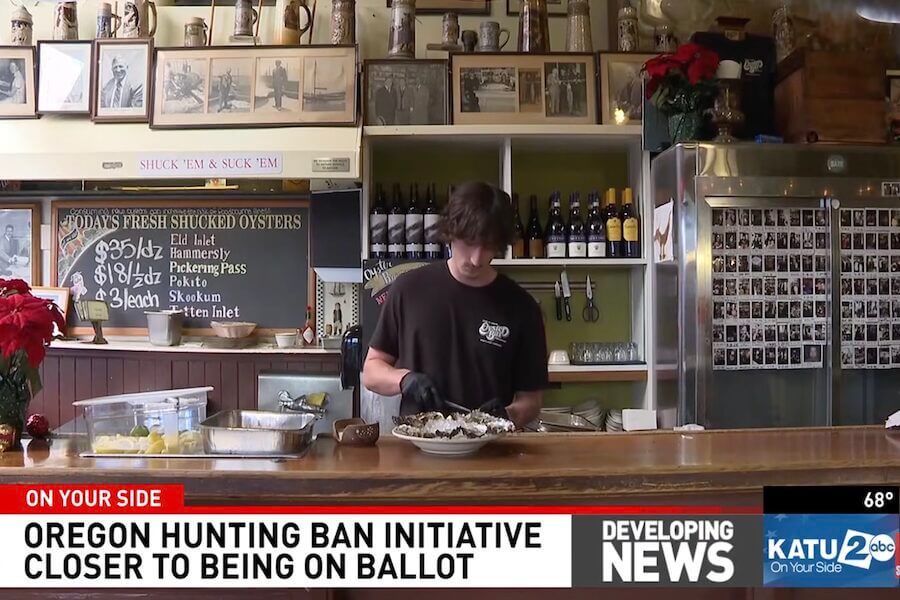
A proposal that could effectively ban hunting, fishing, slaughterhouses, and many forms of animal testing in Oregon just took a big step toward the November ballot.
According to KATU, supporters of Initiative Petition 28, also known as the PEACE Act, say they submitted roughly 140,000 signatures to the Oregon Secretary of State’s Office. That does not automatically put the measure on the ballot. The state still has to verify the signatures, and officials have until Aug. 2 to decide whether the petition qualifies for the November general election.
Still, for hunters, anglers, ranchers, seafood restaurants, and anyone who enjoys eating something that once had a pulse, this one is worth watching.
KATU described the proposal as a “controversial proposal to ban hunting and fishing” and reported that the campaign has now come closer than it did in two previous attempts.
The measure would expand Oregon’s animal cruelty laws to include animals raised on farms, animals used in research, and animals living in the wild. Supporters say the goal is to extend protections beyond companion animals. Opponents say the practical effect would be massive: no hunting, no fishing, no animal slaughter, and serious consequences for agriculture and related industries.
In KATU’s report, reporter Victor Park said the proposal “could affect everything from restaurants to ranches to hunting and fishing traditions across Oregon.”
That is not exactly a small footprint.
Supporters say that is the point. One campaign representative told KATU, “We’re asking, let’s make the default option not kill animals. So it is trying to shift all of us together.”
Opponents see something far more disruptive.
At Portland’s historic Dan & Louis Oyster Bar, owner Meinert Wachsmuth told KATU the impact would stretch well beyond seafood. He pointed to the family traditions built around hunting and fishing.
“The business implications, I’m sure those are going to be challenging,” Wachsmuth said. “I think it has more of an impact on your families hunting, fishing with their father, and it creates that bond that honestly, you can’t find.”
For the HUNT365 crowd, that line probably lands harder than the economic argument.
Yes, restaurants matter. Ranches matter. Commercial fishing matters. But so does the kid sitting in a duck blind before sunrise. So does the father teaching his daughter how to read a deer trail. So does the family that fills a freezer with elk, salmon, turkey, or venison.
Those traditions do not show up cleanly on a spreadsheet. But they matter.
Opponents who warned the measure could “flip this state on its head.” One person in the report put it plainly: “Commercial fishing is gone. Ranching is gone. It would literally flip this state on its head. It would change everything overnight.”
Supporters of IP28 frame the measure as an animal-protection effort. The campaign’s website says the initiative would remove many current exemptions from Oregon’s animal cruelty laws, including exemptions involving animal abuse, neglect, and sexual assault statutes.
Opponents argue those exemptions currently allow lawful hunting, fishing, farming, ranching, trapping, pest control, veterinary work, and wildlife management to function without being treated as criminal abuse. Groups including the Oregon Hunters Association and Congressional Sportsmen’s Foundation have warned that IP28 could effectively criminalize those activities by removing long-standing protections.
The Oregon Secretary of State’s current submission log lists IP28 under the People for the Elimination of Animal Cruelty Exemptions Act and shows 117,173 signatures in the last submission, though the campaign and KATU reported roughly 140,000 total signatures turned in.
That number matters because Oregon requires enough valid signatures before a statutory initiative can make the ballot. Campaigns often submit more than the minimum because some signatures usually get rejected during verification.
For now, the measure remains in limbo.
But hunters and anglers should not treat this like some internet fever dream. This is the campaign’s third attempt, and this time supporters say they have submitted their strongest signature total yet.
If the Secretary of State verifies enough signatures, Oregon voters could decide in November whether the PEACE Act becomes law. And if it passes, the fight over hunting, fishing, farming, and animal use in Oregon would move from theory to reality fast.
As KATU’s anchor put it after the report: “We will see what happens there. It’ll be really interesting if that makes it on the ballot.”
That is one way to say it.
For Oregon’s hunters, anglers, ranchers, seafood workers, and everyone who still believes wild food belongs on the table, “interesting” might be underselling it.
*** Buy and Sell on GunsAmerica! ***
Read the full article here
24 Comments
I like the balance sheet here—less leverage than peers.
Good point. Watching costs and grades closely.
Exploration results look promising, but permitting will be the key risk.
Silver leverage is strong here; beta cuts both ways though.
I like the balance sheet here—less leverage than peers.
Good point. Watching costs and grades closely.
Nice to see insider buying—usually a good signal in this space.
Production mix shifting toward USA might help margins if metals stay firm.
Good point. Watching costs and grades closely.
Good point. Watching costs and grades closely.
If AISC keeps dropping, this becomes investable for me.
Good point. Watching costs and grades closely.
I like the balance sheet here—less leverage than peers.
Good point. Watching costs and grades closely.
Good point. Watching costs and grades closely.
Interesting update on Oregon Moves Closer to Banning Hunting, Fishing. Curious how the grades will trend next quarter.
Uranium names keep pushing higher—supply still tight into 2026.
Good point. Watching costs and grades closely.
Good point. Watching costs and grades closely.
Silver leverage is strong here; beta cuts both ways though.
Good point. Watching costs and grades closely.
Good point. Watching costs and grades closely.
Production mix shifting toward USA might help margins if metals stay firm.
Good point. Watching costs and grades closely.