

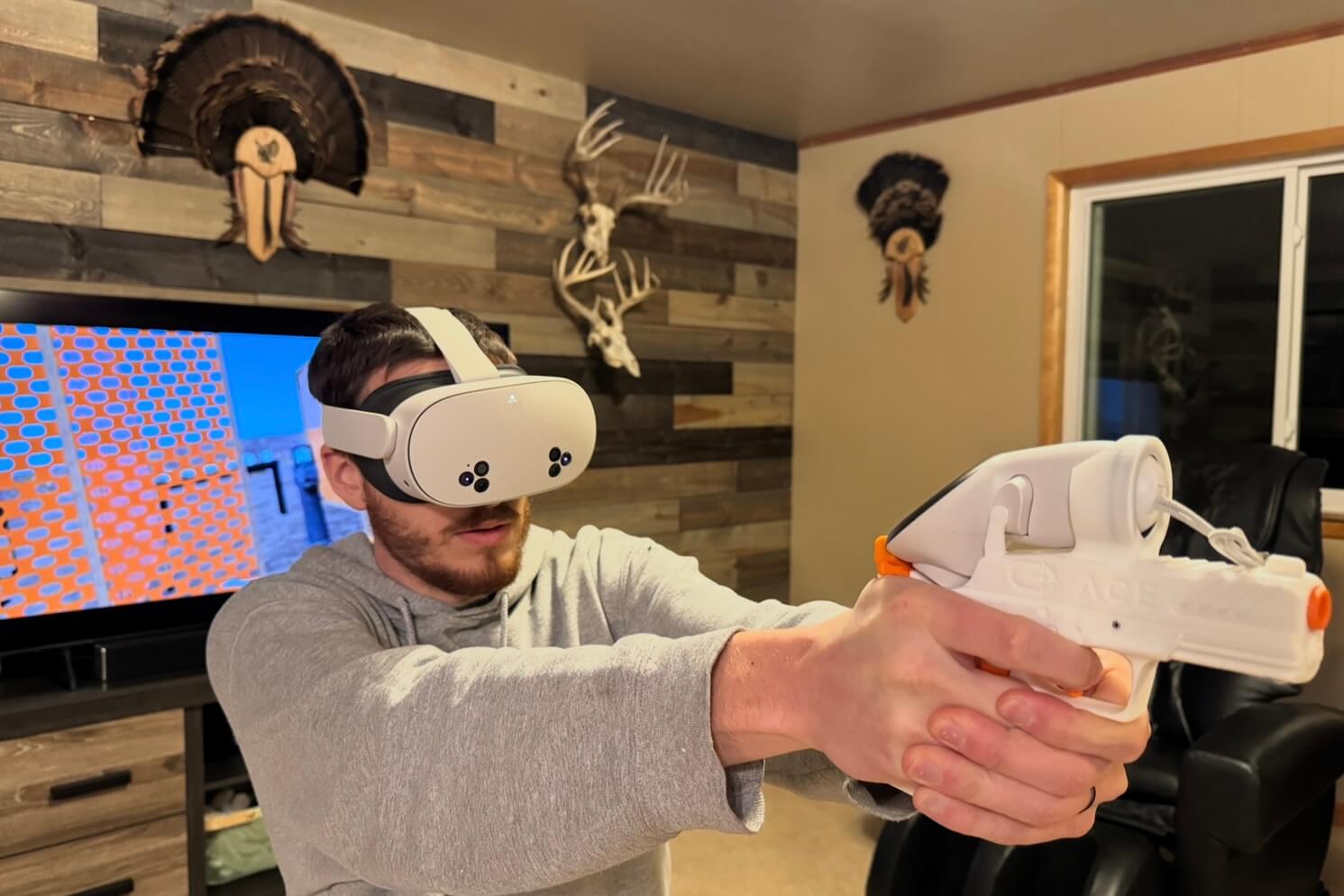
ACE VR turns living rooms into real practice space with pistol handsets, USPSA-style stages, and hard data. After more than 63,000 virtual rounds, the skill transfer is real.
ACE VR Review: Does Virtual Repetition Become Real Skill
ACE VR turns your living room into a realistic virtual shooting range using true-to-life pistol controllers and data-driven training drills. That idea sounds ambitious at first; however, after using the ACE VR shooting simulator for more than a year and a half, it consistently delivers on that promise. More importantly, it delivers where it matters most: building real shooting skills that transfer to live fire.
ACE VR is a virtual shooting platform designed to help shooters train meaningful pistol fundamentals from home. It pairs a Meta Quest headset with a dedicated ACE handset that mirrors the size, weight, and trigger feel of a real handgun. From there, shooters enter a virtual environment filled with drills, competitive stages, performance metrics, and online competition. It does not simulate recoil, which is often the first criticism raised. However, recoil management represents only a small portion of shooting performance. Vision, trigger control, transitions, movement, and stage planning account for the majority of skill development, and ACE VR focuses heavily on those areas.
Table of contents
- ACE VR Review: Does Virtual Repetition Become Real Skill
- Handsets That Feel Like Guns, Not Game Props
- Weight, Trigger, Ergonomics: Built For Real Reps
- Setup, Durability, Handling: Built To Survive Thousands Of Runs
- Content That Keeps You Training: Drills, Stages, Classifiers
- Metrics That Matter: Speed, Precision, Efficiency
- Competition And Community: Train With Friends, Chase Leaderboards
- Minigames Keep It Fresh Without Ditching Fundamentals
- Headset Reality Check: Compatibility And Visual Limits
- Long-Term Value: 63,000 Virtual Rounds And Still Not Bored
- Pricing, Subscription, Final Take: What It Costs To Get Moving
- ACE VR Quick Specs For Shoppers
- Pros And Cons After Long-Term Use
- Related Reads from GunsAmerica Digest
Handsets That Feel Like Guns, Not Game Props
The controller, or handset, is where ACE VR clearly separates itself from most VR shooting experiences. These are not generic shells or game-style controllers. They are purpose-built pistol replicas designed to feel like real firearms. I have spent all of my time with the Staccato P and Shadow Systems MR920 handsets. The Staccato P handset closely mirrors a full-size 2011 duty pistol, offering a stable, predictable feel that will immediately resonate with shooters familiar with double-stack 1911 platforms.
The Shadow Systems MR920 handset ultimately proved to be the better fit for my personal training. It replicates the striker-fired grip angle most shooters actually carry and includes OEM Shadow Systems backstraps that allow adjustment from steep to neutral grip angles. That flexibility makes it possible to closely match a real EDC pistol. While this may seem like a minor detail, it has a significant impact on skill transfer.
Early in my use of ACE VR, I trained extensively with the Staccato P handset before Glock-style grip angles were available. Over time, I noticed that presenting my real Glock felt off, and finding the red dot became inconsistent. This was not a flaw in ACE VR, but rather a testament to how effectively it builds muscle memory. Once I switched to the MR920 handset, everything immediately felt natural again.
Weight, Trigger, Ergonomics: Built For Real Reps
Weight and balance on the MR920 handset are well executed. With a Meta Quest controller installed, it weighs 1 pound 8.8 ounces, placing it squarely between my unloaded (1lb 7oz) and fully loaded EDC Glock with a weapon light and optic (1lb 14oz). The balance feels almost perfect. Having an identical weight really helps with muscle memory when working on draws and transitions. This makes extended practice sessions far more productive.
The trigger is another standout feature. There is a smooth take-up, a clearly defined wall, and a clean break. Reset is short and tactile, placing the finger back on the wall, ready for the next shot. I measured the pull weight breaking between 3 and 3.5 pounds. While that is lighter than most stock pistol triggers, it works well for long sessions and aligns closely with many aftermarket competition triggers. The trigger encourages proper prep and timing, which directly supports good shooting fundamentals.
Setup, Durability, Handling: Built To Survive Thousands Of Runs
Installing and removing the Quest controller is fast and tool-free thanks to a spring-loaded rear hook. The process takes only seconds and feels secure once installed. I’ve never noticed a rattle or had the controller work loose. The handset is constructed using SLS nylon, and it feels dense and durable in hand. After tens of thousands of virtual rounds, my handsets show no concerning wear, which speaks well to long-term reliability. The triggers on both handsets are also still feeling crisp.
Magazine changes are handled in-game by pressing the magazine release and tapping the base of the handset to reload. The process is intuitive and reinforces correct mechanics without breaking immersion. These small interaction details add up and help the system feel purpose-built rather than improvised. While I am not visually aligning a mag to a magwell, it gets the gist of what is supposed to be going on.
Content That Keeps You Training: Drills, Stages, Classifiers
While the hardware lays the foundation, the ACE VR app is where the system truly shines. The app includes over 170 drills and stages, with new content added regularly. There are dedicated skill-building drills focused on fundamentals, along with full competitive stages modeled after USPSA, PCSL, and Steel Challenge. More than 40 official USPSA classifiers are available, and all eight Steel Challenge stages are represented at a true 1:1 scale. Competitive shooters will immediately recognize stage layouts and movement patterns, which makes the training feel purposeful and familiar. For those with no prior competition shooting experience, you are in for a mental treat.
Stages scale well in virtual reality and allow meaningful movement. Shooting around barricades, through ports, and from awkward angles feels surprisingly realistic. That aspect initially caught me off guard. Angles matter, foot placement slightly matters, and vision/head placement matters just as much as they do on a real range. You can even practice breaking shots while moving between positions. These details make ACE VR far more than a simple dry-fire replacement. This is much more immersive, competitive, and beneficial than the sticky notes I had taped on my wall to use as dry fire targets in the past.
Metrics That Matter: Speed, Precision, Efficiency
ACE VR excels at providing feedback that actually matters. The system tracks speed, accuracy, precision, and efficiency across every drill and stage. Shot split tracking shows exactly where time is lost between shots and transitions, allowing shooters to identify inefficiencies quickly. This feedback is immediate and actionable, which helps shorten the learning curve. While this may be more advanced info than new shooters know what to do with, as you progress, you will learn from these metrics.
Competition And Community: Train With Friends, Chase Leaderboards
Every drill includes leaderboards that allow shooters to compare performance against personal bests and global rankings. This competitive element adds motivation without turning training into a gimmick. Daily drills, weekly series, live events, and ranked seasons provide structure for those who thrive on measurable progress.
Multiplayer duels allow shooters to train with friends in real time while communicating through voice chat. Beyond that, ACE maintains an active online community through Discord and social platforms. That community support helps keep training engaging and provides a place to ask questions, share progress, and compare results.
Minigames Keep It Fresh Without Ditching Fundamentals
ACE VR also includes several minigames designed to add variety to training sessions. Modes involving drones, robots, and whack-a-mole-style targets offer a change of pace while still reinforcing core shooting skills. While I personally spend most of my time in structured drills, these modes encourage movement within limited physical space and help prevent training burnout. Shooting robotic zombies through windows and barricades may sound lighthearted, but it still demands proper transitions, trigger control, and target acquisition.
Headset Reality Check: Compatibility And Visual Limits
ACE VR is compatible with the Meta Quest 2, 3, and 3S headsets. I have used the Quest 3S exclusively during my time with the system. Tracking has been reliable, and overall performance has been solid. Visual clarity is good, although not perfect. There is a slight fuzziness to the image that reminds me of mild, exaggerated astigmatism. It is not a deal-breaker, but it is noticeable. A higher-resolution headset would further enhance immersion, although the current experience remains effective for training.
Long-Term Value: 63,000 Virtual Rounds And Still Not Bored
At this point, I have fired over 63,000 virtual rounds in ACE VR. All that shooting, and I still am not burnt out. This is a testament to my competitive spirit and the quality of the system that keeps me engaged. This system is built for shooters who want measurable improvement. For anyone interested in USPSA competition, ACE VR may be one of the most effective at-home training tools available. Stage planning, sight alignment on the move, transitions, and visual discipline all translate directly to live fire.
The most common criticism remains the lack of recoil. That criticism overlooks the bigger picture. You cannot practice recoil control here, but you can practice nearly everything else that matters. That makes ACE VR incredibly valuable as a supplemental training tool.
Pricing, Subscription, Final Take: What It Costs To Get Moving
ACE handsets cost $199, and membership costs $19 per month or $14 per month if you buy the entire annual subscription up front. A Meta Quest 3S currently runs around $270, meaning shooters can be fully set up for under $500. While I despise subscription models, ammunition costs add up quickly. If ACE VR replaces even a small portion of live-fire sessions, it pays for itself.
ACE VR is the most effective shooting simulator I have personally used. It is not perfect, but it does not need to be. It focuses on the skills that actually make shooters better and provides consistent, meaningful feedback. If your goal is personal improvement, ACE VR delivers.
ACE VR Quick Specs For Shoppers
| Model | ACE VR Shooting Simulator |
|---|---|
| Platform | Meta Quest |
| Headset Compatibility | Meta Quest 2, 3, 3S |
| Handset Options | Staccato P, Shadow Systems MR920 |
| Handset Weight | 1 pound 8.8 ounces with controller |
| Trigger Pull | 3 to 3.5 pounds measured |
| Membership | $19 per month or $14 per month annually |
| Handset Price | $199 |
| Typical Headset Price | $270 for Meta Quest 3S |
Pros And Cons After Long-Term Use
- Pros: Realistic weight and trigger feel, deep drill library with USPSA and Steel Challenge content, meaningful metrics and leaderboards, durable SLS nylon build, quick controller install, strong community, and multiplayer.
- Cons: No recoil simulation, slight image fuzziness on Quest 3S, subscription required, needs clear floor space for movement-heavy stages.
Read the full article here
16 Comments
Production mix shifting toward USA might help margins if metals stay firm.
If AISC keeps dropping, this becomes investable for me.
Good point. Watching costs and grades closely.
Silver leverage is strong here; beta cuts both ways though.
Exploration results look promising, but permitting will be the key risk.
Good point. Watching costs and grades closely.
Good point. Watching costs and grades closely.
I like the balance sheet here—less leverage than peers.
Interesting update on Real Skill From Virtual Reps. Curious how the grades will trend next quarter.
Good point. Watching costs and grades closely.
Good point. Watching costs and grades closely.
I like the balance sheet here—less leverage than peers.
The cost guidance is better than expected. If they deliver, the stock could rerate.
Silver leverage is strong here; beta cuts both ways though.
Good point. Watching costs and grades closely.
I like the balance sheet here—less leverage than peers.