


A hero’s return home to the United States on Thursday for a World War II prisoner of war who died in captivity more than eight decades ago.
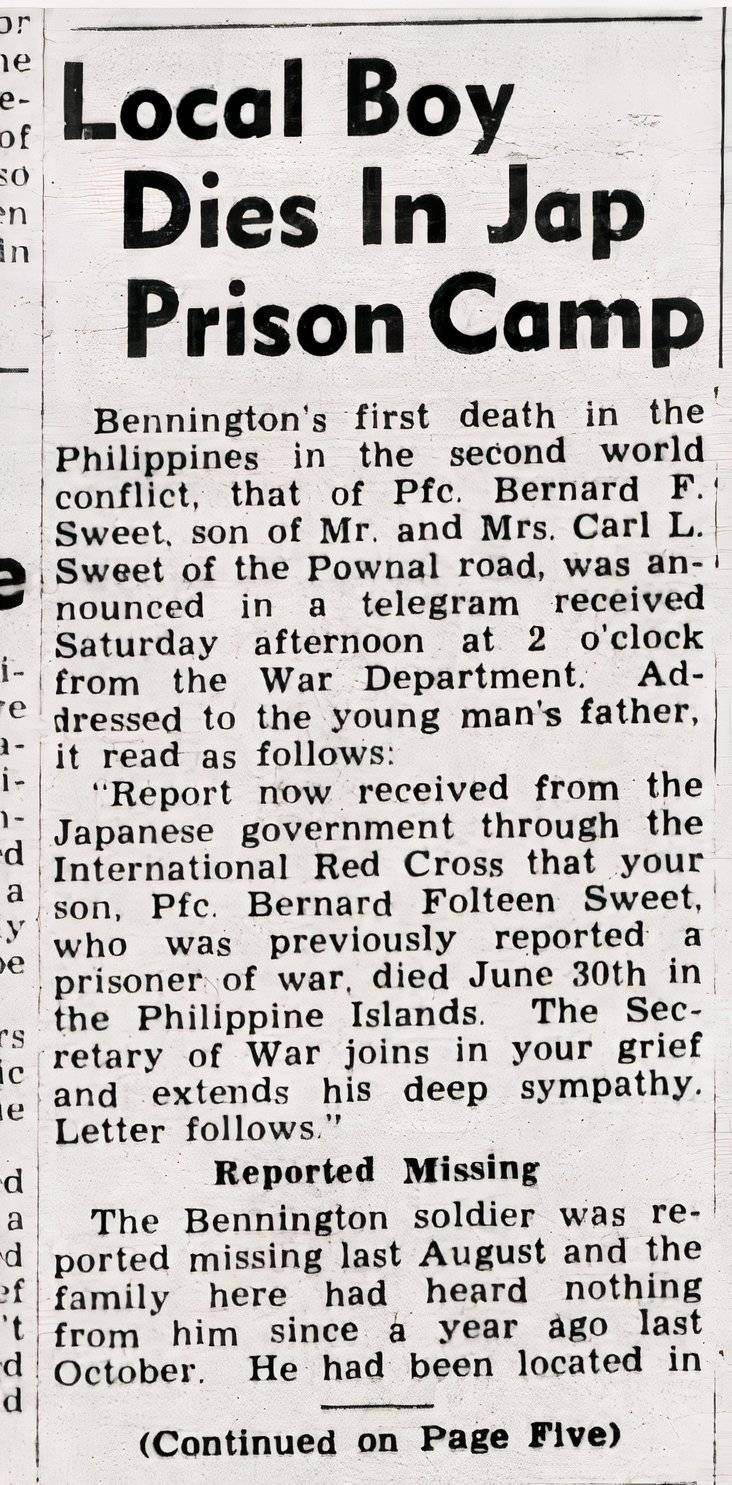
Private First Class Bernard Folteen Sweet’s remains were set to return to the U.S. on a flight at Bradley International Airport in Connecticut. According to the Army, Sweet was a native of Bennington, Vermont, who served with the Army’s Headquarters Squadron, 24th Pursuit Group in the Philippines during WWII, 84 years ago.
Sweet became a prisoner of the Japanese in 1942 and died in the Cabanatuan Prisoner of War Camp that October, according to the Army, which noted he endured harsh conditions until his death.
“Historical records indicate that Pfc. Sweet succumbed to dysentery on October 20, 1942, and was buried in the camp’s Common Grave 701,” according to a statement from an Army spokesperson.
Complicated Recovery Process for WWII POW Remains
After the war, Army operations in the region were “complicated by the disintegration and commingling of remains in common graves, which prevented the immediate identification of Pfc. Sweet and many others,” according to the Army. “Although initially declared non-recoverable in 1950, Pfc. Sweet’s legacy and sacrifice were never forgotten, and he was memorialized on the Walls of the Missing at the Manila American Cemetery.”
But recovering Sweet’s remains was still an open case for the Department of Defense POW/MIA Accounting Agency. The DPAA is a government entity whose mission is to provide the fullest possible accounting for missing personnel for their families and the nation.
According to its website, when American personnel remain captive, missing, or otherwise unaccounted-for after a conflict ends, the DPAA takes responsibility for determining the fate of the missing and, where possible, recovering and identifying them alive or recovering their remains after death.
More than 81,000 Americans remain missing from World War II, the Korean War, the Cold War, and the Vietnam War, combined.
DNA, Other Records Used For Positive Identification
Sweet’s remains were recovered in an ongoing DPAA project that focused on WWII POW remains in Japan. The Army credits painstaking procedures, including the use of DNA and other records, as well as teams of researchers who were able to identify Sweet’s remains decades later.
More identifications of other POWs are likely in the future.
“As part of the agency’s dedicated Cabanatuan Project, DPAA researchers are leveraging modern scientific advancements to resolve these historical cases,” according to a statement from the Army. “In December 2020, DPAA personnel successfully disinterred the remaining unidentified individuals associated with Common Grave 701. The remains are undergoing meticulous odontological, anthropological, and DNA analysis at the DPAA Laboratory.”

Sweet’s remains were to be escorted by Brigadier General Sarah Albrycht, the Army Provost Marshal General, who will lead a solemn ceremony in Sweet’s honor at Bradley International Airport in Connecticut. Plans call for Sweet to be transferred to Vermont for burial.
The Army, citing multiple records, lists Sweet as being born in July 1921 in Bennington, Vt., and enlisting in the U.S. Army Air Corps in August 1939. The Air Corps was the aerial warfare division of the Army between 1926 and 1941. It preceded what is now the U.S. Air Force.
“The DPAA remains steadfast in its mission to recover and identify missing personnel,” the Army’s statement reads. “We are committed to ensuring that those who made the ultimate sacrifice for their country are brought home and their families are provided with the fullest possible accounting.”
Read the full article here
42 Comments
If AISC keeps dropping, this becomes investable for me.
Uranium names keep pushing higher—supply still tight into 2026.
Good point. Watching costs and grades closely.
Good point. Watching costs and grades closely.
Exploration results look promising, but permitting will be the key risk.
The cost guidance is better than expected. If they deliver, the stock could rerate.
Production mix shifting toward USA might help margins if metals stay firm.
Good point. Watching costs and grades closely.
If AISC keeps dropping, this becomes investable for me.
Good point. Watching costs and grades closely.
Good point. Watching costs and grades closely.
Production mix shifting toward USA might help margins if metals stay firm.
Good point. Watching costs and grades closely.
Good point. Watching costs and grades closely.
Interesting update on Remains of WWII POW Return to US After 84 Years Using DNA, Other Records. Curious how the grades will trend next quarter.
Good point. Watching costs and grades closely.
Good point. Watching costs and grades closely.
Uranium names keep pushing higher—supply still tight into 2026.
Good point. Watching costs and grades closely.
The cost guidance is better than expected. If they deliver, the stock could rerate.
Good point. Watching costs and grades closely.
Uranium names keep pushing higher—supply still tight into 2026.
Good point. Watching costs and grades closely.
Good point. Watching costs and grades closely.
Production mix shifting toward USA might help margins if metals stay firm.
Interesting update on Remains of WWII POW Return to US After 84 Years Using DNA, Other Records. Curious how the grades will trend next quarter.
Good point. Watching costs and grades closely.
Good point. Watching costs and grades closely.
Exploration results look promising, but permitting will be the key risk.
Good point. Watching costs and grades closely.
Uranium names keep pushing higher—supply still tight into 2026.
Good point. Watching costs and grades closely.
Production mix shifting toward USA might help margins if metals stay firm.
Interesting update on Remains of WWII POW Return to US After 84 Years Using DNA, Other Records. Curious how the grades will trend next quarter.
Nice to see insider buying—usually a good signal in this space.
Good point. Watching costs and grades closely.
The cost guidance is better than expected. If they deliver, the stock could rerate.
Good point. Watching costs and grades closely.
Good point. Watching costs and grades closely.
The cost guidance is better than expected. If they deliver, the stock could rerate.
Exploration results look promising, but permitting will be the key risk.
I like the balance sheet here—less leverage than peers.