

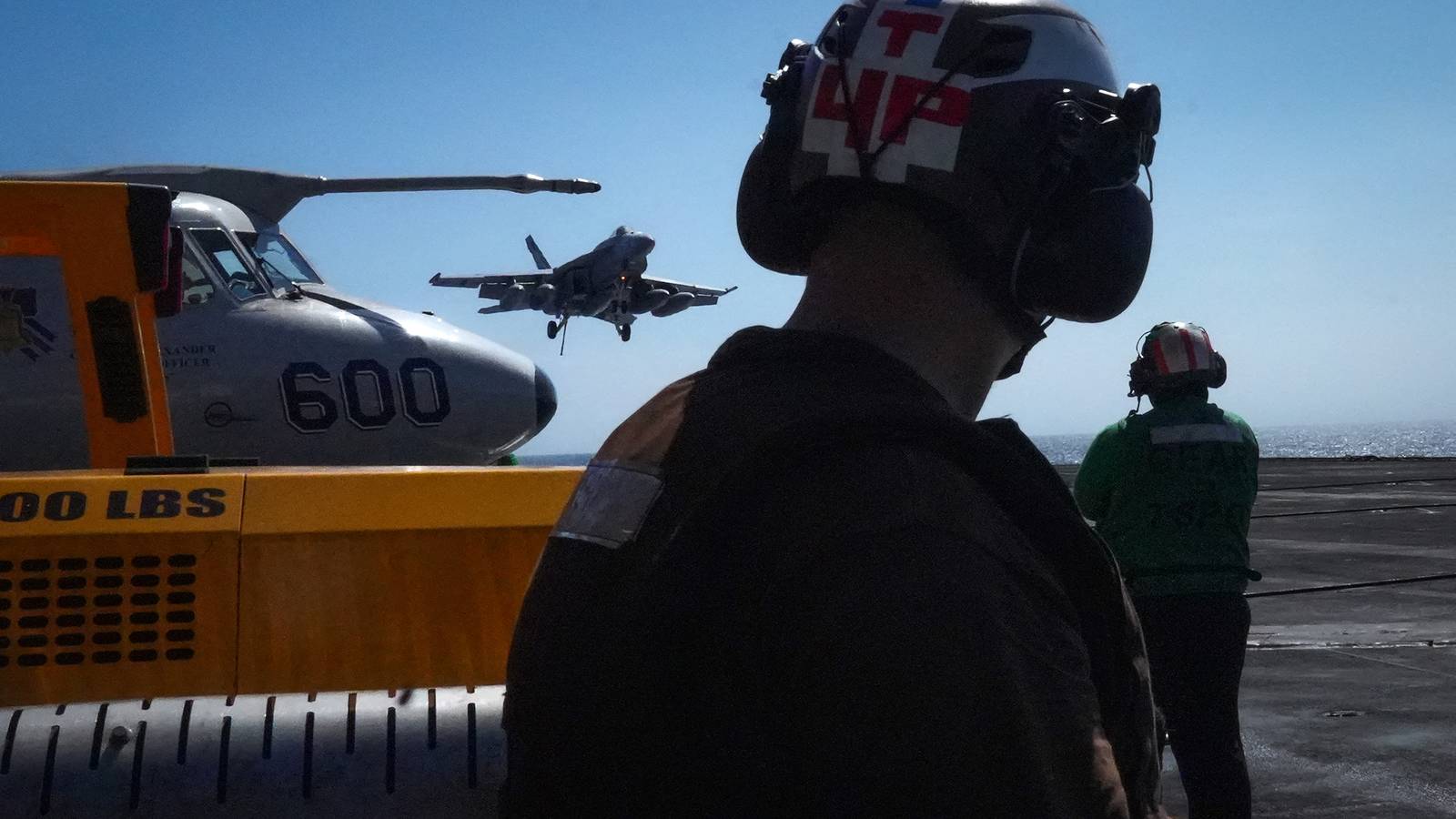
The chances of the U.S. launching another round of mass strikes against Iran appear to have grown in recent days, according to Western officials, as the warring sides escalate their skirmishes.
U.S. President Donald Trump is yet to make a decision on whether to order attacks, but is considering the move, one official said, asking not to be identified talking about sensitive matters.
Trump has been threatening another phase of high-intensity war on Iran for weeks, but came under pressure after the U.S. midterm elections to opt for a diplomatic resolution. The conflict contributed heavily to his Republican party’s loss of Congress, in part due to the inability to find an off ramp.
With peace talks stalled and neither side willing to concede on key points, tensions are rising. Over the past week, Iran has struck U.S. military facilities in Bahrain and Kuwait several times and stepped up strikes on ships going through the Strait of Hormuz. The U.S., which has two aircraft carrier strike groups in the region and is imposing a naval blockade on the Islamic Republic, hit the Iranian island of Qeshm on Tuesday.
Saudi Arabia is facing daily drone and missile attacks from the Iran-backed Houthis in Yemen in what’s effectively a second front in the conflict. On Thursday, the skyscraper housing the headquarters of the kingdom’s wealth fund was damaged, according to an eyewitness. Saudi authorities announced several other assaults over the past day.
The New York Times on Thursday reported that Trump was taking into account new intelligence about Iran rebuilding its missile and drone arsenals and advancing its chemical and biological weapons programs.
He’s also under pressure from Benjamin Netanyahu to act quickly. Israel’s prime minister is pressing the U.S. to agree to a joint campaign of airstrikes lasting four to seven days, the NYT reported.
Netanyahu’s position remains that more military action is needed unless Iran capitulates and ends its nuclear program, according to a person close to the prime minister, who asked not to be named discussing private talks with the U.S.
An escalation in the conflict could also serve Netanyahu’s domestic agenda, as he’s trying to head off efforts by his election challenger, Gadi Eisenkot, to form a new government.
“Tehran and Washington have been gearing up for the next round of fighting,” Becca Wasser and Dina Esfandiary, analysts at Bloomberg Economics, said in a note. “The attacks are happening for two reasons: the status quo is unsustainable, and both the U.S. and Iran are trying to secure their positions — especially when it comes to the Strait of Hormuz. But they risk escalating the conflict.”
None of Trump’s options are good, according to the Western officials. Any attack on Iran would provoke counterstrikes on the U.S.’s Arab allies in the region. If he opts to walk away without a formal ceasefire or peace deal, that would likely leave Iran in de facto control of the Strait of Hormuz, with ships under constant threat of Iranian missile and drone attacks.
European and Gulf Arab governments, said one official, continue to lobby the U.S. against a round of strikes like those during the first phase of the war between late February and early April. Back then, Iran’s retaliation against states such as the United Arab Emirates, Saudi Arabia, Qatar and Jordan caused chaos. Oil and natural gas prices surged as it hit ships around the strait.
European gas prices climbed around 3% in early trading on Thursday on the developments in the Middle East. Brent crude rose slightly to $92.60 barrel. It’s down from about $117 just before the midterms, but still up over 50% this year, mainly because of the war.
More oil from Arab states is flowing through the strait, but Iran’s strikes — with its forces hitting roughly one vessel a day on average — are keeping prices, as well as freight and insurance costs, elevated. The U.S. navy is stretched enforcing the blockade and escorting commercial ships through the waterway.
Qatar is the main mediator between the sides and continuously talking to them to try to bridge their differences. Qatari officials met Iran’s foreign minister, Abbas Araghchi, in Oman this week, without any sign of a breakthrough.
Iran is insisting the U.S. ends the naval blockade before there can be peace talks, as well as lift some sanctions and unfreeze assets belonging to Tehran. The blockade is weakening Iran’s economy, causing inflation to accelerate to around 90% and the currency to plunge.
The U.S. wants Iran to agree to make concessions regarding its nuclear program.
—With assistance from Dan Williams.
___
©2026 Bloomberg L.P. Visit bloomberg.com. Distributed by Tribune Content Agency, LLC.
Read the full article here
22 Comments
Interesting update on Risk of US Strikes on Iran Grows as Sides Escalate Skirmishes. Curious how the grades will trend next quarter.
Good point. Watching costs and grades closely.
The cost guidance is better than expected. If they deliver, the stock could rerate.
Nice to see insider buying—usually a good signal in this space.
Good point. Watching costs and grades closely.
Good point. Watching costs and grades closely.
Uranium names keep pushing higher—supply still tight into 2026.
Exploration results look promising, but permitting will be the key risk.
Good point. Watching costs and grades closely.
If AISC keeps dropping, this becomes investable for me.
Good point. Watching costs and grades closely.
Uranium names keep pushing higher—supply still tight into 2026.
Good point. Watching costs and grades closely.
Uranium names keep pushing higher—supply still tight into 2026.
Good point. Watching costs and grades closely.
The cost guidance is better than expected. If they deliver, the stock could rerate.
Nice to see insider buying—usually a good signal in this space.
Interesting update on Risk of US Strikes on Iran Grows as Sides Escalate Skirmishes. Curious how the grades will trend next quarter.
The cost guidance is better than expected. If they deliver, the stock could rerate.
Interesting update on Risk of US Strikes on Iran Grows as Sides Escalate Skirmishes. Curious how the grades will trend next quarter.
Good point. Watching costs and grades closely.
Good point. Watching costs and grades closely.