

For decades, the relationship between Saudi Arabia and the U.S. has centered on an often-mentioned but rarely tested supposition: If the kingdom were attacked, America would come to its rescue.
But recent events have shown that much-vaunted security umbrella to be a leaky one.
Last month, Iran-aligned Yemeni rebels blitzed through Yemen’s coast and threatened to shut down Saudi Arabia’s Red Sea lifeline. But the Trump administration, reluctant to open a new front in its war with Iran, rebuffed Riyadh’s calls to come to its rescue.
That has left the kingdom searching for friends beyond Washington, for allies ready to put rockets where the rhetoric is and assist in a fight Saudi Arabia considers existential.
Over the last few months, as Persian Gulf nations contended with the fallout from the Israel- U.S. war on Iran, Saudi Arabia has supercharged its military-focused diplomacy. In July, it announced a 15-nation maritime alliance to safeguard shipping through the Red Sea, the Bab al Mandab strait and the Gulf of Aden.
Soon after came the Mecca Joint Defense Agreement, a NATO-inspired security pact where any attack on Saudi Arabia, Turkey and Pakistan would be regarded as an attack against all three.
And this week, Saudi Arabia’s race to rally allies spurred a detente of sorts with its frenemy the United Arab Emirates, with Saudi Crown Prince Mohammed bin Salman — the country’s de facto ruler — and defense minister brother receiving the Emirates’ vice president for the first high-level meeting since the two sides fell out over Yemen late last year.
There have even been reports of possible cooperation between Saudi Arabia and Israel against the Houthis, a notable development — if true — for two countries with no formal diplomatic relations.
The Saudi overtures come at a sensitive time for the kingdom. The standoff between the U.S. and Iran over the Strait of Hormuz has largely cut off Saudi Arabia’s main export channel, and attacks on its energy infrastructure are lowering its oil output.
As a result, the kingdom saw a 25% contraction in “oil activities,” according to official economic data, triggering an almost 5% decrease in the country’s gross domestic product between April and June, compared with the first quarter of the year.
That reduction forced painful cuts to Vision 2030, the prince’s signature policy aimed at remaking Saudi Arabia. So-called giga-projects, such as the Line and Trojena, have revised their ambitions downward amid the financial realities of a Saudi Arabia under fire.
And all that was before the Houthis got involved.
The Houthis had been fighting the Saudis since 2015 in Yemen’s civil war that killed hundreds of thousands of people before settling into a stalemate and an uneasy ceasefire in 2022.
But in July, Saudi Arabia attacked the airport in the Yemeni capital, Sanaa, to prevent the landing of an Iranian plane carrying high-ranking Houthi officials. That set off a flurry of Houthi attacks on Saudi infrastructure, and the Houthis’ announcement of a blockade against Saudi shipping on the Red Sea — now the main corridor for Saudi energy exports.
Then in September, the Houthis overran Yemen’s coastal cities, snapping up materiel left behind by Saudi-backed government fighters and seizing control of territory near the Bab al Mandab strait.
A few days later, the Saudis accused an Iranian-backed militia in Iraq of coordinating with the Houthis to hit the East-West Pipeline, the vital infrastructure that had allowed Saudi Arabia to reorient its oil from Hormuz to the Red Sea.
All that pushed the Saudi crown prince to turn to the U.S. for help — and he had reason to think it would come: Late last year, the U.S. signed a strategic defense agreement with the kingdom, designated it a major non- NATO ally and agreed to sell it advanced F-35 fighter jets.
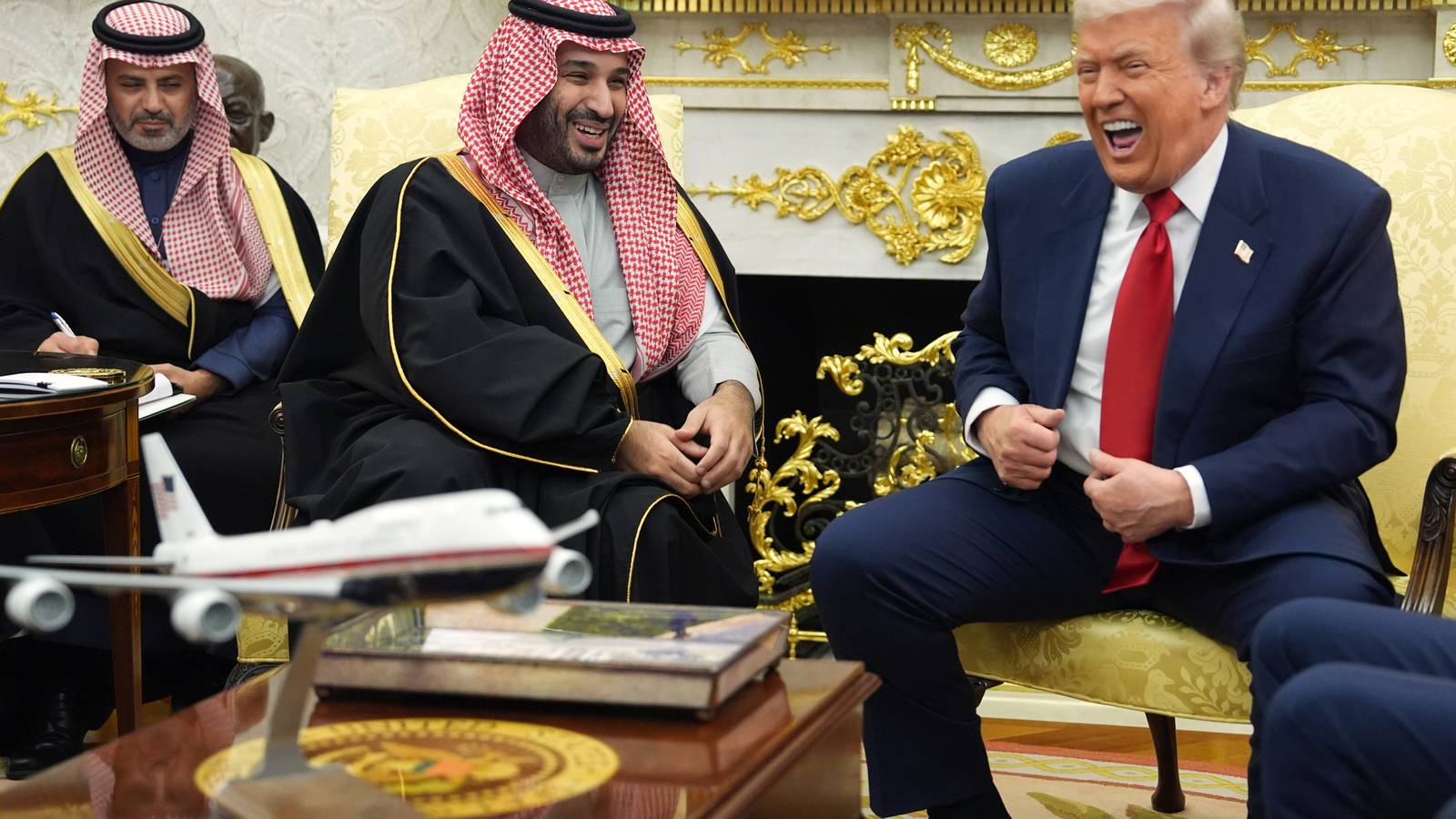
Mohammed also has something of a personal relationship with President Trump, who made Saudi Arabia the first stop of his first overseas tour in 2025 after being reelected and boasted that he had garnered almost $1 trillion in Saudi investments into the U.S. economy.
Trump initially seemed receptive to the prince’s entreaties but reportedly pulled back just as U.S. warplanes were set to take off for sorties on Houthi targets. Later, he told Fox News that Washington was “in constant communication with the Houthis and that they’ve agreed not to fight the United States.”
The Houthis have also assured European nations, which have been wary of provoking the rebels’ ire, that they won’t attack their shipping either. Last month, France and the U.K. said they would offer defensive assistance to Saudi Arabia, while Greece is operating U.S.-made Patriot missile batteries in the kingdom.
With the U.S. hesitating, the expectation is that Saudi Arabia’s partners in the Mecca Joint Defense Agreement will form the international cavalry to help, but that has yet to manifest itself on the ground.
This week, Pakistani Defense Minister Khawaja Muhammad Asif said his country was “bound” by the pact to defend Saudi Arabia.
“That means whatever means are available at our disposal, they’ll be available to Saudi Arabia also,” he said.
Pakistan already has 8,000 troops in Saudi Arabia, along with 16 Chinese-made JF-17 Thunder fighter jets, combat drone squadrons and a surface-to-air missile battery. But it’s unclear whether they have participated in attacking the Houthis.
Turkish officials, meanwhile, say they have “no issues meeting” Saudi Arabia’s “military needs,” especially on technical matters.
The Houthis say any party attacking them will face retaliation.
“By God, if Turkey and Pakistan become involved, we will strike them with an iron fist,” said Mohammed al-Bukhaiti, a senior member of the Houthis, in an interview on Iraqi television.
Observers say Saudi Arabia is gearing up for a ground offensive aimed at preventing the Houthis from consolidating their gains on the Red Sea coast and reversing the tide. The plan is for Saudi-backed Yemeni government fighters to lead the charge.
“It will be mostly an air campaign for the Saudis, with Yemenis and maybe Pakistanis on the ground, though I doubt the latter will get involved beyond being on the border,” said Bernard Haykel, a professor of Near Eastern Studies at Princeton University.
There is little chance the U.S. would contribute to such a fight with boots on the ground. But it could provide intelligence and logistical support, just as it did during Mohammed’s 2015 foray into Yemen. The U.S. Navy could also launch strikes, as it did when the Houthis blockaded the Red Sea in 2025, before Trump declared a ceasefire.
In any case, although Saudi leaders may not expect Washington to get involved, their fear is that the U.S. will forge another agreement with the Houthis to the exclusion of Riyadh’s concerns, Haykel said.
“The Saudis want a signal that the U.S. is in the background as support if something happens,” he said.
“They’d love to have it in the center of everything. But if they can’t, they want to make it seem like America is fully on board without necessarily being in the battle.”
This story originally appeared in Los Angeles Times.
©2026 Los Angeles Times. Visit latimes.com. Distributed by Tribune Content Agency, LLC.
Read the full article here
28 Comments
Silver leverage is strong here; beta cuts both ways though.
Good point. Watching costs and grades closely.
Interesting update on Saudi Arabia Once Counted on US Protection. Now It’s Pivoting to New Alliances. Curious how the grades will trend next quarter.
The cost guidance is better than expected. If they deliver, the stock could rerate.
Uranium names keep pushing higher—supply still tight into 2026.
Uranium names keep pushing higher—supply still tight into 2026.
I like the balance sheet here—less leverage than peers.
Good point. Watching costs and grades closely.
Exploration results look promising, but permitting will be the key risk.
Good point. Watching costs and grades closely.
Exploration results look promising, but permitting will be the key risk.
Good point. Watching costs and grades closely.
Good point. Watching costs and grades closely.
The cost guidance is better than expected. If they deliver, the stock could rerate.
Exploration results look promising, but permitting will be the key risk.
Good point. Watching costs and grades closely.
Good point. Watching costs and grades closely.
Exploration results look promising, but permitting will be the key risk.
Exploration results look promising, but permitting will be the key risk.
Good point. Watching costs and grades closely.
Good point. Watching costs and grades closely.
I like the balance sheet here—less leverage than peers.
Silver leverage is strong here; beta cuts both ways though.
Good point. Watching costs and grades closely.
Production mix shifting toward USA might help margins if metals stay firm.
Good point. Watching costs and grades closely.
Production mix shifting toward USA might help margins if metals stay firm.
Good point. Watching costs and grades closely.