

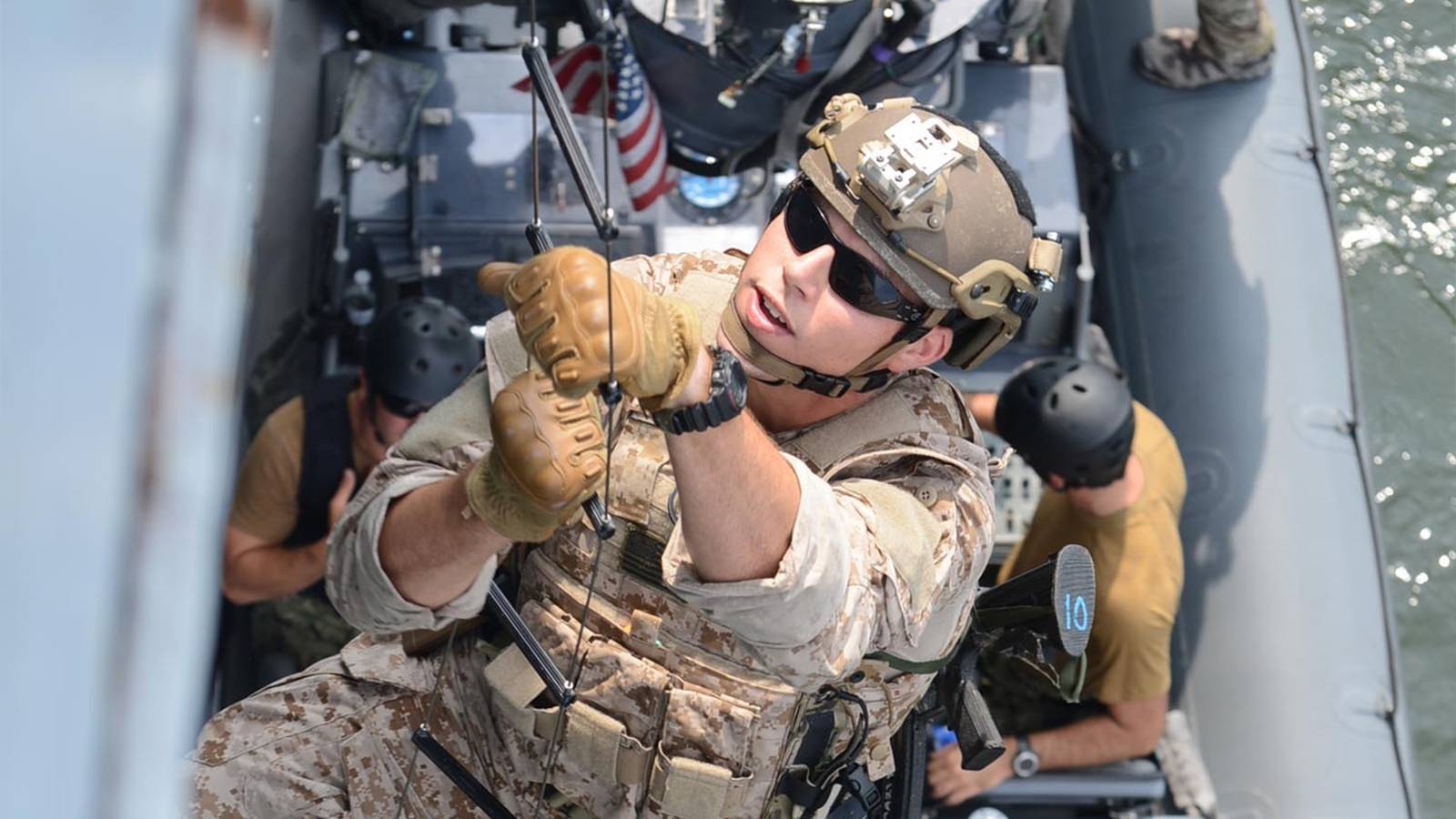
Navy SEALs are among the U.S. military’s most highly trained special operations forces. They conduct specialized missions worldwide, combining advanced training, equipment and tactics to operate in environments where conventional military forces may face significant limitations.
From underwater reconnaissance and counterterrorism to direct-action missions and personnel recovery, Navy SEALs have played an important role in U.S. military operations for more than six decades.
But what exactly do Navy SEALs do, and how did they become one of the military’s most recognized special operations forces?
Key Takeaways
- SEALs are maritime special operators trained to strike from sea, air and land in covert, high‑risk missions.
- Missions include direct action, recon, counterterrorism, personnel recovery, and foreign internal defense worldwide.
- Evolving from WWII UDTs to modern NSW, SEALs adapt tactics, tech and teams for global crises.
What Do Navy SEALs Do?
Special operations are characterized by the use of small units with the unique ability to conduct military actions that are beyond the capability of conventional military forces.
SEALs are trained to operate in a variety of environments and are specialists in maritime special operations. They utilize a combination of specialized training, equipment and tactics to complete missions worldwide.
The most important trait distinguishing Navy SEALs from other military forces is that SEALs are maritime special forces, trained to strike from and return to the sea.
SEALs take their name from the three environments in which they operate: Sea, Air and Land.
Their stealth and clandestine methods of operation allow them to conduct missions against targets that larger forces cannot approach undetected.
What Types of Missions Do Navy SEALs Carry Out?
A tactical force with strategic impact, Naval Special Warfare (NSW) supports a wide range of military operations.
Its mission areas include unconventional warfare, direct action, combating terrorism, special reconnaissance, foreign internal defense, information warfare, security assistance, counter-drug operations, personnel recovery and hydrographic reconnaissance.
Some of the primary missions performed by Navy SEALs include:
Direct Action
Short-duration military operations against specific targets. These missions may involve raids, ambushes or other targeted operations to capture personnel, seize equipment or accomplish strategic objectives.
Special Reconnaissance
Specialized missions focused on gathering intelligence about enemy activities, locations and conditions. SEALs may operate undetected to provide information that supports military planning and decision-making.
Counterterrorism
Operations designed to prevent, disrupt or respond to terrorist threats. These missions may include targeting terrorist organizations and supporting hostage rescue operations.
Unconventional Warfare
Specialized operations conducted in unconventional environments, often involving cooperation with local or resistance forces to achieve military objectives.
Foreign Internal Defense
Training and assisting allied or partner military forces to improve their ability to conduct operations and respond to security threats.
Maritime and Hydrographic Reconnaissance
Operations involving coastal areas, waterways and underwater environments. These missions may include examining beach conditions, identifying obstacles and gathering information to support amphibious military operations.
Together, these capabilities allow SEALs to operate across the spectrum of conflict and provide decision-makers with military options during rapidly changing crises around the world.
The Evolution of Naval Special Warfare
The history of Navy SEALs stretches back to World War II, when the U.S. military recognized the need for specialized personnel capable of conducting reconnaissance, underwater demolition and other missions ahead of larger military forces.
Over the following decades, these early units evolved into the modern Navy SEAL teams, expanding their missions and capabilities in response to changing global threats.
World War II (1940s): The Origins of Naval Special Warfare
If one had to pick a defining moment in the development of modern Naval Special Warfare, the landing on Tarawa in November 1943 validated the need for pre-assault reconnaissance and obstacle-removal specialists.
The Navy responded to the need by transforming naval combat demolition units into underwater demolition teams (UDTs).
Frogmen from UDT-1 and UDT-2 first moved onto the tactical scene in January 1944 at Kwajalein and Roi-Namur, blasting coral and eliminating invasion obstacles.
The community increased to more than 30 teams by the end of World War II and saw action throughout the Pacific and at Normandy.
These early underwater demolition and reconnaissance capabilities helped establish the foundation for the Navy SEAL teams that would emerge nearly two decades later.
The Korean War and 1950s: Expanding Underwater Operations
UDTs expanded their mission during the Korean War when their demolition expertise proved invaluable in clearing mines in Wonsan Harbor.
During the 1950s, the underwater demolition community underwent several reorganizations, including the establishment of UDTs 11 and 12 at Coronado, California, and UDTs 21 and 22 at Little Creek, Virginia.
Through the end of the decade, UDTs continued to serve as specialized units within the Navy. They provided a necessary service but had limited influence on broader war planning.
That would begin to change as military leaders recognized the growing importance of unconventional warfare.
1961 & 1962: The Creation of the Navy SEALs
Chief of Naval Operations Adm. Arleigh Burke recognized that future hostilities would involve guerrilla activities. In 1961, he recommended forming naval special forces to counter the threat.
In an address to Congress on May 25, 1961, shortly after the Bay of Pigs incident, President John F. Kennedy emphasized the need to expand the military’s capabilities for unconventional and paramilitary operations.
This shift in military strategy encouraged the armed services to develop specialized forces capable of responding to unconventional threats.
The Navy utilized existing UDT personnel to form separate units called Sea-Air-Land (SEAL) teams.
SEAL Teams 1 and 2 were established in January 1962, marking the official beginning of the modern Navy SEALs.
The Vietnam War (1960s to 1970s): Navy SEALs in Combat
Throughout 1963 and 1964, SEALs operated in Vietnam as instructors to South Vietnamese frogmen.
Their assignments steadily expanded, and by 1966, SEALs were conducting combat operations against Viet Cong forces in the Rung Sat Special Zone.
Integrated with Helicopter Attack Squadron Light (HAL) 3, Attack Squadron Light 4 and patrol boat river forces, SEAL tactics soon gained respect.
In support of efforts to disrupt supply lines from Cambodia, HAL-3 transported special warfare personnel on more than 6,000 missions during 1970.
The Vietnam War demonstrated how small, specialized teams could conduct reconnaissance, direct-action missions and other operations in environments that presented challenges for conventional military forces.
The 1970s to 1980s: A Changing Role for Special Operations
Naval Special Warfare continued to evolve after the Vietnam War.
In May 1975, Cambodians seized the SS Mayaguez, an incident that reinforced the importance of maintaining quick-response maritime special operations capabilities.
Middle Eastern terrorism began to impact the American psyche in the late 1970s and culminated in the Iranian hostage crisis.
The failed Operation Eagle Claw rescue attempt in 1980 highlighted the need to improve coordination among special operations forces from different military services.
In 1983, existing UDTs were reconfigured and redesignated as either SEAL teams or swimmer delivery vehicle teams.
Later that year, Operation Urgent Fury, the U.S. intervention in Grenada, provided a real-world test of the evolving Naval Special Warfare organization.
These developments helped shape the modern structure and responsibilities of U.S. special operations forces.1986 to 1990s: The Formation of Modern Special Operations CommandDuring the mid-1980s, military and political changes reshaped U.S. defense policy.
The Goldwater-Nichols Department of Defense Reorganization Act of 1986 sought to strengthen military command structures and improve coordination among the armed services.
The following year, United States Special Operations Command (USSOCOM) was established to unify and strengthen the military’s special operations capabilities.
Naval Special Warfare Command (NSWC) was established in April 1987 as the Navy component of USSOCOM.
This new command structure helped coordinate special operations forces across the services while ensuring that specialized units received the training and support required for their missions.
In the buildup to Operation Desert Storm, Naval Special Warfare Command deployed personnel to the region.
Once in place, SEALs conducted strategic reconnaissance, early warning patrols, hydrographic reconnaissance, direct action, mine hunting and combat search and rescue.
These operations reflected the increasingly diverse responsibilities assigned to Naval Special Warfare forces.
2001 to 2011: Navy SEALs in Afghanistan, Iraq and the War on Terror
After the terrorist attacks of Sept. 11, 2001, Navy SEALs played an important role in U.S. military operations in Afghanistan and Iraq.
Years of specialized training and the evolution of Naval Special Warfare capabilities had prepared SEALs to conduct missions against terrorist organizations and other high-priority targets.
Their operations included gathering intelligence, conducting reconnaissance, capturing or killing terrorist leaders and supporting broader military objectives.
In March and April 2002, Naval Special Warfare Command added two new SEAL teams, bringing the total to four East Coast teams and four West Coast teams.
The additional teams were needed to support the growing demands of military operations in Afghanistan and Iraq.
During these conflicts, SEALs conducted a variety of missions, including hunting and capturing bomb makers and terrorist group leaders, as well as gathering intelligence for future operations.
One of the most widely recognized Navy SEAL missions took place in May 2011.
Members of SEAL Team Six conducted a raid in Abbottabad, Pakistan, that resulted in the death of Osama bin Laden, the mastermind of the Sept. 11 attacks.
The operation became one of the most publicized missions in Navy SEAL history.
Read the full article here
43 Comments
I like the balance sheet here—less leverage than peers.
Good point. Watching costs and grades closely.
Good point. Watching costs and grades closely.
Uranium names keep pushing higher—supply still tight into 2026.
Good point. Watching costs and grades closely.
If AISC keeps dropping, this becomes investable for me.
Good point. Watching costs and grades closely.
Interesting update on Secret Missions, History and Elite Operations. Curious how the grades will trend next quarter.
Good point. Watching costs and grades closely.
Good point. Watching costs and grades closely.
Exploration results look promising, but permitting will be the key risk.
Good point. Watching costs and grades closely.
Silver leverage is strong here; beta cuts both ways though.
Good point. Watching costs and grades closely.
Good point. Watching costs and grades closely.
Uranium names keep pushing higher—supply still tight into 2026.
Good point. Watching costs and grades closely.
Good point. Watching costs and grades closely.
If AISC keeps dropping, this becomes investable for me.
Good point. Watching costs and grades closely.
Uranium names keep pushing higher—supply still tight into 2026.
Silver leverage is strong here; beta cuts both ways though.
Production mix shifting toward USA might help margins if metals stay firm.
Good point. Watching costs and grades closely.
Nice to see insider buying—usually a good signal in this space.
Good point. Watching costs and grades closely.
Good point. Watching costs and grades closely.
Nice to see insider buying—usually a good signal in this space.
Good point. Watching costs and grades closely.
Good point. Watching costs and grades closely.
Uranium names keep pushing higher—supply still tight into 2026.
Good point. Watching costs and grades closely.
Good point. Watching costs and grades closely.
Production mix shifting toward USA might help margins if metals stay firm.
Interesting update on Secret Missions, History and Elite Operations. Curious how the grades will trend next quarter.
Good point. Watching costs and grades closely.
Good point. Watching costs and grades closely.
Production mix shifting toward USA might help margins if metals stay firm.
Nice to see insider buying—usually a good signal in this space.
Uranium names keep pushing higher—supply still tight into 2026.
Interesting update on Secret Missions, History and Elite Operations. Curious how the grades will trend next quarter.
Good point. Watching costs and grades closely.
Good point. Watching costs and grades closely.