

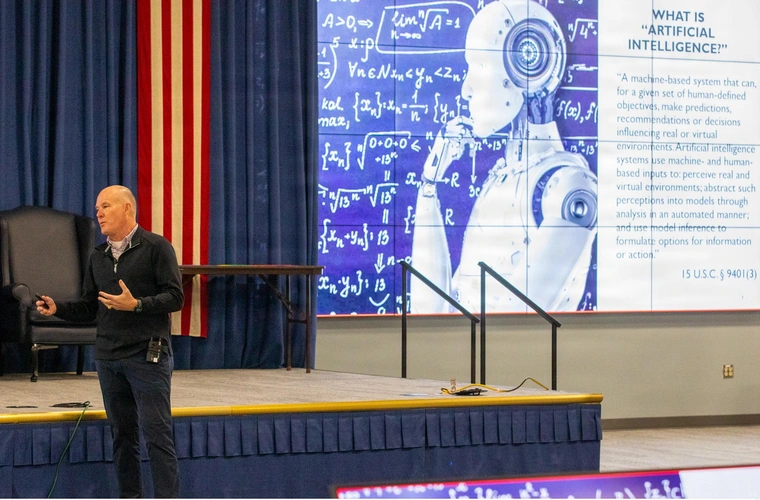
Aptima has secured a place on the Missile Defense Agency’s $151 billion Scalable Homeland Innovative Enterprise Layered Defense contract, or SHIELD, but the small defense technology company is not preparing to build interceptors or radars. Instead, it is looking for opportunities to help operators of complex missile defense systems process information and make time-sensitive decisions with artificial intelligence while retaining human oversight.
The award makes Aptima one of more than 2,400 contract holders eligible to compete for work under SHIELD, a multiple-award indefinite-delivery, indefinite-quantity contract. The $151 billion figure is the ceiling for the entire contracting vehicle, not an award to Aptima or any other individual company.
“Aptima is a small business that just celebrated its 30 years in operations, and we do what we call human-centered engineering,” Sylvain Bruni, Aptima’s division director for Performance Augmentation Systems and a senior principal research engineer, said in an interview with Military.com.
That approach puts humans at the center of technologies involving training, readiness, modeling and simulation, decision support and artificial intelligence. It also underpins Aptima’s broader work in human-machine teaming, where the company has worked on systems designed to assist people rather than simply replace them.
Waiting for the Right SHIELD Work
SHIELD allows the Missile Defense Agency and other defense organizations to rapidly compete for orders covering research, development, engineering, cybersecurity, data analysis and other technical work. The government has specifically identified AI, machine learning, digital engineering and open-system architectures among technologies that may be used under the vehicle.
Bruni said the early SHIELD opportunities Aptima had seen largely involved network capacity and infrastructure, areas outside the company’s core business. Aptima is instead waiting for work involving decision advantage, human-machine teaming and AI-assisted decision-making.
As of late November, Aptima had not publicly announced a SHIELD task-order award, with its newsroom still listing its June contract award without a subsequent task-order release.
What Aptima is waiting for, however, increasingly resembles the problems Golden Dome officials are publicly identifying.
Golden Dome Puts Command and Control at the Center
Golden Dome is intended to integrate existing and future defenses against ballistic, hypersonic, cruise missile and other aerial threats. The challenge is not simply developing individual weapons or sensors, but connecting those systems into a layered architecture that can respond quickly enough to an attack.
In August, Golden Dome officials disclosed that the program’s first large-scale tests focused heavily on command-and-control software and new sensor-to-shooter connections. Lt. Gen. Brian Gibson, Golden Dome’s vice director, said the tests were designed in part to determine how existing systems could be integrated with new technologies.
In September, Golden Dome Director Gen. Michael Guetlein said the program remained on track to deliver operational capability by summer 2028. He described the command-and-control architecture as the program’s “secret sauce” and said it had already undergone two tests.
Those developments align closely with the type of problem Bruni said Aptima wants to tackle.
“We need to give them better information,” Bruni said, rather than simply pushing greater amounts of data to commanders who must make decisions under extreme time pressure.
That pressure is already shaping military AI development elsewhere. To speed up time-sensitive decisions, the Army tested AI-enabled targeting tools that helped the 4th Infantry Division engage 15 targets in one hour during an experiment at Fort Carson, Colorado.
Using AI Without Surrendering the Decision
Bruni said Aptima is already working with the Missile Defense Agency on a technology called DR WATSON, which is designed to help users find relevant information across distributed sources while considering context such as the user’s expertise, workflow, permissions and which information may be outdated.
Rather than depending solely on a large language model, Bruni said Aptima uses “compound agentic” systems in which specialized AI components examine different aspects of a problem. The goal is to flag weaknesses in an AI-generated response, such as missing context, unreliable sourcing or incomplete information, before an operator relies on it.
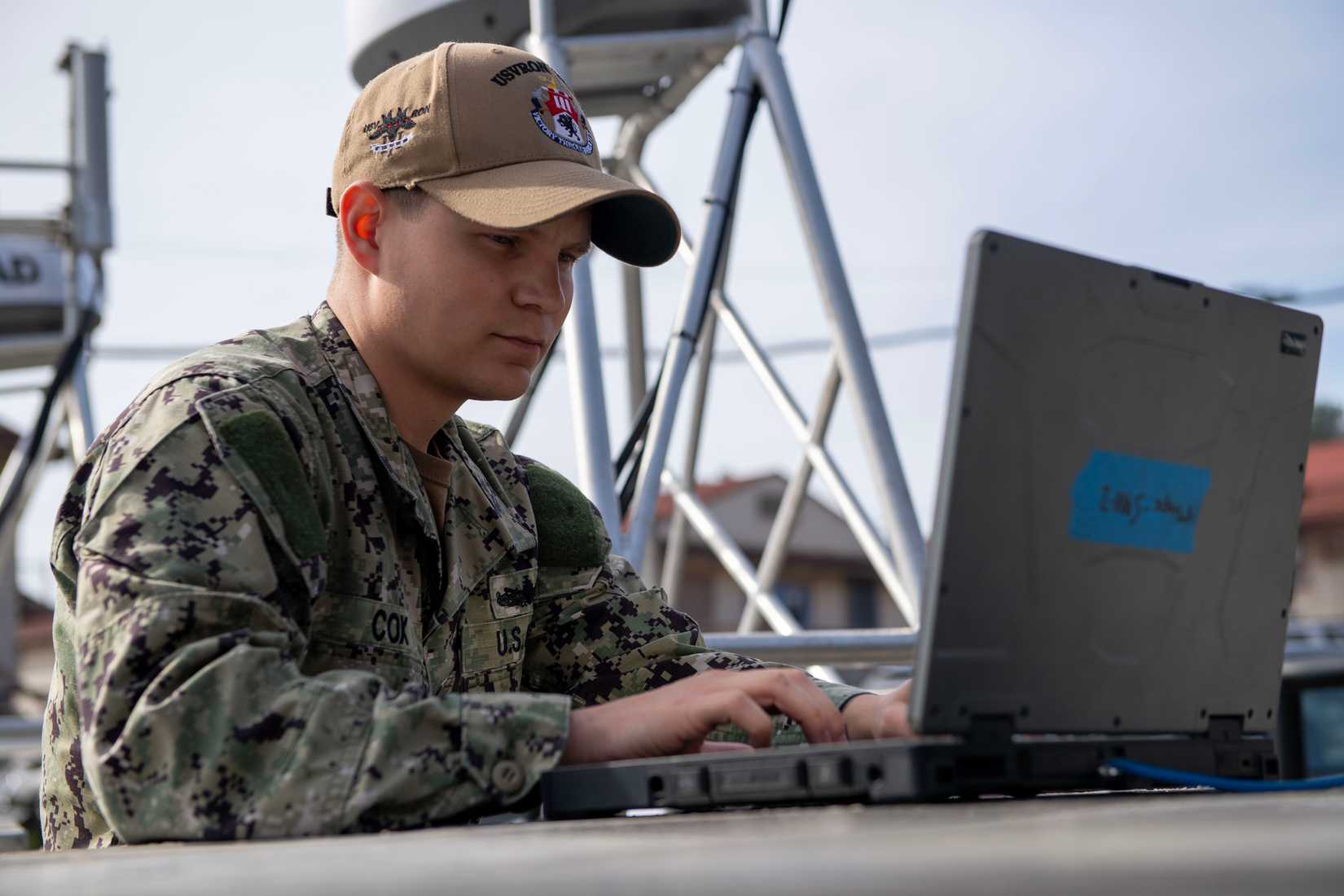
Aptima has identified 14 categories of AI problems, Bruni said, including hallucinations, incomplete answers and sourcing problems. Those technological weaknesses can combine with human vulnerabilities such as cognitive overload, automation bias and tunnel vision.
Bruni argued that computation-heavy functions can be automated, while humans should remain involved in setting parameters, evaluating outcomes and exercising authority over consequential decisions.
Golden Dome’s Architecture Is Still Taking Shape
The government is also trying to bring more companies into the effort. On Aug. 11, the Defense Department launched the Golden Dome for America Ecosystem Hub to give traditional contractors, startups, universities, investors and other organizations a more direct route into the program.
Major questions remain about Golden Dome’s ultimate architecture and cost. In a May 2026 report titled “Potential Costs of a National Missile Defense System,” the Congressional Budget Office said the Pentagon had not released enough detail about the planned “objective architecture” for CBO to estimate the system’s cost.
Instead, CBO modeled a hypothetical national missile defense architecture broadly consistent with the capabilities directed for Golden Dome and estimated that such a system could cost about $1.2 trillion over 20 years.
For Aptima, the more immediate question is whether SHIELD will produce work aimed at the human side of that architecture.
“We want missiles that are stronger and faster. Absolutely, and we need to continue that,” Bruni said.
“But there are other very specific new human-centered problems and gaps that have to be resolved.”
Read the full article here
33 Comments
Interesting update on Small Firm on $151B SHIELD Contract Pitches AI to Help Golden Dome Operators. Curious how the grades will trend next quarter.
Uranium names keep pushing higher—supply still tight into 2026.
Good point. Watching costs and grades closely.
I like the balance sheet here—less leverage than peers.
Silver leverage is strong here; beta cuts both ways though.
Good point. Watching costs and grades closely.
Good point. Watching costs and grades closely.
I like the balance sheet here—less leverage than peers.
Interesting update on Small Firm on $151B SHIELD Contract Pitches AI to Help Golden Dome Operators. Curious how the grades will trend next quarter.
Good point. Watching costs and grades closely.
Interesting update on Small Firm on $151B SHIELD Contract Pitches AI to Help Golden Dome Operators. Curious how the grades will trend next quarter.
Good point. Watching costs and grades closely.
Nice to see insider buying—usually a good signal in this space.
Good point. Watching costs and grades closely.
Good point. Watching costs and grades closely.
The cost guidance is better than expected. If they deliver, the stock could rerate.
Good point. Watching costs and grades closely.
Good point. Watching costs and grades closely.
Nice to see insider buying—usually a good signal in this space.
I like the balance sheet here—less leverage than peers.
Good point. Watching costs and grades closely.
Interesting update on Small Firm on $151B SHIELD Contract Pitches AI to Help Golden Dome Operators. Curious how the grades will trend next quarter.
Good point. Watching costs and grades closely.
The cost guidance is better than expected. If they deliver, the stock could rerate.
Good point. Watching costs and grades closely.
Good point. Watching costs and grades closely.
Exploration results look promising, but permitting will be the key risk.
Uranium names keep pushing higher—supply still tight into 2026.
Silver leverage is strong here; beta cuts both ways though.
Nice to see insider buying—usually a good signal in this space.
The cost guidance is better than expected. If they deliver, the stock could rerate.
Good point. Watching costs and grades closely.
Uranium names keep pushing higher—supply still tight into 2026.