

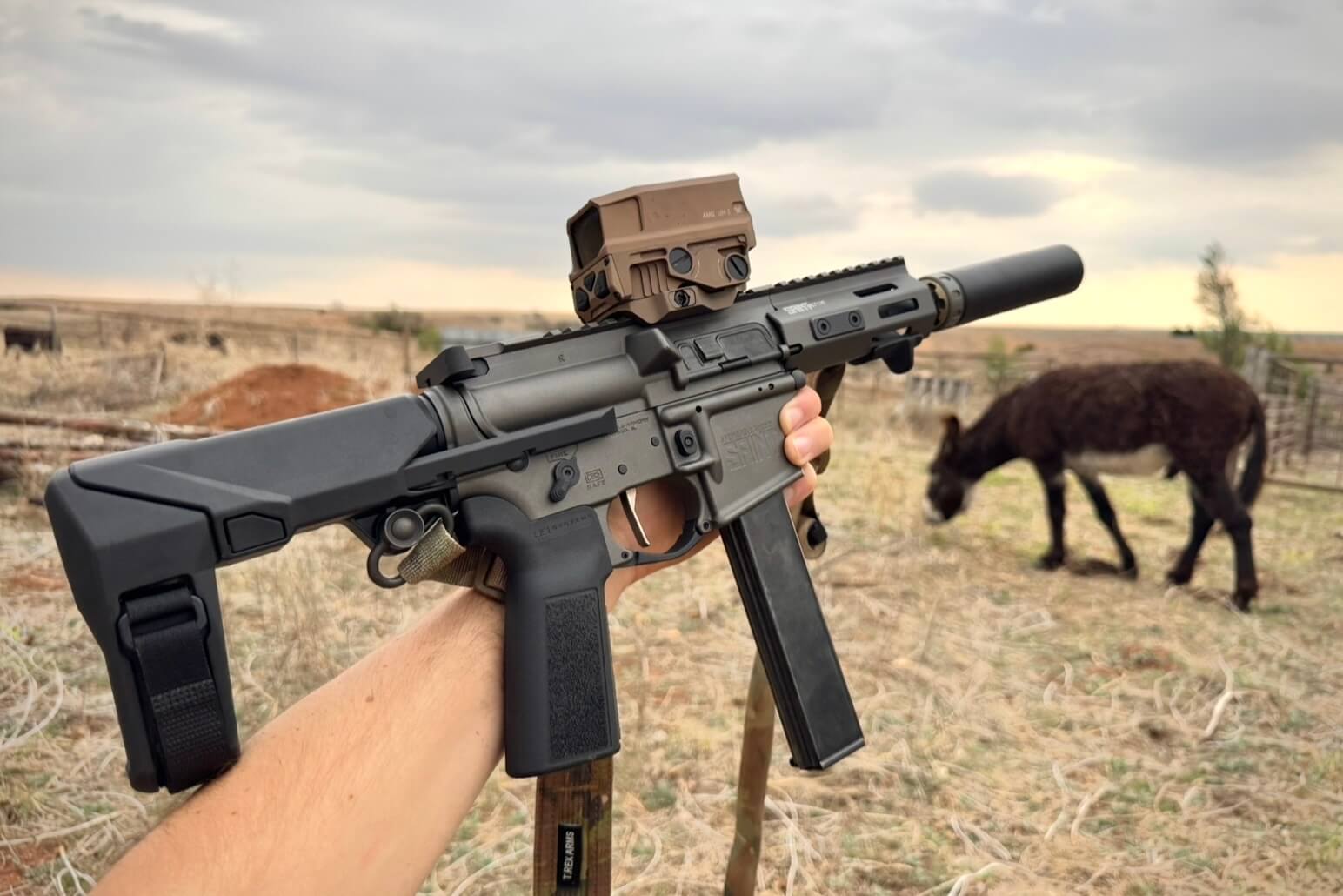
The Springfield Armory SAINT Victor 9mm PDW stuffs compact firepower, suppressor-ready utility, and familiar AR controls into a 5.5-inch package that is easier to carry than it has any right to be. After match use, suppressed shooting, and accuracy testing, this little blaster proved it is more than a range toy.
Why the SAINT Victor 9mm PDW Deserves a Hard Look
The Springfield Armory SAINT Victor 9mm PDW packs compact firepower, suppressor-ready performance, and AR familiarity into a 5.5″ platform. This ultra-short PDW blends maneuverability with control, making it ideal for tight spaces and dynamic shooting. Additionally, its direct blowback system and Colt-pattern magazine compatibility keep things simple and cost-effective. As a result, it stands out as a practical option for training, competition, and defensive use.
🛒 Check Current Price for SAINT Victor 9mm on GunsAmerica
Out of the Box: What the SAINT Victor 9mm PDW Includes
From the factory, the SAINT Victor 9mm PDW ships with a padded rifle case designed to protect the firearm and any mounted optics during transport. The case features a foam shell with adjustable Velcro straps inside, along with exterior magazine pouches for added convenience. In addition, the PDW includes one 32-round Colt-pattern magazine, a chamber flag, a gun lock, and an owner’s manual giving you everything needed to get up and running right out of the box.
Springfield Armory designed the Victor PDW to be compact, capable, and easy to run. This intent shows the moment you pick it up. The forged 7075-T6 upper and lower receivers give the gun a solid feel, while the Accu-Tite™ tension system keeps everything tight with no real play. Moreover, the Tungsten Gray Cerakote finish not only looks sharp but also resists wear and reduces glare during use. At just under six pounds, the platform remains lightweight without feeling fragile, which is important for a firearm built around mobility.
SB Tactical HBPDW Brace Keeps This 9mm PDW Tiny
The SB Tactical HBPDW brace is a defining feature of this PDW, as it allows the system to collapse down to an impressively short footprint. During my run-and-gun competition, this made a noticeable difference because I needed to conceal the firearm for roughly 1.5 miles running up to the first two stages. Even though it printed under an oversized shirt, it remained no longer than my torso with the brace collapsed, which is impressive for a firearm of this type. As a result, the Victor PDW proved far more concealable than most AR-pattern platforms.
The brace offers three-position adjustability, which helps tailor the length of pull for better control and comfort. However, adjusting it requires pressing a button for both extension and collapse, and I would prefer a system that allows it to be pulled out without engaging the button. Despite that minor complaint, the brace locks up securely and performs well under movement. Additionally, its lightweight and low-profile design complements the overall handling characteristics of the firearm.
Compact Handguard, Real Accessory Space
The aluminum free-float handguard on the Victor PDW is purpose-built to keep the platform as compact as possible. It features Springfield Armory’s SA locking tabs, which help keep the rail secure and prevent any unwanted movement under recoil or hard use. While minimal in length, the rail still incorporates M-LOK slots, giving users just enough flexibility to mount essential accessories without adding unnecessary bulk.
Because of its short length, real estate is definitely limited, but it does what it needs to do. I was able to mount a weapon light and pressure pad without issue, although it required a bit more intentional placement than on a full-length rail. Additionally, the included hand stop provides a consistent index point, which becomes more important on a compact platform like this, where hand placement can vary. While I would have liked to see an integrated QD sling socket on the rail itself, the overall design strikes a good balance between size and functionality.
Controls and Ergonomics That Actually Help Under Stress
From a controls standpoint, Springfield made several wise decisions that enhance usability on such a compact platform. The 45-degree ambidextrous safety is quick to manipulate and feels natural, especially when shooting from unconventional positions. Because of the shorter length of pull and steeper wrist angles, that shorter throw becomes even more valuable in practice. The B5 Systems grip also contributes to control, offering a comfortable angle and texture that works well in any situation.
While the brace includes the only QD sling socket, I much prefer two-point mounted slings. Therefore, I added a QD mount to the handguard to run a two-point sling, which provided much better stability during movement. This setup held the PDW securely even while running several miles during competition. Although the rail is minimalist, it still provides enough flexibility for mounting essential accessories without compromising the compact nature of the firearm.
The Flat-Faced Trigger Does Its Job
The flat-faced nickel boron trigger looks clean and functions adequately. There is no take-up, which I appreciate, but the wall is somewhat mushy before the break. However, the reset is short and very positive. After a shot, this sets my finger right back on the wall, ready to re-engage my targets. My trigger measured between 5 and 5.5 pounds, which is acceptable for a firearm in this category.
Springfield’s Muzzle Drum Helps, Then Fights Back
The factory Springfield Armory Muzzle Drum performs its intended function by directing blast, concussion, and debris forward. This is particularly useful on a short-barreled platform, where muzzle blast can otherwise be harsh. For a PDW, I actually think this is a solid option.
However, the design has one drawback when it comes to removal. It is installed extremely tightly from the factory and lacks flats for standard tools. Because I wanted to run a suppressor, removing the muzzle device required more effort than it should have. I ultimately had to use a vice grip pliers, which is not ideal, as I scratched up the muzzle drum quite a bit. A simple design change, such as adding wrench flats, would make a substantial improvement. While it works well once installed, the removal process is unnecessarily frustrating.
Colt-Pattern Magazines Keep Costs Down
The Victor PDW feeds from Colt-pattern 32-round metal magazines, which proved to be both reliable and affordable during testing. These magazines feature a stainless steel body with a nitride finish, along with numbered witness holes and a removable base plate. At around $32 each, they are reasonably priced, making it easy to build out a solid inventory.
More importantly, all of my magazines functioned without issue across multiple range sessions. This consistency reinforces confidence in the platform’s feeding reliability. For a firearm intended for high-volume shooting, dependable magazines are essential, and these deliver.
Ammo Tested and Accuracy at 50 Yards
Throughout this review, I put a few hundred rounds through the Victor PDW. The majority of the ammunition used was 124-grain Blazer Brass supplied by AmmunitionToGo.com. They are the official ammo sponsor for this review and offer a wide selection of competitively priced ammunition. Ordering was straightforward, shipping was fast, and the ammo arrived at my door within the week.
For those interested, they also put together an article covering some of the best 9mm options for self-defense here: Best 9mm Ammo for Self Defense.
In addition, I incorporated premium Hornady defensive loads when shooting for accuracy to better evaluate the platform’s potential. At 50 yards, my 5-round groups ranged from 2.4 to 7.5 MOA, with three different loads producing sub-3 MOA results. That equates to groups under 1.5 inches at 50 yards, which is impressive for a 9mm platform with a 5.5″ barrel.
Although pistol-caliber carbines are not typically known for precision, this PDW performs well within its intended role. Furthermore, I was able to make consistent hits on steel at 100 yards while standing unsupported. I believe this highlights the system’s practical accuracy. While it will not compete with rifle calibers in terms of ballistics, it still delivers solid performance for training and competition use.
Suppressed Shooting, Reliability, and Real Match Impressions
Reliability has been strong overall, although I did encounter one notable malfunction during testing. Across a few hundred rounds, the gun ran flawlessly except for a single failure to eject during a run-and-gun match. The casing became lodged against an incoming round, forcing me to drop the magazine, cycle the charging handle, then finger sweep the rounds after all of the previous efforts didn’t clear it. While that was frustrating given the timing, it has been the only malfunction so far.
I spent most of my time running the Victor PDW suppressed using a SilencerCo Spectre 9, and the setup worked exceptionally well. Even with the suppressor attached, the firearm remains compact and easy to maneuver. Recoil is soft, and the gun does not feel overly gassy, which makes extended shooting sessions more comfortable. As a result, it is a very enjoyable platform to run suppressed.
In practical use, the Victor PDW excels in dynamic environments where compactness and maneuverability are critical. During my run-and-gun event, I carried it for miles, and it remained manageable and secure throughout. The compact size makes it easy to handle in tight spaces, while the lightweight design reduces fatigue over time. As a result, it performs well in scenarios that demand mobility. I kept thinking while I was geared up and running that the Victor PDW felt so light and maneuverable compared to the 16” AR’s I typically have competed with.
While the short handguard and overall compact dimensions can feel slightly awkward at first, after spending time with the platform, it becomes more natural to run. Once acclimated, the PDW offers an appropriate level of control and consistency across a variety of shooting positions.
Final Verdict on the SAINT Victor 9mm PDW
The Springfield Armory SAINT Victor 9mm PDW delivers a compact, capable package that performs well across a variety of applications. While the trigger leaves some room for improvement, the platform excels in maneuverability and overall shootability. Additionally, its strong suppressed performance and practical accuracy make it a versatile option for both competition and training.
For shooters looking for a compact 9mm PDW that balances performance with mid-tier affordability and an MSRP of $1399, the Victor PDW stands out as a strong contender. It is not trying to replace rifle-caliber platforms, but rather it offers a highly shootable alternative that is extremely compact and cost-effective to run.
Pros and Cons of the Springfield SAINT Victor 9mm PDW
- Pros: Extremely compact footprint, soft recoil, strong suppressed performance, reliable Colt-pattern magazines, practical 50-yard accuracy, lightweight enough for hard movement, and match use
- Cons: Trigger wall feels mushy, handguard space is tight, brace adjustment could be faster, muzzle drum is a pain to remove without wrench flats
Read the full article here
52 Comments
I like the balance sheet here—less leverage than peers.
Good point. Watching costs and grades closely.
Good point. Watching costs and grades closely.
Silver leverage is strong here; beta cuts both ways though.
Good point. Watching costs and grades closely.
I like the balance sheet here—less leverage than peers.
Good point. Watching costs and grades closely.
I like the balance sheet here—less leverage than peers.
Good point. Watching costs and grades closely.
Good point. Watching costs and grades closely.
Exploration results look promising, but permitting will be the key risk.
Good point. Watching costs and grades closely.
Exploration results look promising, but permitting will be the key risk.
Good point. Watching costs and grades closely.
Exploration results look promising, but permitting will be the key risk.
Good point. Watching costs and grades closely.
Production mix shifting toward USA might help margins if metals stay firm.
Uranium names keep pushing higher—supply still tight into 2026.
Good point. Watching costs and grades closely.
Good point. Watching costs and grades closely.
If AISC keeps dropping, this becomes investable for me.
I like the balance sheet here—less leverage than peers.
Good point. Watching costs and grades closely.
Good point. Watching costs and grades closely.
Interesting update on Springfield SAINT Victor PDW Full Review. Curious how the grades will trend next quarter.
Good point. Watching costs and grades closely.
Good point. Watching costs and grades closely.
Interesting update on Springfield SAINT Victor PDW Full Review. Curious how the grades will trend next quarter.
Good point. Watching costs and grades closely.
Good point. Watching costs and grades closely.
Silver leverage is strong here; beta cuts both ways though.
Good point. Watching costs and grades closely.
Good point. Watching costs and grades closely.
The cost guidance is better than expected. If they deliver, the stock could rerate.
Good point. Watching costs and grades closely.
Good point. Watching costs and grades closely.
Interesting update on Springfield SAINT Victor PDW Full Review. Curious how the grades will trend next quarter.
Production mix shifting toward USA might help margins if metals stay firm.
The cost guidance is better than expected. If they deliver, the stock could rerate.
Nice to see insider buying—usually a good signal in this space.
Good point. Watching costs and grades closely.
The cost guidance is better than expected. If they deliver, the stock could rerate.
Good point. Watching costs and grades closely.
Exploration results look promising, but permitting will be the key risk.
Good point. Watching costs and grades closely.
Good point. Watching costs and grades closely.
The cost guidance is better than expected. If they deliver, the stock could rerate.
Exploration results look promising, but permitting will be the key risk.
Good point. Watching costs and grades closely.
Production mix shifting toward USA might help margins if metals stay firm.
Good point. Watching costs and grades closely.
Good point. Watching costs and grades closely.