

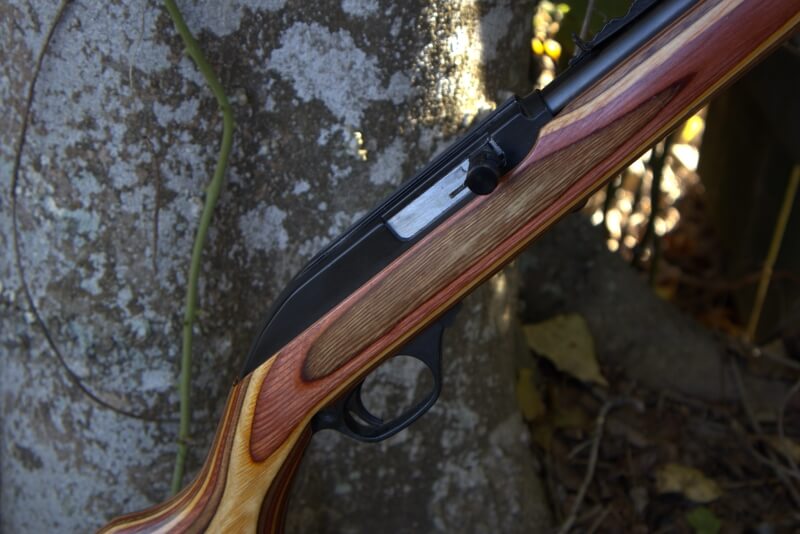
There is something to be said about squirrel hunting. It does not have the appeal of deer hunting, which is an entire industry and pursuit in itself, chock full of gear and guns. The very concept of hunting in the media is predicated on the pursuit of deer. By comparison, squirrel hunting and small game hunting more generally is more minimal. Squirrels can be hunted with a general license and no special tags, often close to home. Legal squirrel guns in most states—rimfire rifles, shotguns, or muzzleloaders—are widely available and usually cheaper than centerfire deer rifles. Over the years, my quarry has been squirrel, and I’ve had the privilege of using all three platforms. Here are my squirrel hunting guns and how, in their respective categories, they perform.
Squirrel Hunting Guns: Only Three Choices
If you are brand new to small game hunting, it can be tempting to question why you are limited to a rimfire rifle, a shotgun, or a muzzleloader. There are three main reasons. The first is legality. In most jurisdictions, state wildlife departments set rules on the types of firearms you can use. Regulations generally boil down to three types of firearms. In my state, squirrel and small game can be hunted with either a .32 or .36 caliber muzzleloader, a rimfire rifle no larger than .22 caliber, or a shotgun. The second reason is less bloodshot meat. Centerfire rifles will leave you with no squirrel left to eat, so small lower lower-velocity options are favored as it does not tear up the meat. Although headshots are the best possible option, the head of a squirrel is hard to hit. Thankfully, these platforms are more forgiving.
Small Bore Muzzleloaders: Chasing Tree Rats with the Smokepole
Small-bore rifled flintlocks and caplock guns ranging from .25 to .40 caliber are labeled squirrel or hog rifles. These are relatively small-bore guns loaded with lead balls that are about the size of a single shotgun buckshot pellet. Outside of a few custom rifles, .25 caliber has fallen out of favor, and .40 caliber is a bit large for squirrel but somewhat underpowered for deer. Modern muzzleloader makers, both custom and factory, have gravitated toward .32 and .36-caliber rifles. The Traditions Crockett Rifle and InvestArms Seneca, among other older models, represent a growing fascination with small-bore muzzleloaders that can be a substitute for, and when loaded hotly, a better alternative to cartridge guns chambered in .22 LR.
Round Ball Ballistics
.32 caliber rifles generally use a .310-.315 inch ball that is patched to a snug fit. The .310 45 grain ball can easily reach over 2,000 feet per second with a moderate charge of fine FFFg blackpowder or a substitute. On the other hand, a mere ten grains of black powder is useful for small game. The cost of the ball and powder is a little less or a little more compared to a round of .22 LR. It also produces little meat damage with a light powder charge.
The only major downside of the .32 rifle is the size of the ball. Lead round balls stink if we are talking about ballistic coefficient. Their initial impressive velocity decays rapidly, and the wind can play havoc. The bigger the ball, the better. And the .32 is about as small as it gets. In a 10 mph crosswind, a .32 caliber ball can drift a foot from the aiming point at 100 yards. In the field, particularly when it is cold, I also had problems feeling and loading the smaller .32 caliber balls.
.36 caliber guns, which take a nominal .35 caliber ball, have some extra versatility. With a healthy powder charge, the .36 can take on some bigger varmints. The larger ball is easier to load and bucks the wind a bit better. Because of this, I ended up building my own .36 caliber squirrel getter. Another factor that the .36 has going for it is that you could use readily available 0 buckshot pellets as ammunition if you did not want to buy .35 caliber balls or cast your own.
Pros and Cons
With either the .32 or .36, it is not hard to hit a squirrel out to 50-75 yards. A harder wind and the sights found on many traditional muzzleloaders are the only handicap. Like any other muzzleloader, fast follow-up shots are out of the question. You have one round, and it takes me upwards of a minute to reload with a measure of powder, a patch, and a ball.
There are also the accouterments to take into consideration. You will need powder, shot, and either percussion caps or a sharp flint. You will need a way of measuring the powder from shot to shot and a way to segregate all these items. I also keep a cleaning jag and a few dry cotton patches on hand, as these small-bore guns tend to foul more than their bigger-bore counterparts. With my own .36, I could go through a dozen rounds before it became difficult to load quickly.
The smallbore muzzleloader is cheap to shoot, effective, and historically relevant, but the learning curve with the accessories can be steep. That leads me to the next platform and a universal one—the rimfire rifle.
The Rimfire Rifle: Born for the Squirrel Hunt, Mostly
With a smallbore muzzleloader, you have to take a chance with a custom builder or one of a few different factory rifles that you cannot find in a big box store. But with a rimfire rifle, it is possible to buy one anywhere, even in places that do not specialize in firearms. Rifles chambered in .22 LR are, by far, the favorite for fun, pest control, and small game work.
Benefits of the Rimfire Rifle
The chief advantage of a rimfire rifle is sheer availability. While it is easy to make a good .17 HMR or .22 WMR rifle work for squirrel, especially with correct headshots, the .22 LR is the ubiquitous choice not only for its more sedate ballistics but also because .22 LR rifles are everywhere and tend to shoot straight. Chances are, if you select any off-the-shelf .22 LR rifle, you are good to go for squirrel hunting. From ancient Winchester pumps and single shots to the latest Ruger 10/22 clone, you can be MOA of squirrel without spending much money or time looking for a hunting gun.
.22 LR rifles and ammunition are cheap and readily available. However, it is not the only compelling reason to select one. A poorly placed shot from a higher-powered .22 Mag or .17 might leave little squirrel left to eat. The lower velocity .22 LR offers some forgiveness, particularly with standard velocity or subsonic loads. The .22 LR bucks the wind better than the round ball out of a muzzleloader, but it is still a single projectile heading toward the target. There is no scatter of pellets you have to pick out of the game after the fact. There is less chance for meat damage and a greater likelihood of securing meat at greater distances; you might not be able to close with a shotgun. Optics are readily mounted, which makes the prospect even easier.
Where the Rimfire Falls Short
Rimfire rifles are available, easy to shoot, easy to scope, and give the prospective squirrel hunter plenty of power and range without being overpowering for the game. The kicker is perhaps too much range. Under ordinary circumstances, shooting a .22 rifle at ground-bound varmints, tin cans, and paper targets causes no concern. But while you can catch tree rats at ground level, chances are they have already spotted you and taken to the trees. That requires you to aim into the air to catch your quarry.
You could hit your squirrel, and have it fall out of the tree and ready for the bag, but you could miss. You can miss and strike the tree. Not ideal, but the tree will heal over and live on. In the extreme, that round can be a clean miss and travel some distance before it hits the earth. Although rounds like the .22 LR are low-powered, they are still rounds fired out of a rifle and capable of going hundreds of yards with potentially fatal consequences.
Ammunition boxes caution shooters about the range and lethality of .22 rimfire ammo, expressing a range of anywhere between 1 and 2 miles. Without a good backstop, rimfire rounds can go too far. For the ethical hunter, ensure a good shot and a fair backstop. For the meat hunter, that might mean passing up on a seemingly easy shot because the squirrel would not present a shot with a good backstop. That is where the shotgun rises to the occasion as a viable choice for squirrel and small game.
Shotguns and Squirrel: A Jack of All Trades
On my very first squirrel hunt, I carried my trusty Winchester 370 16-gauge single-shot shotgun. I went in carrying a pocket of #6 birdshot, the same load I used while dove hunting. When loaded with a round of heavier # 1 buckshot, the Winchester was a deer taker. The shotgun is a jack of all trades, as it can be loaded with finer pellets for small game or larger pellets for larger game. If you are looking at doing small game hunting and perhaps branching out in the future, a shotgun is a good investment.
Gauges to Pick
Just about any shotgun can be used for squirrel hunting. The exact model you choose will be left up to your comfort level and how far you expect to shoot. Smaller shooters may favor the light-kicking .410 bore, but 12 or 20 gauge rounds provide denser shot and longer range. These larger rounds carry higher velocity and shot weight, reducing the chance of game escaping the pattern. Longer barrels also keep a tighter shot column than shorter, tactical models.
Choke and Effective Range
The choke in a shotgun barrel determines how tightly the shot pattern holds together downrange. Shorter defensive shotguns typically have a cylinder bore, meaning the barrel diameter stays consistent. A choke is a constriction that tightens the shot before it exits, producing better patterns.
The most common chokes, from open to tight, are cylinder, improved cylinder, modified, and full. A full choke delivers the best pattern at 40–60 yards, making it ideal for squirrels in open terrain, though at close range it can cause excessive meat damage. A modified choke offers a balanced middle ground, while a straight cylinder bore, which is common on tactical and muzzleloading shotguns, works best inside 30 yards.
Some older shotguns, like my Winchester, came with fixed factory chokes. Most modern hunting shotguns, however, use interchangeable choke tubes that thread into the muzzle, giving hunters the flexibility to match their spread to the game and terrain.
Ammunition
Ammunition can also play into how far and how many pellets hit your target. Most of my shotgun squirrel hunting has been done with standard birdshot loads. I prefer No. 5 or No. 6 shot because there are fewer pellets than No. 7 1/2 or No. 8 shot used in clay competitions. But these slightly bigger pellets carry their energy a bit better downrange, ensuring an ethical kill. Standard loads don’t thump the shoulder much and are powerful enough for a squirrel without chewing up edible meat that turkey loads or magnum loads might.
Pros and Cons
With all of these variables to take into consideration, why pick the shotgun? Aside from the aforementioned flexibility in tailoring the ammunition to different game, the spreading small pellets of a shotgun loaded with birdshot allows you to hit fast, moving squirrels without the need for perfect aim. The pellets also give some leeway if the squirrel is partially hidden among tree branches. Squirrels tend to have coats that range from gray to brown to reddish brown. All of those colors also happen to be the color of bark on various trees.
Once a squirrel stops moving, it is easy for it to simply disappear in plain sight. Some of those pellets will likely find their mark, and even if they don’t, their small size means they will quickly lose their energy. Unlike a rifle, birdshot pellets don’t have the chance to go for miles and still be lethal. One compelling reason to pass on the shotgun is because of the range. The cloud of small pellets spreads out, even with the best choke, and loses its energy quickly. In my own experience, fifty yards is a dicey shot, and if I am working in open areas where I can’t stalk closer than that, I begin the feel better about using the muzzleloader, or better yet, a rimfire rifle.
READ MORE HERE: Retay ACE-R Shotgun Review
Squirrel Hunting Guns: Take Your Pick
Squirrel hunting is an excellent way to get meat for the pot. It is also a good means to get into hunting without spending much money. The game is smaller and more numerous, the stakes are lower, and you can go as upmarket or low market as you want with your gear. The squirrel hunting guns legal in most jurisdictions have their advantages and disadvantages over one another, and a good scout of the land you up to hunt will make the choice of arms clearer so you can be better equipped for a successful squirrel hunt.
Read the full article here
26 Comments
If AISC keeps dropping, this becomes investable for me.
Good point. Watching costs and grades closely.
Uranium names keep pushing higher—supply still tight into 2026.
Good point. Watching costs and grades closely.
The cost guidance is better than expected. If they deliver, the stock could rerate.
If AISC keeps dropping, this becomes investable for me.
Nice to see insider buying—usually a good signal in this space.
Good point. Watching costs and grades closely.
Good point. Watching costs and grades closely.
Production mix shifting toward USA might help margins if metals stay firm.
Good point. Watching costs and grades closely.
Exploration results look promising, but permitting will be the key risk.
Silver leverage is strong here; beta cuts both ways though.
Good point. Watching costs and grades closely.
If AISC keeps dropping, this becomes investable for me.
Good point. Watching costs and grades closely.
Production mix shifting toward USA might help margins if metals stay firm.
Good point. Watching costs and grades closely.
Good point. Watching costs and grades closely.
Nice to see insider buying—usually a good signal in this space.
Good point. Watching costs and grades closely.
Good point. Watching costs and grades closely.
Nice to see insider buying—usually a good signal in this space.
Good point. Watching costs and grades closely.
Uranium names keep pushing higher—supply still tight into 2026.
Nice to see insider buying—usually a good signal in this space.