
Engineering students across 11 universities came together recently to help veterans compete on Team USA’s para bobsled and para skeleton teams.
Through Project S.E.R.V.E. (Student Engineering for Resilience of Veterans & Emergency Responders), students designed custom adaptive devices for athletes with disabilities.
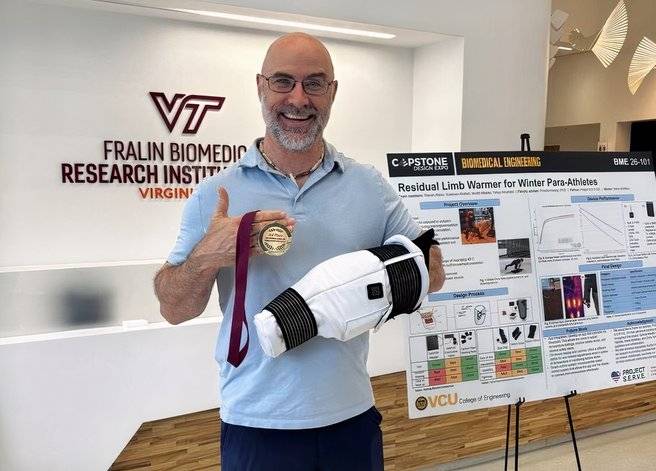
Project S.E.R.V.E. held a national design competition with George Mason University’s “Team 4ward” taking home first place for creating a residual warming sleeve for Paralympic bobsledder Dan Rizzieri. Team members included seniors Jacob Lockey, Leah Werme, Aidan Zenter and Subhi Mekki.
The Virginia Tech Department of Mechanical Engineering finished second, followed by Virginia Commonwealth University in third place.
The contest, in its third year, was sponsored by PenFed Credit Union in partnership with the Virginia Tech Department of Biomedical Engineering.
“Our National Design Competition represents the very best of what Project S.E.R.V.E. stands for: pairing talented student engineers with real people facing real challenges and creating solutions that can immediately improve lives,” said Tara Newell, Executive Director of Project S.E.R.V.E., in a press release. “This year’s teams delivered creativity, compassion and technical excellence, and we are proud to help bring these innovations to veterans, responders, and adaptive athletes, who deserve them.”
Heated Sleeve for Competition
George Mason students designed a multilayered sleeve that contains reusable heat packs to give Rizzieri consistent warmth without having to use an electronic device. Features include a water-resistant outer layer, inside insulation, and a soft, durable liner. The sleeve also includes pockets for storing heat packs, which are easily accessible.
Rizzieri, who was born with fibular hemimelia, had both legs amputated below the knees. He’s participated in para sports competitions around the world for more than 10 years. He appreciates the students’ work and believes it will help in competition.
“For years, competing in the cold meant simply toughing it out,” Rizzieri said. “When my legs got cold, there wasn’t much I could do except wait until practice or competition ended and then deal with the pain of warming back up. This project means so much because it gives para-athletes like me a chance to perform at our full potential with equipment designed for our real needs.”
Rizzieri said the student engineers worked with him to finalize their product design.
“Working with the George Mason students exceeded everything I expected — they included me in every step of the process and truly cared about helping me and others,” he said. “I was incredibly proud to see them win, and this device will absolutely be part of my gear for future practices and competitions.”
Veteran Mentors
Student competitors also worked with two veterans as mentors, sharing their experiences and serving as test dummies to help the groups build their devices.
One of the veterans, former Air Force Major Lee Kuxhaus, was surprised at how much time and effort students at Virginia Tech put into their design. Kuxhaus, a below-the-knee amputee, competes in para skeleton.
“I knew working with the team of mechanical engineering students from Virginia Tech would be fun, but I continued to be amazed at the dedication they demonstrated to designing and building a safe, robust product that is easily adjusted so it can be used by other amputees,” said Kuxhaus. “While the challenge we gave these students was to devise a limb warmer for para sport, it quickly became apparent that what they were designing would be useful to me outside of sport. This device will be so helpful during those times when I get chilled and I can’t seem to warm my residual limb like I can warm the rest of my body. I am so proud to have been their athlete mentor for this project. They are ready for their next adventure!”
Chris Tarte, an Army veteran, worked with a team from Virginia Commonwealth University to create his sleeve, noting the physical challenges of competing in cold weather.
“Operating in the cold for a sport can be troubling sometimes due to the extreme temperatures and wind causing various pain issues,” said Tarte. “Sometimes you have to stand out in freezing weather for a few minutes while you’re waiting your turn or hopping on one leg on ice spikes when you finish your run at the bottom of the track while the wind is biting at you. Working with Virginia Commonwealth University students for this prototype residual limb warmer was amazing. They treated me with the utmost respect, considering everything I discussed with them and incorporating my advice into the product. They made it simple for anyone to use, developing novel and breakthrough ideas for future use for people of all shapes, sizes and disabilities.”
Tarte said the experience was one of the highlights of his career.
Process and Production
Competing in winter sliding sports often requires athletes to remove prosthetics, which can make residual limbs sensitive to freezing temperatures, tightness and possible injury.
In the competition, students had to design a “lightweight comfortable warming system that would help athletes stay warm between and during runs without interfering with movement or equipment.”
Each athlete can use the device made for them in competition and George Mason’s contest winner could be considered for official use by Team USA at international events.
The work was hard, but worth it.
“The work on this project was difficult and definitely came with many sleepless nights, but I am honored to have been surrounded and supported by so many brilliant people,” said Jacob Lockey, George Mason team member.
“Everyone seemed to love our heat pack application, and the data was there to back up our design approach,” said teammate Aidan Zentner.
This year’s contest featured 11 teams from 10 universities across the country. In presentations, students demonstrated their devices before a panel of judges from adaptive sports, engineering and industry.
Read the full article here
34 Comments
If AISC keeps dropping, this becomes investable for me.
Good point. Watching costs and grades closely.
Exploration results look promising, but permitting will be the key risk.
Good point. Watching costs and grades closely.
Exploration results look promising, but permitting will be the key risk.
Good point. Watching costs and grades closely.
Uranium names keep pushing higher—supply still tight into 2026.
Good point. Watching costs and grades closely.
Good point. Watching costs and grades closely.
Uranium names keep pushing higher—supply still tight into 2026.
Good point. Watching costs and grades closely.
Interesting update on Students Design Adaptive Sleeve to Help Veterans on Paralympic Team. Curious how the grades will trend next quarter.
Good point. Watching costs and grades closely.
Good point. Watching costs and grades closely.
Production mix shifting toward USA might help margins if metals stay firm.
Good point. Watching costs and grades closely.
Good point. Watching costs and grades closely.
I like the balance sheet here—less leverage than peers.
Good point. Watching costs and grades closely.
Uranium names keep pushing higher—supply still tight into 2026.
Good point. Watching costs and grades closely.
Interesting update on Students Design Adaptive Sleeve to Help Veterans on Paralympic Team. Curious how the grades will trend next quarter.
Good point. Watching costs and grades closely.
Production mix shifting toward USA might help margins if metals stay firm.
Production mix shifting toward USA might help margins if metals stay firm.
Silver leverage is strong here; beta cuts both ways though.
I like the balance sheet here—less leverage than peers.
Good point. Watching costs and grades closely.
Good point. Watching costs and grades closely.
Exploration results look promising, but permitting will be the key risk.
Exploration results look promising, but permitting will be the key risk.
Good point. Watching costs and grades closely.
Good point. Watching costs and grades closely.
Exploration results look promising, but permitting will be the key risk.