

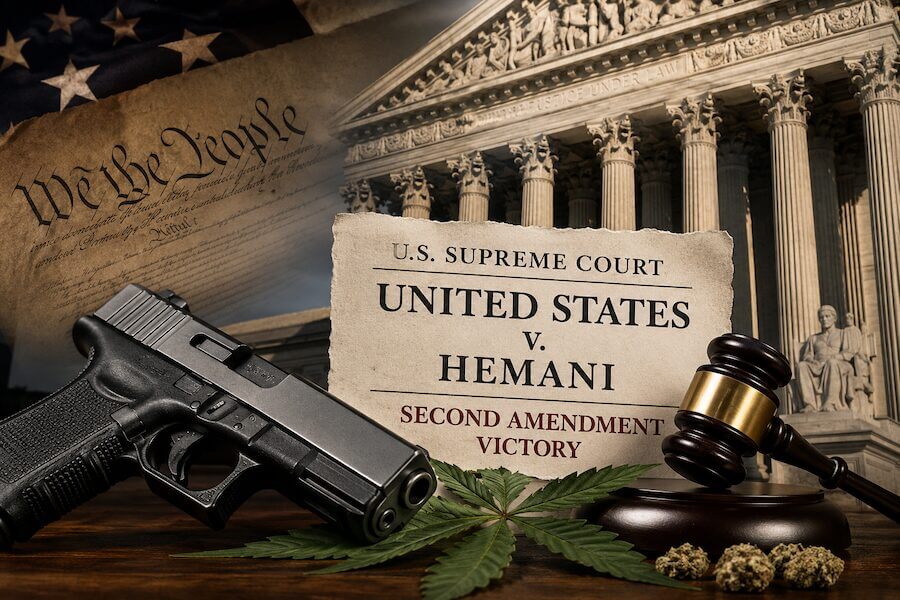
The U.S. Supreme Court handed gun owners a major victory Thursday, ruling that the federal government can’t automatically strip someone of their Second Amendment rights simply because they use marijuana.
In a unanimous decision, the Court sided with Texas resident Ali Danial Hemani, a man who admitted he uses marijuana several times a week but wasn’t accused of violence, brandishing a firearm, drug trafficking, or doing anything reckless with a gun.
According to reporting from the Associated Press and Reuters, the case has been closely watched because it sits at the intersection of expanding marijuana legalization and the Supreme Court’s post-Bruen Second Amendment jurisprudence.
Yet the federal government still wanted to prosecute him. Why?
Because under federal law, marijuana remains a controlled substance, and prosecutors argued that Hemani’s marijuana use alone was enough to make him a prohibited person under 18 U.S.C. §922(g)(3).
The Supreme Court wasn’t buying it.
“That Fact Alone”
Justice Neil Gorsuch wasted no time getting to the heart of the case.
“Ali Hemani uses marijuana a few times a week. That fact alone, the government says, means he is automatically banned from possessing a firearm under federal law.”
Gorsuch then laid out what was at stake:
And because Mr. Hemani admits he owns a gun despite this ban, the government now seeks to prosecute him, imprison him for up to 15 years, and disarm him for life.
That’s a pretty steep penalty for a guy who wasn’t accused of threatening anyone, hurting anyone, or misusing a firearm.
According to the Court, Hemani told investigators he used marijuana “about every other day” after federal agents searched his family’s home. More than six months later, prosecutors charged him with possessing a firearm while being an unlawful user of a controlled substance.
That’s it. No violent crime. No armed drug trafficking. And, no allegation that he was high while handling a firearm. Just marijuana use.
The Government’s Argument Gets a History Lesson
Under the Supreme Court’s Bruen decision, the government can’t simply claim a gun restriction promotes public safety and call it a day. It has to show that the restriction fits within America’s historical tradition of firearm regulation.
To make its case, the government pointed to old laws that targeted “habitual drunkards.”
The argument was essentially this: People who regularly use intoxicants were restricted in the past, so people who regularly use marijuana can be restricted today.
The Court wasn’t impressed.
“We disagree,” Gorsuch wrote. Then he delivered what may become one of the most quoted lines from the opinion:
“The habitual drunkard laws on which the government relies here differ dramatically from §922(g)(3)’s unlawful user provision on every single metric the government invites us to consider.”
In other words, the government’s historical analogy wasn’t just weak. It missed the target completely.
The Court noted that historical laws generally focused on people whose drinking had become so severe that they could no longer manage their lives or care for themselves.
That’s a far cry from automatically disarming everyone who uses marijuana a few times a week.
George Washington Accidentally Enters the Chat
One of the more entertaining parts of the opinion comes when Gorsuch starts discussing how much alcohol Americans consumed during the founding era.
The opinion notes that John Adams drank hard cider with breakfast. Thomas Jefferson enjoyed wine with dinner. George Washington regularly drank madeira. The point wasn’t to embarrass the Founding Fathers.
SEE ALSO: This Custom Platypus Shoots Like a Cheat Code
It was to show that early Americans drew a distinction between people who consumed alcohol and people who were genuinely incapacitated by it.
The government, meanwhile, wanted the Court to treat all regular marijuana users as the modern equivalent of chronic drunkards. The justices weren’t convinced.
As the Court explained, the government’s theory would sweep in huge numbers of people without ever asking whether they were actually dangerous.
Are Millions of Americans Suddenly Dangerous?
This is where the opinion gets especially interesting. The government argued that marijuana users can be disarmed because they’re categorically dangerous.
The Court responded by pointing out something awkward. The federal government itself has spent years backing away from marijuana enforcement while most states have legalized cannabis in some form.
As Gorsuch put it:
“All of which leaves it awkwardly positioned to suggest that the millions of Americans who now regularly use marijuana are categorically and unusually dangerous.”
That’s about as close as Supreme Court opinions get to saying, “Come on, really?”
The Court wasn’t saying marijuana is harmless. It wasn’t saying people should mix guns and drugs.
What it was saying is that the government can’t simply wave its hands and declare millions of Americans dangerous without proving it.
The Bigger Second Amendment Issue
For many gun owners, the most important part of the opinion may have nothing to do with marijuana. Instead, it has to do with who gets to decide which groups of Americans lose their constitutional rights.
Quoting a famous dissent written by then-Judge Amy Coney Barrett, the Court warned:
Affording the government that kind of broad power to designate any group as dangerous and thereby disqualify its members from having a gun would risk allowing it to quickly swallow the Second Amendment.”
That concern extends well beyond marijuana.
If the government can disarm one group simply by labeling it dangerous, what stops it from doing the same thing to another group tomorrow?
The Court clearly viewed that question as a serious one.
What This Ruling Does Not Do
Before anyone starts declaring victory for every marijuana user in America, it’s worth reading the fine print.
The Court repeatedly emphasized that this is a narrow ruling.
- It does not address firearm bans for drug addicts.
- It does not address laws prohibiting gun possession while someone is actively intoxicated.
- It does not affect the federal prohibition on firearm possession by convicted felons.
- And it leaves open the possibility that the government could bring future cases if it can actually show that a particular person’s drug use makes them dangerous.
So no, the Court didn’t wipe out every drug-related gun law. But it did make one thing crystal clear.
The federal government cannot automatically strip an otherwise law-abiding citizen of his Second Amendment rights simply because he uses marijuana. For gun owners, that’s a significant win.
For the government, it’s another reminder that after Bruen, broad restrictions need more than good intentions. They need history on their side.
And in this case, the Court concluded the government came up short.
*** Buy and Sell on GunsAmerica! ***
Read the full article here
30 Comments
Nice to see insider buying—usually a good signal in this space.
Good point. Watching costs and grades closely.
Good point. Watching costs and grades closely.
I like the balance sheet here—less leverage than peers.
I like the balance sheet here—less leverage than peers.
Good point. Watching costs and grades closely.
Uranium names keep pushing higher—supply still tight into 2026.
Uranium names keep pushing higher—supply still tight into 2026.
If AISC keeps dropping, this becomes investable for me.
Good point. Watching costs and grades closely.
Silver leverage is strong here; beta cuts both ways though.
Good point. Watching costs and grades closely.
Exploration results look promising, but permitting will be the key risk.
Good point. Watching costs and grades closely.
Nice to see insider buying—usually a good signal in this space.
Good point. Watching costs and grades closely.
The cost guidance is better than expected. If they deliver, the stock could rerate.
Good point. Watching costs and grades closely.
Silver leverage is strong here; beta cuts both ways though.
Good point. Watching costs and grades closely.
Silver leverage is strong here; beta cuts both ways though.
If AISC keeps dropping, this becomes investable for me.
Good point. Watching costs and grades closely.
Uranium names keep pushing higher—supply still tight into 2026.
I like the balance sheet here—less leverage than peers.
Good point. Watching costs and grades closely.
Good point. Watching costs and grades closely.
If AISC keeps dropping, this becomes investable for me.
Good point. Watching costs and grades closely.
Good point. Watching costs and grades closely.