


Attorneys and advocates arguing against the federal government, in the nation’s highest court, said oral arguments this week show promise for a broader environmental review around a U.S. territory.
A rally on Wednesday outside the U.S. Supreme Court coincided with proceedings within the hallowed halls, where the seven justices evaluated the merits of the case, Department of the Air Force v. Prutehi Guåhan, which centers on the Air Force’s open practice of burning and detonating hazardous munitions in the open at Tarague Beach at Andersen Air Force Base in Guam—one of five U.S. territories, and an island where more than one-fourth remains under U.S. military control.
Claimants argue that the Air Force’s permit renewal in 2021 allowing the service’s Open Burning and Open Detonation policy at Tarague Beach, situated above the Northern Guam Lens Aquifer, violated the National Environmental Policy Act (NEPA) because it failed to complete an environmental impact statement or environmental assessment prior to submitting its permit renewal application.
Right to Democracy filed an amicus brief on behalf of 18 community-based environmental and cultural organizations from all five U.S. territories: Guam, Puerto Rico, the U.S. Virgin Islands, American Samoa and the Northern Mariana Islands.
“The argument went well,” Neil Weare, co-director of Right to Democracy, told Military.com. “Justices from across the ideological spectrum expressed some skepticism about the federal position that it can proceed with the detonation of hazardous munitions without having to go through the standard environmental review process.”
Several dozen Indigenous, environmental and community leaders from across the territories were outside Wednesday morning for what they described as a “Cross-Territorial Rally for Indigenous Solidarity.”
The Legal Case Being Made
Plaintiffs purport that the ecological and cultural implications are in jeopardy, due to how munitions and bombs are being detonated directly above an aquifer that supplies drinking water to more than 80% of the island.
They also believe the Air Force must undergo the same federal environmental review and public participation required for other military projects.
It’s not just about Guam, either. Plaintiffs say they argue on behalf of the more than 3.6 million people live in the five U.S. territories, where residents cannot vote for president and lack voting representation in Congress.
For these communities, environmental review and public participation can be one of the few opportunities to weigh in on federal decisions affecting their land, water and health.
“This particular case is about the detonation of hazardous ordnance on a pristine beach in Guam, but communities and other territories are facing other impacts,” Weare said. “It’s also relevant as there are ongoing considerations of deep sea mining in the Pacific as well.”
That was a legal argument previously backed by a Ninth Circuit decision requiring the U.S. Air Force to conduct additional environmental review and allow for community participation.
Supporting Fellow Territories Against ‘Widespread Impacts’
Right to Democracy is a nonprofit that works to advance democracy, equity and self-determination. Representatives of U.S. territories and community partners , such as the Micronesian Climate Change Alliance in Guam and other organizations, came together to file the brief.
Zeno Deleon Guerrero, solidarity director of Right to Democracy for the Northern Mariana Islands, was also outside the Supreme Court earlier this week. He told Military.com that his presence was to show support for Guam, roughly a half-hour flight from the Northern Mariana Islands.
“More broadly, in terms of NEPA as a procedure and as a policy, all the territories have been utilizing NEPA for decades to kind of have that meaningful community participation and consultation when it comes to federal action,” Guerroro said. “We’re all deeply concerned that the potential rulings from this case can have widespread impacts towards how we in our communities fight to be consulted on these decisions that are often made thousands of miles away.”
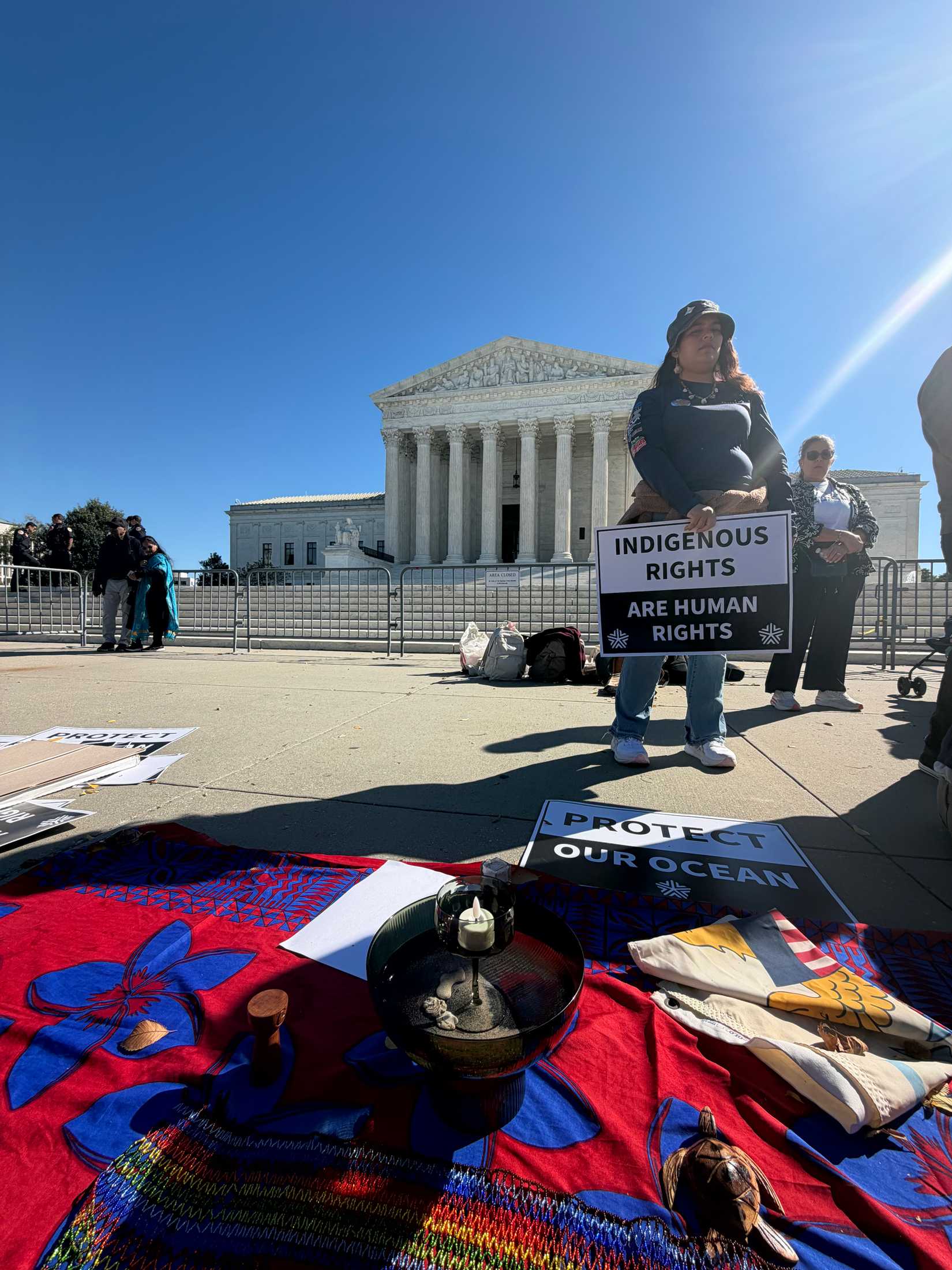
Asked whether the environmental and military aspects are on equal footing, or if one aspect is viewed more egregiously than another, Guerroro described it as “two sides of the same coin.”
“They’re all very connected to one another, so more often than not, when there’s military activity, environmental degradation is sure to follow in most cases—at least if the historical pattern is followed in terms of what has happened in our islands for decades,” he said.
Defending Human Rights and Long-Term Precedent
Sabrina Suluai-Mahuka, founder of the environmental organization Finafinau of the American Samoa, told Military.com that her presence on Wednesday was attributed to fighting back against those attempting to “infringe on our basic human rights.”
“When indigenous communities and lands are impacted, then we have to be mindful that indigenous rights are human rights,” Suluai-Mahuka said. “And so that’s why we showed up [Wednesday].”
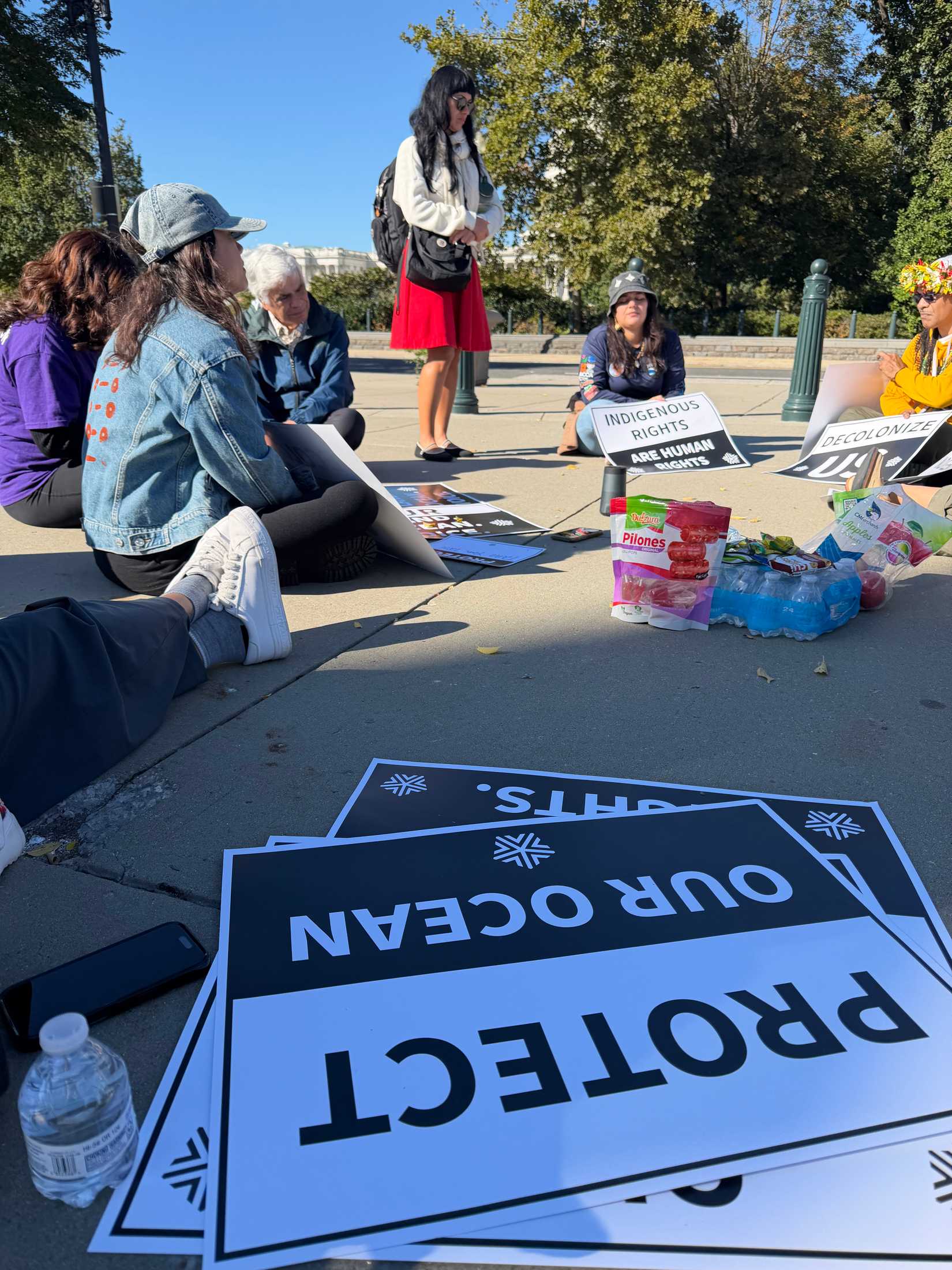
One of the main issues revolves around deep-sea mining, she said, which could have ill-fated effects on the future preservation of the region—for both the people who live there, and the environment they have long relied on for sustenance and otherwise.
More specifically, she mentioned potential degradation of coral reefs.
“I think it definitely sets a precedent,” she said. “When we’re talking about deep-sea mining, that’s a hypothetical, unproven industry, but it’s definitely extractive. However, our ocean isn’t theoretical. Our livelihoods tied to the ocean aren’t theoretical, and the future of our children are not theoretical.
“When we’re talking about something that is based on maybe AI technology or something that hasn’t been proven at commercial scale—it is a gamble for our livelihoods. It’s not a lottery ticket for us, but it’s a slow decimation of our natural resources and, eventually, our people.”
Weare said a Supreme Court ruling is expected early next year. He hopes the territories get the legal reprieve they seek.
“The people of Guam and other territories don’t have a say in who the president of the United States is, who nominates the Supreme Court justices,” Weare said. “They have no voting representation in the Senate, who confirms those justices, and really don’t have a say in what federal law is.
“And so, at all levels, there’s an undemocratic colonial relationship between the United States and people in each of the territories. So, while we hope for a favorable decision in the case, really, however the court rules, there remains broader questions about the nature of the relationship between the United States and people in each of its five territories.”
Read the full article here
32 Comments
If AISC keeps dropping, this becomes investable for me.
Good point. Watching costs and grades closely.
Good point. Watching costs and grades closely.
Silver leverage is strong here; beta cuts both ways though.
Good point. Watching costs and grades closely.
Good point. Watching costs and grades closely.
I like the balance sheet here—less leverage than peers.
Good point. Watching costs and grades closely.
Good point. Watching costs and grades closely.
The cost guidance is better than expected. If they deliver, the stock could rerate.
Uranium names keep pushing higher—supply still tight into 2026.
Good point. Watching costs and grades closely.
Good point. Watching costs and grades closely.
The cost guidance is better than expected. If they deliver, the stock could rerate.
Good point. Watching costs and grades closely.
Good point. Watching costs and grades closely.
If AISC keeps dropping, this becomes investable for me.
Silver leverage is strong here; beta cuts both ways though.
Good point. Watching costs and grades closely.
Nice to see insider buying—usually a good signal in this space.
Nice to see insider buying—usually a good signal in this space.
Good point. Watching costs and grades closely.
Good point. Watching costs and grades closely.
Exploration results look promising, but permitting will be the key risk.
Good point. Watching costs and grades closely.
Good point. Watching costs and grades closely.
Nice to see insider buying—usually a good signal in this space.
Production mix shifting toward USA might help margins if metals stay firm.
Good point. Watching costs and grades closely.
Interesting update on Supreme Court Hears Oral Arguments on Air Force Activity at Andersen Air Base. Curious how the grades will trend next quarter.
Good point. Watching costs and grades closely.
Exploration results look promising, but permitting will be the key risk.